

Are LED Strips Really Cheaper Than Traditional Lights in the Long Run?
Your client looks at the quote. They see the price for LED strips, drivers, and channels, then compare it to a simple, cheap fluorescent tube or halogen bulb. They ask the inevitable question: "Why should I pay more for this?" How do you confidently justify the investment?
Yes, LED strips are significantly cheaper over their lifespan. While the initial purchase price can be higher, their radical energy efficiency and near-zero maintenance costs result in a much lower total cost of ownership and a fast return on investment, typically within 1-3 years.
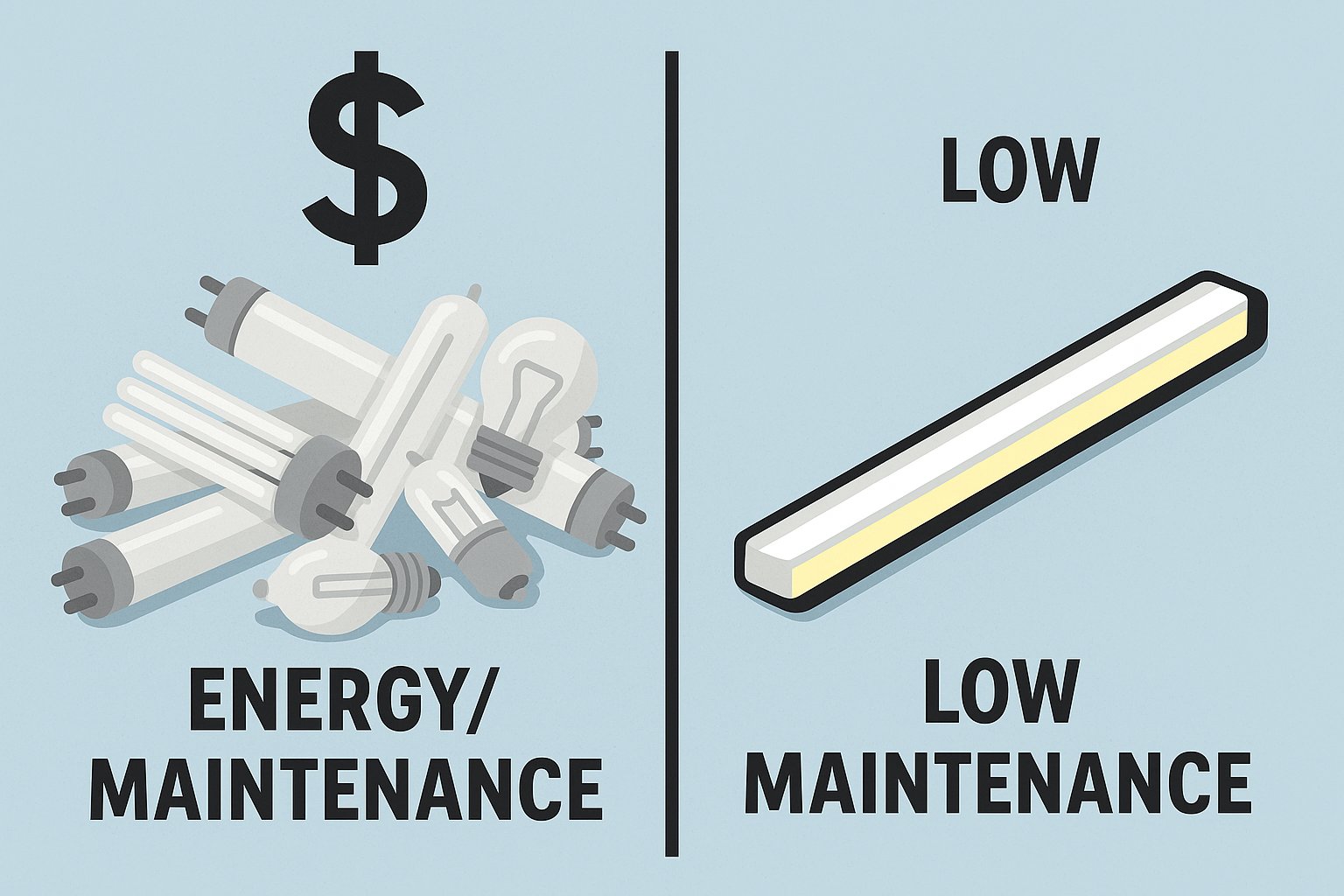
As a manufacturer, I deal with the economics of lighting every day. The conversation with savvy clients like Tom always moves past the initial price tag to the "Total Cost of Ownership" or TCO. This is the true measure of what a lighting system costs. It includes the purchase price, the cost of the electricity it will consume for its entire life, and the cost of labor and replacement parts to maintain it. When you look at the full picture, the financial argument for LED strips isn’t just strong; it’s unbeatable. Let’s break down the numbers so you can explain this with absolute clarity.
How Does the Upfront Cost Really Compare?
It’s easy to look at a single fluorescent tube and see a low price. Then you look at an LED strip, a separate power supply, and maybe an aluminum channel, and it seems more complex and expensive. Is it a fair comparison?
A true upfront cost comparison must be system-to-system. You must compare the total cost of all components—lamps, ballasts, and fixtures for traditional lighting versus strips, drivers, and channels for LED systems—required to effectively light the same space.
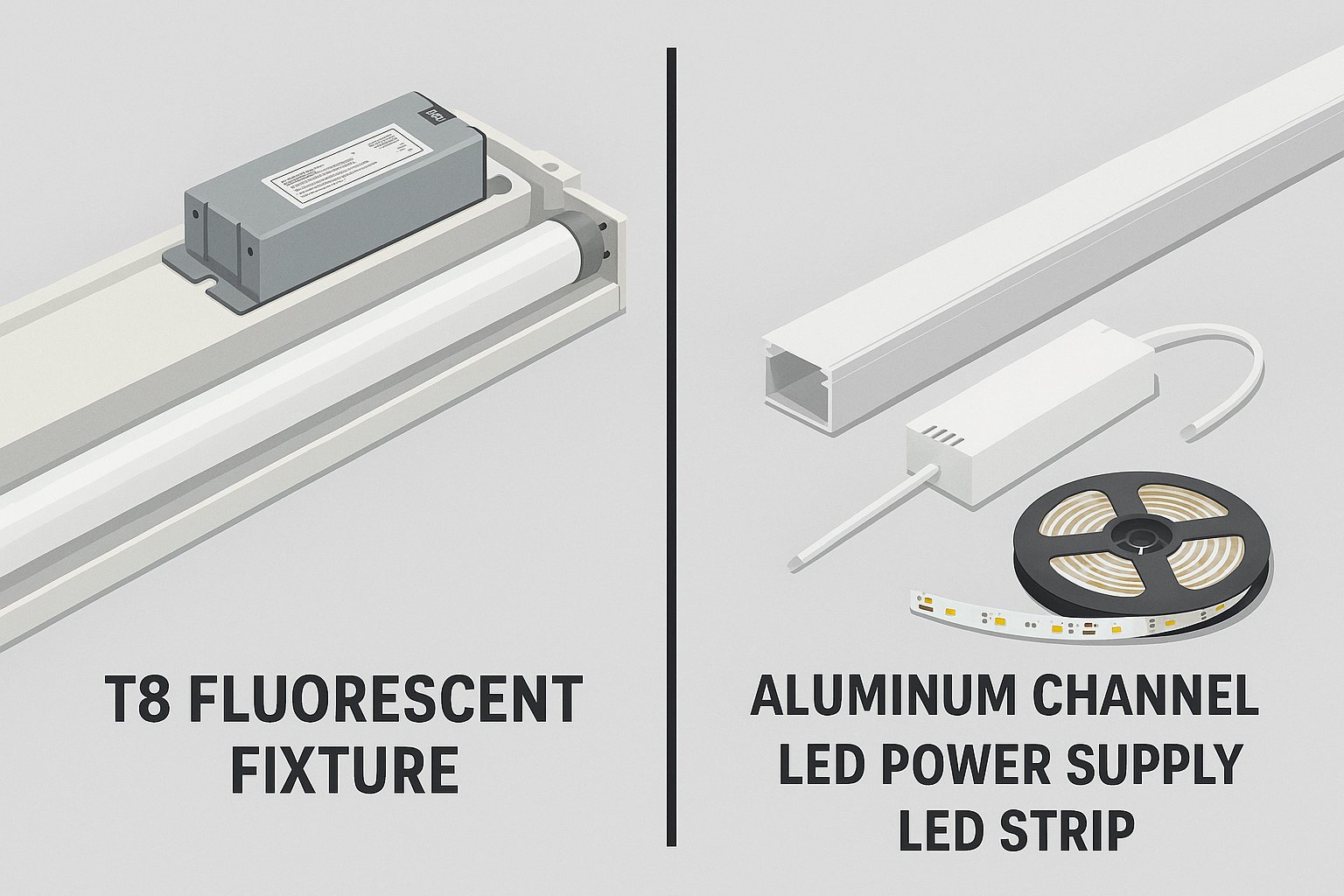
Focusing on the price of a single bulb is the most common mistake. Traditional lighting is a system of multiple parts that fail at different rates. The fluorescent tube has a ballast that also fails. The halogen bulb is part of a larger fixture. With LED strips, the system is simpler and more integrated. While the initial component cost might be higher, the design flexibility often means you can achieve the desired effect with less hardware. For example, lighting a long ceiling cove with fluorescent tubes means stringing together multiple bulky 4-foot fixtures, leaving dark spots at the ends. With an LED strip, you can create one continuous, unbroken line of light with a single run, which can simplify installation and reduce hardware needs.
A Deeper Dive into the Initial Investment
For a buyer like Tom who needs to justify project budgets, a detailed cost breakdown is essential.
- Apples-to-Apples Comparison: A 20-Meter Cove Lighting Example
Let’s compare the hardware needed for a typical commercial cove lighting project. The goal is to create a continuous line of ambient light.
| Component | Traditional Fluorescent System (T8) | Professional LED Strip System |
|---|---|---|
| Light Source | 14 x 4-foot T8 Tubes (multiple needed for length, plus spares) | 1 x 20-meter Reel of High-Quality LED Strip1 |
| Fixtures/Housing | 14 x 4-foot T8 Troffer/Batten Fixtures | 20 meters of Aluminum Channel & Diffuser |
| Power/Control Gear | Built-in Ballasts (14 of them, a common failure point) | 1-2 x High-Reliability LED Drivers (Power Supplies) |
| Complexity & Labor | Mounting 14 separate, heavy fixtures. Complex wiring. | Mounting a lightweight channel. Simpler low-voltage wiring. |
| Aesthetic Result2 | Visible dark spots/gaps between each 4-foot fixture. | A single, continuous, unbroken line of perfect light. |
| Initial Cost Estimate3 | Moderately Lower | Moderately Higher |
- The Hidden "Cost" of Poor Design4
As you can see from the table, while the initial parts cost for the fluorescent system might be lower, the aesthetic result is vastly inferior. The "scalloping" and dark spots from using separate fixtures look cheap and unprofessional. The LED strip system delivers a high-end, architectural result. For many projects, this superior quality alone justifies the initial investment. Tom’s clients in lighting and architecture would immediately recognize the visual difference. The question then becomes not just "what does it cost," but "what is the value of getting the lighting design right the first time?"
Where Do the Real Savings Come From?
So the upfront cost can be higher. Why then do we claim LED strips are cheaper? Your client is skeptical, looking at their electricity bill and wondering if a light bulb can really make a difference. Where is the proof?
The overwhelming savings come from energy efficiency. LED strips consume 50-80% less electricity than traditional lighting to produce the same amount of light (lumens). Over a 50,000-hour lifespan, this energy savings alone dwarfs the initial purchase price.
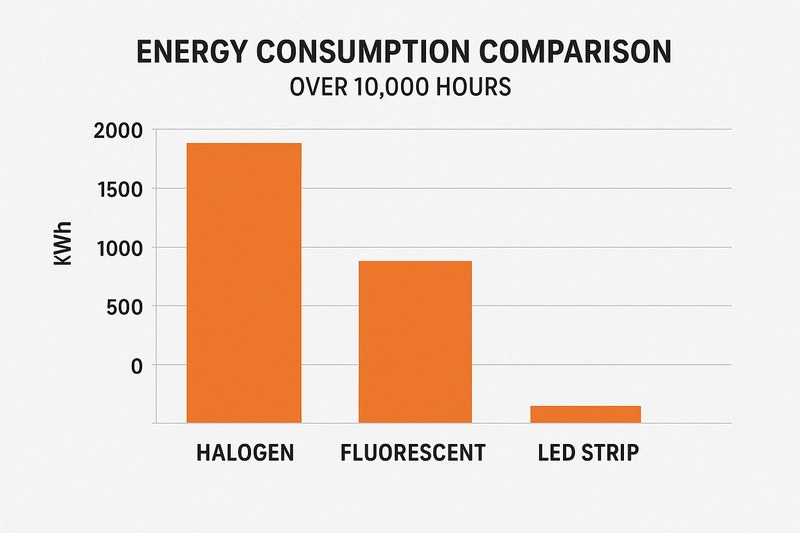
This is the core of the financial argument. It’s not magic; it’s just better technology. Lighting efficiency is measured in lumens per watt (lm/W)—how much light you get for each unit of energy you pay for. A halogen bulb is incredibly inefficient; most of its energy is wasted as heat. Fluorescents are better, but LEDs are in a completely different league. For a business running its lights 12 hours a day, the impact on their operational budget is massive. As a manufacturer committed to quality, we focus on producing high-efficacy strips, ensuring our clients get the absolute maximum light output for their energy spend.
A Deeper Dive into Lifetime Energy Costs
Let’s put concrete numbers to this. This is the kind of analysis that closes deals.
-
Calculating the Cost of Operation
Let’s use our 20-meter cove example again. Assume the lights run for 12 hours/day, 365 days/year, and the electricity cost is $0.15 per kilowatt-hour (kWh).-
Traditional Fluorescent System:
- Power per fixture (32W tube + ballast): ~40 Watts
- Total fixtures: 14
- Total Power: 40W * 14 = 560 Watts
- Annual Energy Use: 560W 12 hrs/day 365 days/yr = 2,452,800 Watt-hours = 2,453 kWh
- *Annual Electricity Cost5: 2,453 kWh $0.15/kWh = $367.95**
-
Professional LED Strip System6:
- Power per meter: ~14.4 Watts
- Total length: 20 meters
- Total Power: 14.4W * 20 = 288 Watts
- Annual Energy Use: 288W 12 hrs/day 365 days/yr = 1,261,440 Watt-hours = 1,261 kWh
- *Annual Electricity Cost: 1,261 kWh $0.15/kWh = $189.15**
-
| Metric | Traditional Fluorescent System | Professional LED Strip System | Result |
|---|---|---|---|
| Annual Energy Cost | $367.95 | $189.15 | Annual Savings of $178.80 (a 51% reduction!) |
| 10-Year Energy Cost | $3,679.50 | $1,891.50 | $1,788 in savings on this single installation. |
This table clearly demonstrates how an initial extra investment in LED technology pays for itself through raw energy savings, often in a very short period.
What About Maintenance and Lifespan?
The lights are installed high up in a commercial lobby. A few months later, one flickers and dies. The client has to hire a crew with a scissor lift, disrupt their business, and pay for labor and a replacement bulb. This is a real, hidden cost.
LED strips virtually eliminate maintenance costs. With a lifespan of 50,000 hours or more, compared to just 1,000 for halogen or 10,000 for fluorescents, you install them once and they operate reliably for years, removing the recurring cost of replacement lamps and labor.
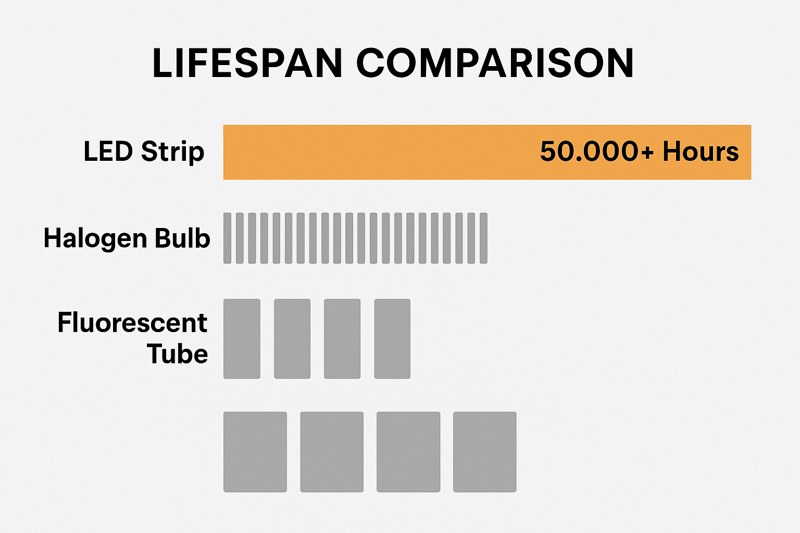
This is a huge factor for any commercial or industrial client. Maintenance isn’t free. Paying an electrician to spend an hour replacing a dead ballast in a hard-to-reach fixture can easily cost over $100. If you have hundreds of fixtures, this becomes a constant drain on the maintenance budget. The "install and forget" nature of a high-quality LED system is a massive operational advantage. The ultra-long lifespan isn’t just a feature; it’s a direct contributor to a lower TCO. This is why we, as a factory, are obsessed with quality control, using top-tier LED chips and robust PCB design. A product that lasts is a product that saves our clients the most money.
A Deeper Dive into Longevity and Reliability
Let’s quantify the maintenance savings using our 20-meter cove example over a 10-year period (approx. 43,800 operating hours).
-
Traditional Fluorescent System7:
- T8 Tube Lifespan: ~15,000 hours
- Ballast Lifespan: ~40,000 hours
- Number of Tube Replacements: You will replace all 14 tubes at least twice.
- Number of Ballast Replacements: You will likely replace several of the 14 ballasts once.
- Replacement Events: At least 3 major maintenance events requiring lifts and labor.
- Total Maintenance Cost (Estimate): 28 tubes + 5 ballasts + labor = $1,000 – $1,500+
-
Professional LED Strip System8:
- LED Strip Lifespan: 50,000+ hours
- Driver Lifespan: 50,000+ hours
- Number of Replacements Needed: Zero.
- Total Maintenance Cost: $0
| Cost Factor over 10 Years | Traditional Fluorescent System | Professional LED Strip System |
|---|---|---|
| Initial Hardware Cost | ~$800 | ~$1,200 |
| Energy Cost | $3,680 | $1,892 |
| Maintenance Cost | $1,000+ | $0 |
| TOTAL 10-YEAR COST | ~$5,480 | ~$3,092 |
This final calculation proves the point beyond any doubt. Despite a higher initial cost, the LED strip system is over 40% cheaper when you account for the true costs over a decade of operation.
Conclusion
The debate is over. While traditional lighting may offer a lower initial price, professional LED strip systems deliver a profoundly lower total cost of ownership. The massive savings in energy and the complete elimination of maintenance make them the smartest, most cost-effective choice for any serious project.
-
Exploring the benefits of high-quality LED strips can enhance your project’s aesthetic and functional value. ↩
-
Discovering the aesthetic advantages of LED lighting can elevate your design choices and client satisfaction. ↩
-
Understanding the initial cost estimate helps in making informed decisions about lighting investments. ↩
-
Learning about the costs of poor design can help avoid mistakes and ensure a successful lighting project. ↩
-
Understanding the factors affecting Annual Electricity Cost can help you make informed decisions on energy-efficient lighting. ↩
-
Exploring the benefits of a Professional LED Strip System can reveal how it can save energy and costs in the long run. ↩
-
Learn about the differences in maintenance, lifespan, and costs between fluorescent and LED systems for better decision-making. ↩
-
Explore the advantages of LED strip systems, including longevity and cost savings, to make informed lighting choices. ↩
Interested in Our LED Solutions?
Get professional consultation and customized LED lighting solutions for your projects. Contact our expert team today.
Related Articles

How Do You Build Profitable Custom Vehicle and RV Interior LED Rope Lights?
You lose RV installation contracts because your interior lights fail on rough roads. Standard strips show bright dots on glossy…

How to Perfect Bookshelf and Display Cabinet LED Rope Lighting?
You lose retail clients when bookshelves look incredibly dark. Ugly shadows hide expensive products inside display cabinets daily. You need…

How to Master Mirror and Vanity LED Rope Light Installation?
Your clients complain about ugly shadows in their bathroom mirrors. Bad lighting ruins expensive vanity designs. You lose future contracts…
