

COB vs. SMD LED Strips: Which Technology Is Better for Professional Installations?
You see this new "COB" LED technology everywhere, promising a perfectly seamless line of light. But your go-to SMD strips have been reliable for years. Is this new tech just a gimmick, or is it a genuine upgrade you need to offer?
SMD (Surface Mount Device) is the traditional, proven technology using individual LED chips that create distinct points of light. COB (Chip-on-Board) is a newer technology that produces a completely uniform, dot-free line of light, making it superior for applications where the light source is visible.
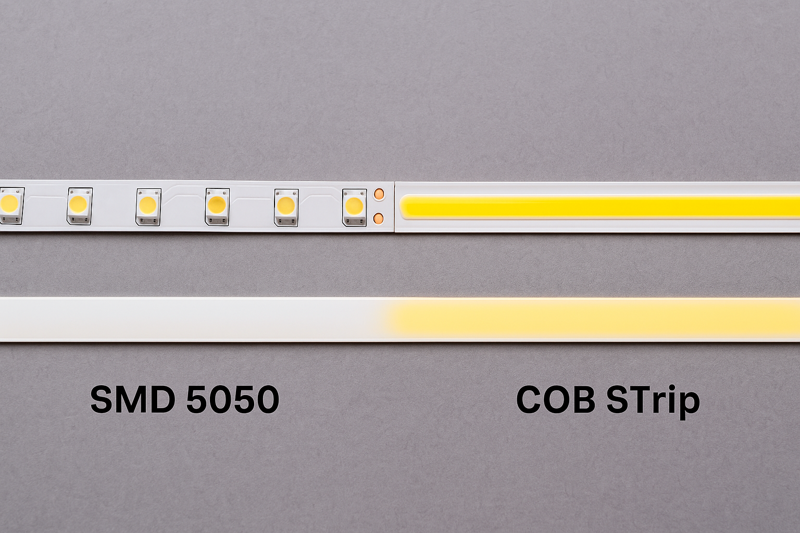
In our factory, we have production lines running for both SMD and COB strips, and I can tell you definitively that this is not a gimmick. COB represents a significant evolution in flexible lighting. However, the most experienced lighting professionals I work with know that "better" always depends on the specific application. Understanding the fundamental differences in how these two technologies are constructed is the key to choosing the right tool for the job, ensuring a flawless result, and cementing your reputation as an expert.
What Makes COB’s Light Quality So Seamless?
Your client loves the under-cabinet lighting, but they point out the distracting reflection on their polished granite countertop—a line of cheap-looking dots. You had to use a deep, bulky channel to diffuse the light, which complicated the installation.
COB (Chip-on-Board) achieves its seamless light by mounting hundreds of tiny, unpackaged LED dies directly onto the flexible circuit board and covering them with a continuous layer of phosphor. This creates one solid, uninterrupted line of light, unlike the distinct points of light from individual SMD chips.
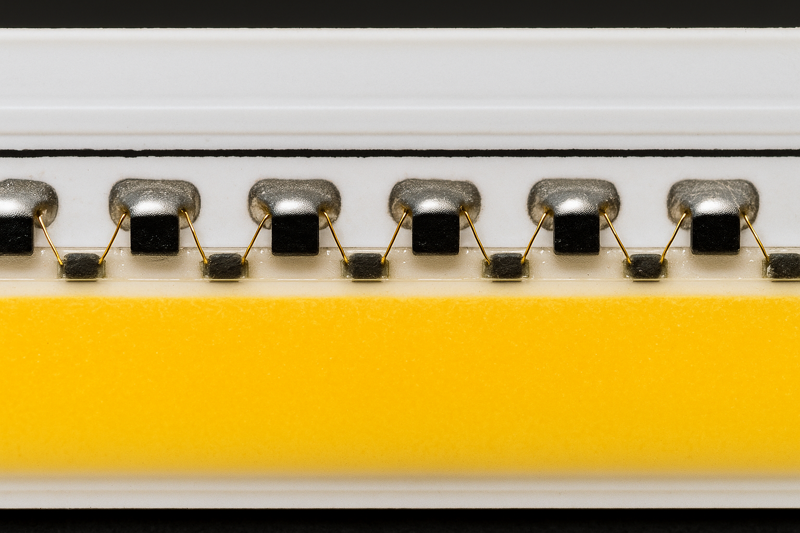
The "dot" problem is the single biggest aesthetic challenge with traditional LED strips. It’s the tell-tale sign of a lower-end installation. For years, the only solution was diffusion—using channels and covers to blur the light from the individual SMD chips. COB technology solves this problem at the source. It doesn’t need to be diffused because the light is born diffused. For any application where the light source itself or its reflection is visible—in-cabinet lighting, tight coves, display cases, or any surface-mounted application—COB provides a dramatically cleaner and more professional look.
A Look Under the Hood: The Architectural Difference
To understand why the light output is so different, you need to see how they are built. From my factory-floor perspective, they are two completely different manufacturing processes.
-
SMD (Surface Mount Device) Architecture1: This is the technology that made LED strips mainstream.
- The Component: The process starts with a pre-packaged LED chip. This is a self-contained unit with the semiconductor die inside a small plastic housing with a phosphor lens on top (e.g., a 2835 chip is 2.8mm x 3.5mm).
- The Assembly: These individual packages are then picked up by a machine and soldered onto the copper pads of the flexible printed circuit board (PCB) at set intervals.
- The Result: You see a series of distinct, separate light sources. The space between these chips is what creates the "dots" or "hotspots."
-
COB (Chip-on-Board) Architecture2: This is a more advanced and integrated manufacturing approach.
- The Component: We start with tiny, raw semiconductor dies—much smaller than a packaged SMD chip and without the bulky plastic housing.
- The Assembly: These tiny dies are mounted directly onto the flexible PCB, extremely close together (e.g., 500+ dies per meter). Then, a "river" of liquid phosphor is poured directly over all the dies, encapsulating them and bonding them to the board.
- The Result: The entire phosphor strip glows as one continuous, uniform line of light. There are no gaps, and therefore, no dots.
How This Impacts Your Installations
This fundamental difference in construction has direct practical consequences for you, the installer.
| Feature | Standard SMD Strip | COB Strip | The Professional Takeaway for Tom |
|---|---|---|---|
| Visual Appearance | Visible dots of light ("hotspots"). | A single, seamless line of light. | COB is visually superior for direct-view applications. |
| Diffusion Requirement | Requires a deep channel with a frosted/opal diffuser to hide dots. | Appears dot-free even with a clear cover or no channel at all. | COB allows for the use of slimmer, more discreet channels, or no channel, saving cost and install time. |
| Light Quality | Can create shadows or "scalloping" effects in tight coves. | Produces a perfectly even, smooth wash of light. | COB provides a more uniform and high-end lighting effect, especially for wall grazing and under-cabinet tasks. |
Which Technology is More Flexible and Reliable?
You’re trying to fit a strip around a tight curve in a custom millwork piece. As you bend it, one of the SMD chips flickers and dies—the solder joint on that rigid component has broken, forcing a costly repair.
COB strips are generally more flexible and can handle a tighter bend radius than SMD strips. This is because their light source consists of tiny dies covered by a pliable phosphor layer, rather than larger, rigid SMD chip packages that create stress points when bent.
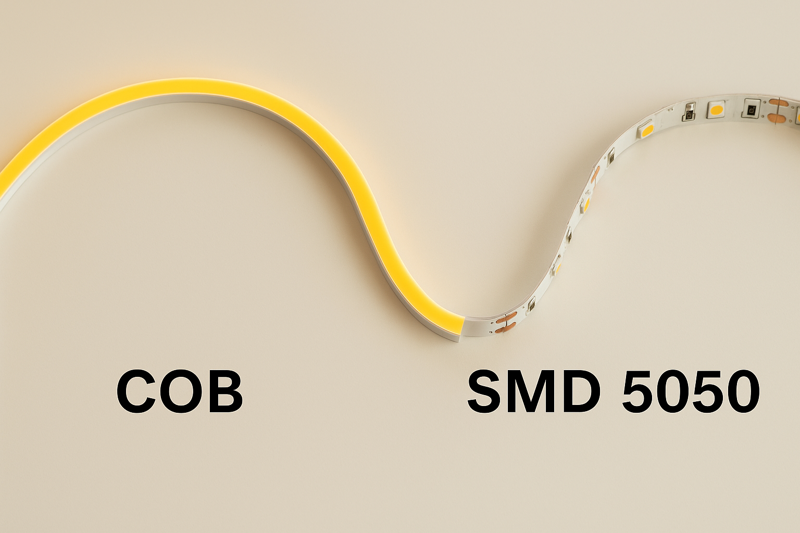
Reliability is everything for a professional’s reputation. Callbacks for failed sections are profit killers and damage client trust. While both COB and high-quality SMD strips are very reliable, the physical construction of COB gives it some inherent advantages in certain situations. The flexibility is a major one. When you bend an SMD strip, you are putting a lot of mechanical stress on the two solder points connecting that rigid plastic chip to the flexible board. If that joint fails, the rest of the 3-LED section goes dark. This is a common failure point, especially in installations with lots of curves.
A Deeper Dive into Durability and Lifespan
Beyond just flexibility, we need to consider the entire system for a fair comparison of reliability.
-
- SMD: The rigid SMD chips4 (like 2835 or 5050) act like little bricks on a flexible road. The stress concentrates at their edges and solder joints. Bending too tightly or repeatedly can easily cause a fracture.
- COB: The light-emitting part of a COB strip is made of thousands of microscopic dies covered in a relatively flexible phosphor. There are fewer large, rigid components to create stress points. This allows for a much smoother and tighter bend without damaging the circuit. This is a huge advantage for organic shapes, signage, and complex architectural details.
-
Heat Dissipation and Lifespan5:
- This is a key area where SMD can have an advantage. SMD chips are designed to dissipate heat efficiently through their solder pads to the copper on the PCB. It’s a very mature and effective thermal pathway.
- COB technology6‘s "flip-chip" design creates a very short thermal path from the die directly to the PCB, which is excellent. However, the continuous phosphor layer can act as a slight insulator.
- The Verdict: In our thermal testing labs, high-quality SMD and COB strips have very comparable lifespans when mounted correctly. The rule is the same for both: for any strip consuming over 3 watts per foot, it is essential to mount it in an aluminum channel. The channel acts as a heat sink for both technologies and is the single most important factor in ensuring a long, reliable life. A high-wattage COB strip without a heat sink will fail just as surely as a high-wattage SMD strip.
-
Overall Failure Points:
- A typical SMD strip has hundreds of individual solder points connecting the chips to the board. Each is a potential point of failure.
- A COB strip has far fewer solder points in its light-emitting section (just the dies themselves), which theoretically reduces the number of potential failure points along the strip’s length.
- In reality, for professional-grade strips from a quality manufacturer, the most common failure point is not the chip or the die, but improper installation—poor connections, water damage, or overheating due to a lack of heat sinking.
How Do SMD and COB Compare on Brightness and Efficiency?
Your project requires extremely bright light for the main illumination in a workshop. You look at a COB strip, but it seems like the highest-output options are all still SMD.
Currently, for the absolute highest brightness (lumens per meter), high-power SMD strips still lead the market. However, COB technology is rapidly catching up and often provides better efficiency (lumens per watt) at common brightness levels due to its design.
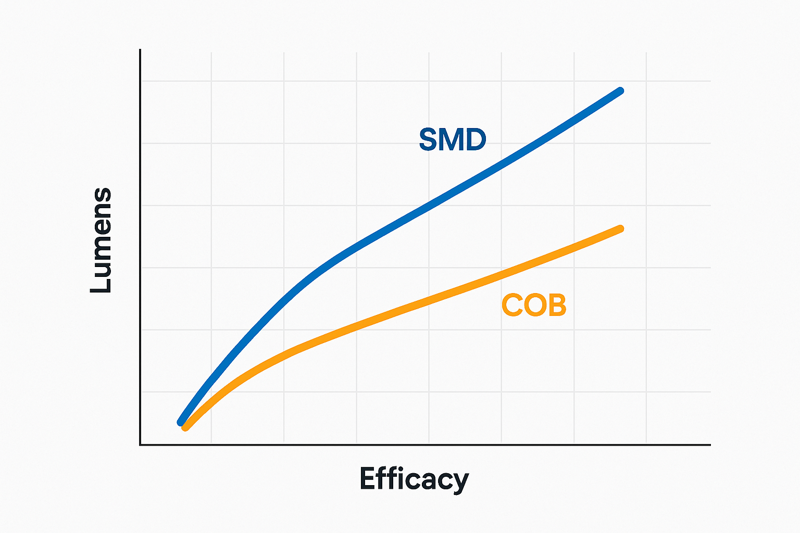
This is a question I get constantly from my technically-minded clients, like Tom. They need to deliver a specific amount of light (lumens) for a project, and they want to do it using the least amount of power (watts). This balance of brightness and efficiency is critical. While COB is the undisputed champion of seamless appearance, the title for raw power output is still mostly held by specialized, high-power SMD strips.
Breaking Down Performance Metrics
Let’s look at the numbers and the reasons behind them.
-
- SMD: The SMD ecosystem is more mature. There are large, powerful chips (like 2835 or 5050) that can be overdriven to produce a massive amount of light. Manufacturers can place multiple rows of these chips on a wider PCB to create strips with outputs exceeding 2000 lumens per foot. This is ideal for high-bay lighting, outdoor applications, and situations where maximum "punch" is required.
- COB: COB technology8 is newer and has been primarily focused on solving the "dot" problem at moderate brightness levels. While high-output COB strips exist and are getting better every year, they haven’t yet reached the peak lumen output of the most powerful specialty SMD strips9.
-
Efficiency (Lumens per Watt)10:
- This is where COB has a fascinating advantage. The "flip-chip" design of COB dies allows for a more direct path for light to escape and a shorter path for heat to dissipate compared to the more complex structure of a packaged SMD chip.
- What this means in practice is that at the same power consumption (watts), a COB strip can often produce more light (lumens) than its SMD equivalent. For example, a 3 W/ft COB strip might be 10-15% more efficient than a 3 W/ft SMD strip. For a large project, this energy saving can be a significant selling point for the end client.
-
Practical Recommendations for Tom:
- For Architectural & Aesthetic Lighting: For under-cabinet, cove, in-shelf, and any application where the light quality and seamlessness are paramount, COB is the superior choice. Its efficiency is excellent, and its appearance is unbeatable.
- For Raw Power & Primary Illumination: For projects that need to light a whole room from a single strip source or require very high brightness for a task (like a workshop or garage), a high-output, multi-row SMD strip is likely still the best tool for the job.
Conclusion
COB technology’s seamless light is a revolutionary step forward, making it the better choice for most high-end architectural and accent lighting. However, the proven power and versatility of SMD strips still make them indispensable for specific high-brightness applications.
-
Explore this link to understand the significance of SMD architecture in LED technology and its impact on light output. ↩
-
Discover the benefits of COB architecture and how it revolutionizes LED lighting with uniform light output. ↩
-
Exploring flexibility in LED strips can help you choose the right product for complex designs and installations. ↩
-
Discovering SMD chips will deepen your understanding of their role in modern lighting solutions and their benefits. ↩
-
Understanding heat dissipation can enhance your knowledge of LED lifespan and performance, crucial for effective lighting solutions. ↩
-
Learning about COB technology can provide insights into its advantages over traditional methods, enhancing your lighting choices. ↩
-
Understanding maximum brightness helps in selecting the right lighting for specific applications, ensuring optimal performance. ↩
-
Learning about COB technology reveals its benefits in efficiency and light quality, crucial for modern lighting solutions. ↩
-
Discovering SMD strips’ features can guide you in choosing the right lighting for high-output needs. ↩
-
Exploring efficiency metrics can lead to better energy savings and performance in lighting projects. ↩
Interested in Our LED Solutions?
Get professional consultation and customized LED lighting solutions for your projects. Contact our expert team today.
Related Articles

How Do You Build Profitable Custom Vehicle and RV Interior LED Rope Lights?
You lose RV installation contracts because your interior lights fail on rough roads. Standard strips show bright dots on glossy…

How to Perfect Bookshelf and Display Cabinet LED Rope Lighting?
You lose retail clients when bookshelves look incredibly dark. Ugly shadows hide expensive products inside display cabinets daily. You need…

How to Master Mirror and Vanity LED Rope Light Installation?
Your clients complain about ugly shadows in their bathroom mirrors. Bad lighting ruins expensive vanity designs. You lose future contracts…
