

Do You Need a Party Pool or a Classy Oasis? Color-Changing vs Single Color LED Pool Lights?
You stare at the dark hole in the backyard. A pool without light is just a hazard, but choosing the wrong light makes the water look murky or the control system a nightmare.
Single Color LEDs offer timeless elegance, maximum brightness, and fail-safe operation, making them ideal for high-end architectural designs. Color-Changing (RGB) LEDs provide versatility and entertainment value for families, but they require complex wiring and controllers to ensure the colors stay synchronized.
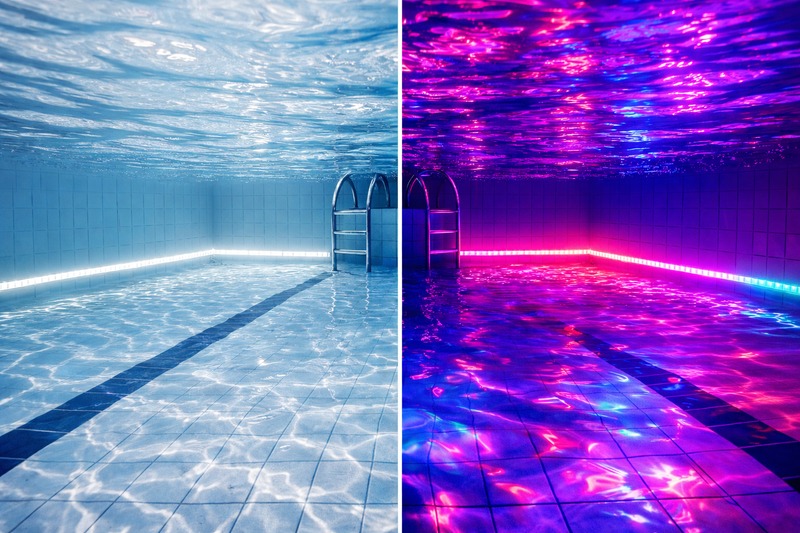
In the early days of my factory, we only produced 300W halogen bulbs. They were hot, inefficient, and only came in one color: "yellowish." Today, the LED revolution gives your clients infinite choices. But with choice comes confusion. I often see distributors stocking the wrong ratios of RGB to Single Color lights. They end up with dissatisfied homeowners calling about remote controls that don’t work or colors that don’t match. Understanding the technical trade-offs will save you from these headaches.
Are You Selling Safety or Entertainment?
Clients often ask for "the one that changes colors" because they think it sounds cool. However, they rarely understand that they are sacrificing pure lumen output for that gimmick.
Single color LED lights use dedicated white phosphors to produce superior brightness and clarity for safety and visibility. RGB lights must split their power across three channels, often resulting in a mixed "white" that looks dim and unnatural compared to a dedicated single-color chip.
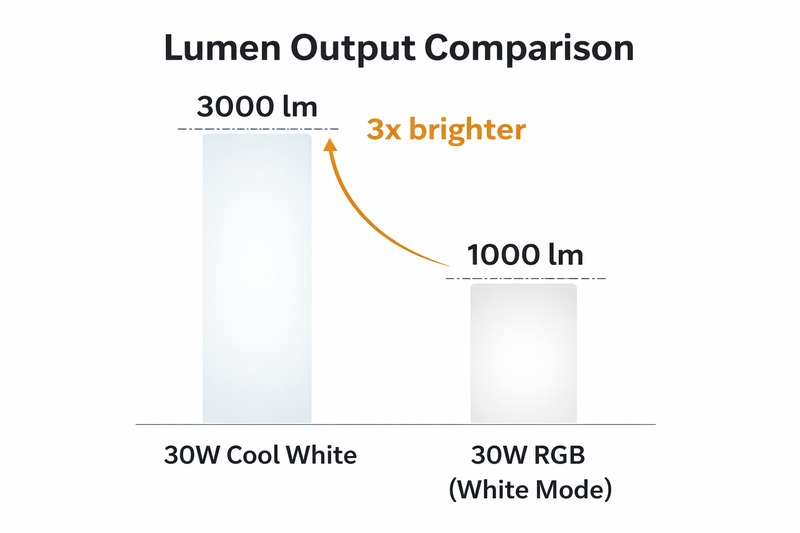
When we manufacture a Single Color LED board, every single diode on that PCB is working toward one goal: brightness. If we make a 30-Watt Cool White pool light, you get the full intensity of those 30 Watts converted into visible light. This punches through the water. It reaches the bottom of the deep end. It eliminates shadows where debris or—God forbid—a person could be hiding. For commercial projects, hotels, or lap pools, safety codes often dictate lux levels that only Single Color lights can easily achieve. The water looks like a glowing diamond.
The Physics of "Fake White" vs. Real White
On the other hand, an RGB (Red-Green-Blue) light is a compromise. To make "white" light with an RGB fixture, the chip turns on Red, Green, and Blue simultaneously. This mixes to create a whitish light, but it is never pure. It often has a pink or blue tint, known as "chromatic aberration" at the edges of the beam. Furthermore, because the heat is distributed across three different colors, we often have to limit the total power output to prevent overheating. So, a 30W RGB light1 might only output the equivalent brightness of a 20W Single Color2 light.
Application Scenarios
If your client wants to read a book by the pool or needs to monitor kids swimming at night, Single Color2 is the functional winner. RGB is strictly for mood and atmosphere. It creates a "lagoon" feel, not a "stadium" feel. You must explain this trade-off to the client: do they want the pool to be a centerpiece of entertainment (RGB), or a functional architectural element (Single Color2)?
| Feature | Single Color2 (White/Blue) | Color Changing (RGB/RGBW) | The Reality |
|---|---|---|---|
| Brightness | High (100% Efficiency) | Medium (Mixed Output) | Single color is for seeing; RGB is for looking. |
| White Tone | Pure, Crisp (6000K) | Unnatural, Tinted | RGB cannot make a true brilliant white. |
| Purpose | Safety, Architecture | Parties, Mood | Decide the function before the form. |
| Cost | Lower | Higher | RGB requires more components and controllers. |
Will the Control System Become a Nightmare?
The number one reason for warranty claims in my business isn’t a dead bulb; it is a "desynchronized" system. This is the hidden trap of selling color-changing lights.
Single color lights operate on a simple on/off switch with zero chance of software failure. RGB lights rely on external controllers, Wi-Fi signals, or power-toggling chips that can easily drift out of sync, leaving you with one red light and one blue light.
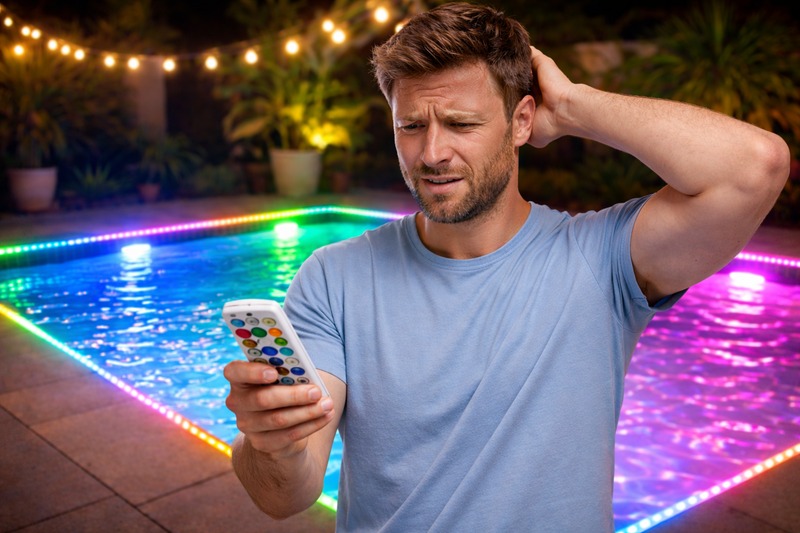
Let’s dive into the "brains" of the light. A Single Color light is electrically simple. You send it 12 Volts or 24 Volts, and it turns on. There is no data signal. There is no memory chip. It just works. For a contractor, this is "install and forget." You will never get a call on a Saturday night saying the lights won’t turn on. The reliability is nearly bulletproof because the complexity is zero.
The "Switch Logic" Trap
RGB lights are different. They need a language to tell them what color to display. The most common cheap method we use in the factory is Switch Control (On/Off Logic)3. The user flicks the wall switch Off and On quickly to change the color mode. This is cheap and requires no extra wiring. But here is the problem: signal timing. If you have three lights in a pool and the voltage drop is slightly different for the furthest light, its internal timer might read the switch-flick differently. Suddenly, two lights are Green, and the third one is Blue. The client tries to reset it, gets frustrated, and calls you.
Retrofitting Wiring Challenges
The second method is External Control (4-wire or DMX)4. This uses a separate wire (or wires) for data. It is reliable, but it requires running new conduit and cable. If you are retrofitting an old pool that only has 2-wire cable installed, you cannot use this system easily. You are stuck with the unpredictable Switch Control or expensive Power Line Communication (PLC) systems. Single color lights bypass this entire headache. If your client is not tech-savvy, do not sell them RGB. You are selling yourself a future service call.
| Control Method | Single Color | RGB (Color Changing) | Headache Level |
|---|---|---|---|
| Operation | Wall Switch | Remote / App / Logic | RGB leads to "lost remotes." |
| Wiring | 2-Wire (Simple) | 2, 4, or 5-Wire | Retrofits are hard for RGB. |
| Sync Issues | Impossible | Frequent (on cheap models) | The complaint for pool pros. |
| Maintenance | Minimal | High | Electronics are the first thing to fail. |
Which Light Lasts Longer Under Water Pressure?
Water is the ultimate destroyer of electronics. The more components you pack into a sealed underwater can, the higher the risk of failure.
Single color lights have fewer internal components and generate less heat per chip, leading to a longer lifespan. RGB lights require complex driver boards and run at varying temperatures, which can stress the waterproof seals over time.
In my testing lab, we run lights until they die. We call it "destructive testing." We consistently see that Single Color lights outlast RGB versions. It comes down to basic physics and engineering constraints within the housing.
Heat Dissipation and Efficiency
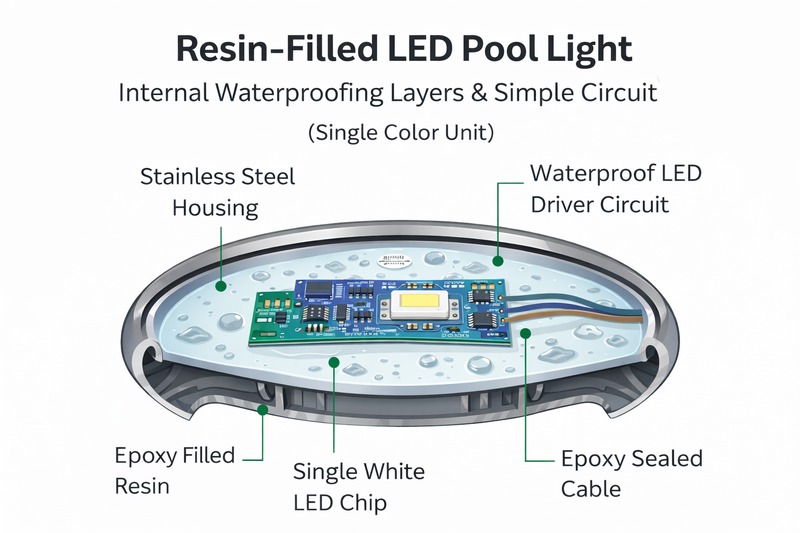
An LED chip hates heat. In a Single Color fixture, we can spread the chips out evenly on the aluminum PCB. The heat dissipation is uniform. We use a simple driver that regulates current. There is plenty of space inside the housing for resin potting (the glue we pour in to stop water). In an RGB fixture, we have to pack three diodes (Red, Green, Blue) into the space of one, or use a "3-in-1" chip. This creates concentrated hot spots. Higher heat degrades the lifespan of the LED phosphor and the driver components faster.
The Thermal Cycling Risks
Furthermore, the constant changing of colors causes "thermal cycling5." The light heats up on White mode, cools down on Red mode, and heats up again on Blue mode. This rapid expansion and contraction can continuously stress the rubber O-rings or the resin seal bonding. Eventually, a microscopic gap opens, water gets in, and the light shorts out. We use Resin-Filled Technology6 to mitigate this, filling the entire light engine with epoxy so there is no air gap. But even then, the simpler the circuit, the longer it lasts. If your client wants a light that they won’t have to touch for 10 years, Single Color is the statistically safer bet.
| Durability Factor | Single Color | RGB (Color Changing) | Factory Insight |
|---|---|---|---|
| Heat Gen | Stable / Uniform | Fluctuating / Hotter | Cyclical heat stresses seals. |
| Circuitry | Basic | Complex (Microchips) | More parts = More failure points. |
| PCB Density | Low | High | RGB boards are crowded. |
| Warranty | Often Longer | Standard | Reliable engineering wins. |
Conclusion
If the goal is safety and zero maintenance, choose Single Color. If the goal is "wow factor" and the budget allows for professional control systems, choose RGB. Don’t let a client choose RGB without understanding the control complexity.
-
Learn about RGB light technology and its unique applications for mood and atmosphere. ↩
-
Explore the advantages of Single Color lighting for functional and architectural purposes. ↩ ↩ ↩ ↩
-
Understanding this method can help you avoid common pitfalls and frustrations with RGB lighting setups. ↩
-
Explore this resource to learn about reliable RGB control methods and how they can improve your lighting installations. ↩
-
Learn about thermal cycling’s impact on LED performance and lifespan, crucial for making informed lighting choices. ↩
-
Explore this link to understand how Resin-Filled Technology enhances LED durability and prevents water damage. ↩
Interested in Our LED Solutions?
Get professional consultation and customized LED lighting solutions for your projects. Contact our expert team today.
Related Articles

How Do You Build Profitable Custom Vehicle and RV Interior LED Rope Lights?
You lose RV installation contracts because your interior lights fail on rough roads. Standard strips show bright dots on glossy…

How to Perfect Bookshelf and Display Cabinet LED Rope Lighting?
You lose retail clients when bookshelves look incredibly dark. Ugly shadows hide expensive products inside display cabinets daily. You need…

How to Master Mirror and Vanity LED Rope Light Installation?
Your clients complain about ugly shadows in their bathroom mirrors. Bad lighting ruins expensive vanity designs. You lose future contracts…
