

Event and Wedding LED Rope Lighting: Are Your Lights Ruining the “Big Day”?
Picture the scene: A bride spent thousands on her floral arrangements. The photographer is lined up for the perfect shot. But when the venue lights dim and the accent lighting turns on, the roses look muddy brown, and the guests look pale and ghostly in the photos. Or worse, a sudden summer rainstorm hits the outdoor reception, and half the perimeter lighting shorts out, leaving the tent in darkness. As an event planner or lighting contractor, this is your nightmare.
To guarantee a flawless event experience, you must transition from cheap, flickering PVC ropes to professional-grade COB LED solutions. By utilizing High-CRI (Ra90+) chips to ensure photogenic color accuracy, employing IP68 Solid Extrusion Silicone for fail-safe outdoor weatherproofing, and leveraging "Dot-Free" continuous illumination, you protect your reputation and deliver the magical atmosphere clients pay for.
In the high-stakes world of weddings and corporate events, there are no "do-overs." The lighting has to work, and it has to look expensive, even if you are working on a tight margin. Let’s strip away the marketing fluff and look at the actual manufacturing specs that determine whether a light strip survives the rigors of the event industry.
Why Is the "Dot-Free" Effect Crucial for Event Photography?
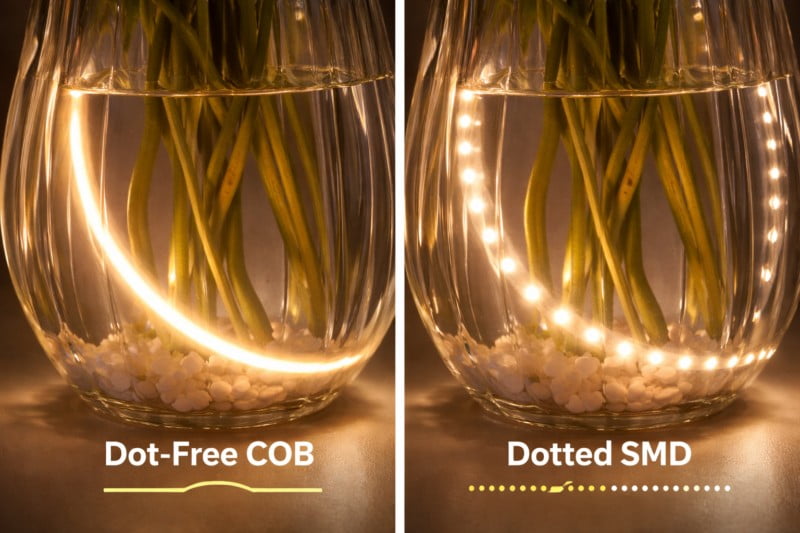
Ten years ago, it was acceptable to see individual points of light (LED dots) reflecting off a glossy dance floor or a glass centerpiece. Today, with 4K video and high-resolution wedding photography, those "dots" create visual noise that ruins the aesthetic. Clients want a seamless ribbon of light that looks like high-end neon, not a string of Christmas bulbs.
You need to adopt Chip-on-Board (COB) technology with high density (320 to 512 LEDs per meter). Unlike traditional SMD strips where LEDs are spaced apart, COB strips cover the chips with a continuous phosphor layer. This eliminates glare spots and "dark zones," providing a soft, uniform glow that acts like a natural filter for cameras, making every photo look professional without the need for heavy diffusion covers.
The Photogenic Standard
Prop and stage designers often ask me, "Jeremy, why do my lights look flickering or harsh on camera?" The answer usually lies in the density and the phosphor coating.
The "Zebra Stripe" Problem:
Standard LED tape (like the old 5050 models with 60 LEDs/m) leaves gaps between light sources.
- The visual impact: When a photographer lowers their shutter speed to capture a romantic low-light moment, these gaps can cause "banding" or strobing effects in the video footage.
- The COB Solution: Our COB series puts chips as close as 1.8mm apart. The light is continuous. There are no gaps for the camera shutter to catch.
Color Rendering Index (CRI) – The Secret to Beautiful Skin1:
Wedding planners obsess over color palettes—Blush Pink, Sage Green, Navy Blue.
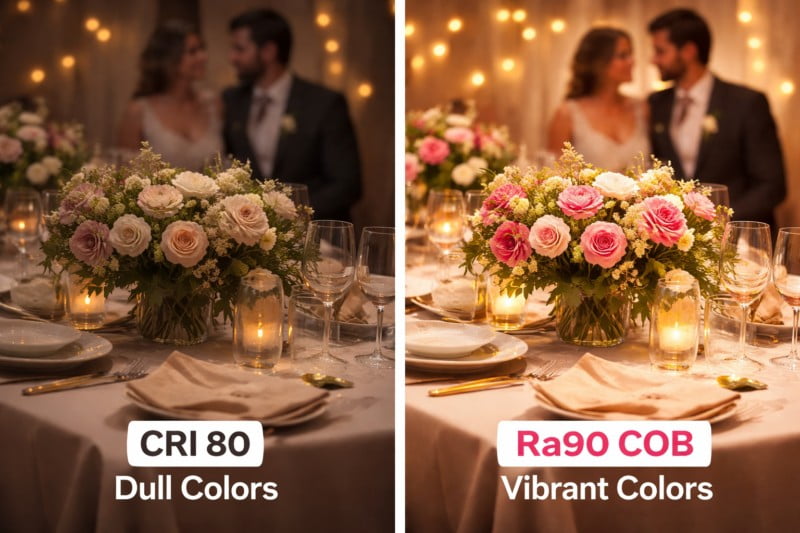
- The Low CRI Disaster: A standard commercial LED (Ra70 or Ra80) lacks the R9 (deep red) spectrum. Under this light, skin tones look greyish or sickly green, and vibrant food looks stale.
- The Ra90 Advantage: We manufacture our event-grade strips with a CRI of Ra902. This creates a "True Color" environment. The red in the roses pops; the gold on the silverware glimmers correctly; and most importantly, the bride’s skin looks healthy and radiant.
Beam Angle for Ambience:
- Traditional LEDs shoot light straight out (120 degrees).
- COB Wide Angle: Due to the dome shape of the phosphor, COB strips emit light at 180 degrees. When you hide these in a cove or under a table lip, the light washes the surface much more evenly, eliminating harsh shadows.
Will Your Outdoor Lighting Survive a Sudden Downpour?
I have seen it happen too many times. A contractor buys "Waterproof" tape from a random supplier. The event is outdoors. It rains. Water gets inside the silicone sleeve, and the lights short out. The party ends early, and the contractor gets sued. "Waterproof" on a spec sheet is meaningless unless you understand the technology behind it.
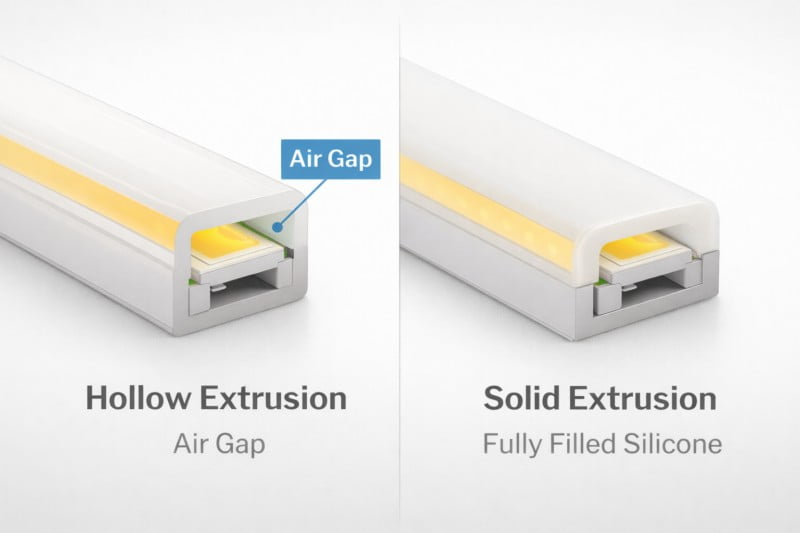
Stop using "Hollow Extrusion" (IP67) sleeves for critical outdoor events and switch to "Solid Extrusion" (IP68) silicone technology. In hollow tubes, air gaps allow condensation to form and water to pool if the seal is breached; Solid Extrusion completely encapsulates the PCB and LEDs in silicone, eliminating air pockets and creating a rugged, unbreakable barrier that can even withstand being submerged or stepped on.
The Physics of "Weatherproof"
As a factory owner, I can tell you that not all silicones are created equal. For the rental and event industry, durability is just as important as waterproofing.
The Condensation Killer:
- Old Tech (Hollow Tube): You slip the LED strip into a silicone tube. It looks waterproof. But when the lights heat up and the outdoor air cools down (common at evening weddings), pressure changes suck moisture into the tube. Eventually, the water corrodes the copper.
- New Tech (Solid Extrusion): We use a co-extrusion process where the silicone is molded with the LED board. There is zero air space inside. No air means no condensation.
UV Resistance for Day Events:
- Many cheap PVC casings turn yellow after a few months of sun exposure. Yellow casing = Blue light turns Green.
- We use food-grade silicone3 which is UV resistant. You can leave these lights installed on a permanent marquee or tent frame for years, and they will stay clear.
Durability for Rentals:
- Event lighting gets abused. It is rolled out, taped down, ripped up, and thrown in a truck.
- Hollow tubes tear easily. Solid silicone protects the delicate chips and resistors like a layer of rubber armor. You can literally step on our IP68 Solid Extrusion4 lights in high heels, and they likely won’t break. This extends the ROI (Return on Investment) for rental companies significantly.
| Feature | IP67 Hollow Tube (Cheap) | IP68 Solid Extrusion (Pro) |
|---|---|---|
| Water Resistance | Good for splashes | Submersible / Rain-Proof |
| Condensation Risk | High (Air gaps) | Zero (Encapsulated) |
| Durability | Prone to tearing | Impact Resistant |
| Flexibility | Kinks easily | Smooth Bending |
How Can Custom Neon Signs Be Made Flawless?
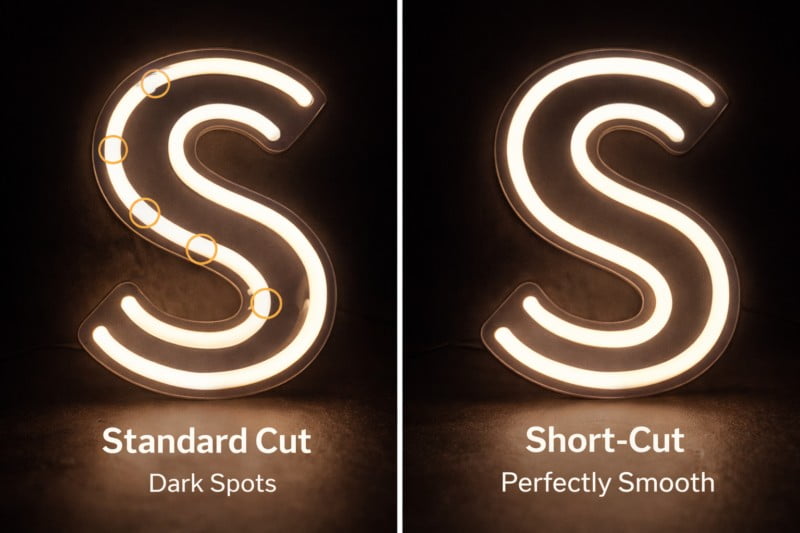
The hottest trend in events right now is the custom neon sign—"Mr. & Mrs. Smith," "Let’s Party," or corporate logos. But making these signs with standard LED strips is a nightmare because the "cut points" are too far apart. You end up with dark corners on the letters.
Utilize specialized "Short-Cut" COB strips with cutting units as small as 10mm or 12.5mm. This extreme precision allows sign makers to cut the light exactly where the letter curve ends, eliminating the dark spots visible in traditional neon signs (which cut every 50mm) and creating a perfectly continuous stroke of light for intricate typography.
Precision Engineering for Aesthetics
In sign making, geometry is everything. If you are bending light to form a cursive "Love," a 5cm dark spot ruins the illusion.
The Cutting Math:
- Standard 12V Strip: Usually cuts every 25mm or 50mm.
- Standard 24V Strip: Usually cuts every 50mm or 100mm.
- The Problem: If a letter stroke is 12cm long, and your cut unit is 5cm, you cut at 10cm. You have 2cm of unlit silicone channel. It looks cheap.
- The Solution: Our specialized 12V COB strips5 feature a cut length of just 10mm. On that same 12cm stroke, you cut at 12cm exactly. The light fills the channel 100%.
The "Mini" Sizes:
- Standard strips are 8mm or 10mm wide. This is too fat for delicate script fonts.
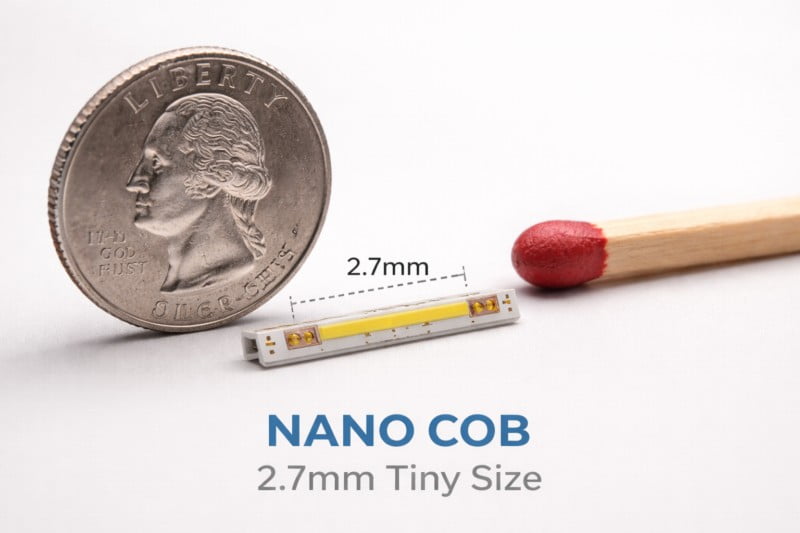
- We produce 4mm and even 2.7mm wide COB strips. These fit into extremely thin routed channels in acrylic or wood. This allows for fine detail—you can create neon signs with thin, elegant fonts rather than just big block letters.
Bending Radiuses:
- Creating a sharp corner in a sign puts stress on the PCB (circuit board).
- Our strips are engineered with ample copper and flexible solders to withstand the tight bends required for signage without snapping the circuit. However, we always advise adhering to a minimum bending radius6 (R>15mm) or using the correct "Zig-Zag" (S-Type) strips for lateral bends to ensure longevity.
Can You Hide Lighting In Delicate Decor Without It Being Bulky?
Wedding table centerpieces, acrylic podiums, and floral arches are delicate. A chunky aluminum profile with a thick white cover ruins the look. You want the light to appear "magically" without seeing the fixture.
Switch to Ultra-Slim "Nano" COB strips with a PCB width of just 2.7mm or 4mm. These microscopic profiles can be embedded directly into narrow saw grooves in plywood, hidden behind thin acrylic edges, or woven into floral garlands, providing high-intensity illumination that remains completely invisible to the guest until it is switched on.
The Art of Invisible Integration
For high-end event designers, lighting is an architectural element, not just an add-on.
Thermal Management in Tight Spaces:
- One concern designers have with tiny strips is heat. "Will this melt my acrylic?"
- While our 2.7mm and 4mm strips are powerful, we recommend mounting them on a metal surface whenever possible to act as a heat sink.
- However, because we use Flip-Chip COB technology7, the electrical resistance is lower than older wire-bonded LEDs. This means less energy is wasted as heat. They run cooler than you would expect, making them safe for temporary installation near fabrics or plastics (always test first, safety is paramount).
The "Floating" Effect:
- By using a 4mm strip, you can route a tiny channel under a floating shelf or a bar counter.
- Because the source is so small, it doesn’t need a heavy diffuser to look good (since it’s already dot-free).
- This creates a razor-sharp line of light that makes heavy furniture look like it is floating on air.
- Backlighting Menus: Thin enough to sandwich between two sheets of paper or acrylic.
- Costume Design: Low voltage (5V or 12V) and flexibility make these perfect for sewing into illuminated performance costumes for the reception entertainment.
How Do You Handle Long Runs Without Voltage Drop?
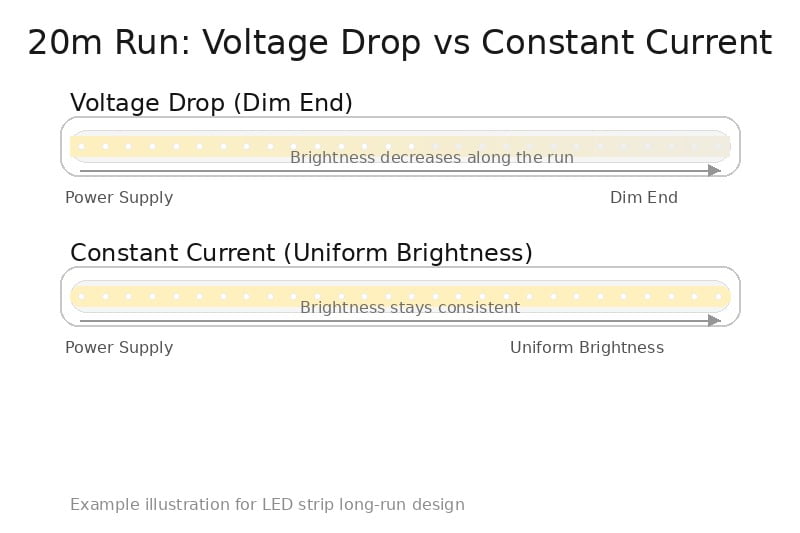
Events often involve lighting huge tents or long perimeter fences. If you run 20 meters of standard 12V tape, the end of the run looks dim and yellow compared to the start. Adding power supplies every 5 meters is labor-intensive and messy (more cables to hide).
Standardize on 24V Constant Voltage or specialized Constant Current LED strips for perimeter lighting. This allows you to run lengths of 10 to 15 meters (or more) from a single power source with consistent brightness and color temperature from beginning to end, significantly reducing cabling labor and potential failure points during setup.
Efficiency Meets Labor Savings
In the event business, time is money. Typical setup windows are 4-6 hours. You don’t have time to solder power injection wires every few meters.
The Physics of Voltage Drop:
- As electricity travels through copper, it meets resistance. Voltage drops.
- On a long 12V strip, the 12V might drop to 9V at the end. The LEDs get dimmer and the color shifts warm.
- The 24V Solution: By doubling the voltage, we reduce the current needed for the same power. Less current means less voltage drop. You can run longer lines with thinner wires.
Double-Sided Copper FPC:
- Economy strips use a single, thin layer of copper. They snap easily and heat up.
- We use double-sided copper PCBs (Printed Circuit Boards). This acts like a "superhighway" for electricity, allowing it to travel further without traffic jams (resistance).
- Benefit: It also makes the strip physically stronger. When your crew is pulling the strip off a reel to hang it on a marquee, that extra copper prevents the internal circuits from tearing.
High Efficiency Options:
- If you are running off a generator (common for outdoor weddings), power consumption matters.
- We offer high-efficiency chips that deliver up to 180 lumens per watt. A standard strip might only be 80lm/W.
- This means you can light up a larger area using a smaller, quieter generator. No one wants a noisy diesel generator ruining the wedding vows.
Conclusion
In the event industry, your lighting is as much a part of the decor as the flowers. It sets the mood, defines the space, and ensures the memories captured in photos are beautiful. By upgrading to IP68 Solid Silicone for weather reliability, choosing High-CRI COB for flawless photography, and utilizing Short-Cut and Ultra-Slim profiles for custom fabrication, you stop fighting with your equipment and start delivering seamless, magical experiences. Don’t let cheap lighting be the reason a bride cries on her wedding day; invest in professional solutions.
-
Understanding CRI is crucial for achieving beautiful skin tones in photography and videography, enhancing the overall visual quality. ↩
-
Exploring the benefits of Ra90 can help you create stunning visuals for events, ensuring colors appear vibrant and true to life. ↩
-
Explore the advantages of food-grade silicone, especially its UV resistance and durability for outdoor use. ↩
-
Learn about IP68 Solid Extrusion technology and how it enhances durability and waterproofing for event lighting. ↩
-
Explore how 12V COB strips enhance lighting precision and aesthetics in sign making, ensuring a flawless finish. ↩
-
Learn about the significance of bending radius in sign making to prevent damage and ensure durability of your designs. ↩
-
Explore this link to understand how Flip-Chip COB technology enhances lighting efficiency and safety, crucial for modern design. ↩
-
Discover various innovative uses of versatile lighting in design, from backlighting to costume design, to inspire your next project. ↩
Interested in Our LED Solutions?
Get professional consultation and customized LED lighting solutions for your projects. Contact our expert team today.
Related Articles

How Do You Build Profitable Custom Vehicle and RV Interior LED Rope Lights?
You lose RV installation contracts because your interior lights fail on rough roads. Standard strips show bright dots on glossy…

How to Perfect Bookshelf and Display Cabinet LED Rope Lighting?
You lose retail clients when bookshelves look incredibly dark. Ugly shadows hide expensive products inside display cabinets daily. You need…

How to Master Mirror and Vanity LED Rope Light Installation?
Your clients complain about ugly shadows in their bathroom mirrors. Bad lighting ruins expensive vanity designs. You lose future contracts…
