

Extreme Temperature LED Rope Lights: Are Cold and Heat Destroying Your Projects?
You install expensive lights in summer. They melt. You install them in winter. They snap like glass. Re-doing jobs kills your profit. You need lights built for extreme weather.
To survive extreme temperatures, use IP67 hollow extrusion or IP68 solid extrusion pure silicone. Combine this with FPC double sides copper to manage heat. Never use IP65 potting compound outdoors. Always respect the 15mm bending limit to stop freezing weather from cracking the waterproof seal.
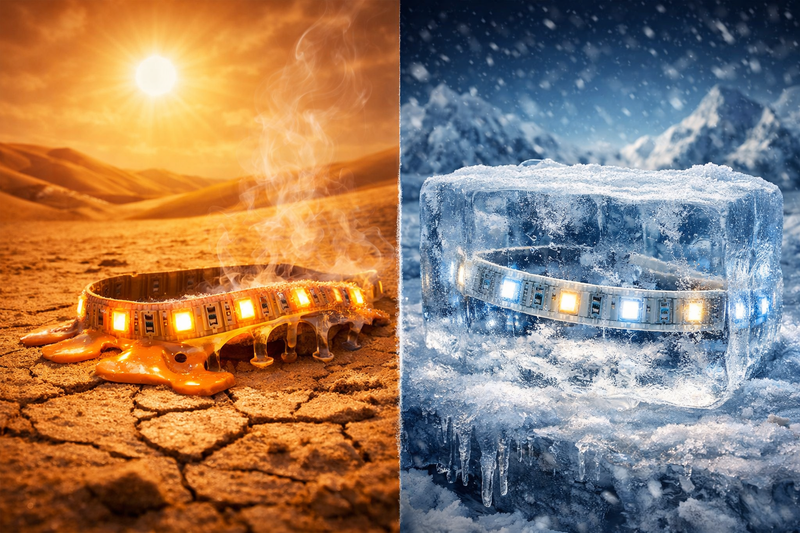
I am Jeremy Hou. I run Rhstriplighting in China. I sell B2B led strip lights. Many buyers call me. One of them is Tom. Tom runs a business in the United States. He buys LED lights and sells them to local contractors. Tom had a big problem. His lights failed in Texas summers. His lights cracked in New York winters. His contractors got very angry. Tom lost a lot of money. He thought all factory lights were bad. I told Tom the truth. The materials dictate the survival of the lights. Cheap factories sell indoor lights with an outdoor label. They fake their tests. Here is my guide to buying LED strips that survive real weather.
How Does Extreme Heat Kill Standard LED Strips?
High heat cooks cheap LED strips. The sun bakes the outside. The chips burn the inside. Cheap waterproof layers turn brown and soft. The lights stop working fast.
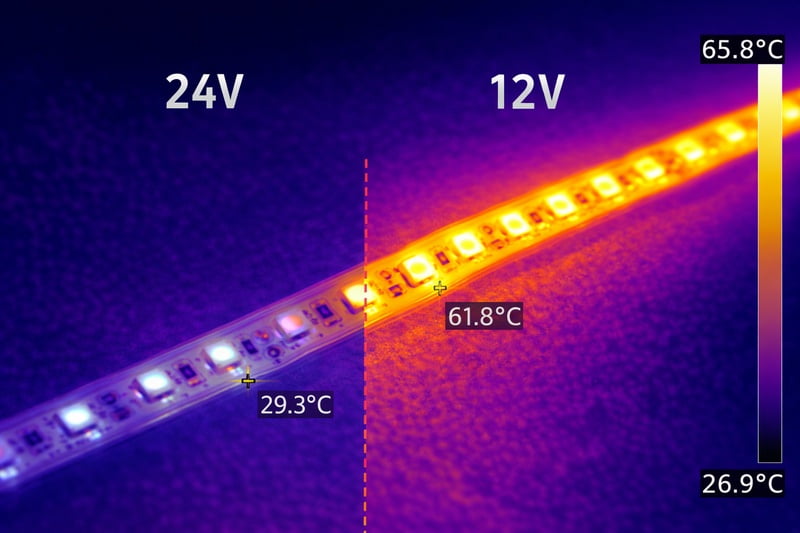
Summer heat destroys IP65 potting compound waterproofing. To beat the heat, use FPC double sides copper to move heat away from chips. Use 24VDC to lower internal current. Use high efficiency chips so power becomes light, not heat.
The Importance of Double Sided Copper
In a hot summer, the outside temperature reaches forty degrees Celsius. The sun shines directly on the lights. But the outside heat is not the only problem. The LED chips make their own heat. If you use a cheap circuit board, the heat stays under the chip. The chip burns out. We use FPC double sides copper1. The thick copper works like a road. It takes the heat away from the hot LED chips. It spreads the heat across the whole board. This keeps the internal temperature low. Tom used to buy single-sided copper from other suppliers to save one dollar. He lost hundreds of dollars replacing melted lights. Good copper is the best heat protection.
High Luminous Efficiency Fights Heat
Many buyers only look at the price. They do not look at efficiency. This is a big mistake in hot climates. A cheap chip uses energy to make a little light and a lot of heat. Our COB high-density flexible strip light features high luminous efficiency2 . We have SMD strips that achieve up to 184 Lm/w . This means almost all the power turns into bright light. Very little power turns into heat. The strip stays cool to the touch. When the Texas sun heats the outside of the silicone tube, the inside remains safe. Heat kills the lifespan of lights. Keeping the chips cool helps us guarantee a life span of >36000hours .
Why 24VDC3 is Better for Hot Weather
Voltage choices also change heat levels. You can choose 12V or 24V. Buyers like 12V because the cutting units are smaller. But 12V is bad for long outdoor runs in the heat. 12V pulls high current. High current creates friction and heat in the copper wires. We offer 24VDC for outdoor use . 24VDC uses half the current to push the same power. Less current means less friction. Less friction means less internal heat. When you pair 24VDC with IP674 waterproofing by hollow extrusion, the air inside the tube also helps cool the chips. The hollow space acts as a heat sink.
Avoid IP65 for Summer Sun
You must choose the right outer layer. IP65 potting compound waterproofing is very popular . It is cheap. But it is only a drop of glue on top of the copper. It sits directly on the heat source. Hot summer sun melts this thin compound. It turns yellow quickly. It traps the heat inside. You must upgrade to IP67. The thick silicone tube ignores the sun. It does not melt.
| Feature | Best Choice for Heat | Cheap Alternative | Result of Cheap Choice |
|---|---|---|---|
| Circuit Board | FPC double sides copper | Single-sided copper | Chips burn out quickly |
| Efficiency | > 140 Lm/w | < 80 Lm/w | Energy turns into extreme heat |
| Voltage | 24VDC | 12VDC | High current adds extra heat |
| Waterproofing | IP67 Hollow Extrusion | IP65 Potting Compound | Coating melts and turns yellow |
Can Freezing Temperatures Crack Your Waterproof Casing?
Winter is cruel to plastic. Cheap plastic freezing point is high. It gets hard like a rock in the snow. When wind moves the building, the hard plastic snaps. Water enters instantly.
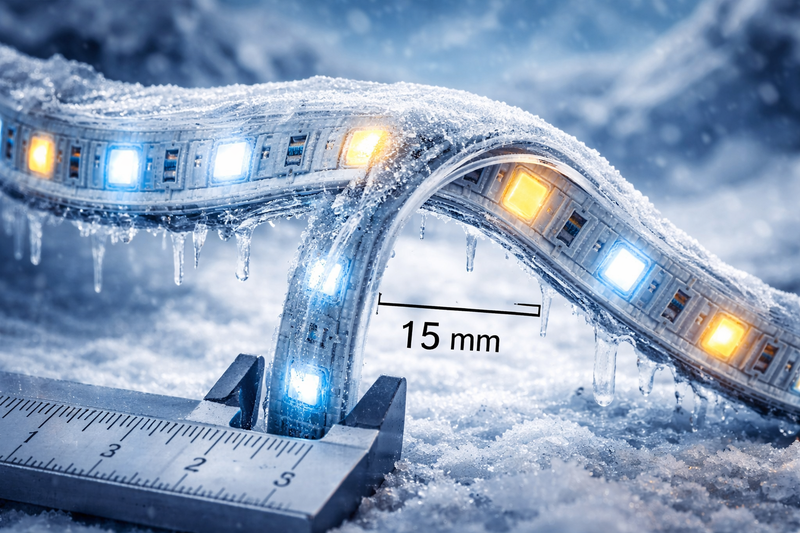
Cold weather requires flexible silicone. You must choose IP67 or IP68 made from pure silicone. Never bend the frozen strip sharply. Keep the bending diameter to R > 15mm. Never fold the strip, or the ice will break it.
Pure Silicone Stays Soft
Tom sells lights in cold states. His old suppliers used epoxy resin for the waterproof coat. Epoxy resin is terrible for the cold. Below freezing, epoxy turns into hard glass. The cold wind constantly shakes the building walls. The lights shake with the wall. The hard epoxy cracks into tiny pieces. We fix this by using real silicone. We make IP68 waterproofing by solid extrusion using pure liquid silicone5 . Silicone has an amazing chemical structure. Even at minus 20 degrees Celsius, it feels soft. It stays flexible. It moves with the building. It does not crack.
The Bending Diameter Limits
Even with the best silicone, you must follow the laws of physics. Cold silicone is a little stiffer than warm silicone. Your workers must be careful during a winter installation. Our manual clearly says: bending diameter : R > 15mm6. You cannot pinch the strip tight. You cannot squeeze it into a sharp corner. If you bend the strip tighter than 15mm in the freezing cold, you put massive stress on the cold silicone. You also stretch the copper board inside. The cold copper will snap faster. Keep the curves gentle.
The Warning Against Horizontal Bending
Workers make bad mistakes because their hands are cold. They try to do the job fast. They reach a corner. Instead of cutting the strip, they twist it sideways. We print a warning: Please do not bend it horizontally. FPC double sides copper is flat. When you bend it sideways, the heavy copper traces tear open. The cold weather makes the copper less forgiving. A sideways bend also pulls the silicone tube open. Cold air and snow enter the hollow tube. Your job is ruined. You must cut the strip and use wires to turn a flat corner.
Never Fold the Product
When a job is done, workers pack up the extra materials. They grab the cold strip. They fold it like paper. Our factory rule is simple: Please do not fold it in half. A hard fold in freezing weather creates a permanent break in the silicone wall. The waterproof seal dies. IP67 waterproofing by hollow extrusion relies on a perfect outer tube. A fold ruins that shape. Treat the strip like an expensive hose. Roll it smoothly. Never pinch it.
| Weather Condition | Installation Rule | Why It Matters in Winter |
|---|---|---|
| Below Freezing | Use Solid Pure Silicone | Epoxy cracks like glass |
| Corner Turning | Bending diameter: R > 15mm | Sharp bends break cold copper |
| Flat Turns | Do not bend horizontally | Sideways stress tears cold circuits |
| Storage | Do not fold in half | Folding snaps the waterproof seal |
Are You Ignoring the Connection Points in Harsh Climates?
A chain is only as strong as its weakest link. In lighting, the weakest link is the cut point. Ice and heat attack open cuts first. Bad sealing destroys good materials.
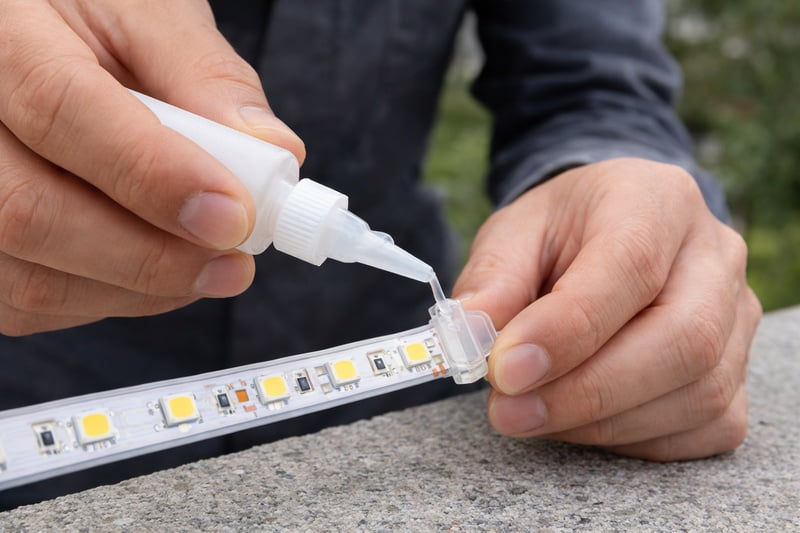
To protect cut points, you must cut exactly on the line. For 24V, use the 50mm cutting length marks. Fill the end cap completely with neutral silicone glue. Let it cure fully before the snow or rain hits.
Managing Cutting Lengths Safely
When you install lights outside, you must cut them to fit the space. If you cut them wrong, you expose the inside to extreme weather. You must follow the exact cutting marks. For our DC-24V lights, we have a cutting length – 50mm7. For our DC-12V boards, the cutting length – 25mm. When you cut the strip in the winter, be gentle. Do not crush the silicone tube. Use very sharp scissors. A clean cut makes it easier to seal. If the cut is messy, the silicone end cap8 will not fit tight. Wind will push snow inside. Hot summer air will push humidity inside.
The Power of the End Cap
Many contractors are lazy. They cut the strip. They wrap a piece of black electrical tape around the end. They leave it outside. This is a disaster. In the summer, the tape adhesive melts and falls off. In the winter, the cold shrinks the tape, leaving a big gap. You cannot use tape. You must use the silicone end cap. You must inject non-acidic silicone glue into the cap. You push the cap onto the strip. The glue fills every empty space. This replaces the IP67 waterproofing by hollow extrusion seal that you just cut . It blocks water. It blocks ice. It blocks heat.
Curing Time is Critical
Tom used to have problems with foggy tubes. His workers sealed the lights perfectly. But the lights failed in the cold. Why? The workers sealed the tubes and immediately turned the lights on in the snow. The glue contains moisture. You must give the glue 24 hours to cure and dry. If you don’t fully dry it, the LED chips heat up. The moisture from the wet glue creates steam. The cold outside air hits the steam. The steam turns into water drops inside the hollow tube. This causes a short circuit. Good installation takes patience.
Verify Factory Quality
Extreme weather tests a factory’s honesty. Many suppliers lie. They test their lights inside a warm office. They print fake certificates. Then Tom installs them in standard outdoor jobs and they die. Real factories use environmental testing chambers9. We put our lights in testing ovens at very high temperatures. We put them in freezing boxes. We verify that the COB high-density flexible strip light features soft light, excellent resistance to folding and bending, and there are no light spots even after extreme abuse. We build lights for real contractors facing real weather.
| Installation Step | Correct Method | Bad Habit | Consequence of Bad Habit |
|---|---|---|---|
| Cutting the Strip | Use scissors on the 50mm mark | Cutting anywhere | Destroys the circuit completely |
| Sealing the End | Use silicone glue and end cap | Electrical tape | Tape falls off in heat, shrinks in cold |
| Curing the Glue | Wait 24 hours before use | Turning on power directly | Traps water fog inside the tube |
| Bending Safely | Gently curve up/down | Bending horizontally | Ruins the copper and the waterproof seal |
Conclusion
Extreme weather does not have to ruin your projects or take away your profit. You can beat the heat and the cold by choosing the right factory materials and using proper installation rules.
Always select FPC double sides copper and high efficiency chips to maintain a cool temperature in summer. Only use IP67 hollow or IP68 solid silicone to stop freezing cracks in winter. Protect your cut points carefully and never bend horizontally.
-
Explore how FPC double sides copper enhances heat dissipation and prolongs LED lifespan. ↩
-
Learn why high luminous efficiency is crucial for energy savings and heat management in LED lights. ↩
-
Discover the advantages of using 24VDC for reducing heat and improving performance in outdoor settings. ↩
-
Find out how IP67 waterproofing protects LED lights from heat and environmental damage. ↩
-
Explore how pure liquid silicone maintains flexibility and durability in extreme cold, making it ideal for waterproofing. ↩
-
Learn why adhering to bending diameter guidelines is crucial for preventing damage to silicone and copper components. ↩
-
Understanding the correct cutting length ensures proper installation and prevents damage to the lights. ↩
-
Exploring the benefits of silicone end caps can help you achieve a more reliable and waterproof seal for your outdoor lights. ↩
-
Discovering the role of environmental testing can help you choose reliable lighting products that withstand extreme weather. ↩
Interested in Our LED Solutions?
Get professional consultation and customized LED lighting solutions for your projects. Contact our expert team today.
Related Articles

How Do You Build Profitable Custom Vehicle and RV Interior LED Rope Lights?
You lose RV installation contracts because your interior lights fail on rough roads. Standard strips show bright dots on glossy…

How to Perfect Bookshelf and Display Cabinet LED Rope Lighting?
You lose retail clients when bookshelves look incredibly dark. Ugly shadows hide expensive products inside display cabinets daily. You need…

How to Master Mirror and Vanity LED Rope Light Installation?
Your clients complain about ugly shadows in their bathroom mirrors. Bad lighting ruins expensive vanity designs. You lose future contracts…
