

How Can LED Strips Create Unforgettable Event and Stage Designs?
Your client is planning a major event—a concert, a corporate launch, a trade show booth. They want to create a "wow" factor, something that looks sleek and modern, but they’re stuck with bulky, hot, power-hungry traditional stage lights. The setup is slow, the creative options are limited, and the budget is tight.
Professional LED strips transform event and stage design by enabling fully integrated, dynamic lighting. Their flexibility allows light to be built directly into the set, stage, and structures, creating immersive visual experiences that are impossible with traditional fixtures, all while being lighter, cooler, and more energy-efficient.
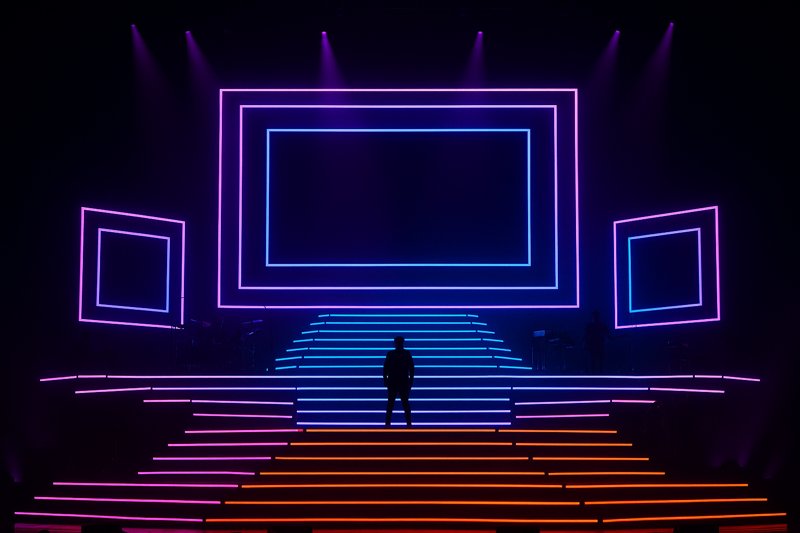
In my position as a manufacturer, I’ve seen the incredible creativity of event professionals like Tom who are pushing the boundaries of what’s possible. In the world of events, lighting isn’t just about visibility; it’s a core part of the show. It sets the mood, directs the audience’s attention, and creates memorable visual moments. The major shift we’ve enabled is moving light from something you hang on a truss to something you build into the very fabric of the event space. LED strips are the key to this integration. They are the versatile, digital-native lighting tool that allows designers to paint with light in ways that were previously unimaginable.
How Do You Control So Many Lights with Perfect Synchronization?
You’ve designed an incredible set with hundreds of feet of RGB LED strips. During the show, you need one section to be blue, another to be red, and a third to chase in a synchronized pattern, all perfectly timed to the music. How do you achieve this complex, pixel-perfect control?
This level of precise, synchronized control is achieved using the DMX512 protocol. By using addressable LED strips and DMX decoders, each small section of the strip can be given a unique address, allowing it to be controlled individually by professional lighting software and consoles.
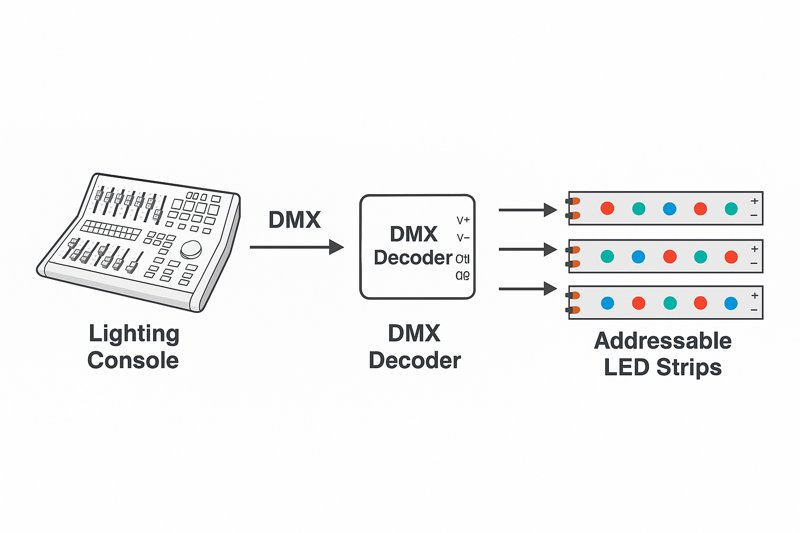
This is the single most important technical concept in professional event lighting, and it’s a frequent source of confusion. Standard RGB strips are great for simple applications, but they can only be one color at a time across their entire length. For dynamic effects, you need addressable (also called "pixel" or "digital") LED strips. In these strips, a tiny integrated circuit (IC) chip controls a small group of LEDs (or even a single LED). The DMX protocol is the universal language that lighting designers use to "talk" to these individual chips. It allows a lighting operator to sit at a console and have granular, real-time control over every single pixel in the entire installation, creating waves of color, video effects, and perfectly synchronized cues.
A Deeper Dive into DMX and Addressable LED Control
For a professional like Tom, understanding this technology is not optional; it is the price of entry for serious event and stage work. It directly addresses the need for reliable, professional-grade control.
-
The Key Components of a DMX System:
- The Controller: This can be a physical lighting desk (like those from MA Lighting or Avolites) or software running on a laptop (like Madrix or Resolume). This is where the designer programs the show.
- The DMX Decoder/Driver1: This is the crucial bridge. It takes the DMX signal from the controller and "translates" it into the voltage and data signals that the addressable LED strip understands. You must match the decoder to the IC type of your LED strip (e.g., WS2811, WS2812B, SK6812).
- The Addressable LED Strip2: The strip itself, with the embedded ICs that make individual control possible.
- The Power Supply3: A robust, reliable power supply is critical. In live events, you can’t afford a power failure. Using high-quality, certified power supplies is non-negotiable.
-
Understanding Channels and Universes4
- Channel: Each controllable function requires a DMX channel. For a standard RGB pixel, this means 3 channels (one for Red, one for Green, one for Blue).
- Universe: A single DMX "universe" consists of 512 channels.
- Calculation: If you have an RGB strip with 60 pixels per meter, each meter will require 60 pixels * 3 channels/pixel = 180 DMX channels. This means you can control just under 3 meters of this strip per DMX universe. For large-scale shows, designers use multiple universes to control the entire rig.
| Component | Role in the System | Critical Specification for Events |
|---|---|---|
| Controller | The "brain" where the show is programmed. | Compatibility with industry-standard protocols (DMX, Art-Net). |
| Decoder | Translates DMX signal for the LED strip. | Must match the IC type and voltage of the strip. |
| Addressable Strip | The light source with individually controlled pixels. | IC type (e.g., WS2811, WS2812B), Voltage (12V/24V), Pixels per meter. |
| Power Supply | Provides stable power to the system. | High reliability, correct voltage, and sufficient wattage. |
Mastering this system allows you to deliver the complex, dynamic, and perfectly timed lighting effects that major productions demand.
How Can Lighting Be Built for Rapid Setup and Teardown?
Events and tours have a brutal schedule. The crew has only a few hours to load in, build a massive stage, run the show, and then tear it all down and move to the next city. Heavy, complex lighting rigs are a nightmare. How can your lighting system be designed for this reality?
You design for speed and durability by creating modular, pre-fabricated lighting elements. LED strips are built into lightweight aluminum channels or custom set pieces with quick-connect cables, allowing large sections to be deployed and connected in minutes, not hours.
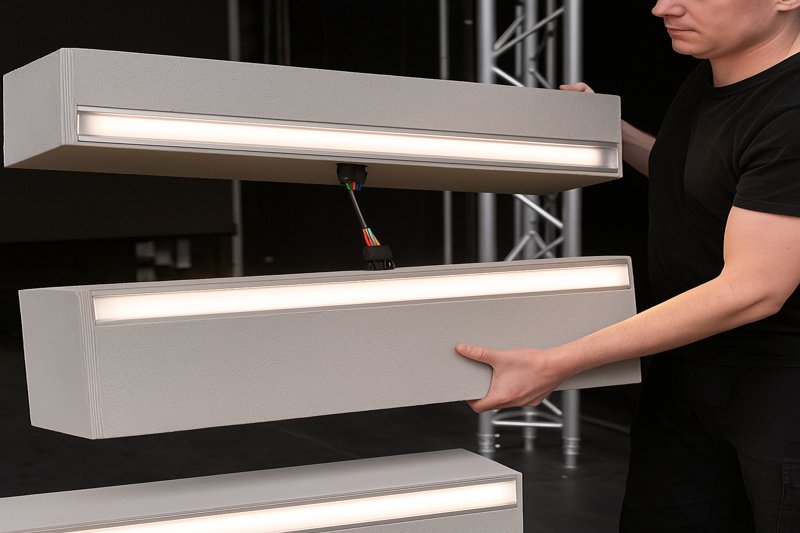
This is a problem I love solving with our clients. The low weight, low profile, and flexibility of LED strips make them perfect for a modular design approach. Instead of running hundreds of individual cables on-site, you pre-wire entire sections in the workshop. For example, a 10-foot section of truss can have an LED strip fixture pre-mounted. A set of stairs can be built with the riser lights and all their wiring already integrated. These pieces are then fitted with professional, multi-pin "quick-connect" cables. On-site, the crew simply bolts the set pieces together and clicks in a few connectors. This dramatically reduces setup time, minimizes on-site errors, and ensures the system is robust enough to withstand the rigors of touring.
A Deeper Dive into ‘Tour-Ready’ LED Systems
This addresses Tom’s clients’ need for efficiency and reliability under pressure. A system that saves them time and money on labor is a powerful selling point.
-
The Power of Aluminum Channels:
In a stage environment, an unprotected LED strip is a liability. It can be easily damaged by being stepped on, hit by road cases, or exposed to spilled drinks. Mounting the strip inside a sturdy aluminum channel with a durable diffuser5 is mandatory.- Protection: The channel provides essential physical protection.
- Heat Dissipation: It acts as a heat sink6, which is crucial for high-power strips running for hours during a show. Overheating drastically shortens an LED’s lifespan and can cause color shifts.
- Appearance: It provides a clean, finished look and helps diffuse the light for a smooth, professional effect.
-
Cabling and Connections: The Weakest Link
A bad connection can bring down a whole section of the show.- Soldering is Key: In the workshop, all connections to the LED strip itself should be carefully soldered. Weak, clipped-on connectors will fail under the vibration and stress of a touring environment. We provide strips with pre-soldered wire leads to ensure a solid starting point.
- Quick-Connectors: Use professional-grade connectors (like XLR for data or multi-pin connectors like Socapex for power and data). This allows for fast, foolproof connections in the low-light, high-pressure environment backstage.
| Design Principle | Standard Method | Tour-Ready Method | Benefit |
|---|---|---|---|
| Installation | Install individual strips on-site. | Pre-install strips into modular set pieces7. | Drastically reduces load-in time and on-site wiring complexity. |
| Protection | Exposed, bare strip. | Mount inside a durable aluminum channel with a diffuser. | Protects against damage, improves cooling, and enhances appearance. |
| Connectivity | Flimsy clip-on connectors or on-site soldering. | Soldered leads with professional multi-pin quick-connectors. | Ensures reliable, fast, and error-proof connections during setup. |
Building your systems this way proves that you understand the unique demands of the live event industry.
How Do You Create Immersive Environments with Light?
Your client wants to move beyond just lighting the stage. They want to light up the entire room—the walls, the ceiling, even the furniture—to make the audience feel like they are inside the show. How can you achieve this total immersion?
You create immersive environments by using the flexibility of LED strips to integrate light into every surface. By outlining architectural features, backlighting scenic panels, and building custom-lit props, you break the boundary between the stage and the audience.
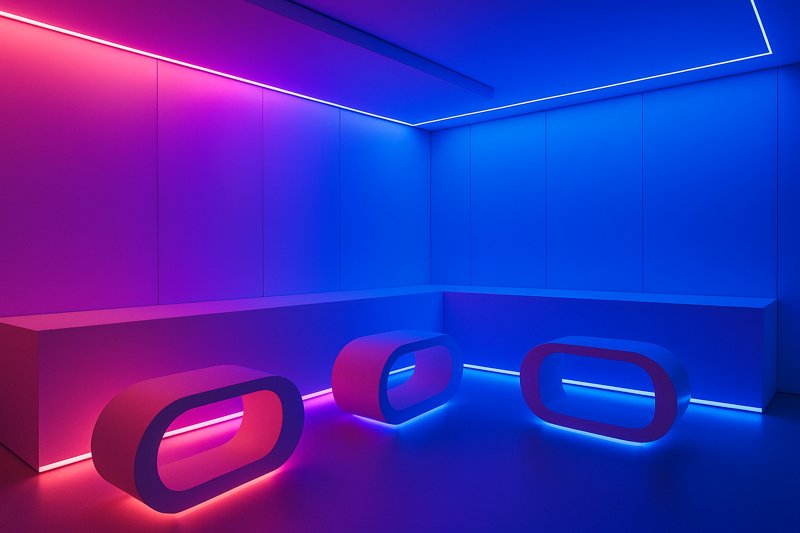
This is where the creativity of event design truly shines. Because LED strips are so thin, flexible, and lightweight, you can put them places you could never install a traditional fixture. This is the key to creating a cohesive visual theme that extends throughout the entire venue. You can transform a boring hotel ballroom into a dynamic, branded environment. You can make a trade show booth visible from across the hall. The light becomes a living, breathing part of the architecture, responding to the music or video content to create a powerful emotional impact on everyone in the room.
A Deeper Dive into Immersive Lighting Techniques
This section provides Tom with a portfolio of creative ideas he can pitch to his clients.
-
Architectural Outlining8:
Use LED strips in channels to trace the lines of the room—columns, ceiling coves, window frames, and doorways. With DMX control, you can make the entire room pulse with color or chase with light, all in sync with the stage. -
Backlighting and ‘Light Boxes’9:
Many event sets use large panels covered in fabric or other translucent materials. By placing RGB strips behind these panels, you transform them into massive, low-resolution video surfaces or vibrant, glowing color fields. This is a very cost-effective way to create a huge visual impact. -
Custom Props and Furniture10:
Because LED strips are low voltage (typically 12V or 24V), they are safe to integrate into things that people might be close to.- Lit Furniture: Build strips into bars, tables, and seating to make them a glowing centerpiece.
- Wearable Lighting11: Addressable strips can be powered by small battery packs and integrated into costumes for performers.
- Branded Signage: Create custom signs and logos that can change color and animate to draw attention.
| Immersive Technique | Description | Key Advantage |
|---|---|---|
| Architectural Outlining | Tracing the lines of a room with linear light. | Connects the stage design to the venue, creating a cohesive look. |
| Backlighting Panels | Placing strips behind translucent materials. | Creates large, glowing surfaces for high-impact, low-cost video effects. |
| Custom Prop Lighting | Integrating battery-powered strips into furniture, signs, or costumes. | Makes every element of the event part of the lighting show. |
By thinking of every surface as a potential canvas for light, you can design truly unique and unforgettable event experiences.
Conclusion
For events and stages, LED strips are the ultimate creative tool. They combine precise digital control with the physical flexibility to be integrated anywhere, enabling designers to build dynamic, tour-ready, and deeply immersive visual worlds.
-
Understanding the DMX Decoder/Driver is essential for effective LED control in professional lighting setups. ↩
-
Explore the versatility of Addressable LED Strips to enhance your lighting designs with individual pixel control. ↩
-
Learn why a robust Power Supply is vital for preventing power failures during live performances. ↩
-
Grasping Channels and Universes is key to managing complex lighting setups in large-scale events. ↩
-
Explore this link to understand how aluminum channels enhance LED strip protection and performance in demanding environments. ↩
-
Discover how heat sinks can prevent overheating and extend the lifespan of your LED systems, ensuring consistent performance. ↩
-
Find out how modular set pieces can streamline installation and reduce setup time for live events. ↩
-
Explore this link to understand how Architectural Outlining enhances venue aesthetics and creates immersive experiences. ↩
-
Discover the transformative power of Backlighting and ‘Light Boxes’ for creating stunning visual effects at events. ↩
-
Learn about creative ways to integrate lighting into props and furniture for a unique event atmosphere. ↩
-
Find out how Wearable Lighting can elevate performances and engage audiences in a memorable way. ↩
Interested in Our LED Solutions?
Get professional consultation and customized LED lighting solutions for your projects. Contact our expert team today.
Related Articles

How Do You Build Profitable Custom Vehicle and RV Interior LED Rope Lights?
You lose RV installation contracts because your interior lights fail on rough roads. Standard strips show bright dots on glossy…

How to Perfect Bookshelf and Display Cabinet LED Rope Lighting?
You lose retail clients when bookshelves look incredibly dark. Ugly shadows hide expensive products inside display cabinets daily. You need…

How to Master Mirror and Vanity LED Rope Light Installation?
Your clients complain about ugly shadows in their bathroom mirrors. Bad lighting ruins expensive vanity designs. You lose future contracts…
