

How Can You Build the Ultimate High-End Christmas Light Display That Lasts for Years?
Your wealthy clients want the most spectacular holiday home on the block, but they are tired of unreliable plastic string lights that fail halfway through December. They want magic, not maintenance.
The solution is to upgrade from standard strings to professional 24V Addressable RGB+IC LED Neon Flex. These programmable, fully waterproof silicone strips offer stunning "chasing" effects, can survive freezing blizzards, and provide a permanent architectural asset that justifies a premium price tag.
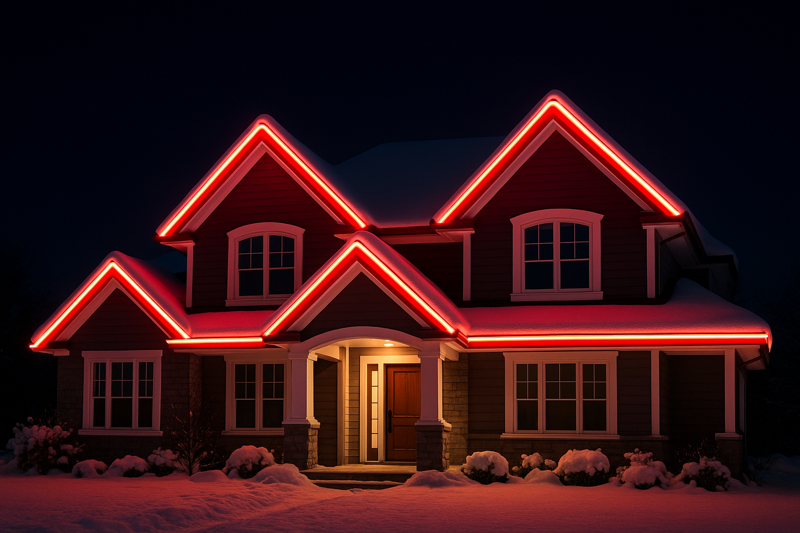
As a factory owner who supplies lighting for massive commercial projects in Singapore and North America, I have seen the market shift. The era of the $20 big-box store light string is ending for high-end properties. Contractors like you are now installing what we call "Digital Decor." This isn’t just lighting; it’s a programmable show. By using the technologies I manufacture, such as high-density COB strips and addressable IC chips, you can offer Tom’s clients something their neighbors can’t buy: a custom, animated light show that is built to last for a decade, not just a season. Let’s look at how you can dominate this profitable niche.
Why Are "Magic Color" RGB+IC Strips the Only Choice for Modern Holiday Displays?
Standard RGB lights are boring. They can only show one solid color at a time. To create a true "display," you need movement, flow, and complex patterns that mesmerizingly capture attention.
You must use Addressable RGB+IC strips (often called "Magic Color" or "Pixel" tape). These strips have intelligent chips that control creating stunning effects like flowing water, falling snow, or chasing colors, which are impossible with standard LEDs.

This technology is the difference between a "lit house" and a "light show." In my factory, we produce the HC-Series (like the HC-12-24-S06120-RGB+IC), which is specifically designed for this. With a standard strip, if you turn it red, the whole 16 feet is red. With RGB+IC, you can make the first foot red, the second foot green, and the third foot white, and then make them "chase" each other around the roof. For a client paying thousands of dollars, this is the "wow" factor they demand. It allows you to program a "Candy Cane" mode (Red-White-Red moving) or a "Frozen" mode (Ice Blue and White twinkling). You become a lighting artist, not just an installer.
The Tech Behind the Magic
To sell this to a skeptical client (or to understand why it costs more), you need to know what is happening under the silicone.
1. The Power of the "IC" (Integrated Circuit1)
In a standard "Analog" LED strip, the electricity flows through the whole copper board equally. It’s safe, but dumb. In a "Digital" Addressable strip, we solder a tiny microchip (the IC, usually utilizing protocols like UCS2904 or WS2811) onto the PCB every few inches.
- Pixel Control: This chip acts as a gatekeeper. It listens for data commands from your controller. You can tell Pixel to be Red and Pixel to be Off. This is how you get the "Falling Snow" effect where a drop of light seems to fall from the roof line.
- The Resolution: We measure this in "Pixels per Meter2." A strip with 60 LEDs per meter but only 10 Pixels per meter means every 6 LEDs act as one group. For architectural rooflines, this is perfect. It reduces the data load while still looking smooth from the street.
2. The 24V Advantage3 for Large Displays
Most cheap holiday lights are 5V or 12V. This is a nightmare for a house-sized display.
- Voltage Drop: If you run a 12V addressable strip for more than 15 feet, the end will turn pinkish-orange because it’s not getting enough power. You have to inject power wires everywhere, which looks messy.
- The 24V Solution: Our professional HC-12-24 series uses 24 Volts. You can run 30 to 50 feet of continuously moving, bright light on a single power connection. This saves you hours of labor hiding wires.
3. Safety and Reliability
High-end "Magic" strips use a "Break-point Resume4" function (often WS2818 or similar backup chips). In cheap strips, if one chip dies, the rest of the strip goes dark. It ruins the show. In our professional series, the data has a backup path. If one LED burns out, the signal skips it and keeps the rest of the roof lit. That means no emergency service calls on Christmas Day.
| Feature | Standard Holiday String | Professional RGB+IC Strip | Benefit for Your Business |
|---|---|---|---|
| Visual Effect | Blinking or Static | Chasing, Flowing, Custom Patterns | Justifies a 3x higher price point to the homeowner. |
| Voltage | 120V (Dangerous) or 12V | 24V DC (Safe & Efficient) | safer installation; longer runs with less wiring labor. |
| Control | Simple Timer | App-Controlled / Music Sync | Client can change themes from their phone instantly. |
| Reliability | One bulb out = strand out | Breakpoint Resume Backup | Prevents system failure if a single component breaks. |
How Do You Ensure Your Display Survives Deep Freeze and Heavy Snow?
North American winters are brutal. Standard PVC plastic strips become brittle and crack when the temperature drops below freezing. Once the cracks appear, water gets in, and the lights die.
You must use IP67 or IP68 rated LED Neon Flex made with pure Food-Grade Silicone extrusion. Silicone remains flexible and crack-proof down to -40°F, ensuring the electronics stay dry and functional even when buried under ice.
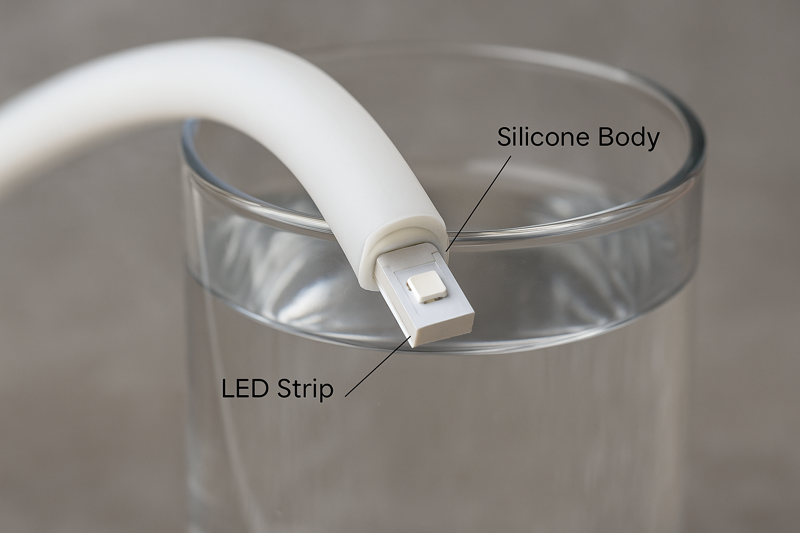
I tell all my US clients: "PVC is for indoors; Silicone is for outdoors." It is that simple. In my factory, we use a co-extrusion process where the LED strip and the liquid silicone are molded together instantly. This leaves no air gaps for condensation to form. This "Solid Silicone" technology creates a light that is virtually indestructible by weather. It resists the UV rays from the sun in the summer (so it doesn’t turn yellow) and stays soft in the winter. For Tom, this is the ultimate insurance policy. You install it once, and it works for years.
Weatherproofing Wisdom
Water is the enemy of electronics. In the outdoor lighting industry, we fight water with three layers of defense.
Layer 1: The Material Science (PVC vs. Silicone)
- PVC (Polyvinyl Chloride): This is what cheap garden hoses are made of. In the summer heat, it expands. In the winter cold, it shrinks and hardens. This constant movement tears the delicate copper circuits inside the LED strip. It also yellows very quickly under UV light, making your beautiful blue Christmas lights look dirty green.
- Silicone: This material is inert. It does not react to UV light. Most importantly, its thermal expansion coefficient is very stable. It won’t snap in a Chicago winter or melt in a Texas summer. We use Food Grade silicone, which has high light transmission, so your colors stay vivid and bright.
Layer 2: The Ingress Protection (IP) Rating
You see these numbers on boxes, but they mean specific things.
- IP65 (Splash Proof): Good for a kitchen, bad for a roof. It usually means a thin layer of epoxy on top. This epoxy will crack in the sun after 6 months.
- IP67 (Immersion): This is the minimum standard for your business. It means the strip is inside a hollow silicone tube. It’s good, but condensation can sometimes form inside the tube if the end caps aren’t perfect.
- IP68 (Solid Extrusion)5: This is the gold standard. We inject silicone around every single component. There is no air inside. You could put this strip in a swimming pool. For a Christmas display that might get covered in melting snow, this is what you want.
Layer 3: The Weakest Link (Connectors)
The strip itself is waterproof, but the connection points are not. This is where 90% of failures happen. You must use waterproof screw-connectors6 (like xConnect or Ray Wu pigtails) that have O-rings. Never, ever use "clip-on" connectors for outdoor displays. They will corrode in weeks. Always solder your connections and seal them with adhesive-lined heat shrink tubing. It takes 5 minutes longer, but it saves you a trip back to the job site.
| Environment Factor | The Failure Mode | The Professional Fix |
|---|---|---|
| Extreme Cold | PVC jacket cracks; water enters. | Pure Silicone Extrusion (stays flexible). |
| UV Sunlight | Lens turns yellow; light gets dim. | UV-Stabilized Silicone7 (stays clear). |
| Ice/Snow Melt | Water shorts out the connection. | IP68 Rating + Heat Shrink Connections. |
| Wind | Adhesive tape fails; lights fall. | Aluminum Mounting Channel (screwed in). |
How Can You Design a "One-Stop" System That Pays You All Year?
The problem with traditional Christmas lights is that you have to take them down in January. It is double the labor for one season of profit. What if the lights didn’t have to come down?
Install a permanent, architectural-grade system using RGBW technology. Hidden in color-matched aluminum tracks, these lights provide warm white security lighting for 11 months and switch to dazzling holiday colors for December, giving you a recurring revenue model without recurring labor.
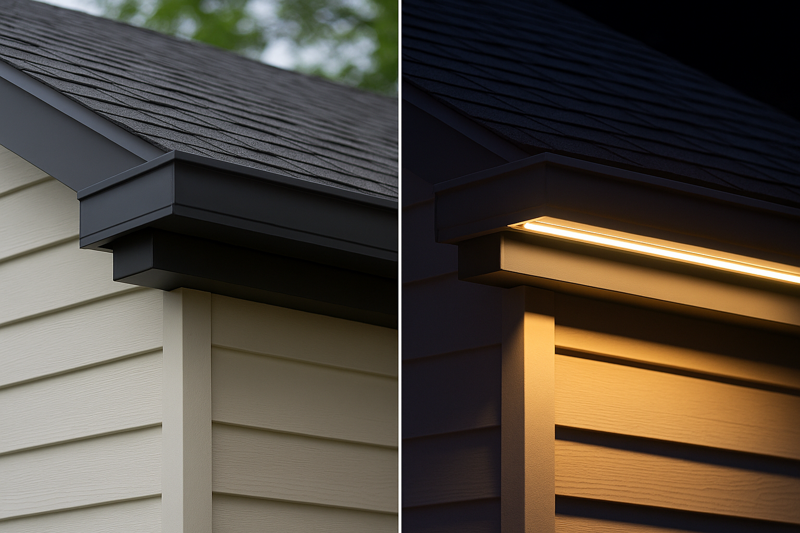
This is the holy grail for a business like yours. We call it "Permanent Holiday Lighting," and it is exploding in the US. By using an RGBW strip (Red, Green, Blue, + dedicated White), you solve the biggest complaint homeowners have: "I don’t want a disco house all year." With the dedicated White diode (3000K), the system looks like elegant, high-end landscape lighting for parties and security. Then, simply by changing the mode on the app, it becomes a Christmas display. You sell the system once, install it once, and then offer a small annual "maintenance subscription" to check the power supplies and update the app scenes. It’s genius.
Maximizing Profit with Smart Design
To make this business model work, you have to treat the installation like a renovation, not a decoration.
The Hardware Strategy: Concealment
If the client can see the strip during the day, you have failed. You need to use our Aluminum Profile Systems8.
- The Track: We manufacture aluminum tracks that mount directly to the soffit (the underside of the roof overhang), facing down.
- The Paint: You must offer color-matched tracks (White, Black, Brown, Beige) to blend with the client’s gutters and trim. When done right, the track looks like a piece of architectural molding.
- The Diffuser: Use a smoky or milky diffuser cover. This hides the orange copper look of the circuit board when the lights are off. It makes the installation look like a finished building product, not a DIY electronics project.
The Control Strategy: The "Cloud" Upsell
Don’t just give them a remote. Give them an App.
- Wi-Fi Controllers9: Use controllers compatible with WLED or Tuya Smart Life.
- The "Service" Angle: Because these controllers are online, you can offer a "Concierge Service." You can tell Tom: "For $100 a year, we will remotely program your lights for every holiday. You don’t have to touch a thing." Valentine’s Day? You turn their house pink from your office. St. Patrick’s Day? You turn it green.
- Calendar Automation10: You can set the lights to turn on automatically at sunset 365 days a year. This creates a "Security" selling point. A well-lit house is safer. Now you aren’t just selling decorations; you are selling home security.
The Inventory Strategy: 24V RGBW is King
Stick to one main product type. My recommendation is the 5050 RGBW 4-in-111 or the addressable RGBW strip.
- Why RGBW? The "W" (White) is crucial. Creating white by mixing Red+Green+Blue results in a cold, blueish-white that looks cheap and tacky on a nice house. A dedicated 3000K White diode gives that warm, golden glow that rich clients love.
- Stock Efficiency: If you only stock this one type of premium strip, you eliminate waste. You can use the off-cuts from a Christmas job for a kitchen cabinet job or a patio job in the summer. It simplifies your warehouse and your life.
| Sales Pitch | Traditional Lights | Permanent RGBW System | Why Tom Wins |
|---|---|---|---|
| Usage | 4-6 weeks / year | 365 days / year | Easier to justify the $3k-$5k investment to the homeowner. |
| Labor | Install & Remove every year | Install Once | Huge labor savings; your crews can focus on selling new jobs. |
| Aesthetics | Wires hanging everywhere | Invisible during the day | Appeals to high-end, picky HOA neighborhoods. |
| Function | Decoration only | Decor + Security + Architecture | You are solving multiple problems with one product. |
Conclusion
Stop renting your time and start selling a permanent solution. By using 24V Addressable RGB+IC strips encased in IP68 silicone, you replace the headache of cheap seasonal lights with a profitable, high-end architectural asset.
-
Understanding Integrated Circuits is crucial for grasping the technology behind advanced LED strips. ↩
-
Discover how Pixels per Meter impacts the visual quality and control of LED lighting. ↩
-
Explore the advantages of 24V systems for efficient and reliable lighting solutions. ↩
-
Learn how Break-point Resume enhances reliability in LED lighting systems, preventing failures. ↩
-
Learn about the IP68 rating, the gold standard for waterproofing, perfect for outdoor lighting solutions. ↩
-
Discover why using waterproof screw-connectors is crucial for preventing failures in outdoor lighting installations. ↩
-
Find out how UV-Stabilized Silicone keeps outdoor lights clear and functional, enhancing their longevity. ↩
-
Explore how Aluminum Profile Systems enhance aesthetics and functionality in lighting installations. ↩
-
Learn about the advantages of Wi-Fi Controllers for seamless smart lighting control and automation. ↩
-
Find out how Calendar Automation can enhance security and convenience in home lighting systems. ↩
-
Discover the versatility and quality of the 5050 RGBW 4-in-1 strip for premium lighting solutions. ↩
Interested in Our LED Solutions?
Get professional consultation and customized LED lighting solutions for your projects. Contact our expert team today.
Related Articles

How Do You Build Profitable Custom Vehicle and RV Interior LED Rope Lights?
You lose RV installation contracts because your interior lights fail on rough roads. Standard strips show bright dots on glossy…

How to Perfect Bookshelf and Display Cabinet LED Rope Lighting?
You lose retail clients when bookshelves look incredibly dark. Ugly shadows hide expensive products inside display cabinets daily. You need…

How to Master Mirror and Vanity LED Rope Light Installation?
Your clients complain about ugly shadows in their bathroom mirrors. Bad lighting ruins expensive vanity designs. You lose future contracts…
