

How Can You Decorate Your Client’s Outdoors for the Whole Year with Just One LED Strip Installation?
Your clients love the look of holiday lights, but they hate the annual hassle of hiring someone to put them up and take them down. It is expensive, creates clutter, and risks damage to their roof every single season.
The solution is a permanent, addressable RGBW LED strip system installed in color-matched aluminum channels. This setup allows your client to have elegant warm white architectural lighting daily and instantly switch to dynamic color patterns for Christmas, Halloween, or the Fourth of July with a single tap.
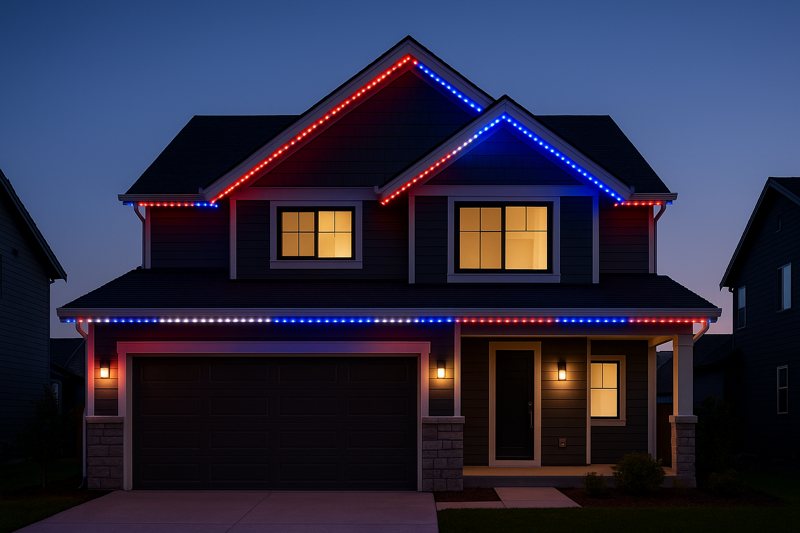
As a factory owner, I have watched this specific niche explode in North America over the last two years. It is the smartest upsell you can offer. You are not just selling "lights"; you are selling a service. You are selling the convenience of never having to climb a ladder in the freezing cold again. But to make this a true "year-round" solution, the hardware must be flawless. It cannot look like a cheap string of Christmas bulbs left up by mistake. It must appear integral to the home’s architecture. This guide will teach you the specific technology, installation methods, and control systems needed to master this high-margin category.
Why Should You Switch to Permanent Addressable RGBW Systems Instead of Seasonal Lights?
The old model of "seasonal lighting" is dying. Clients want versatility. A standard RGB strip is okay, but it can’t do the chasing patterns or multi-color effects that holiday decorating demands. So, what product handles both tasks?
You must use 24V Addressable RGBW strips (often called "Digital" or "Pixel" strips). The "W" (White) diode provides the daily architectural luxury, while the "Addressable" chips allow for the moving, multi-color animations required for festive holidays.
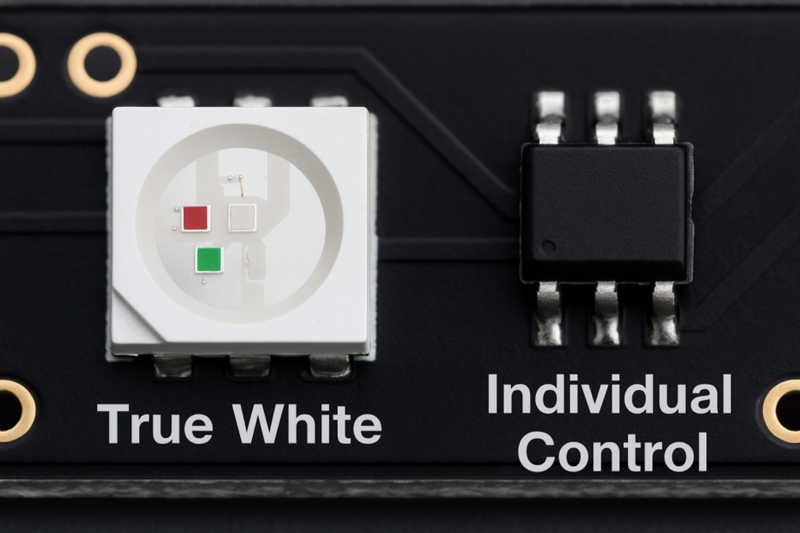
This is the secret weapon in your inventory. If you install standard RGB strips, the "white" creates a weird bluish-rainbow hue that looks cheap and tacky for daily use. Your sophisticated clients will hate it. They want a true, warm 3000K white that looks like traditional soffit lighting. But they also want the "Candy Cane" red-white-red-white chasing pattern for December. Only Addressable RGBW can do both. As a manufacturer, I see many contractors make the mistake of buying cheap 12V strips for this. Do not do that. For the long runs around a house perimeter, 24V is mandatory to prevent voltage drop and ensure the lights at the end of the roof are just as bright as the ones at the start.
The Technology Behind the "One-Time" Install
Let’s dig into the engineering that makes this system viable for a 10-year lifespan. You are asking a product to survive freezing winters and baking summers while staying permanently mounted.
First, you need to understand the chipset1. We typically use a UCS2904 or WS2814 IC chip for these 24V strips. This allows you to control groups of LEDs (usually every 6 LEDs is one "pixel" or "segment"). The magic here is the dedicated White diode. In a standard RGB strip, to make white, you mix Red, Green, and Blue. It’s inefficient and the light quality is terrible (low CRI). In an RGBW strip, the White is a separate phosphor-coated diode. When it’s July 15th and the client just wants their house to look nice, they turn on only the White channel. To the naked eye, it looks exactly like high-end landscape lighting.
Second, consider the Waterproofing2. This is where I see the most failures in the US market. For permanent outdoor installation, a simple "PU glue" (polyurethane) coating will not work. It turns yellow after one year of UV exposure, ruining the color of the light. You need a hollow silicone extrusion3 or a solid silicone injection process (IP67 or IP68). Silicone is the only material that resists UV light and maintains its transparency for five to ten years. It also stays flexible in freezing temperatures, whereas PVC or PU will crack.
Finally, let’s talk about the Voltage4. House perimeters are long—often 100 to 200 feet. If you use 12V strips, you will need to inject power every 16 feet. That means running huge copper trunk cables all over the roof. It is a nightmare. With 24V systems, you can run up to 32 or even 50 feet (with proper PCB design) on a single power feed. This cuts your installation labor in half and saves you a fortune on wire.
| Feature | Standard RGB Strip | Addressable RGBW Strip | Why It Matters for "Year-Round" Use |
|---|---|---|---|
| White Light Quality | Poor (Blueish tint) | Excellent (True Warm White) | Essential for daily implementation. Bad white light ruins the curb appeal. |
| Holiday Effects | Single color at a time | Moving patterns (Chasing) | Allows for "Candy Cane" or "Patriotic" multi-color themes on the same strip. |
| Voltage | Usually 12V | 24V Standard | Allows for longer runs around rooflines with less wiring labor. |
| Installation Type | Temporary | Permanent | Justifies a higher price point to the homeowner as a home improvement asset. |
Where Do You Hide the Strips So They Are Invisible During the Day?
The biggest objection clients have to "permanent" holiday lights is aesthetics. They do not want to see ugly wires, clips, or plastic strips hanging off their beautiful home during the day. The system needs to be invisible when off.
You must install the strips inside deep, architectural-grade aluminum channels with diffusers that mount directly to the soffit or sub-fascia. The channel should be color-matched to the trim, ensuring the light source completely disappears when not in use.
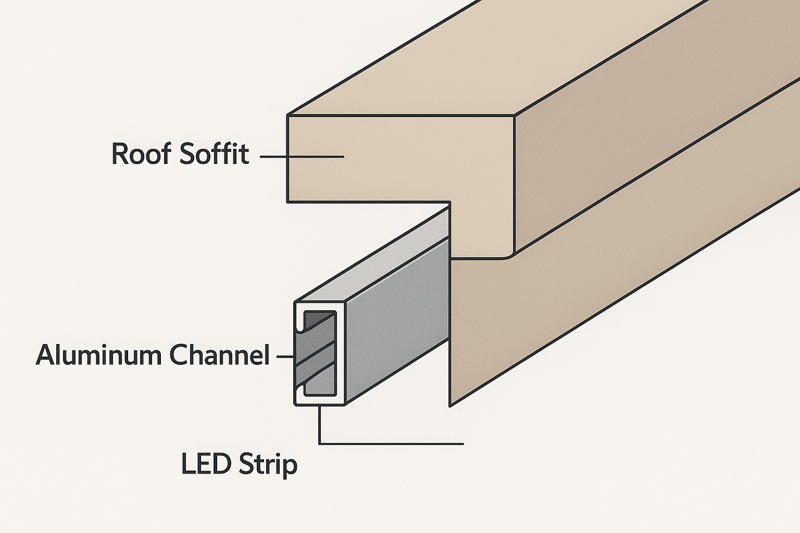
This is where the "Craftsmanship" comes into play. If you just stick the tape to the wood, it will fall off in 6 months, and it will look terrible. You need a mechanical mounting system. The aluminum channel does three things: it acts as a heat sink to extend the LED life, it holds the diffuser lens that softens the light, and it physically protects the strip from hail, birds, and squirrels. For a designer like Tom, the selling point is "Stealth." You tell the client, "You won’t even know they are there until you turn them on." That is the level of finish that commands a premium price.
The Art of the Invisible Install
If you get the mounting wrong, the whole project fails. I have supplied strips for thousands of these projects, and the difference between a happy client and a refund request is always the channel application.
The Mounting Location: The best place to mount these permanent strips is on the Soffit5, facing downward, about 2-4 inches away from the Fascia board. This technique offers two massive benefits.
- Wall Washing: By pointing the light down, you wash the exterior walls of the house with light. This creates a stunning architectural effect that increases the home’s value and curb appeal.
- Concealment: When the channel is up under the eaves, it is completely hidden from the street view. A passerby cannot see the fixture, only the light it produces.
The Diffuser Choice: You must use a Milky (Opal) Diffuser6. Do not use clear or frosted. Why? Because with LEDs, you get distinct "hot spots"—little dots of light. A milky cover blends these dots into a seamless "neon-like" bar of light. This looks much more premium. Furthermore, the milky cover helps to mask the orange copper look of the LED circuit board inside the channel during the day. It just looks like a white architectural trim piece.
Color Matching7: This is a pro tip that separates the amateurs from the experts. If the client has white trim, use a white powder-coated aluminum channel. If they have black or dark brown trim, you must spray paint the channel (or order it custom black from my factory) to match. The goal is camouflage. You can even buy spray paint that matches common vinyl siding colors. Taking the extra hour to paint the track before installation ensures the system blends perfectly.
Fastening: Never rely on the 3M adhesive tape on the back of the strip alone suitable for outdoor use. It will fail. The temperature swings cause the aluminum to expand and contract, shearing the glue. You must use the aluminum channel which is screwed into the wood or vinyl soffit. The strip sits inside the channel, and the lens cap snaps over it. This mechanical bond is permanent. For the entry and exit wires, drill small holes directly through the channel and into the soffit to hide all wiring in the attic space. No visible wires. Ever.
| Component | Amateur Mistake | Professional Solution | The Benefit for Tom |
|---|---|---|---|
| Channel Profile | Shallow, surface mount | Deep, 45-degree or J-channel | Better light cut-off and cleaner wall-washing effect. |
| Lens Cover | Clear/Transparent | Milky/Opal | Eliminates pixelation ("dots") and hides the electronics during the day. |
| Mounting | Adhesive tape only | Screwed Aluminum Track8 | Guarantees the system will never sag or fall down, reducing callback costs. |
| Wire Management | Wires stapled to exterior | Wires hidden in attic/soffit | A specialized, neat finish that justifies a high installation fee. |
How Do Smart Controls Manage the "Year-Round" Aspect?
You have the right lights and the right mounting. Now, how does the client actually use them? If it’s hard to use, they won’t use it. The controller is the brain of the operation.
Utilize a Wi-Fi/Bluetooth SPI controller compatible with an intuitive app (like WLED or Tuya). This allows clients to schedule automatic changes: warm white for weekdays, team colors for Game Day, and animated themes for holidays, all without lifting a finger.
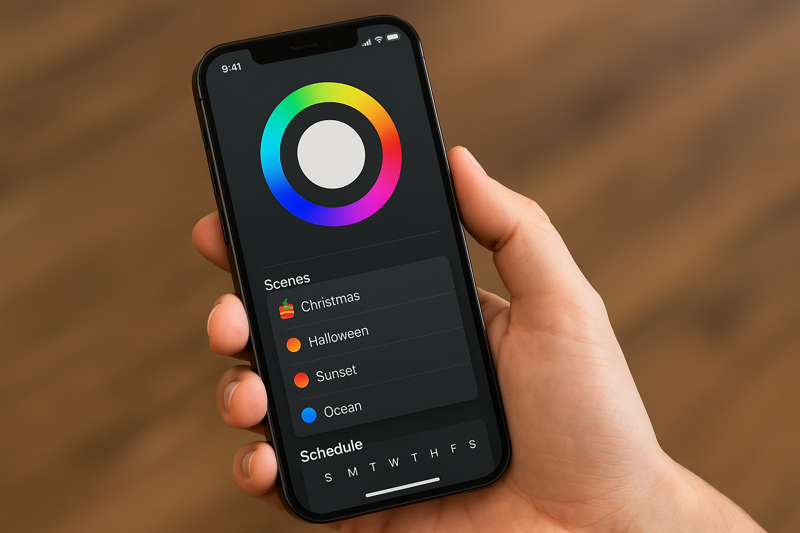
This is the "closer" for the sale. You are selling automation. The client is busy; they are Tom’s age or older, and they don’t want to fiddle with switches. They want "Set it and Forget it." With the modern SPI (Serial Peripheral Interface) controllers we manufacture, the lighting becomes part of their lifestyle. Imagine this pitch: "Mr. Client, I can program your house to automatically turn bright white at sunset for security. Then, heavily dim to a soft gold at 10 PM for ambiance. And on December 1st, it will automatically switch to a slow-moving red and green pattern. You don’t have to do anything." That is powerful.
Mastering the Control Protocol
For a technical buyer like Tom, understanding the "Brain" is crucial. We are moving beyond simple "On/Off" switches. We are dealing with data.
The Protocol (SPI vs. DMX):
For residential projects, SPI is the winner. It communicates directly with the IC chips (WS2811/UCS2904) on your strip. It requires fewer wires than DMX and is much easier to set up. DMX is great for massive commercial stages, but for a home, it’s overkill and too expensive.
A good SPI controller connects to the home’s Wi-Fi network. This allows "Cloud Control," meaning the client can turn on their Christmas lights from their office or vacation home to make the house look occupied.
The App Ecosystem:
You should choose controllers that run on established platforms.
- WLED: This is an open-source favorite among tech-savvy installers. It has hundreds of pre-built effects (fireworks, meteor showers, breathing). It is incredibly stable and free, but the interface can be a bit "techy" for an older homeowner.
- Tuya / Smart Life: These are the most consumer-friendly. The interface is simple, looking just like their thermostat or doorbell app. It integrates seamlessly with Amazon Alexa and Google Home. This is a huge selling point. Being able to say, "Alexa, turn the house to Party Mode" is a feature that clients love to show off to their neighbors.
Zoning and Power Injection:
The controller can’t power the whole house alone. It sends the signal. You need to plan the power distribution.
- Data Signal: This travels from the controller to the first LED, then to the second, and so on. It’s a daisy chain. If you have a gap between roof sections (like from the first floor to the second floor), you need to run a "Data Jumper" wire.
- Amplifiers: If the run is super long (over 200 pixels), the data signal might degrade. You may need a signal amplifier, or simply a controller with multiple output ports (Port 1 for the Garage, Port 2 for the main roof).
- The "GND" (Ground) Rule: This is a technical tip that will save you hours of troubleshooting. Ensure the DC ground of your power supply and the Ground of your controller are connected. If they aren’t, the data signal has no reference, and your lights will flicker uncontrollably. We call this a "floating ground," and it’s the reason for erratic behavior in addressable LEDs.
| Feature | Basic Controller | Pro SPI Controller | Why Tom Needs the Pro Version |
|---|---|---|---|
| Connectivity | IR Remote (Line of sight) | Wi-Fi + Bluetooth | Control from anywhere; no need to point a remote at a box in the garage. |
| Smart Home | None | Alexa / Google Assistant | Voice control is a standard expectation in modern luxury homes. |
| Effect Library | 10-12 static colors | 100+ Dynamic Scenes | The ability to customize specific holiday patterns is the core product value. |
| Music Sync | Poor (built-in mic) | Software-based Sync | Allows lights to dance to music for parties, creating a total entertainment experience. |
Conclusion
Year-round outdoor decorating is not about hanging lights; it is about installing a permanent intelligent system. By using 24V addressable RGBW strips in concealed aluminum channels, you provide unmatched value: daily beauty, holiday magic, and zero maintenance.
-
Understanding the right chipset can enhance your LED lighting experience and ensure longevity. ↩
-
Learn effective waterproofing techniques to protect your LED strips from weather damage. ↩
-
Explore how hollow silicone extrusion can improve the durability and performance of your LED installations. ↩
-
Discover the benefits of 24V systems for longer runs and reduced installation hassle. ↩
-
Explore this link to learn optimal soffit mounting techniques for lighting, enhancing both aesthetics and functionality. ↩
-
Discover why milky diffusers are essential for achieving a seamless lighting effect and improving overall appearance. ↩
-
Find expert tips on color matching for LED installations to ensure a flawless and professional finish. ↩
-
Learn about the advantages of using a screwed aluminum track for lighting installations, ensuring durability and reliability. ↩
Interested in Our LED Solutions?
Get professional consultation and customized LED lighting solutions for your projects. Contact our expert team today.
Related Articles

How Do You Build Profitable Custom Vehicle and RV Interior LED Rope Lights?
You lose RV installation contracts because your interior lights fail on rough roads. Standard strips show bright dots on glossy…

How to Perfect Bookshelf and Display Cabinet LED Rope Lighting?
You lose retail clients when bookshelves look incredibly dark. Ugly shadows hide expensive products inside display cabinets daily. You need…

How to Master Mirror and Vanity LED Rope Light Installation?
Your clients complain about ugly shadows in their bathroom mirrors. Bad lighting ruins expensive vanity designs. You lose future contracts…
