

How Do You Choose the Best Outdoor LED Strip Lights for 2025?
Your beautiful outdoor lighting project looks fantastic, until the first winter hits. Now, half the strip is yellowed, cracked, or completely dead from moisture and sun damage, making you look unreliable.
The best outdoor LED strips for 2025 combine a truly weatherproof IP67 or IP68 rating with a durable, UV-resistant silicone coating. They must also offer high brightness, proven color consistency, and verified safety certifications like UL Listing.
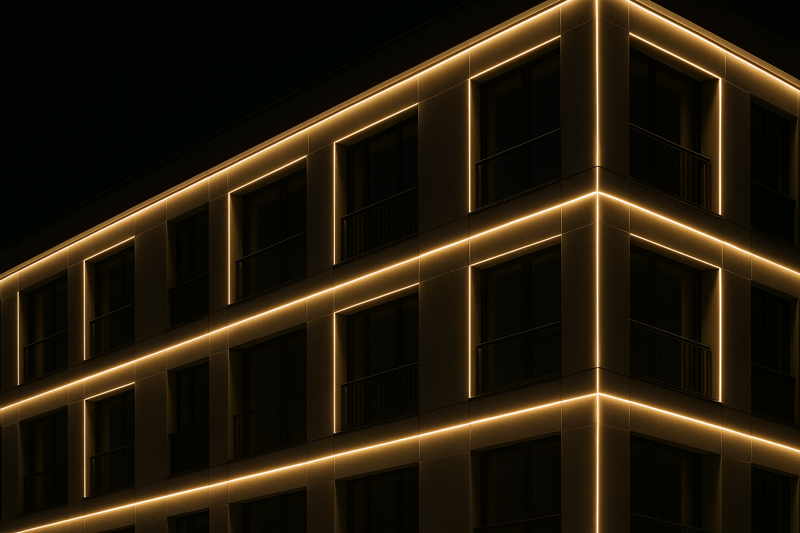
As a factory that engineers these products, I’ve seen exactly what causes an outdoor LED strip to fail. It’s almost never just one thing. It’s the slow, combined attack of water, sunlight, and temperature extremes. Choosing the "best" isn’t about finding the brightest or cheapest option; it’s about selecting a complete system designed to win that battle for years.
What IP Rating is Truly ‘Weatherproof’ for Outdoor Use?
You see IP65, IP67, and IP68 ratings on product sheets. The numbers all sound high, but choosing the wrong one means your expensive installation will inevitably fail from water getting inside.
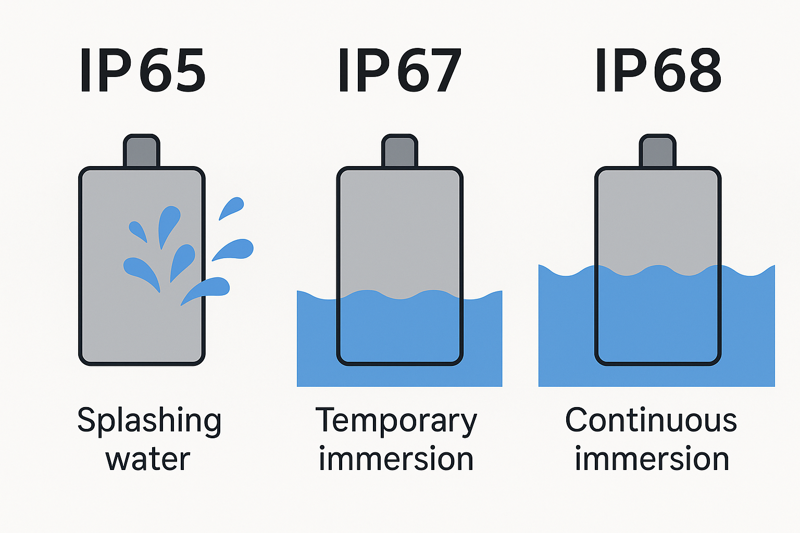
For most professional outdoor installations, IP67 is the reliable standard. It guarantees protection from dust and temporary water submersion. IP65 is not sufficient for ground-level use, while IP68 is only for permanent underwater applications.
I constantly have to explain this to clients. Some think IP65 is "good enough" to save money, but I’ve seen the expensive results. When a strip is installed on a deck or patio where water can pool, even for a few minutes during a heavy downpour, IP65 will fail. IP67 is the minimum level of protection I would ever put my name on for a serious outdoor project.
Decoding Ingress Protection
"IP" stands for Ingress Protection, and the two numbers tell a specific story.
Breaking Down the Numbers
The first digit rates protection against solid objects (like dust), and the second digit rates protection against liquids (water).
- First Digit (6): This means the product is completely "dust-tight1." For outdoor use, you should never consider anything less than a 6.
- Second Digit (5, 7, 8): This is where the real difference is.
- 5 (IP65): Protects against water jets from any angle. Think of it as "splash-proof." It’s okay for a vertical wall that gets rain, but not for flat surfaces.
- 7 (IP672): Protects against temporary immersion in water (up to 1 meter for 30 minutes). This is the key. It can handle puddles, melting snow, and heavy storms. This is your professional baseline.
- 8 (IP68): Protects against continuous, long-term submersion under pressure. This is specifically for pools, ponds, and fountains. It’s overkill for anything else.
| IP Rating | Protection Level | Best Application |
|---|---|---|
| IP65 | Water Jets / Splash-Proof | Vertical surfaces, under deep eaves. Risky for ground use. |
| IP67 | Temporary Immersion | Patios, decks, pathways, landscape borders. The pro standard. |
| IP68 | Continuous Submersion | Pools, fountains, underwater features. |
How Do Silicone and PU Coatings Affect Long-Term Durability?
You installed a crystal-clear outdoor LED strip. One year later, it’s a disgusting yellow-brown color, it’s hard as a rock, and it’s starting to crack and peel away from the LEDs, exposing them to the elements.
High-quality outdoor strips use a silicone extrusion or coating. Silicone is inherently UV-resistant, so it won’t yellow or crack. Cheaper epoxy or polyurethane (PU) coatings will rapidly degrade under sun exposure, leading to failure.
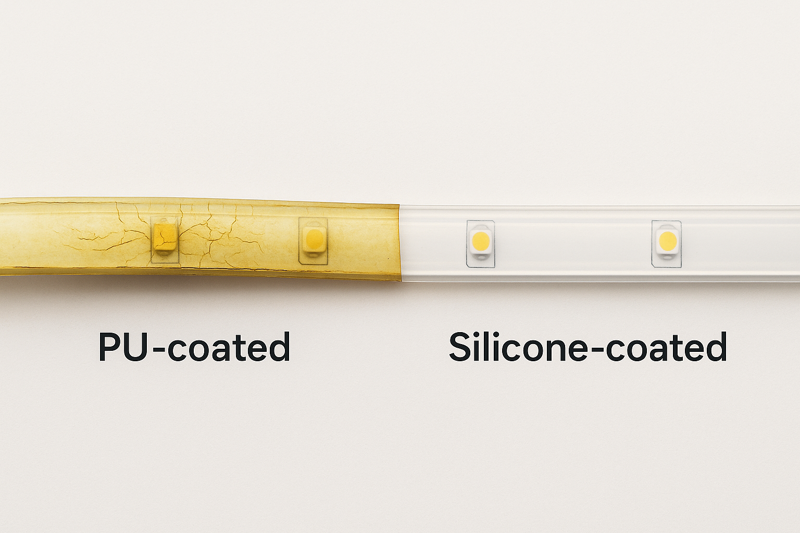
In our factory’s R&D lab, we run accelerated aging tests on these materials. The results are not subtle. After just a few hundred hours under intense UV lamps, the epoxy and PU strips look a decade old. The silicone strips look brand new. For a client like Tom who needs to protect his reputation, specifying a silicone-encased product is a simple way to guarantee durability.
The Battle Against the Sun
The material used to achieve the IP rating is just as important as the rating itself.
The Silicone Advantage
Silicone3 is a highly stable material. Its molecular structure is not easily broken down by ultraviolet (UV) radiation from the sun. This means it remains optically clear and flexible for years. It also handles extreme temperature swings, staying pliable in freezing cold and stable in desert heat. This flexibility prevents the waterproof seal from breaking as the strip expands and contracts with temperature.
The Problem with Epoxy and PU
Epoxy and polyurethane are organic plastics. UV radiation shatters their chemical bonds. This process, called photodegradation4, is why they turn yellow. As the material breaks down, it loses its flexibility and becomes brittle. It then shrinks and cracks, pulling away from the circuit board and creating pathways for water to enter. The IP rating becomes meaningless because the protective shell has failed.
| Material | UV Resistance | Temperature Flexibility | Long-Term Clarity |
|---|---|---|---|
| Epoxy/PU | Poor | Poor (Becomes Brittle) | Poor (Yellows) |
| Silicone | Excellent | Excellent | Excellent |
What Makes an Outdoor LED Strip Bright and Color-Consistent?
You install a 60-foot run of LED strip lighting along a building’s edge. You step back to admire your work, but your heart sinks. The start of the strip is a clean white, the middle has a greenish tint, and the end is dim and yellowish.
To ensure consistent brightness and color, you need two things. First, use a 24V strip for any long run to minimize voltage drop. Second, demand strips that use LEDs from a tight bin, like a 3-Step MacAdam ellipse, to guarantee uniform color.
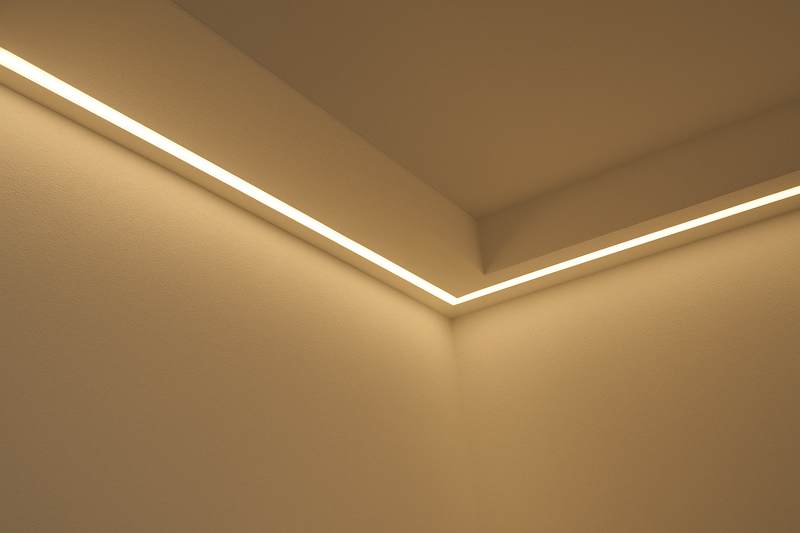
This is a technical point that separates the pros from the amateurs. When a client reports this issue to me, it’s almost always one of these two factors. As a manufacturer, we control the LED binning process tightly. Providing a 24V option is standard for professional-grade products. A supplier who cannot speak confidently about both of these is not one you should trust for a large project.
The Science of Uniform Light
Getting a long run of light to look perfect is not an accident.
Battling Voltage Drop5
Voltage drop is a law of physics. As electricity travels along a wire or a long PCB, it loses energy. In a 12V system, this loss is very noticeable after about 16 feet (5 meters), causing the LEDs at the far end to be dim and appear warmer in color. A 24V system pushes half the current for the same amount of power, which dramatically reduces this energy loss. For long outdoor runs, 24V isn’t just an option; it’s a requirement.
The Secret to Perfect Color: LED Binning
No two LEDs are manufactured with the exact same color. "Binning" is the process of sorting LEDs by their precise color temperature and tint after production. The tightest, most expensive bins (like a 3-Step MacAdam ellipse) contain LEDs that are virtually indistinguishable to the human eye. Cheaper strips use LEDs from a huge range of bins, resulting in the visible color shifts that look so unprofessional.
| Quality Factor | Poor Quality Strip | Professional Grade Strip |
|---|---|---|
| Voltage | 12V Only | 12V and 24V Options |
| LED Binning6 | Wide Bin / No Specification | 3-Step MacAdam Ellipse |
| Result | Dimming & Color Shift on long runs | Consistent Brightness and Color Purity |
Why are Certifications Like UL Listing Critical for Outdoor Projects?
A potential supplier offers you an amazing price on an outdoor power supply. When you ask for the UL certificate, they send you a blurry document that seems suspicious. You know that installing uncertified equipment is a huge liability.
Safety certifications from a respected lab like UL or ETL are non-negotiable. They are independent proof that a product has been tested to survive electrical faults, resist water ingress properly, and not become a fire hazard. It protects you from liability.
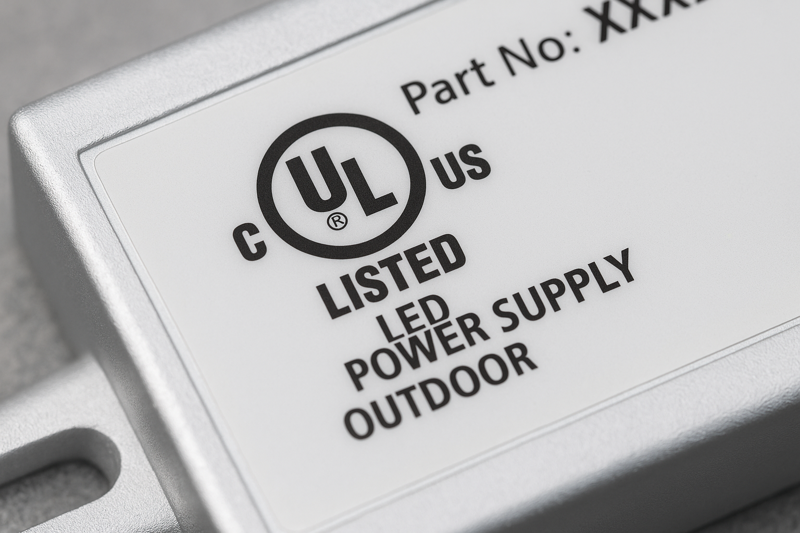
This is a major pain point I hear from clients like Tom, who have been burned by falsified certificates. I tell them that UL Listing is not just a sticker; it’s a legal and safety standard. Using a non-listed power supply or strip could void a property’s insurance and make you personally liable in the case of a fire or electrical shock. It’s a risk that no professional should ever take.
Proof of Safety and Quality
A certification is an investment in peace of mind.
What UL Testing Actually Covers
For an outdoor LED product to earn a UL mark7, it undergoes brutal testing that mimics real-world conditions. Testers will intentionally short-circuit the product to ensure it fails safely. They subject it to high-voltage surges. They run it for thousands of hours in heat and humidity chambers. For outdoor products, they perform extensive water spray and submersion tests to verify the IP rating is real. It’s a rigorous process designed to find any potential weakness before the product gets to your job site.
How to Verify a Certification
Never trust a PDF from a salesperson. Every legitimate UL or ETL certification is publicly searchable. You can go to the UL Product iQ™ database8 online and enter the product’s model number or the company’s file number (which should be printed on the product). If you can’t find it in the database, the product is not certified. It’s that simple. This five-minute check can save you from a massive headache.
| Product Status | Fire/Safety Risk | Liability Risk for Installer | Insurance Compliance |
|---|---|---|---|
| No Certification | High | High | No |
| Unverifiable Certificate | Unknown / High | High | No |
| Verified UL/ETL Listed | Tested / Low | Low | Yes |
Conclusion
Choosing the best outdoor strip for 2025 means looking past simple specs. Demand a complete system: a verified IP67 rating, a durable silicone body, a 24V option for consistency, and legitimate safety certifications.
-
Exploring the concept of dust-tight protection helps you choose the right products for outdoor use, ensuring they remain functional in dusty conditions. ↩
-
Understanding IP67 is crucial for selecting devices that can withstand temporary water immersion, ensuring durability in various environments. ↩
-
Explore the advantages of silicone, including its UV resistance and flexibility, which make it ideal for long-lasting applications. ↩
-
Understanding photodegradation is crucial for selecting materials that withstand UV exposure, ensuring durability and performance. ↩
-
Understanding voltage drop is crucial for optimizing LED performance and ensuring consistent brightness over long distances. ↩
-
Exploring LED binning helps you grasp how color consistency is achieved in lighting, enhancing your project’s quality. ↩
-
Understanding the significance of a UL mark can help you ensure the safety and reliability of your products. ↩
-
Exploring the UL Product iQ™ database can empower you to verify product certifications and avoid potential risks. ↩
Interested in Our LED Solutions?
Get professional consultation and customized LED lighting solutions for your projects. Contact our expert team today.
Related Articles

How Do You Build Profitable Custom Vehicle and RV Interior LED Rope Lights?
You lose RV installation contracts because your interior lights fail on rough roads. Standard strips show bright dots on glossy…

How to Perfect Bookshelf and Display Cabinet LED Rope Lighting?
You lose retail clients when bookshelves look incredibly dark. Ugly shadows hide expensive products inside display cabinets daily. You need…

How to Master Mirror and Vanity LED Rope Light Installation?
Your clients complain about ugly shadows in their bathroom mirrors. Bad lighting ruins expensive vanity designs. You lose future contracts…
