

How Do You Choose the Right Smart Control for Outdoor LED Strip Lights?
Your client wants their new landscape lighting to change colors with a tap on their phone. They want to schedule it, sync it with music, and have it work with their Alexa or Google Home. You’re faced with a dizzying array of options—WiFi, Bluetooth, Tuya, Zigbee. Choosing the wrong system means an unhappy client with an unreliable app and a lighting system that doesn’t integrate as promised.
To choose the right smart control, first determine the required control ecosystem (e.g., Tuya/Smart Life, a brand-specific app, or a professional system like Zigbee/DALI). Then, select a high-quality IP67/IP68 weatherproof LED strip and a compatible controller rated for outdoor use that supports the chosen ecosystem.
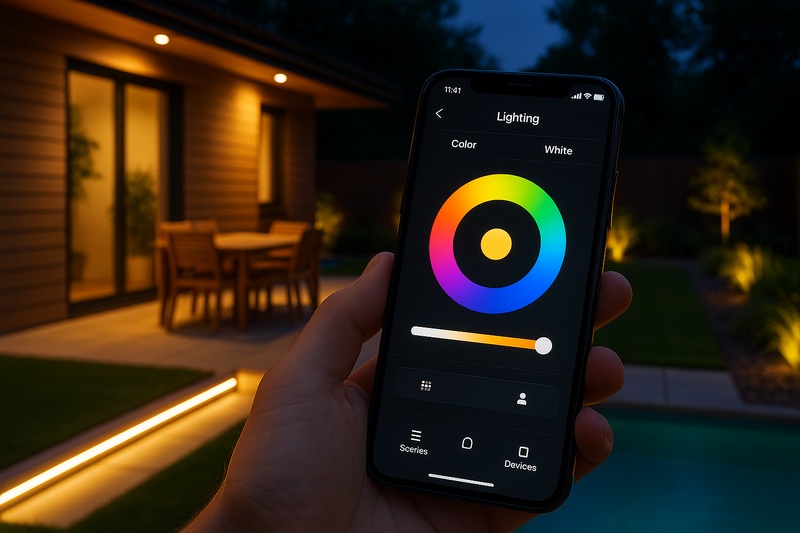
As a manufacturer providing complete lighting solutions, I’ve seen firsthand how "smart" technology can be both a powerful feature and a major headache. The strip light itself is only half the equation; the reliability of the control hardware and the user-friendliness of the software are what truly determine the success of a smart lighting project. Many buyers, even seasoned professionals like Tom, get lost in the sea of app names and logos. The secret is to ignore the marketing and focus on the underlying control protocol. This guide will demystify the technologies so you can select a robust, reliable, and user-friendly smart lighting system for any exterior project.
What is the Most Common and Versatile Smart Control System?
You need a reliable, widely supported smart solution that works for most residential and light commercial projects. You don’t have the time or budget for a complex, custom-programmed system, but you need it to work flawlessly with voice assistants and have a solid, proven app.
The Tuya platform, used by apps like "Smart Life" and "Tuya Smart," is the most versatile and widely adopted ecosystem. It uses WiFi-based controllers, offers extensive features, and natively integrates with Amazon Alexa, Google Assistant, and IFTTT, making it the go-to choice for most projects.
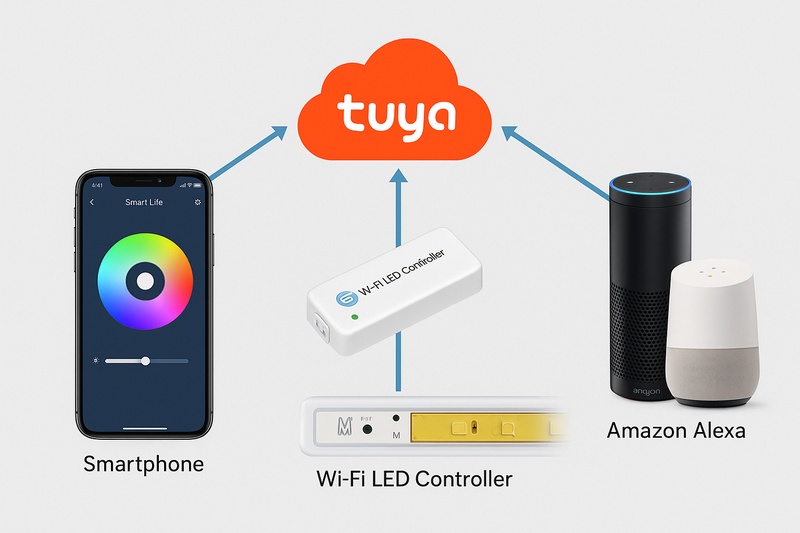
When clients ask me for a straightforward "app-controlled" solution, nine times out of ten, Tuya is the answer. It’s not a brand, but a massive IoT (Internet of Things) platform that hundreds of factories, including mine, use to make their products "smart." The advantage is immense. All these products, from light bulbs to power outlets to LED controllers, can all be controlled from one app—usually "Smart Life." This means your client doesn’t need ten different apps to run their home. For a contractor or installer, it means you’re providing a solution that is already part of a huge, stable, and feature-rich ecosystem. It’s the de facto standard for consumer and prosumer smart home control.
A Deeper Dive into the Tuya / Smart Life Ecosystem
Let’s break down why this platform is so dominant and what you need to specify to build a reliable system with it.
-
The Technology: WiFi1 is Key
The foundation of Tuya is WiFi. The LED controller you use will connect directly to the client’s home or business 2.4GHz WiFi network. This is its biggest strength and its main consideration.- Pro: No central hub or gateway is needed. Each controller is independent. This makes installation simple and cost-effective.
- Con: It relies on a good WiFi signal. For large outdoor projects, you must ensure strong WiFi coverage reaches the location of every controller. You may need to plan for WiFi mesh extenders as part of the project scope.
-
The Hardware: The Outdoor-Rated WiFi Controller
This is the brain of the system. You cannot use an indoor controller in a plastic box outside; condensation and temperature swings will destroy it. You must specify a dedicated outdoor WiFi LED controller.- Waterproofing: Look for an IP67-rated controller2. The case should be fully sealed with waterproof pigtails for all connections (power in, power out to the strip).
- Compatibility: Ensure the controller matches your LED strip. If you have an RGBW strip, you need a 5-channel (R, G, B, W, V+) controller. If it’s a Tunable White (CCT) strip, you need a 3-channel (WW, CW, V+) controller. Voltage must also match (e.g., 24V).
-
The Software: App Features and Voice Control
The beauty of the Tuya platform is the powerful, pre-built software experience.- Core Features: The Smart Life app3 provides color wheel selection, brightness control, CCT tuning, preset static colors, and dynamic scenes (like "fade" or "strobe").
- Automation: This is what makes it "smart." You can set schedules (e.g., turn on at sunset, turn off at 11 PM), create timers, and build "tap-to-run" automation routines4.
- Vast Integration: It seamlessly connects to Amazon Alexa and Google Assistant for powerful voice control5. It also works with IFTTT (If This Then That), allowing for complex automation linked to other services (e.g., "If my Ring doorbell detects motion, turn the front yard lights red").
| Aspect | Tuya / Smart Life (WiFi) | Core Benefit for Professionals |
|---|---|---|
| Technology | WiFi (2.4GHz) direct to router | Simple setup, no central hub required. |
| Hardware | Requires an IP67-rated, strip-compatible WiFi controller. | Must ensure hardware is weatherproof and matched to the LED strip. |
| Software | "Smart Life" or "Tuya Smart" app | Mature, feature-rich app with scheduling, scenes, and automation. |
| Integration | Alexa, Google Assistant, IFTTT | Delivers the voice control and smart home features clients demand. |
What if WiFi is Unreliable or the Project is Too Large?
You’re designing the lighting for a large estate, a hotel campus, or a commercial park. The distances are vast, and relying on a homeowner-grade WiFi network to control dozens of fixtures is a recipe for disaster. You need a rock-solid, professional-grade communication system.
For large-scale or mission-critical projects, a mesh network protocol like Zigbee is the superior choice. Zigbee controllers create their own robust network, independent of WiFi, ensuring instantaneous and reliable communication over long distances.
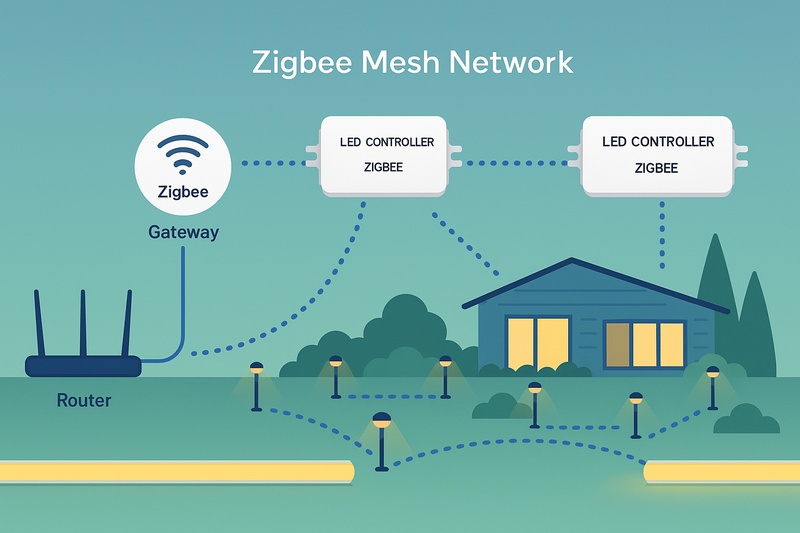
While WiFi is great for simplicity, it has limitations. Every device fighting for bandwidth on a single router can lead to lag and dropped signals, especially outdoors. Zigbee was built from the ground up for professional automation. It’s a low-power mesh protocol. This means each Zigbee device (like an LED controller) can talk to other devices. They act as repeaters, extending the network’s range and reliability. If one controller can’t talk directly to the main hub, it will relay the message through a closer controller. This self-healing network is incredibly robust and is the standard for serious, large-scale smart lighting installations where failure is not an option.
A Deeper Dive into Zigbee6 and Other Professional Systems
Let’s explore why mesh networks are the professional’s choice for complex jobs.
-
The Technology: Zigbee Mesh vs. Bluetooth Mesh7
Both are mesh technologies, but Zigbee has a longer history and wider adoption in professional lighting control.- Zigbee: Requires a dedicated Zigbee Gateway8 or Hub (like a Philips Hue Bridge, an Amazon Echo with a built-in hub, or a dedicated Tuya Zigbee Hub) that plugs into the router. This gateway creates the private Zigbee network. Its range and reliability are excellent for lighting control.
- Bluetooth Mesh: A newer player. It also creates a mesh network but often relies on your phone as the primary control point when you are in range. Some systems use Bluetooth-to-WiFi gateways for remote access. It’s great for smaller, self-contained areas where WiFi is poor, but Zigbee is generally considered more robust for whole-property systems.
-
The Hardware: Gateways and Mesh Controllers
A Zigbee system has two key hardware components.- The Gateway: This is the bridge between the Zigbee network and the internet/your WiFi network. You only need one per project. It connects to the router with an ethernet cable.
- The Controllers: You’ll use IP67-rated Zigbee LED controllers9. They look identical to their WiFi counterparts but have Zigbee radios inside. You’ll pair each controller to your gateway through the app, and they will automatically begin forming the mesh network.
-
The Professional Advantage: Speed and Reliability
The difference in performance is noticeable.- Instant Response10: Because the commands don’t have to travel through a congested WiFi network, Zigbee lighting responds almost instantly to app or voice commands.
- Scalability11: You can have dozens (or even hundreds) of devices on a single Zigbee network without performance degradation. For large commercial projects, this is essential.
- Independence: The lighting network operates independently. Even if the home’s WiFi goes down, the internal schedules and automations programmed into the Zigbee system will continue to run without interruption.
| Protocol | How it Works | Best For | Pro / Con |
|---|---|---|---|
| WiFi | Each controller connects directly to the router. | Small to medium residential projects with good WiFi coverage. | Pro: Simple, no hub. Con: Relies on WiFi quality, can have lag. |
| Zigbee | Controllers form a mesh network via a dedicated Gateway. | Large residential, commercial, and mission-critical projects. | Pro: Extremely reliable, fast, and scalable. Con: Requires a gateway. |
| Bluetooth | Controllers form a mesh network, often controlled by phone. | Standalone areas (e.g., a detached shed or gazebo) without WiFi. | Pro: Works without WiFi. Con: Remote access can be complex. |
What About Simple, Direct Control Options?
Your client is completely non-technical. They find apps confusing and don’t use voice assistants. They just want a simple, waterproof remote control to change the colors of their patio lights. Does a "smart" system have to be complicated?
For clients who want simple, tactile control, a system using a dedicated Radio Frequency (RF) remote and receiver is the perfect solution. It’s incredibly reliable, does not require WiFi or an app, and provides direct, instantaneous control over the lights.

Sometimes the "smartest" solution is the simplest one. We often forget that not every client wants to pull out their phone to adjust their lights. For many, a dedicated physical remote is far more convenient. Radio Frequency (RF) systems are the professional choice for this. Unlike old infrared (IR) remotes, RF does not require line-of-sight. The signal travels through walls and objects, making it perfect for outdoor use. As a manufacturer, I always recommend this for clients who express any hesitation about app-based control. It’s a bulletproof, intuitive solution that always works.
A Deeper Dive into App-Free RF Control
Let’s look at why this "old-school" tech is still a fantastic and relevant option for many projects.
-
The Technology: Radio Frequency (RF)
The system consists of two parts: a handheld remote (the transmitter) and a receiver/controller (which is wired between the power supply and the LED strip). When you press a button, the remote sends a powerful radio signal directly to its paired receiver. It’s a simple, point-to-point command. There’s no network, no cloud, and no software to worry about. -
The Hardware: Waterproof Remotes and Receivers
This is where specifying professional hardware is crucial.- The Receiver: Just like with WiFi/Zigbee systems, you need a fully weatherproof IP67-rated RF receiver/controller. This unit is wired in-line and must be sealed against the elements.
- The Remote: While many basic RF remotes exist, for premium outdoor projects, you can offer clients sleek, waterproof handheld remotes. Some systems even offer wall-mountable RF keypads that can be placed outdoors (in a protected location) for a permanent control point without running new high-voltage wiring.
-
The User Experience: Simplicity is the Feature
The main selling point of an RF system is its pure simplicity and reliability.- Instant Control: It’s as fast as turning on a light switch. There is zero lag.
- No Setup: There are no apps to download, passwords to enter, or networks to connect to. You simply "pair" the remote to the receiver with a button press, and it’s done.
- Total Reliability: Because it’s a self-contained system, it is not dependent on any other technology. It cannot fail because the WiFi is down or an app needs an update. This level of dependability is a powerful feature in itself. Many high-end systems can even be controlled by both RF and WiFi/Zigbee, offering the client the best of both worlds: a physical remote for everyday use and an app for scheduling and remote access.
Conclusion
Choosing the right smart control means matching the technology to the project’s scale and the client’s needs. Use Tuya WiFi for most jobs, step up to Zigbee for large-scale reliability, and never forget the elegant simplicity of a robust RF remote system. This is how you deliver a smart lighting experience that is powerful, not frustrating.
-
Understanding WiFi’s role is crucial for optimizing smart home setups and ensuring reliable connectivity. ↩
-
Learn about IP67 ratings to ensure your outdoor devices are protected from water and dust, enhancing their longevity. ↩
-
Explore the Smart Life app’s features to maximize your smart home experience with automation and control. ↩
-
Understanding automation routines can help you create a more efficient and responsive smart home environment. ↩
-
Discover how voice control can simplify your smart home interactions and improve user convenience. ↩
-
Explore the benefits of Zigbee, especially its reliability and scalability for professional lighting control. ↩
-
Learn about Bluetooth Mesh’s capabilities and limitations in comparison to Zigbee for better decision-making. ↩
-
Understand the role of a Zigbee Gateway in creating a robust mesh network for lighting control. ↩
-
Discover the advantages of using IP67-rated controllers for durability and performance in various environments. ↩
-
Explore the factors that enable Zigbee systems to respond quickly, enhancing user experience. ↩
-
Find out why scalability is crucial for large projects and how Zigbee excels in this area. ↩
Interested in Our LED Solutions?
Get professional consultation and customized LED lighting solutions for your projects. Contact our expert team today.
Related Articles

How Do You Build Profitable Custom Vehicle and RV Interior LED Rope Lights?
You lose RV installation contracts because your interior lights fail on rough roads. Standard strips show bright dots on glossy…

How to Perfect Bookshelf and Display Cabinet LED Rope Lighting?
You lose retail clients when bookshelves look incredibly dark. Ugly shadows hide expensive products inside display cabinets daily. You need…

How to Master Mirror and Vanity LED Rope Light Installation?
Your clients complain about ugly shadows in their bathroom mirrors. Bad lighting ruins expensive vanity designs. You lose future contracts…
