

How Do You Create an Immersive Outdoor Atmosphere with LED Strips?
Your client’s backyard has a beautiful patio, a nice garden, and a separate fire pit area. But at night, it’s just a collection of disconnected bright spots—a glaring porch light here, a harsh spotlight on a tree there. It lacks cohesion and kills any chance of creating a magical feeling.
To create an immersive atmosphere, use layers of indirect light to connect separate outdoor zones into a single, cohesive experience. The key is to use continuous lines of light along pathways, perimeters, and structural elements to guide the eye and unify the entire space.
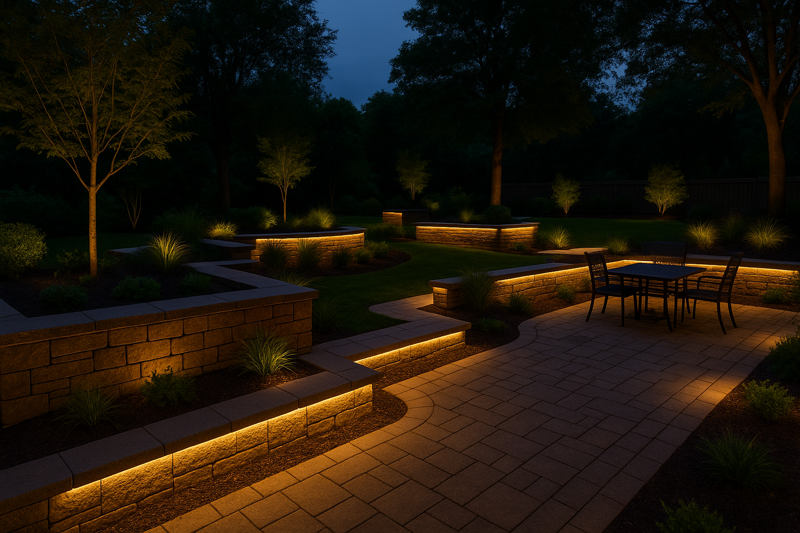
As a factory owner supplying lighting professionals, I’ve learned that the most successful projects don’t just illuminate objects; they create a feeling. They make a landscape feel like a journey. The real magic happens when your client steps outside and feels like they’ve entered a different world, not just their backyard. This is achieved by thinking about the layout—how light defines spaces, guides movement, and creates depth. Let’s break down the strategies to achieve this.
How Do You Define the ‘Boundaries’ of an Outdoor Room?
A patio or deck feels like it just drops off into a black void at night. This makes the space feel smaller and less secure, discouraging guests from relaxing near the edge.
Use LED strips to create soft, glowing "walls" of light. Install them under deck railings, along the capstones of seating walls, and beneath the lip of a raised patio. This defines the perimeter, making the space feel intentionally designed, larger, and more intimate.
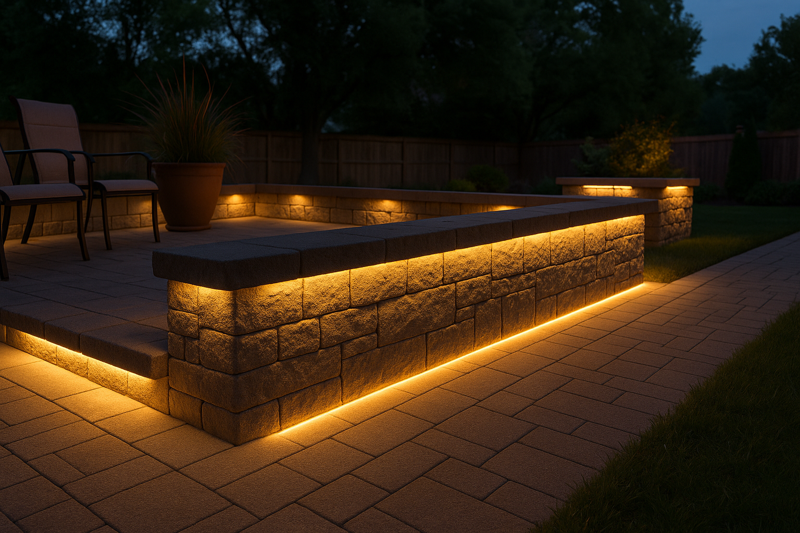
This is the first step in creating an immersive experience: establishing the "room." When you outline the functional area with a soft, indirect glow, you’re creating a psychological sense of enclosure and safety. It’s like drawing the floor plan with light. I often advise my B2B clients, like Tom in the US, to sell this concept as "creating an outdoor living room." The light should come from a hidden source, so the effect is what’s noticed, not the fixture. For example, running a continuous strip under a deck handrail does more than just light the floor; it frames the entire deck, making it the clear focal point of the yard. This foundational layer of light provides orientation and a sense of place, which is the bedrock of an immersive design.
Techniques for Defining Boundaries
Each placement creates a slightly different feeling of enclosure.
| Placement Technique | Visual Effect1 | Best For | Psychological Impact2 |
|---|---|---|---|
| Under Deck Railings | Creates a "frame" around the deck at waist level. | Elevated decks and patios with railings. | Provides a strong sense of safety and enclosure. |
| Under Wall Caps | Highlights the texture of the wall and creates a low visual border. | Retaining walls, seating walls, and garden borders. | Defines the space while integrating it with the landscape. |
| Under Patio Edge | Makes the entire patio slab appear to "float" on a cushion of light. | Raised concrete or paver patios. | A modern, high-impact technique that feels very custom. |
What’s the Best Way to Connect Different Zones with Light?
The path from the patio to the garden or the fire pit is dark and uninviting. Using sporadic stake lights creates a jarring on-off-on experience, breaking the sense of a single, unified property.
Create a continuous "river of light" by installing LED strips along the entire length of a pathway. This creates a strong visual line that physically and aesthetically connects one zone to another, guiding both vision and movement seamlessly.
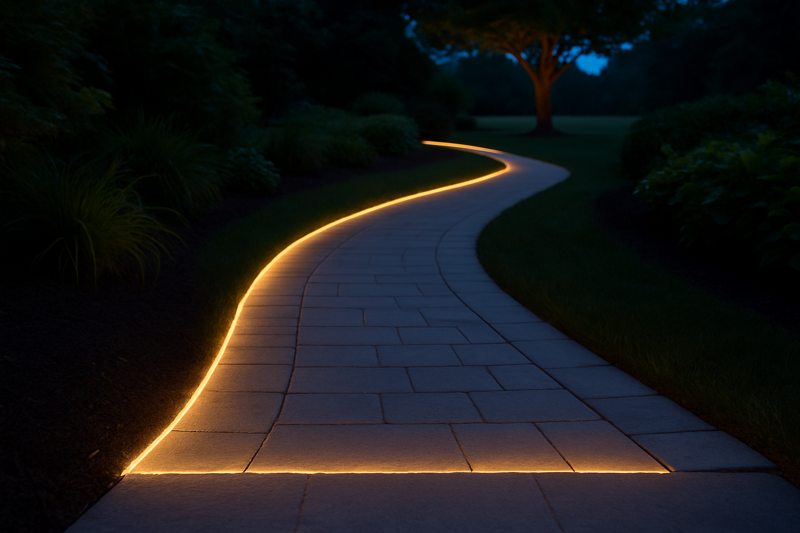
This is where you act as a director, guiding the viewer’s experience of the space. In art and photography, these are called "leading lines." By creating an unbroken line of light along a path, you are telling the visitor’s eye where to go. It transforms a simple walkway into a deliberate journey. This single design choice makes a landscape feel larger and more thoughtfully planned. A project I supplied in Japan used this technique to brilliant effect. A long, winding path from the house to a teahouse was lit with a single, warm white LED strip on one side. It not only made the walk safe but also created a sense of anticipation and flow. It unified two very different architectural elements into one cohesive experience. This is far more powerful than just placing lights; it’s about creating a narrative.
Unified Pathway Lighting Strategies
The style of the line impacts the journey’s feel.
| Strategy | Description | Feel | Pro Tip |
|---|---|---|---|
| Single-Edge Guide3 | A continuous strip along one side of the path. | Asymmetrical, modern, and guides the eye forward. | Best for curving paths to emphasize the flow. |
| Dual-Edge "Runway" | Strips installed along both edges of the path. | Symmetrical, formal, and creates a grand sense of arrival. | Excellent for straight paths leading to a main entrance or feature. |
| "Floating" Steps | Strips placed under the nose of each integrated step. | Rhythmic, dramatic, and makes the elevation change a feature. | Connects lower and upper levels with a beautiful, cohesive look. |
How Do You Add Depth and Prevent a ‘Flat’ Look?
If all the lights are at the same height (e.g., all under railings), the scene can look flat and one-dimensional, like a lit stage with no backdrop.
Create visual depth by layering light at different heights and distances. While low-level strips define the foreground (paths, patio edges), use other strips to subtly uplight vertical elements in the mid-ground and background, like tree trunks, fences, or decorative walls.

An immersive space needs a foreground, mid-ground, and background. This is a concept that lighting designers I work with obsess over. Your foundational pathway and patio lighting establish the foreground. Now, you need to draw the eye further into the scene. For example, placing a short, vertically-oriented LED strip at the base of several trees in the mid-ground creates pillars of light that add height and dimension. Even more subtly, you can wash a back fence or a distant retaining wall with a gentle, even glow from a hidden strip. This creates a softly lit backdrop, making the entire yard feel deeper and more expansive. This pushes the perceived boundaries of the property out, preventing that "black wall of nothing" feeling. Each layer adds to the richness of the overall picture.
Building Lighting Layers
Combine these layers for a truly dimensional look.
| Layer | Goal | Placement Example | Result |
|---|---|---|---|
| Foreground (Low)4 | Ground the viewer, provide safety, define immediate space. | Under stair treads and pathway edges. | The space you occupy is clear and well-defined. |
| Mid-ground (Medium)5 | Create interest, add height and texture. | Uplighting planters, under bench seats, behind water features. | Your eye is drawn to interesting features within the space. |
| Background (High/Far) | Create depth, push back boundaries, form a backdrop. | Grazing a perimeter fence or wall, uplighting the trunk of a tall tree. | The entire property feels larger, more complete, and enclosed. |
Conclusion
Creating an immersive atmosphere is about layout and connection. By using LED strips to define boundaries, create visual pathways, and build layers of light, you transform a simple yard into a unified, magical experience.
-
Exploring visual effects can inspire innovative designs that elevate your outdoor spaces. ↩
-
Understanding the psychological effects can enhance your design choices and create more inviting spaces. ↩
-
Explore this link to understand how Single-Edge Guide lighting enhances modern path aesthetics and functionality. ↩
-
Explore how Foreground (Low) lighting enhances safety and defines spaces effectively. ↩
-
Discover the impact of Mid-ground (Medium) lighting on adding texture and height to your environment. ↩
Interested in Our LED Solutions?
Get professional consultation and customized LED lighting solutions for your projects. Contact our expert team today.
Related Articles

How Do You Build Profitable Custom Vehicle and RV Interior LED Rope Lights?
You lose RV installation contracts because your interior lights fail on rough roads. Standard strips show bright dots on glossy…

How to Perfect Bookshelf and Display Cabinet LED Rope Lighting?
You lose retail clients when bookshelves look incredibly dark. Ugly shadows hide expensive products inside display cabinets daily. You need…

How to Master Mirror and Vanity LED Rope Light Installation?
Your clients complain about ugly shadows in their bathroom mirrors. Bad lighting ruins expensive vanity designs. You lose future contracts…
