

How to Master Mirror and Vanity LED Rope Light Installation?
Your clients complain about ugly shadows in their bathroom mirrors. Bad lighting ruins expensive vanity designs. You lose future contracts because standard lights fail in humid rooms.
To install vanity strip lights, use IP65 potting compound or IP67 hollow silicone tubes. Choose 24VDC double-sided copper COB strips for even brightness. Cut strictly on factory marks, maintain a 15mm bending radius, and seal ends perfectly to block steam.
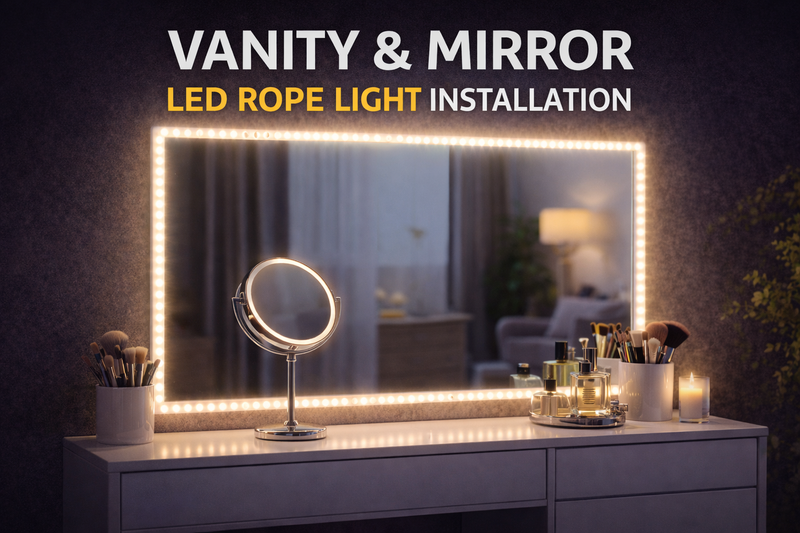
I am Jeremy Hou. I own Rhstriplighting in China. I sell B2B led strip lights. I communicate with US buyers like Tom every day. Tom sells wholesale lighting products to local design contractors. His contractors struggled with failing bathroom mirrors. Hot steam destroyed the copper boards quickly. Visible light dots ruined the glass reflection. Homeowners demanded their money back. I helped Tom fix these exact installation issues with better materials. Here are the exact steps to build flawless vanity mirrors and protect your business profits completely.
Why Do Standard LED Strips Fail Behind Vanity Mirrors?
You install cheap standard strips behind a bathroom mirror. The client turns it on. They see horrible bright dots reflecting on the wall. The light looks very cheap.
Standard SMD strips have large gaps between light chips. These gaps create bad shadows on human faces. You must use COB high-density flexible strip lights to create a flawless, soft, and continuous glowing border.
The Problem with Visible Light Dots
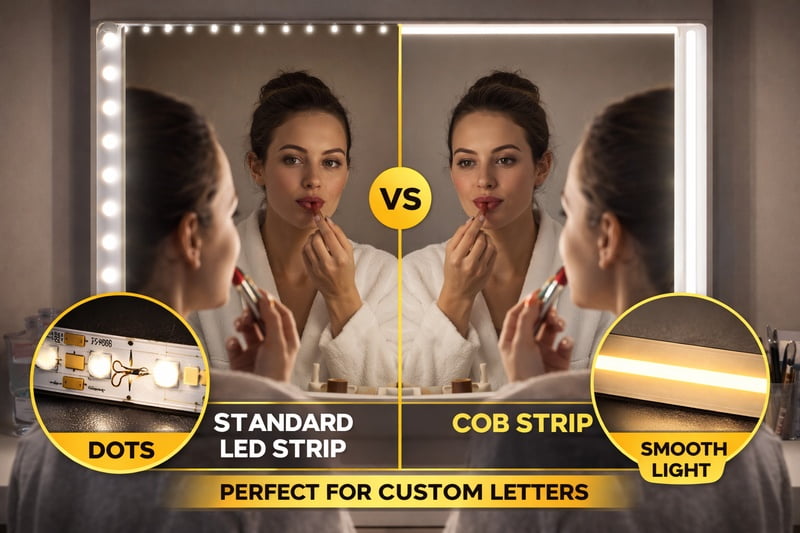
Standard LED strips use old technology. They place individual chips far apart on the board. When you put this strip behind a flat vanity mirror, the light bounces off the back wall. The human eye sees every single dot clearly. It looks like a cheap string of holiday lights. This ruins the modern luxury feel of a bathroom. Women cannot apply makeup properly because the dotted light creates uneven shadows on their faces. They need pure, continuous light to see clear details.
We solve this large problem by manufacturing COB high-density flexible strip lights1. COB technology packs hundreds of tiny chips together into one single yellow line. For example, our boards hold up to 512 LEDs per meter. This high density creates a perfectly smooth light output. It features absolutely no dark areas. The light transmittance is very high. It produces a soft glow. The client feels like they are in a high-end luxury hotel. Tom now only buys COB strips for his vanity mirror projects. His contractors love the easy professional look.
You also need good color rendering2. Standard strips often make skin look grey or yellow. Our COB strips feature Ra90 or higher. This means the colors look real and natural. Skin tones appear healthy. You can choose different color temperatures. 3000K warm white feels relaxing in a home bathroom. 4000K or 5000K daylight looks clean and bright for professional makeup application. You match the color temperature to your client’s exact daily needs.
| Feature | Standard SMD Strip | COB High-Density Strip | Impact on Vanity Mirror |
|---|---|---|---|
| Chip Spacing | Far apart | Packed tightly together | Eliminates ugly wall dots |
| Light Output | Uneven and harsh | Smooth and continuous | Creates perfect makeup lighting |
| Color Quality | Low CRI | Ra90 high CRI | Shows true natural skin colors |
How Should You Waterproof Bathroom Mirror Lights Properly?
You use basic dry interior lights for a bathroom mirror. The client takes a hot shower. Thick steam covers the room. The lights short circuit and die forever.
Bathroom humidity kills bare circuit boards. You must use IP65 potting compound or IP67 hollow extrusion. These waterproof layers block daily steam from rusting the internal copper paths.
The Danger of Bathroom Steam
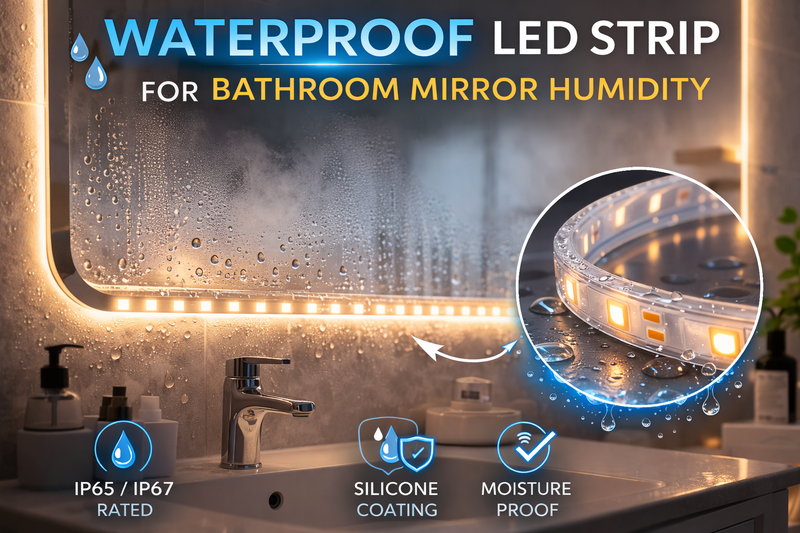
Bathrooms are the worst indoor environment for electronic parts. Hot showers create massive amounts of thick steam. This steam floats up and gets trapped directly behind the vanity mirror. If you use bare IP20 light strips, the water vapor touches the metal chips immediately. The metal begins to rust the very next morning. The light will change color. Eventually, the entire circuit will break open. You will have to tear the mirror off the wall to fix it. This costs you time and money.
We recommend IP65 potting compound waterproofing3 for basic vanity mirrors. We apply a clear layer of glue over the top of the chips. This glue blocks the floating steam easily. For commercial gyms or very heavy moisture areas, we strongly suggest IP67 waterproofing by hollow extrusion4. We put the entire strip inside a pure silicone tube. Water simply cannot penetrate the thick silicone wall. The heat escapes safely through the empty air space inside the tube.
You must also seal your wire connections perfectly. Do not use electrical tape behind a mirror. Tape melts into a sticky mess in a hot bathroom. You must use dedicated silicone end caps. You inject pure neutral silicone glue into the cap. You slide the cut strip inside. You let it dry for twenty-four hours before turning it on in a wet room. This creates a permanent lock against water damage.
| Waterproof Rating | Material Used | Moisture Resistance | Best Application |
|---|---|---|---|
| IP20 | No cover | Zero | Dry bedrooms only |
| IP65 | Clear top compound | Good | Standard home bathroom mirrors |
| IP67 | Hollow silicone tube | Excellent | Heavy steam vanity rooms |
Why Is the 15mm Bending Rule Critical for Mirror Corners?
You bend the light strip tightly to follow the sharp square corner of the glass. You hear a small crack. Half of the mirror frame goes completely dark.
You must protect the internal metal paths. Never bend the strip horizontally. Keep vertical bends gentle with a bending diameter of R > 15mm to avoid snapping the circuits.
Protecting the Internal Copper Paths
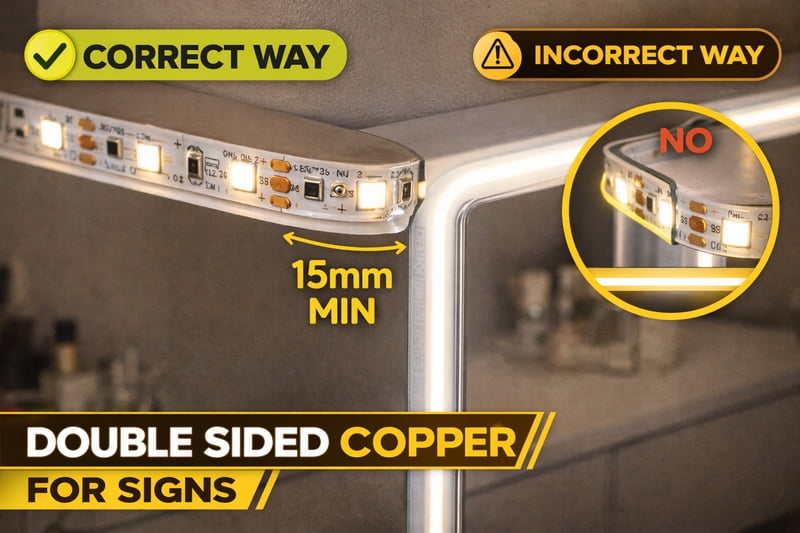
Vanity mirrors have corners. Contractors try to bend the light strip around these corners in one continuous piece. The flexible light strip looks like a soft shoelace. Workers treat it roughly. They fold it tight to make a clean 90-degree visual angle. This is a fatal installation mistake. Inside the soft yellow plastic is a real, flat metal base. A hard fold acts like a knife. It cuts the metal trace instantly. The electrical power stops moving. The light dies.
We print strict instructions for our B2B buyers. The bending diameter must remain R > 15mm5. If you bend it tighter than 15mm, you stretch the flexible board too far. The solder points pull apart. You must gently curve the strip around the shape. You must never fold it in half. A gentle curve still looks beautiful hidden behind the mirror frame. The light will diffuse softly and hide the curved corner completely.
You also face another risk. You must never bend the strip horizontally. The circuit board does not bend sideways. It only bends up and down. If you lay the strip flat against the wall and try to bend it left or right, you will rip the copper apart immediately. To make a sharp square corner on a flat surface, you must cut the strip6. You then use short, soft wire jumpers to connect the two straight lengths. This keeps the rigid board totally safe.
| Bending Action | Allowed | Physical Result on Mirror |
|---|---|---|
| Curve up/down (R > 15mm) | Yes | Safe, powers up perfectly |
| Fold flat in half | No | Breaks metal trace instantly |
| Bend sideways (horizontal) | No | Rips copper base entirely |
Does Voltage Choice Affect Long Mirror Installations?
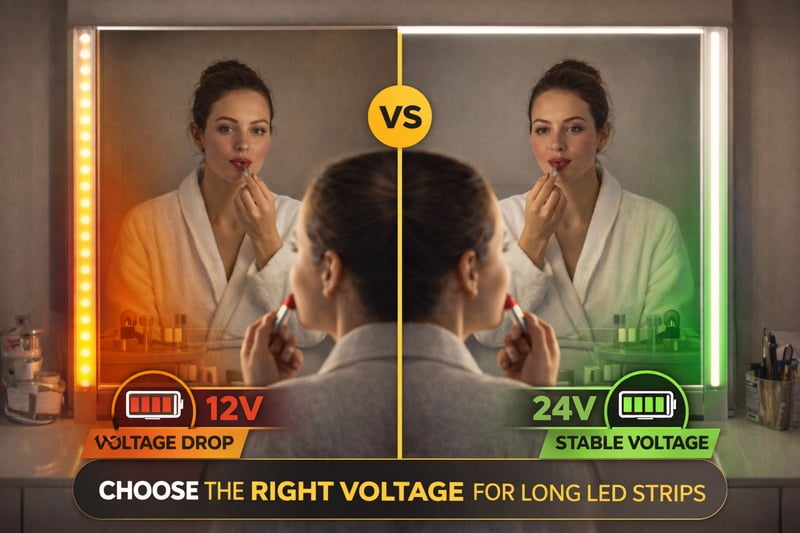
Your client wants a massive double vanity mirror. You run a long 12V strip around the entire frame. The start is bright. The end looks dim and weak.
Voltage drop causes long runs to lose brightness. Choose 24VDC over 12VDC for large double vanity mirrors. 24VDC pushes the current further, keeping the light perfectly even everywhere.
Overcoming Voltage Drop on Big Mirrors
Modern luxury bathrooms feature huge custom mirrors. Some mirrors stretch across two sinks and measure over three meters long. When you install lights around a large mirror perimeter, the total length gets very long. If you use a 12VDC power supply, the electric current struggles to travel the full distance. The current loses energy due to friction inside the copper wire. The first meter is super bright. The last meter is sad and dim. Your client complains the mirror looks broken.
We solve this with 24VDC7 architecture. We manufacture our long strips with 24VDC because it carries power much better than 12VDC. 24VDC uses lower current to push the same amount of power. Lower current creates less friction in the wire. Less friction means less voltage drop8. When you run a 24VDC strip around a massive double vanity, the light stays incredibly bright and perfectly uniform from the very first inch to the very last inch.
You also benefit from heat management. High current generates high heat. Heat destroys the delicate silicone waterproof layers over time. We use FPC double sides copper on our 24V boards. The double copper layer pulls the heat away from the light chips. It transfers the heat safely into the ambient air. The mirror stays cool to the touch. The LED lifespan extends beyond 36,000 hours. The client enjoys their perfect mirror for many years.
| Voltage Choice | Run Length Capability | Brightness Consistency | Heat Level |
|---|---|---|---|
| 12VDC | Short mirrors only | Poor on long runs | Higher heat |
| 24VDC | Large double vanities | Perfect across whole length | Low and safe |
How Do Factory Cutting Marks Save Your Vanity Project?
You reach the bottom edge of the mirror. The strip is too long. You cut it blindly with a kitchen knife. The whole bottom edge goes dark permanently.
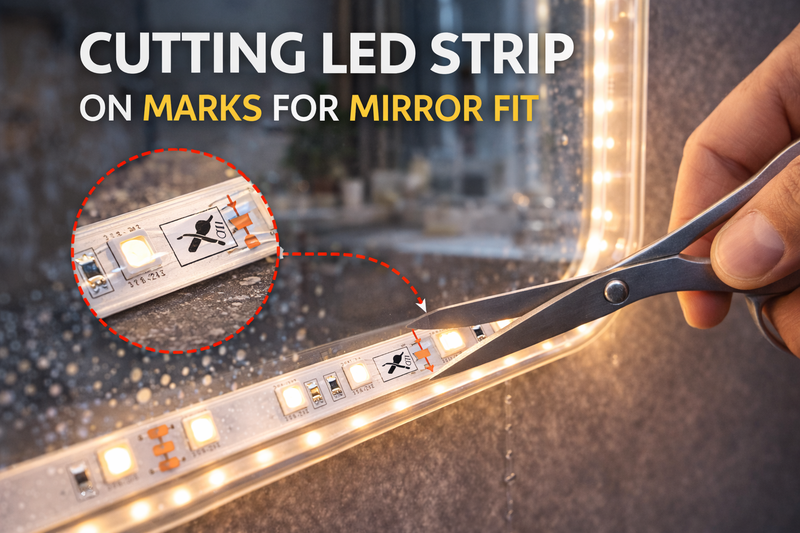
You must cut the strip strictly on the factory printed lines. Use sharp scissor blades to cut precisely at the 50mm mark for 24V strips to keep the circuits closed.
Following the Safe Cutting Zones
Vanity mirrors come in random custom sizes. A standard roll of light strip is 5000mm long. You will always need to cut the material to size. Many contractors just grab a knife and cut the strip wherever it meets the edge of the mirror. This destroys the product completely. A light strip is grouped into small electrical circuits. If you cut the strip in the middle of a circuit, you break the connection. That whole section goes totally dead.
We design specific cutting points onto every light strip we make. You look at the back of the tape. You will see clear lines. For our standard 24VDC COB strip, you will see a marking every 50mm. You must only cut the strip exactly on these lines. You must use very sharp scissor blades. A sharp tool makes a clean cut straight through the copper pads. A clean cut leaves enough copper metal exposed so you can solder new power wires easily.
If you miss the line, you lose that 50mm section entirely. This creates an ugly dark shadow at the bottom corner of your beautiful vanity mirror. After you cut the strip properly, you must seal that open end immediately to stop bathroom steam from entering. This exact attention to detail separates amateur jobs from highly paid professional installations. Tom teaches all his buyers this strict cutting rule to stop product returns and protect factory warranties entirely.
| Action Item | Tool Needed | Location of Action | End Result |
|---|---|---|---|
| Bad random cut | Dull knife | Anywhere | Creates dead dark spots |
| Proper safe cut | Sharp scissor blades | Only on factory mark | Keeps light running perfectly |
| Post-cut step | IP67 end cap and glue | On the freshly cut edge | Stops steam damage totally |
Conclusion
Mastering vanity mirror lights requires professional habits. Stop using tape and use real silicone sealants. Cut exclusively on the printed factory lines. Never fold the strips sharply, and embrace 24VDC for massive mirrors to secure high client satisfaction.
-
Explore the advantages of COB technology for lighting solutions, ensuring a smooth and luxurious experience. ↩
-
Understanding color rendering can enhance your lighting choices, ensuring natural and vibrant appearances in any setting. ↩
-
Explore this link to understand how IP65 waterproofing can protect your bathroom electronics from steam damage. ↩
-
Learn about IP67 waterproofing to see how it offers superior protection for electronics in high-moisture environments. ↩
-
Understanding the bending diameter is crucial for maintaining the integrity of flexible light strips and ensuring their longevity. ↩
-
Learning the correct cutting techniques can prevent damage and ensure a seamless installation of your lighting. ↩
-
Explore the benefits of 24VDC for lighting, including improved brightness and reduced heat, ensuring a perfect mirror experience. ↩
-
Learn how voltage drop impacts lighting performance and discover solutions to maintain brightness in large setups. ↩
Interested in Our LED Solutions?
Get professional consultation and customized LED lighting solutions for your projects. Contact our expert team today.
Related Articles

How Do You Build Profitable Custom Vehicle and RV Interior LED Rope Lights?
You lose RV installation contracts because your interior lights fail on rough roads. Standard strips show bright dots on glossy…

How to Perfect Bookshelf and Display Cabinet LED Rope Lighting?
You lose retail clients when bookshelves look incredibly dark. Ugly shadows hide expensive products inside display cabinets daily. You need…

How Do You Build Profitable Custom LED Rope Light Signs and Letters?
You lose commercial clients because your custom signs look cheap. Standard lights show dark spots and break easily. You need…
