

IP65 vs. IP67 vs. IP68: Which IP Rating is Right for Your Outdoor LED Strip?
Your client’s beautiful, expensive outdoor lighting project fails just six months after installation. The LED strip, installed along a garden path, is now flickering and dead after a season of heavy rain. The client is furious, and you’re facing a costly replacement job.
The wrong IP rating was chosen. IP65 protects against splashes, like rain hitting a wall. IP67 handles temporary submersion, ideal for ground-level areas that might flood. IP68 is for continuous underwater use, like in fountains. Matching the rating to the specific location is critical.
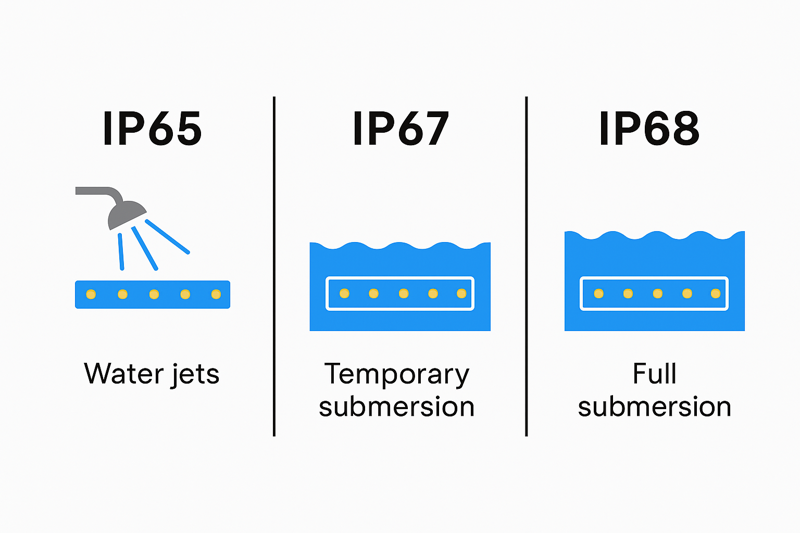
As a factory owner, I see this issue frequently. A misunderstanding between "water-resistant" and "waterproof" can lead to expensive failures and damage a contractor’s reputation. My goal is to make these numbers crystal clear. For a buyer like Tom, getting this right means successful projects, happy clients, and no surprise costs. Let’s break down what each rating really means for your outdoor installations.
What Does the IP65 Rating Really Mean?
You see an LED strip is rated for "outdoor use" and assume it can go anywhere outside. You install an IP65 strip along a low garden wall where rainwater often pools at the base.
IP65 means the strip is dust-tight (the ‘6’) and protected from low-pressure water jets from any direction (the ‘5’). Think sprinklers or light rain. It is not designed to sit in standing water or be submerged, even for a moment.
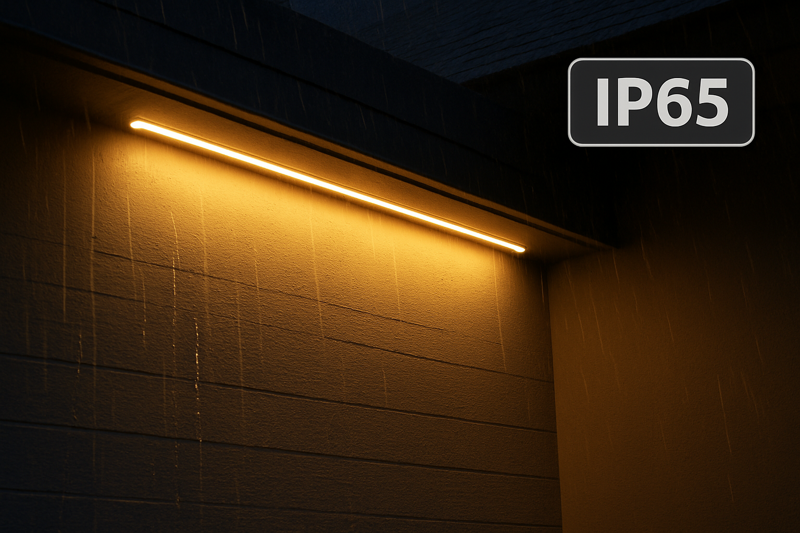
This is your go-to rating for most "damp location" applications, but not "wet locations." The key is drainage. As long as water can run off and away from the strip, IP65 is often sufficient and the most cost-effective choice. I had a client in Florida who used IP65 for all his path lighting to save on costs. After one hurricane season with significant flooding, he had to replace nearly 40% of the installation. A simple upgrade to IP67 in the ground-level areas would have saved him thousands. We now use his story as a case study. IP65 is perfect for areas like soffits, under handrails on an elevated deck, or high up on a wall under an eave—places that get wet but never flood.
IP65 Application Guide
| Application | Is it Suitable? | Why? | My Professional Tip |
|---|---|---|---|
| Under Roof Soffits | Yes | Protected from the worst of the rain; no chance of submersion. | This is the most common and ideal use case for IP651. |
| High on a Wall | Yes | Gets wet from rain, but water drains away immediately. | Use a channel to ensure water can’t pool on top of the strip. |
| In a Garden Bed | No | At risk of being covered by mulch, soil, and puddles. | This is a classic misapplication that leads to failure. |
| Ground-level Paths | No | Prone to standing water and puddles after heavy rain. | This area requires a minimum of IP67 for reliability. |
When is IP67 the Necessary Upgrade?
A client wants lights embedded in their deck surface, or running along the base of a retaining wall where snow melts and water puddles. You know IP65 isn’t enough, but is IP68 overkill?
IP67 is necessary for any location where the strip might be temporarily underwater. The ‘7’ certifies it can be immersed in up to 1 meter of water for 30 minutes without damage. This is the reliable choice for ground-level installations.
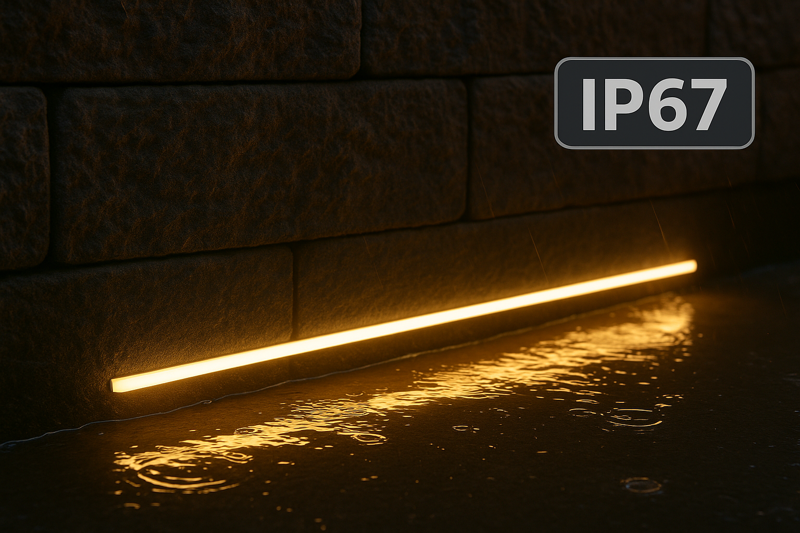
Think of IP67 as your standard for "wet location" reliability. This is the rating that protects against common landscape scenarios: heavy downpours, sprinklers hitting the strip directly, melting snow, and temporary puddles. For my wholesale clients in North America, I almost always recommend IP67 as the default for any in-ground or near-ground application. The small price increase from IP65 is cheap insurance against a failed installation. Falsified certificates are a huge problem in our industry; we always provide third-party lab reports to prove our ratings. An authentic IP67 rating ensures that a product has been properly sealed and tested. It’s the professional’s choice for robust, near-ground outdoor lighting that needs to survive more than just a bit of rain.
IP65 vs. IP67: Key Differences
| Feature | IP65 | IP67 | The Deciding Question |
|---|---|---|---|
| Protection Type | Water jets (splashing)2 | Temporary immersion (submersion)3 | Will the strip ever sit in a puddle, even for a few minutes? |
| Typical Cost | Lower | Moderately Higher | Is the potential cost of a callback worth the initial savings? |
| Ideal Location | Elevated, well-drained areas. | Ground-level, near pools, in-deck. | Where is the installation located relative to the ground? |
| Key Takeaway | If the answer to the deciding question is "yes" or even "maybe," you must use IP67. |
Why Would You Ever Need an IP68 Rating?
Your project involves a fountain, the inside of a swimming pool, or a custom water feature. The lights will be underwater constantly, for days, weeks, or even years.
IP68 is for permanent and continuous submersion in water, typically deeper than 1 meter. The ‘8’ signifies a hermetically sealed product, tested under pressure for long periods. This is a specialty rating for underwater applications only.
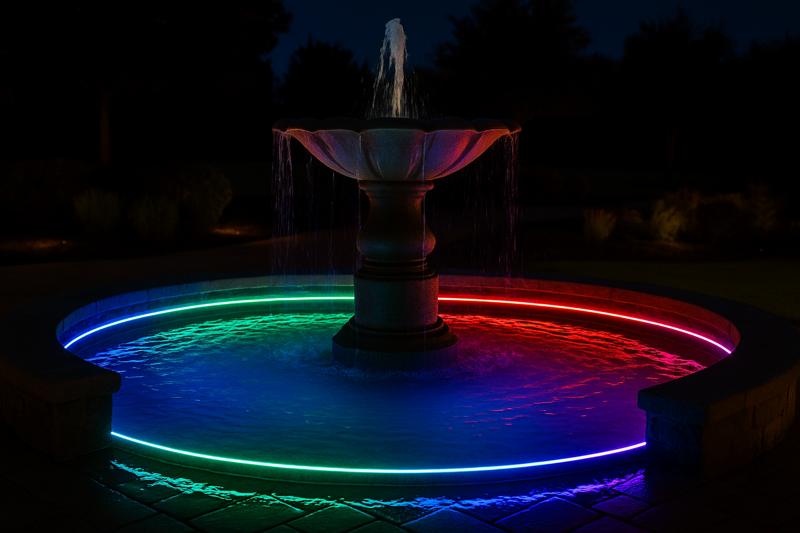
The jump from IP67 to IP68 is significant in terms of construction and cost. An IP68 product is not just sealed; it’s often solid-injected with silicone or polyurethane to eliminate any air gaps where water could penetrate under pressure over time. As a factory, the manufacturing process for IP68 is far more intensive. This is not a rating you choose "just to be safe" for a landscape project. It is specifically for being underwater. Using IP68 for path lighting is unnecessary and a waste of money. However, for a landscape designer incorporating a pond or a "disappearing edge" water feature, IP68 is non-negotiable. It’s crucial to verify the manufacturer’s testing parameters for IP68, as the depth and duration can vary. We specify our IP68 testing conditions clearly on our spec sheets so buyers know exactly the performance they are getting.
Choosing the Right IP Rating4: A Final Checklist
| Checkpoint | IP65 | IP67 | IP68 |
|---|---|---|---|
| Will it get rained on but drain freely? | ✅ | ✅ | ✅ |
| Will it sit in puddles or temporary floods? | ❌ | ✅ | ✅ |
| Will it be underwater for hours/days/years? | ❌ | ❌ | ✅ |
| Is it for a pool, fountain, or pond? | ❌ | ❌ | ✅ |
Conclusion
Choosing the correct IP rating is not about over-engineering; it’s about predictable reliability. Match the rating to the real-world conditions: IP65 for damp spots, IP67 for wet ground, and IP68 for underwater.
-
Understanding the IP65 rating is crucial for selecting the right equipment for outdoor use, ensuring durability and safety. ↩
-
Learn about water jets protection to ensure your devices are safe from splashes and sprays. ↩
-
Understanding temporary immersion helps you choose the right waterproofing for your needs. ↩
-
Understanding IP Ratings is crucial for selecting the right equipment for various environments, ensuring durability and performance. ↩
Interested in Our LED Solutions?
Get professional consultation and customized LED lighting solutions for your projects. Contact our expert team today.
Related Articles

How Do You Build Profitable Custom Vehicle and RV Interior LED Rope Lights?
You lose RV installation contracts because your interior lights fail on rough roads. Standard strips show bright dots on glossy…

How to Perfect Bookshelf and Display Cabinet LED Rope Lighting?
You lose retail clients when bookshelves look incredibly dark. Ugly shadows hide expensive products inside display cabinets daily. You need…

How to Master Mirror and Vanity LED Rope Light Installation?
Your clients complain about ugly shadows in their bathroom mirrors. Bad lighting ruins expensive vanity designs. You lose future contracts…
