

Is Your Bedroom Lighting Keeping You Awake or Putting You to Sleep?
You spend a third of your life in your bedroom, yet you likely rely on a single, glaring ceiling fixture that blasts the room with uninviting light. It kills the mood instantly and signals your brain to stay alert just when you want to wind down.
Bedroom LED rope light ideas focus on creating indirect, layered lighting that mimics the cozy atmosphere of a boutique hotel. By installing warm-white (2700K) strips under the bed frame for a floating effect, or behind the headboard for a soft reading halo, you reduce eye strain and signal your body to produce melatonin for better sleep.
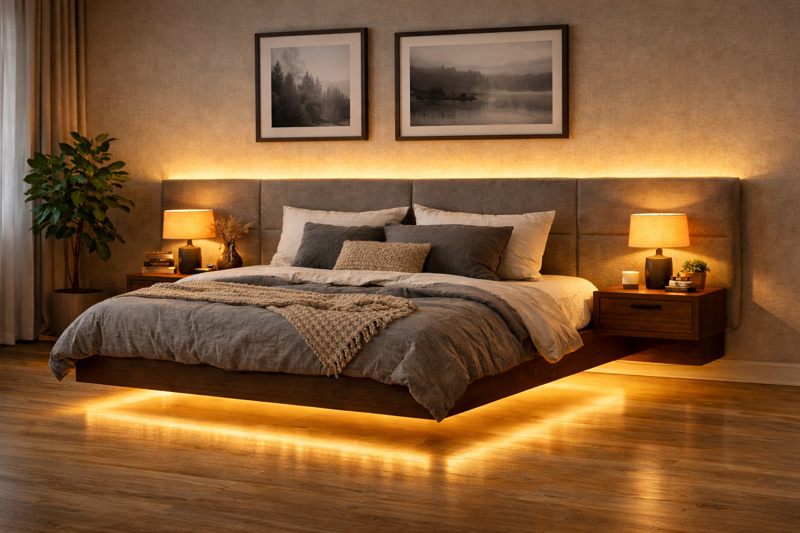
In my factory, we produce lighting for huge hotel chains, and the number one rule for bedroom lighting is "Invisible Source." If you can see the light bulb or the LED chip directly, the design has failed. I often see homeowners buy industrial-grade, super-bright rope lights for their bedrooms, thinking "brighter is better." In the bedroom, brighter is the enemy. You want control, warmth, and concealment. Let’s look at how to use modern flexible lighting to turn your bedroom into a sanctuary, not an interrogation room.
Can a "Floating Bed" Light Actually Help You Sleep Better?
Stumbling to the bathroom in the middle of the night usually involves kicking the bedpost or blinding yourself with the main light. This shocks your system and makes it hard to fall back asleep.
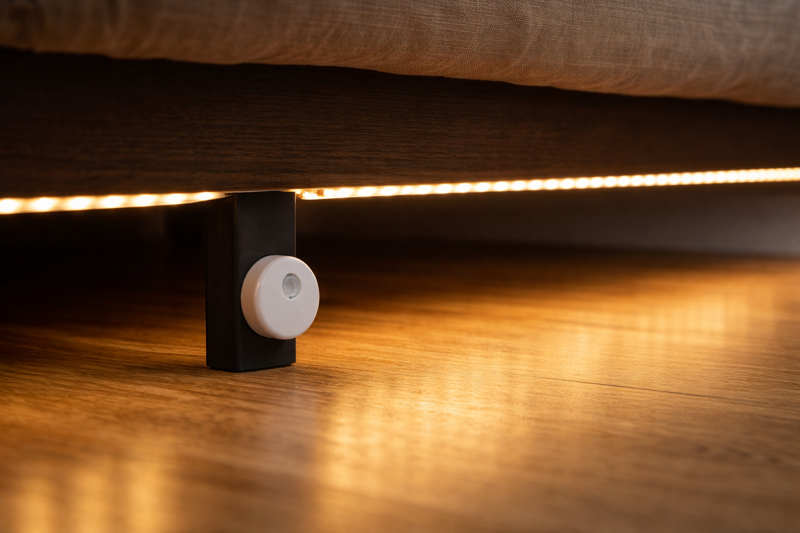
Installing motion-activated LED rope lights under the perimeter of your bed frame creates a soft, navigational glow that guides you without waking your partner. The key is using low-lumen, warm light combined with a PIR sensor that triggers only when your feet hit the floor.
The Science of "Sleep-Safe" Lumens
When I consult with lighting designers, we talk about "Lux" levels. For a kitchen, you want 500 Lux. For a bedroom general light, 200 Lux. But for this under-bed application, you want less than 50 Lux.
Standard "Rope Lights" found in hardware stores are often too bright and lack dimming capabilities. If you install a high-output strip here, the reflection off the floor will bounce up and light up the whole room, disturbing your partner.
I recommend using a Low-Density 24V Strip (60 LEDs/meter) paired with a dimmer. You want the light to be a whisper, not a shout.
The Science of "Sleep-Safe" Lumens
When I consult with lighting designers, we talk about "Lux" levels. For a kitchen, you want 500 Lux. For a bedroom general light, 200 Lux. But for this under-bed application, you want less than 50 Lux1.
Standard "Rope Lights" found in hardware stores are often too bright and lack dimming capabilities. If you install a high-output strip here, the reflection off the floor will bounce up and light up the whole room, disturbing your partner.
I recommend using a Low-Density 24V Strip2 (60 LEDs/meter) paired with a dimmer. You want the light to be a whisper, not a shout.
Smart Sensor Placement
The biggest mistake I see with DIY kits is the sensor placement. If you put the motion sensor (PIR) too high or pointing at the bed sheets, the light will turn on every time you toss and turn in your sleep. This is a nightmare.
The Installation Trick: Mount the sensor underneath the bedside table or on the leg of the bed, pointing strictly outward and downward. Ideally, it should create a "tripwire" effect that is only broken when a foot physically touches the floor.
In my factory, we now produce "Dual-Sensor" kits. Why? Because if only one side of the bed has a sensor, your partner on the other side is left in the dark. You need independent sensors on both sides connected to the same light source.
Rugs and Reflection
Consider your floor material.
- Carpet: Absorbs light. You might need slightly higher brightness (approx 300 lumens/meter).
- Hardwood/Tile: Reflects light like a mirror. You absolutely need a Diffuser Channel3.
Without a milky diffuser channel, a polished floor will reflect the ugly circuit board and individual dots of the LED strip. It looks cheap. The diffuser softens the light into a neon-like haze.
| Factor | Standard Solution | Jeremy’s Recommendation | Why? |
|---|---|---|---|
| Brightness | High (Standard Roll) | Low or Dimmable | Prevents "waking up" the brain. |
| Trigger | Manual Switch | PIR Motion Sensor4 | Hands-free safety at 3 AM. |
| Color | 3000K or 4000K | 2200K – 2700K | Warmer light equals better sleep. |
| Mounting | Adhesive Tape | Aluminum Profile | Protects strip from vacuum cleaners. |
Why Should You Light the Headboard Instead of Using Table Lamps?
Table lamps take up valuable nightstand space and often cast uneven pools of light that are too bright for relaxed reading but too dim for cleaning. They add clutter to the visual design of the room.
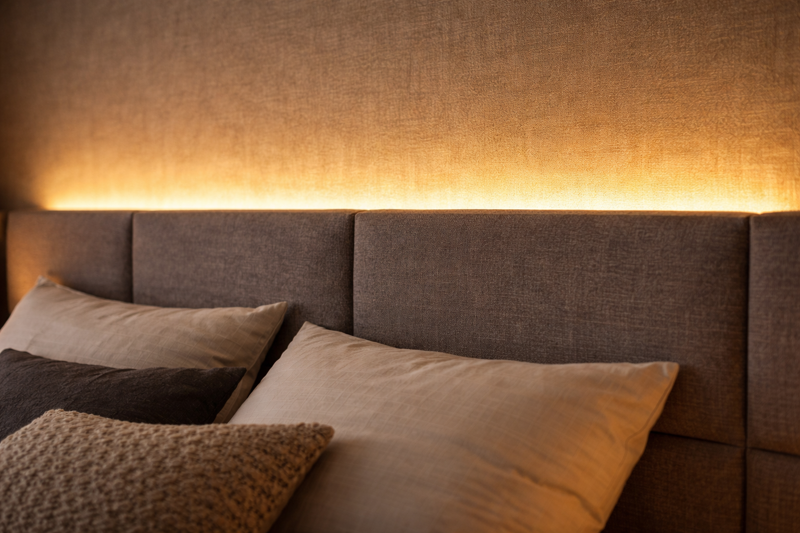
Backlighting your headboard with LED rope lights creates a dramatic focal point and provides an even wash of "Bias Lighting" that reduces contrast eye strain when watching TV in bed. By bouncing light off the wall behind the bed, you create a softer illumination that expands the visual depth of the room.
The "Wall Washing" Technique
This technique is purely architectural. By pushing the headboard off the wall by about 2 inches (5cm) and mounting LED lights on the back of the headboard aiming outward, you wash the wall with light.
This highlights the texture of your wallpaper or paint.
However, you must be careful with Color Temperature (CCT)5.
If you have a blue wall and you use a warm yellowish light (2700K), the light will mix with the paint color and look muddy gray.
- Warm Wall Colors6 (Beige, Red, Cream): Use 2700K Warm White.
- Cool Wall Colors (Blue, Gray): Use 3000K or 4000K Neutral White to keep the wall looking crisp.
Reading vs. Relaxing: The Dual Circuit
I always advise my clients to separate the headboard light into two practical zones or "channels."
- The Ambient Halo: This is the light behind the headboard we just discussed. It is for mood and watching Netflix.
- The Reading Light: This is a stronger strip of light often mounted inside a recess or shelf above the bed.
Reading requires high CRI (Color Rendering Index). If you use a cheap rope light with CRI 70, the pages of your book will look slightly green, and your eyes will get tired faster. You need CRI 90+7.
Do not put these on the same switch. You need to be able to turn off the bright reading light while keeping the soft halo on for intimacy.
The "Blue Light" Hazard
We hear a lot about blue light from phones ruining sleep. Cheap Cool White (6000K) LEDs are essentially blue pumps with a phosphor coating. They emit a spike of blue spectrum.
For headboards, strictly avoid anything over 3000K.
Recently, we started manufacturing "Sunset Dimming" strips (Dim-to-Warm). At full power, they are good for reading (3000K). As you dim them, they shift to 1800K (like a candle). This is the ultimate luxury feature for a master bedroom because it simulates the natural sunset, triggering your circadian rhythm.
| Feature | Standard "Rope" | Professional Strip | User Benefit |
|---|---|---|---|
| CRI | 70-80 | 90+ | Less eye strain when reading. |
| Spectrum | High Blue Spike | Low Blue / Warm | Better sleep quality (melatonin). |
| Control | On/Off | Dim-to-Warm | Adjusts from "Reading" to "Romance". |
| Look | Dotted/Spotty | Seamless | Looks like high-end furniture. |
Can You Make Your Closet Look Like a Luxury Boutique?
Most bedroom closets are dark caves where it is impossible to distinguish a navy blue sock from a black one. A single overhead bulb casts your own shadow onto the clothes you are trying to find.
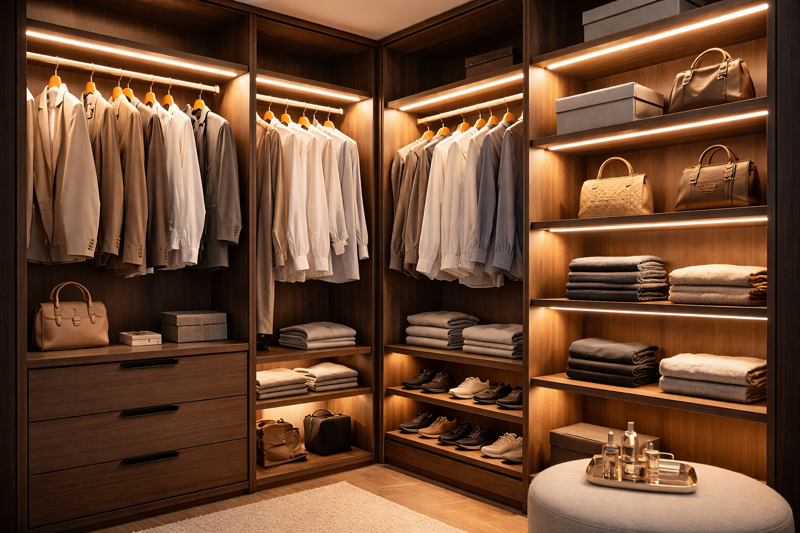
Installing high-CRI LED rope lights inside wardrobe rails or along the vertical frames of open shelving transforms getting dressed into a high-end experience. The light must be front-facing or angled inward to illuminate the fabric directly, allowing you to see true colors and textures.
The Importance of High CRI (Color Rendering Index)
If there is one place in your house where technical specs matter, it is the closet.
Have you ever put on a shirt thinking it matched your pants, stepped outside into the sun, and realized they clashed? That is because your bedroom light had low CRI.
Sunlight is CRI 100.
Cheap rope lights are CRI 70-80. They miss the R9 (Red) spectrum. Skin looks pale; wood looks flat.
For closets, I refuse to sell anything less than CRI 90 or 958. This ensures that the "Black" looks deep black, and "Navy" looks clearly blue. It helps you coordinate outfits quickly and confidently.
The "Dotless" Necessity in Joinery
Closet shelves are often at eye level. If you use a standard LED strip, you will stare directly at the harsh LED dots. It hurts your eyes and looks unfinished.
You have two options here:
- COB (Chip on Board) Strips9: These create a continuous line of yellow phosphor. No dots, even without a diffuser.
- Corner Aluminum Profiles: These mount in the corner of the shelf at a 45-degree angle. They have a milky cover that diffuses the light and directs it toward the center of the shelf (at your clothes), not out into your eyes.
Pro Tip: If you are retrofitting an existing closet, you cannot easily route wires through the wood. In this specific case, rechargeable battery-operated LED bars are acceptable, though hardwiring is always the permanent B2B solution I prefer.
Heat Management in Confined Spaces
Clothing is flammable. While LEDs run cooler than halogen bulbs, they still generate heat.
Cheap high-voltage rope lights (the thick plastic ones) get warm. Putting them in a closed wooden cabinet with wool sweaters is not ideal.
Always use 12V or 24V Low Voltage strips10. They are safe to touch.
Furthermore, mounting them on an aluminum profile11 is not just for looks; the aluminum acts as a heat sink. It pulls the heat away from the LED chip and dissipates it ensuring the light lasts for 50,000 hours instead of burning out in a year.
| Requirement | Why it matters in a closet |
|---|---|
| CRI > 90 | Distinguish black from blue; see true skin tone. |
| Angled Profile | Directs light onto clothes, not your eyes. |
| Door Sensor | Lights turn on automatically when you open the wardrobe. |
| Low Voltage | Fire safety near fabrics and wood. |
Conclusion
Creating a sanctuary in your bedroom is not about buying the brightest light; it is about buying the right light. Utilize motion sensors for under-bed utility, prioritize Warm White (2700K) to protect your sleep cycle, and strictly use High CRI sources in your closet so you always look your best. Avoid the cheap, thick plastic rope lights—opt for aluminum profiles and modern strips for a safe, professional finish.
-
Understanding the optimal Lux level can enhance your sleep quality and overall well-being. ↩
-
Discover how Low-Density LED strips can create a soothing ambiance while being energy efficient. ↩
-
Learn how a diffuser channel can enhance the aesthetics and functionality of your lighting setup. ↩
-
Explore the technology behind PIR motion sensors and their benefits for home automation. ↩
-
Understanding CCT is crucial for selecting the right lighting to enhance your space’s aesthetics. ↩
-
Learn how warm wall colors interact with lighting to create a cozy and inviting atmosphere. ↩
-
A high CRI ensures accurate color representation, reducing eye strain and improving your reading experience. ↩
-
Understanding CRI 90 or 95 helps you choose lighting that enhances color accuracy, making outfit coordination easier. ↩
-
Explore how COB strips provide a seamless light experience without harsh dots, improving aesthetics and comfort. ↩
-
Learn about the safety and efficiency of low voltage strips, especially in confined spaces like closets. ↩
-
Discover how aluminum profiles enhance heat dissipation, prolonging the life of your LED lights and ensuring safety. ↩
Interested in Our LED Solutions?
Get professional consultation and customized LED lighting solutions for your projects. Contact our expert team today.
Related Articles

How Do You Build Profitable Custom Vehicle and RV Interior LED Rope Lights?
You lose RV installation contracts because your interior lights fail on rough roads. Standard strips show bright dots on glossy…

How to Perfect Bookshelf and Display Cabinet LED Rope Lighting?
You lose retail clients when bookshelves look incredibly dark. Ugly shadows hide expensive products inside display cabinets daily. You need…

How to Master Mirror and Vanity LED Rope Light Installation?
Your clients complain about ugly shadows in their bathroom mirrors. Bad lighting ruins expensive vanity designs. You lose future contracts…
