

Is Your Expensive Home Theater Missing That True “Cinema Logic”?
You have invested heavily in a 4K laser projector and a Dolby Atmos sound system, yet when the main lights go out, the room feels like a disorienting cave rather than a luxury cinema. You fumble for snacks in the dark, and after an hour, your eyes burn because the screen is too bright against the pitch-black wall.
Home theater LED rope lighting creates a functional "Bias Lighting" effect behind screens to reduce eye strain and adds dimmable, indirect path lighting for safety. To achieve a true cinema experience, you must use RGB+W strips that allow for immersive color scenes during movies, while switching to high-CRI white light for cleaning and maintenance.
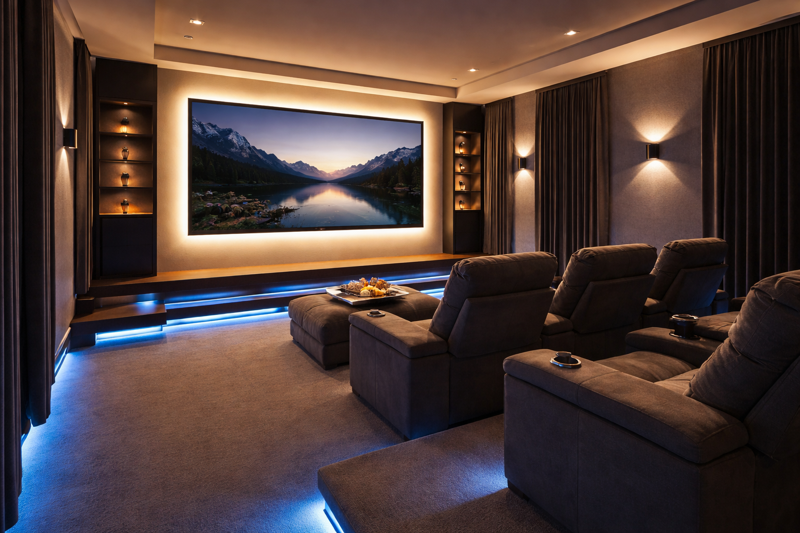
In my factory, we produce lighting solutions for both commercial cinemas and high-end residential installers across North America. I often see homeowners make the same mistake: they treat their theater like a nightclub, buying cheap, flashy "gaming lights" that distract from the movie. A real cinema uses light to guide the eye, not to grab attention. The goal is total immersion. Whether you are retrofitting a basement or building a dedicated media room from scratch, the secret lies in controlling where the light doesn’t go. Let’s explore how to design your theater lighting like a professional engineer using the correct specifications found in our catalog.
Does Your Screen Cause Eye Strain or Immersion?
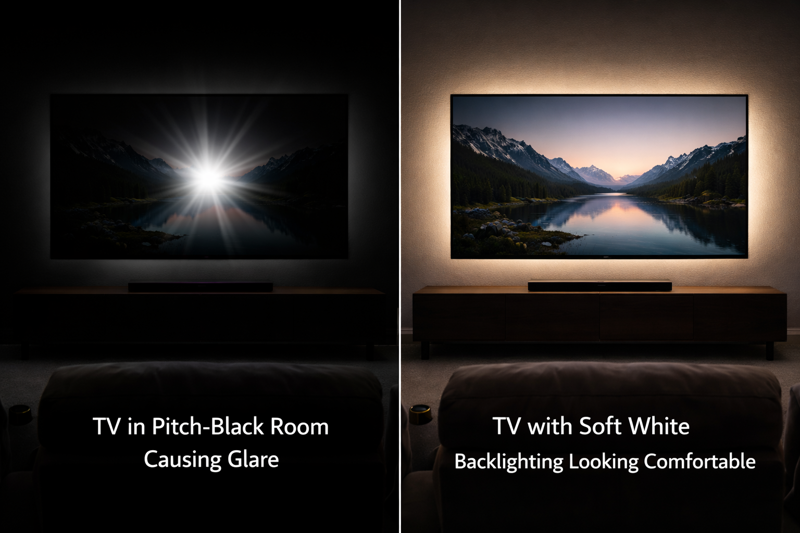
Watching a bright TV or projector screen in a completely dark room forces your pupils to dilate and constrict constantly as film scenes change rapidly from dark to bright. This physiological reaction causes headaches and visual fatigue known as "contrast strain," which ruins the relaxation you expect from a movie night.
"Bias Lighting" involves placing LED strips on the back of your screen or around the projection frame to bounce soft light off the rear wall. This raises the ambient light level just enough to relax your iris without washing out the image contrast, making onscreen blacks appear darker and richer.
The Science of 6500K1, High CRI, and RGBW
When designing lighting for a screen environment, color accuracy is the single most important factor. Film directors unleash their masterpieces using a reference white point of D65, which corresponds roughly to 6500K. If your bias lighting is not calibrated to this temperature, it will distort your perception of the colors on the screen. For example, if you use a "Warm White" strip (2700K or 3000K), your eyes will adjust to the yellow ambient light. Consequently, the white snow or clouds on your television screen will appear bluish by comparison. Conversely, if you use a cheap cool white strip that drifts into 8000K, the image will look muddy and yellow. In our manufacturing facility, we produce specific 6500K Daylight White2 COB strips designed for this exact purpose.
Furthermore, home theaters are rarely just about the screen; they are often tributes to the art of film, decorated with framed movie posters or memorabilia. If you light these display areas with standard retail LEDs (which typically have a Color Rendering Index of < 80), the colors will look "off." The vibrant red of a superhero’s cape or the deep nuances of a vintage noir poster will appear dull, brown, or washed out. To capture the true "Cinema Lobby" feel, you need Ra90 (CRI 90+)3. Our professional COB series maintains Ra90 across all color temperatures. High CRI (Ra90) LEDs contain a fuller spectrum of light, allowing them to reveal the true saturation of colors in your decor.
Finally, I often have clients like you, Tom, ask for simple RGB strips because you want to flood the room with "Deep Blue" or "Red" to match a specific movie theme. While RGB is excellent for mood, it is terrible for functional white light. RGB strips create "white" by mixing Red, Green, and Blue, which often results in a pinkish or bluish tint that ruins your color accuracy. The professional solution is RGBW (Red, Green, Blue + White)4. By adding a dedicated white chip to the strip, you get the best of both worlds without compromise.
| Lighting Goal | Wrong Product choice | Correct Product Choice | Logic & Engineering |
|---|---|---|---|
| Image Fidelity | Warm White (3000K) | Cool White (6500K) | Matches video D65 calibration standards to prevent color shift. |
| Color Depth | CRI 80 (Standard) | Ra90 (High CRI) | Essential for rendering the ink colors in movie posters accurately. |
| Light Aesthetics | Standard SMD (Dots) | COB (Dotless) | Provides a smooth, non-distracting glow that looks like neon. |
| Versatility | Standard RGB | RGBW (4-in-1) | Allows for both pure white functional light and saturated mood colors. |
In a commercial theater, you can walk to the restroom without tripping because of subtle, low-level path lighting. In a typical DIY home theater, turning on a light usually floods the room with brightness, ruining the immersion for everyone else.
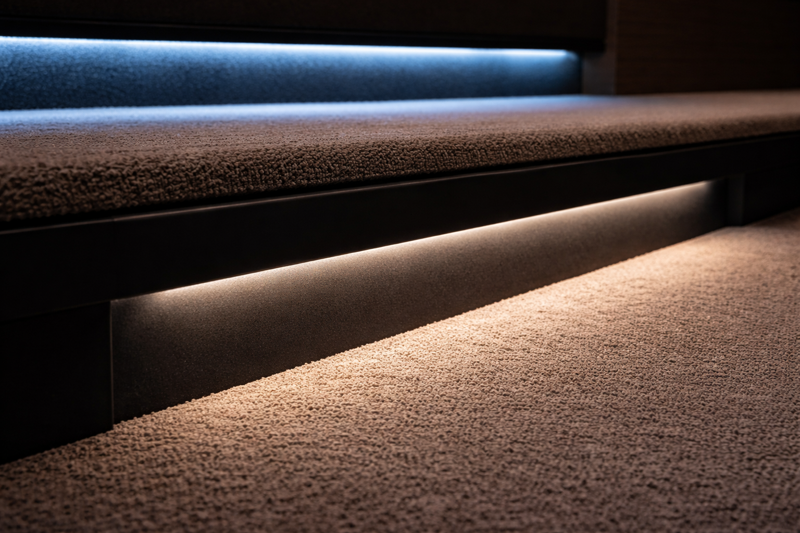
Install LED rope lights in black aluminum profiles along the baseboards or riser steps to create a "Safety Glow." These lights must be dimmable to 1% intensity and should face downward to ensure they never shine directly onto the projector screen or into the viewers’ eyes.
The "Dotless" Necessity and Durability
In a home theater, seating is often low and plush. From this lower vantage point, you are more likely to see the reflection of the floor lighting. If you use standard "SMD" LED strips (like the older 5050 or 2835 styles found in many retail kits), you will see individual "dots" of light reflected in the glossy trim of your risers or on polished floorboards. This "dotted line" effect is incredibly distracting and looks cheap. I strongly recommend using COB (Chip on Board) Strips5. Our COB series packs 480 LEDs per meter6. This tightly packed arrangement eliminates gaps between light sources, creating a solid, neon-like line of light with absolutely no dark spots. Even if you don’t use a deep diffuser cover, the light appears as a continuous, fluid beam.
Lighting near the floor is also vulnerable to hazards that ceiling lights never face. People will step on the edges of the floor risers in the dark, the vacuum cleaner will bump into the baseboards during cleaning, and sodas or popcorn butter will inevitably spill. We manufacture IP65 and IP67 waterproof7 versions of our COB strips. IP65 means the strip is coated in a layer of silicone, protecting the chips from dust and low-pressure water jets (like a damp mop). IP67 means the strip is fully encased in a hollow silicone tube, which is robust enough to withstand temporary submersion. While you don’t need waterproofing for rain inside a theater, the heavy-duty silicone coating acts as mechanical armor. A standard IP20 (bare board) strip effectively has exposed circuitry that will short out if a drink is spilled on it or if it gets kicked; an IP67 strip is virtually indestructible in a residential environment.
You do not want your baseboard light bouncing up and hitting the screen, creating a "hot spot" that washes out the movie. To solve this, you must use the LED strip in conjunction with a Deep Channel aluminum profile with a narrow beam angle. Our strips come in standard widths like 8mm and 10mm, which fit perfectly into these slim architectural profiles.
| Feature | Standard Home Use | Theater Requirement | Why? |
|---|---|---|---|
| Protection | IP20 (Bare PCB) | IP67 (Silicone Tube) | Protects against spills, kicks, and vacuum cleaners. |
| Light Style | Spotted (60 LEDs/m) | COB (480 LEDs/m) | Creates a seamless "Laser" look without distracting dots. |
| Brightness | 100% Output | 1-100% Dimmable | Critical for fading down to "Showtime" levels without flickering. |
| Width | 12mm+ | 8mm/10mm | Fits into discreet, slim profiles to hide the light source. |
How Do You Control 50 Meters of Light with One Remote?
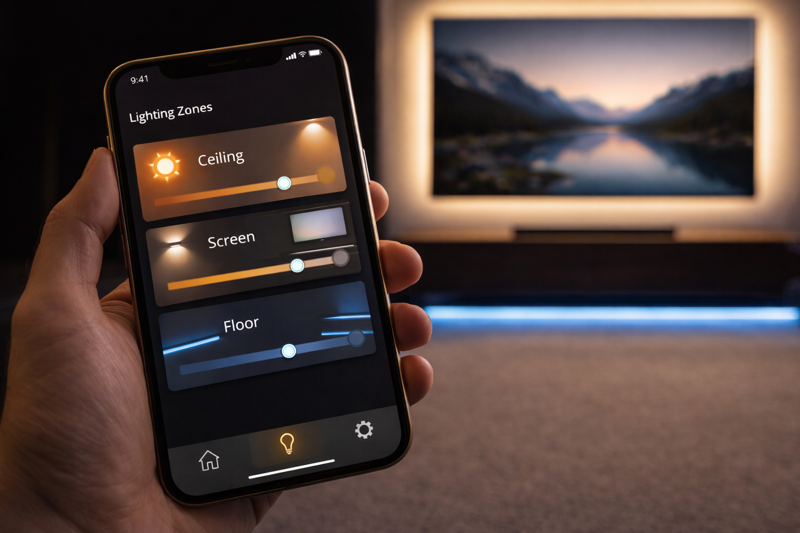
Home theaters often have complex, multi-layered lighting layouts: cove lighting in the ceiling, bias lighting behind the screen, and step lighting on the floor. Running around the room to plug them in individually destroys the "magic" of the experience.
You need a centralized system powered by high-voltage backbones (24V or 48V) to eliminate voltage drop, paired with a Multi-Zone LED Controller. This allows you to group different strips (Ceiling, Screen, Floor) into separate zones but control them all from a single interface.
Voltage Drop, Cutting Precision, and Control
Theaters are usually large rooms, often requiring perimeter runs of 20 meters or more. If you run a standard DC12V strip around the entire ceiling cove, the electrical resistance in the copper PCB causes the voltage to drop as it travels. By the time the power reaches the far end of the strip, the LEDs will look pinkish and dim compared to the start. Always use DC24V or even DC48V systems8 for theater perimeters. Our 24V COB strips allow for cutting lengths of 50mm and can run up to 10 meters with consistent brightness. For massive theater rooms or whole-basement runs, we offer DC48V options. A 48V system reduces the current flowing through the strip, which means you can run very long lengths (up to 30-50 meters) without needing to inject power every few meters. This simplifies installation significantly because you don’t need to hide bulky transformers in every corner of the ceiling.
There is a trade-off in LED strip engineering between voltage and cutting precision9. When installing lighting in precise architectural coves or behind screens, you need the strip to fit exactly. 12V strips typically have a smaller cutting unit, often around 25mm, which is great for tiny furniture. 24V strips typically have a cutting unit of 50mm. While 12V offers slightly more precise cutting, the voltage drop issues make it unsuitable for perimeter lighting. The 24V system is the professional balance between run length and cutting precision.
Finally, we manufacture "Magic Color" or "Pixel" strips (using IC chips) that can create chasing rainbow effects. My honest advice is that these are great for a "Game Room" vibe, but they are distracting for a pure "Cinema" vibe. Nothing ruins a dramatic, emotional movie scene faster than a rainbow LED chasing itself around your ceiling in your peripheral vision. If you want the best of both worlds, use an addressable RGB strip10 that also has a dedicated White channel. However, for most adults, a high-quality static color setup using 24V COB technology11 is more elegant. It provides a solid, unwavering wall of light that acts as architectural decor rather than a gimmicky toy.
| Setup | Why it fails | Why it succeeds | |
|---|---|---|---|
| Power Voltage | 12V (Dimming ends, pink hue) | 24V or 48V (Consistent) | Ensures uniform brightness across the entire large room. |
| Run Length | Short (5m max) | Long (up to 20m+ with 48V) | Simplifies wiring by reducing the number of power supplies needed. |
| Cut Unit | 25mm (High precision) | 50mm (Balanced) | 24V offers the best compromise of length and precision. |
| Effect | Rainbow Chase (Distracting) | Static Scenes (Immersive) | Keeps the focus on the content, not the lighting hardware. |
Conclusion
A true home theater is defined by contrast and control. Use 6500K Bias Lighting to save your eyes and preserve the director’s intent, install 480 LEDs/m COB strips for invisible, seamless path lighting, and invest in a 24V or 48V system that gives you balanced brightness across the whole room. Don’t let bad lighting be the plot hole in your home theater design.
-
Understanding 6500K is crucial for achieving accurate color representation in screen environments. ↩
-
These strips are designed for optimal color accuracy, making them ideal for home theaters and display areas. ↩
-
Ra90 ensures vibrant colors in your decor, making it essential for any film enthusiast’s home theater. ↩
-
RGBW offers the perfect blend of mood lighting and functional white light, enhancing your viewing experience. ↩
-
Explore the advantages of COB strips for seamless lighting in your home theater, enhancing both aesthetics and functionality. ↩
-
Discover how a higher LED density creates a more uniform light output, perfect for immersive home theater experiences. ↩
-
Understanding IP ratings helps you choose the right waterproof lighting for durability and protection in your home. ↩
-
Explore the advantages of higher voltage systems for consistent brightness and longer runs in large spaces. ↩
-
Understand the importance of cutting precision for achieving seamless installations in various applications. ↩
-
Discover how addressable RGB strips can enhance lighting effects while maintaining a dedicated white channel for elegance. ↩
-
Learn how 24V COB technology enhances lighting quality and design in architectural settings. ↩
Interested in Our LED Solutions?
Get professional consultation and customized LED lighting solutions for your projects. Contact our expert team today.
Related Articles

How Do You Build Profitable Custom Vehicle and RV Interior LED Rope Lights?
You lose RV installation contracts because your interior lights fail on rough roads. Standard strips show bright dots on glossy…

How to Perfect Bookshelf and Display Cabinet LED Rope Lighting?
You lose retail clients when bookshelves look incredibly dark. Ugly shadows hide expensive products inside display cabinets daily. You need…

How to Master Mirror and Vanity LED Rope Light Installation?
Your clients complain about ugly shadows in their bathroom mirrors. Bad lighting ruins expensive vanity designs. You lose future contracts…
