

Is Your Landscape Lighting Business Leaking Profits Due to Cheap LED Strips?
You finish a $50,000 landscape project, the client is happy, and you get paid. But three months later, the phone rings with news that the lights under the retaining wall are dead, forcing you to send a crew back to replace them for free.
To scale a profitable landscape lighting business, you must stop treating LED strips as a commodity. You need to switch to "Current Regulated" IP68 Silicone Strips. These professional-grade lights eliminate voltage drop over long garden runs, resist the acidity of soil and fertilizers, and prevent the "dotted" look that cheapens high-end stone work.
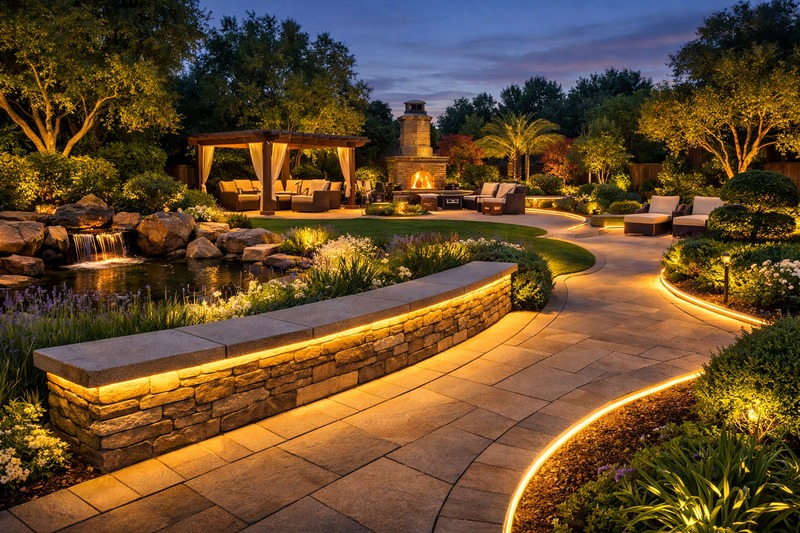
In my years running a factory here in China, I have seen thousands of orders from US distributors. I can tell instantly which businesses will succeed and which will fail just by looking at their spec sheets. The failing businesses buy the cheapest 12V rolls they can find on Alibaba. The successful ones—the ones building million-dollar reputations—buy specific engineering solutions that survive the harsh outdoors. They know that the cost of the light is nothing compared to the cost of labor. Let me show you the three technical upgrades that will stop your callbacks and increase your referrals.
Why Do Standard Waterproof Strips Rot in the Garden?
Most contractors think "waterproof" is a simple Yes/No question, so they see an IP65 rating and think it is safe for the garden. They are wrong because standard glue-covered strips are not designed for the chemical warfare happening in your client’s soil.
You must abandon Epoxy and PVC coatings in favor of "Solid Dual-Extrusion Silicone." Silicone is an inorganic material that is immune to the corrosive nitrogen in fertilizers and the UV radiation that cracks standard plastics. Only solid silicone injection (IP68) can stop water from wicking up the wire and destroying the circuit.
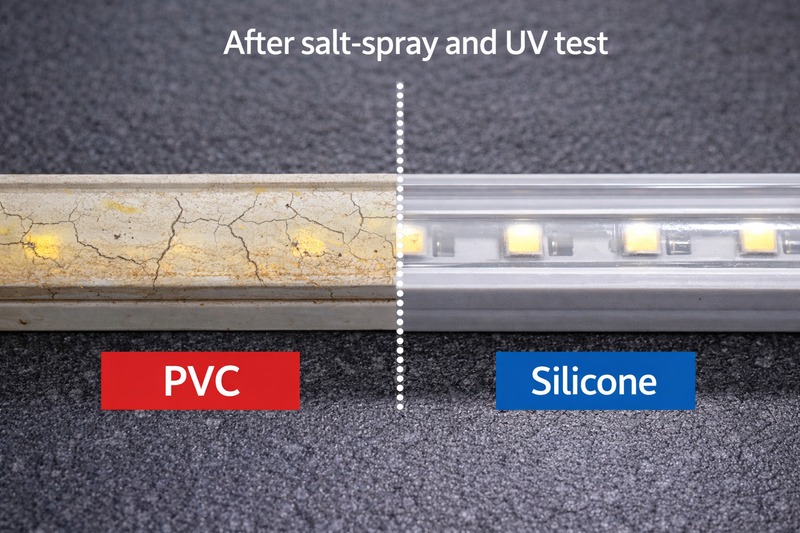
Let’s dig into the chemistry, because this is where your money is disappearing efficiently. Most cheap "outdoor" strips use PVC (Polyvinyl Chloride) or PU (Polyurethane). These are organic polymers.
The Hidden Chemistry of Plastic Failure
To make PVC flexible, manufacturers add chemicals called plasticizers. In an outdoor landscape environment, your lights are exposed to UV sunlight and Soil Chemistry. Consistently, UV light breaks down these plasticizers. They evaporate. The clear coating turns yellow (shifting your nice 3000K light to a sickly 2300K brown) and then it cracks. Furthermore, garden fertilizers are rich in nitrogen and sulfur. These chemicals react aggressively with PU and PVC, often turning strips installed in flower beds into a sticky, melted mess after just one season.
The Solid Silicone Solution
The solution I manufacture for professional clients is Food-Grade Silicone1. Silicone is inorganic. It does not react with fertilizer. It does not degrade under UV light. We use a "Solid Injection" process where we don’t just put a sleeve over the strip; we fill every tiny air gap with liquid silicone to create a solid block of protection. Additionally, we add a "Water-Stop" block in the lead wire. In landscape business, if a wire nut is not sealed perfectly, water will travel inside the copper wire insulation like a straw. Our solid injection blocks this path perfectly.
| Feature | Epoxy / PU Glue | PVC Tube | Solid Silicone Extrusion |
|---|---|---|---|
| UV Resistance2 | Poor (Yellows in 3 months) | Medium (Yellows in 6-12 months) | Excellent (Years of clarity) |
| Chemical Resistance | Low (Melts with fertilizer) | Low (Hardens with cold) | High (inert to acids/alkalis) |
| Waterproofing | IP65 (Splash only) | IP67 (Rain only) | IP68 (Submersible) |
| Thermal Range | Cracks in winter | Stiff in winter | Flexible from -40°F to 140°F |
How Can You Run 50 Feet of Light Without Dimming?
Nothing creates a "cheap" look faster than a long retaining wall where the light is bright on the left and dim on the right. This is Voltage Drop, and it is the enemy of clean, professional hardscape design.
Stop using standard 12V or constant-voltage 24V strips for hardscapes. Switch to "Constant Current (CC)" Integrated Circuit strips. These chips regulate the energy flow at every cut point, guaranteeing that the first LED and the last LED over a 20-meter (65-foot) run have exactly the same brightness.
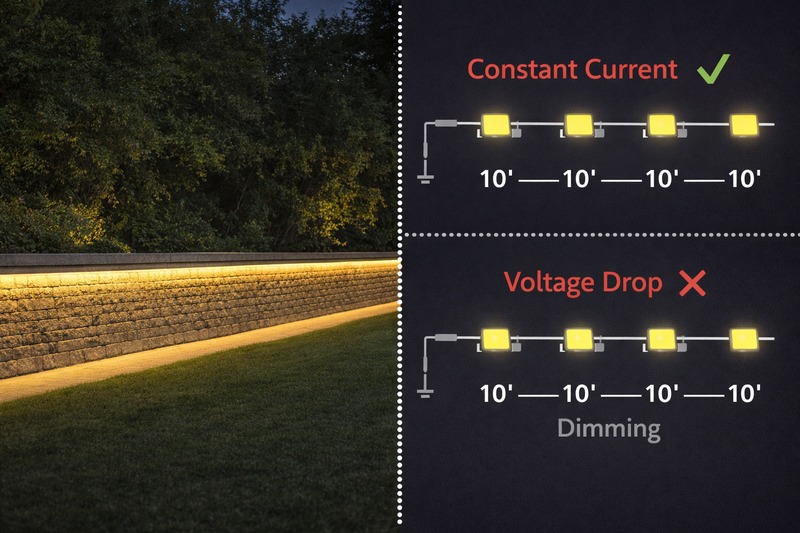
In landscape design, you rarely work with short 5-meter lengths. You are lighting long driveways, perimeter fences, or massive tiered stone walls. If you use a standard 12V strip, you are fighting Ohm’s Law.
Fighting Ohm’s Law in the Garden
As electricity travels through the copper PCB, it meets resistance, causing voltage to be lost. By the time the power reaches 20 feet, the voltage might drop from 12V to 10V, causing the LEDs to dim visibly. To fix this the "old way," your installers have to run "home runs" of thick 12-gauge wire3 back to the transformer for every 16 feet of light. This approach requires more trenching, more wire, more labor, and more connectors (which are failure points).
The Integrated Circuit (IC) Advantage
The "Factory Insider" solution is Constant Current (CC) LED Strips4. We mount a small transistor (IC) on the strip itself for every group of LEDs. This IC acts like a gatekeeper. It doesn’t matter if the voltage arriving at the chip is 24V, 23V, or even 21V; the IC automatically adjusts its resistance to ensure exactly 20mA of current flows to the LED. This means you can run a single strip for 15 to 20 meters (up to 65 feet) powered from one end. For massive commercial estates, we even produce 48V systems that can run 50 meters (165 feet) on a single connection.
| System Voltage | Max Run (Standard) | Max Run (Constant Current) | Installation Benefit |
|---|---|---|---|
| 12 Volt | 16 ft (5m) | Not Recommended | Good for small step lights only. |
| 24 Volt | 32 ft (10m) | 65 ft (20m) | Standard for most retaining walls. |
| 48 Volt | 65 ft (20m) | 165 ft (50m) | Best for perimeter fencing & driveways. |
Why Does "Dot-Free" Lighting Matter for Stone Surfaces?
Hardscape materials like granite, marble, and polished concrete are expensive, so your clients pay for these textures. If your lighting reflects harsh rows of dots, you ruin the aesthetic value of the stone and make the installation look like a DIY project.
You must utilize COB (Chip on Board) technology for any application involving reflective surfaces or direct-view lines. COB strips pack 480+ chips per meter under a continuous phosphor layer, creating a seamless "laser beam" of solid light that enhances, rather than distracts from, the architecture.
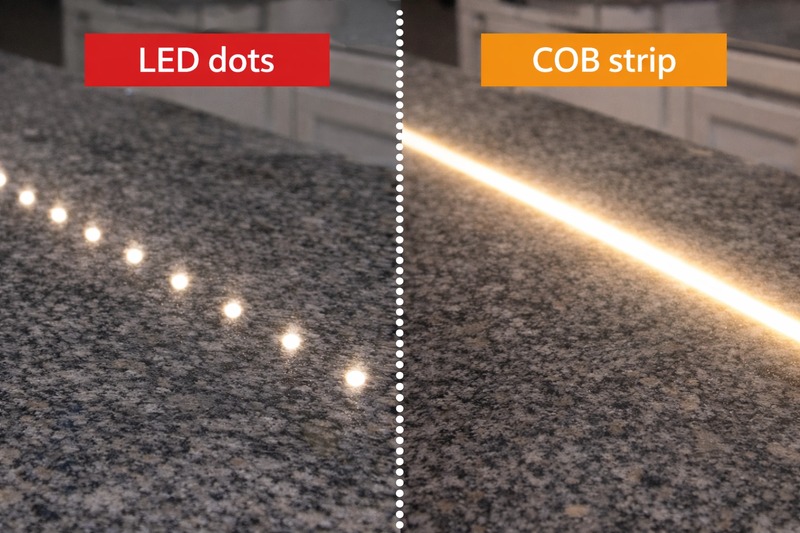
Aesthetics are subjective, but quality is objective. In luxury landscape lighting, the goal is to see the light, not the light fixture. Standard "SMD" strips (the ones with the little yellow squares spaced apart) point light sources every inch or so.
Eliminating the "Scallop" Effect
When you mount older style strips under a capstone on a retaining wall, two bad things happen. First, the Shadow Effect5: if the strip is close to the wall, you see "scalloping"—little cones of light and dark shadows that look busy. Second, the Glare: on wet pavement, each LED creates a harsh reflection. COB (Chip on Board) is the revolution here. We mount the LED dies directly to the circuit board—hundreds of them next to each other—and then cover the unlimited line with a single layer of silicone phosphor, creating a single, continuous bar of light without dots or shadows.
The Importance of MacAdam Ellipse
You also need to care about Color Consistency6. Imagine a client calls you two years later to extend their garden path. You buy a new roll of "3000K" light, but the old lights look yellow, and the new lights look slightly pink. Cheap suppliers sell "loose bin" LEDs that vary wildly. Professional factories like mine use 3-Step MacAdam Ellipse binning. We strictly sort the chips. If you buy 3000K from me today, and buy 3000K from me in three years, I can guarantee they will match visually.
| Metric | Standard Generic Strip | Professional COB Strip | Impact on Landscape |
|---|---|---|---|
| Dot Visibility | Visible dots imply cheapness | Zero dots (Seamless) | High-end, custom look. |
| Beam Angle | 120 Degrees | 180 Degrees | Softer, wider wash of light on paths. |
| Color Binning | 5-7 Step (Inconsistent) | 3-Step (Tight/Consistent) | Perfect matching for repairs/expansions. |
| CRI | 70-80 (Dull colors) | 90+ (Vibrant colors) | Plants look green, flowers look vivid. |
Conclusion
Landscape lighting is 10% design and 90% engineering. By sourcing IP68 Silicone, Constant Current, and COB strips directly from a factory that understands these physics, you stop losing money on repairs and start building a portfolio that commands higher prices.
-
Explore the advantages of Food-Grade Silicone for outdoor use, ensuring durability and resistance to environmental factors. ↩
-
Learn about UV Resistance and its importance in prolonging the life of outdoor materials, crucial for landscaping and construction. ↩
-
Learn about the importance of 12-gauge wire in minimizing resistance and ensuring optimal performance in electrical systems. ↩
-
Explore the advantages of CC LED Strips for efficient lighting solutions and reduced voltage drop. ↩
-
Understanding the Shadow Effect can help you avoid common lighting mistakes and enhance your design. ↩
-
Exploring Color Consistency will ensure your lighting projects maintain a uniform look over time, crucial for aesthetics. ↩
Interested in Our LED Solutions?
Get professional consultation and customized LED lighting solutions for your projects. Contact our expert team today.
Related Articles

How Do You Build Profitable Custom Vehicle and RV Interior LED Rope Lights?
You lose RV installation contracts because your interior lights fail on rough roads. Standard strips show bright dots on glossy…

How to Perfect Bookshelf and Display Cabinet LED Rope Lighting?
You lose retail clients when bookshelves look incredibly dark. Ugly shadows hide expensive products inside display cabinets daily. You need…

How to Master Mirror and Vanity LED Rope Light Installation?
Your clients complain about ugly shadows in their bathroom mirrors. Bad lighting ruins expensive vanity designs. You lose future contracts…
