

Is Your Outdoor Lighting Stuck in the 90s? Outdoor LED Strip Lights vs Rope Lights?
You walk past a high-end commercial building, and the lighting looks sleek, uniform, and architectural. Then you walk past a local diner, and the lighting looks like leftover Christmas decorations that were never taken down. This is the visible difference between professional LED Strip Lights and old-school Rope Lights.
The choice is clear for professional installers: Rope lights are outdated, dim, and difficult to customize, suitable only for temporary holiday decor. LED Strip lights are the modern standard, offering superior brightness, precise cutting intervals, and architectural-grade durability for permanent installations.
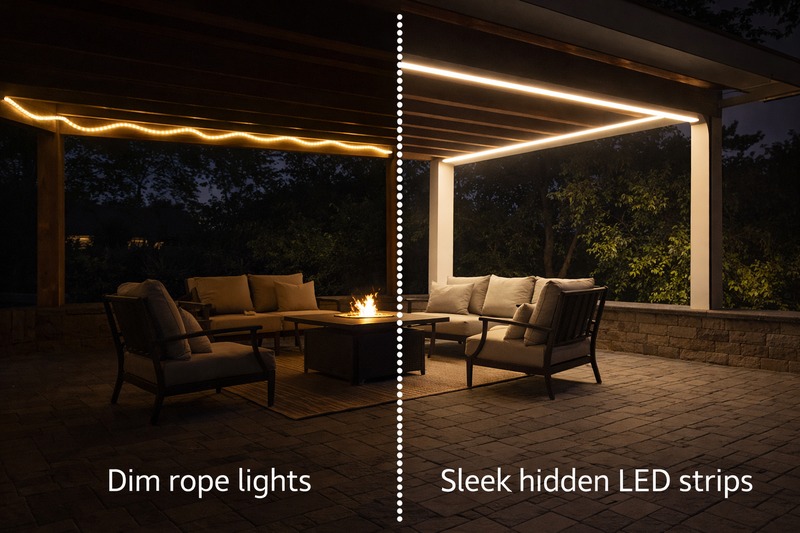
In the early 2000s, rope lights were the only game in town for outdoor linear lighting. I used to ship containers of them. But technology has moved on. Today, as a factory owner, I see successful US distributors phasing out rope lights entirely in favor of IP68 LED Strips and Neon Flex. If you are still pitching rope lights to your clients for permanent hardscape or architectural projects, you are leaving money on the table and risking a cheap aesthetic. Let’s break down the engineering so you can explain to your clients why they need to pay for the upgrade.
Do You Want a Faint Glow or Professional Illumination?
Clients often say they just want "accent lighting," but they are disappointed when the result looks like a dim toy. Understanding the output difference between these two technologies is critical for managing expectations.
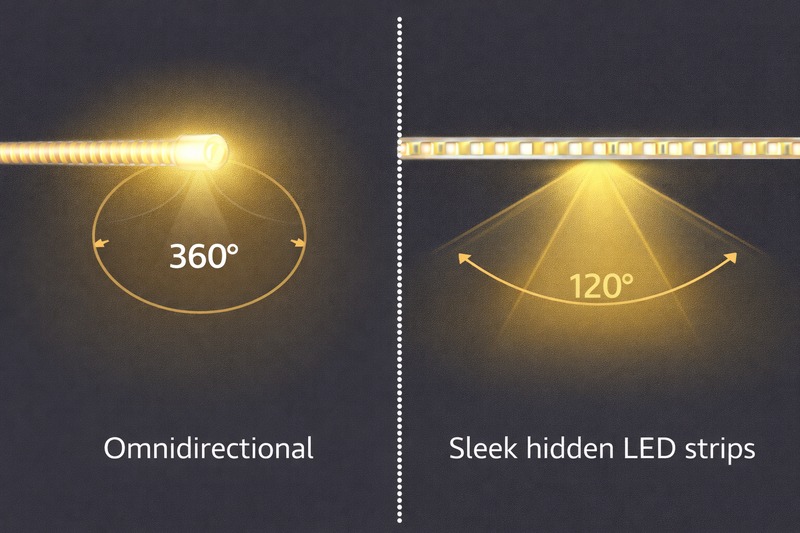
Rope lights are omni-directional and typically produce less than 100 lumens per foot, causing light to be wasted inside the wall or ground. LED Strips are directional (120-degree beam) and can easily exceed 500 to 1000 lumens per foot, putting the light exactly where you need it.
The Physics of Light Efficiency
To understand why rope lights look so dim, you have to look inside the tube. A traditional rope light consists of LEDs placed vertically inside a round, clear plastic tube. Because the tube is round, the light shoots out in 360 degrees. While this sounds good in theory, in practice, it is wasteful. If you mount a rope light under a stair tread or a capstone, 50% of that light is shining directly into the concrete or wood behind it. You are paying for electricity that is immediately absorbed by the mounting surface.
Furthermore, the plastic tubing used in rope lights is thick and often slightly cloudy to diffuse the "hot spots." This absorbs even more light output1. Generally, a standard rope light struggles to produce 15 to 20 lumens per watt. It is simply inefficient technology.
The Power of Directional LED Strips2
In contrast, an LED strip light is a flat, flexible Printed Circuit Board (PCB)3. The Surface Mounted Diodes (SMD) are mounted flat on the board. This creates a focused, 120-degree beam angle. When you mount this under a cabinet or a retaining wall, 100% of the light is directed outward and downward onto the path or subject.
In my factory, we engineer strips specifically for high output4. We can pack 120, 240, or even more chips onto a single meter. This density creates high intensity. For outdoor architectural washing, we use high-power chips that turn the strip into a legitimate light fixture, not just a decoration. When your client wants to see the texture of their stone wall from 20 feet away, a rope light will fail every time. An LED strip will deliver the punch required to highlight the architecture.
| Feature | LED Rope Light | LED Strip Light | The Result |
|---|---|---|---|
| Beam Angle | 360° (Omni-directional) | 120° (Directional) | Strips focus light; Rope lights waste it. |
| Brightness | Low (50-150 lm/ft) | High (200-1000+ lm/ft) | Strips provide functional light; Rope is just decor. |
| Efficiency | Low (Light trapped in tube) | High (Direct emission) | Strips give more light for less power. |
| Visual Effect | Grainy, visible dots | Smooth, seamless option | Strips look like a solid bar of light (COB). |
Can You Install Around Corners Without Ugly Bulges?
Nothing screams "amateur installation" like a light fixture that sags, bulges at the corners, or leaves dark spots because it couldn’t be cut to the right length. Mechanical flexibility is where strips vastly outperform ropes.
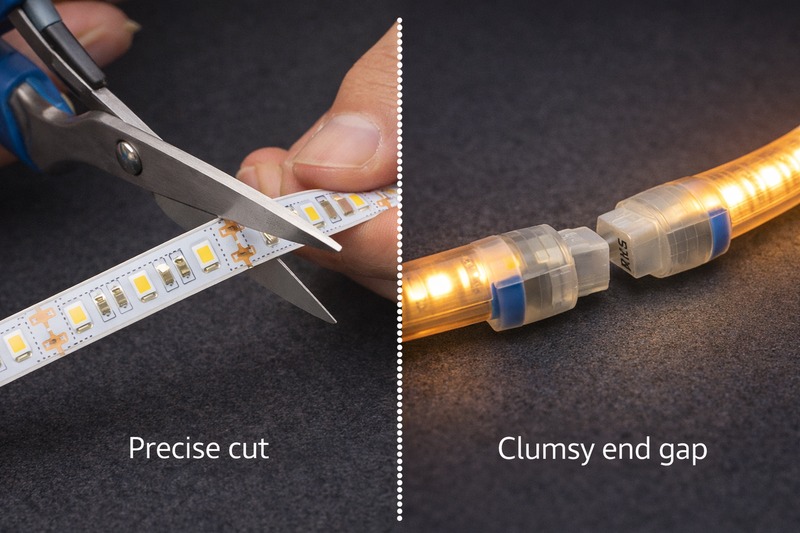
Rope lights have massive cutting intervals (often 18 to 24 inches) and a thick radius that makes sharp corners impossible. LED strips can be cut every 1 to 2 inches and lie perfectly flat, allowing for a custom, "built-in" appearance that commands a higher installation fee.
Mounting and Form Factor
Rope lights are heavy cylinders. They don’t have adhesive backs because the contact area with the wall is too small. To install them, you have to nail in plastic "P-clips" or tracks every foot. These clips are visible, they crack in the sun, and they ruin the clean lines of the building. Plus, trying to make a 90-degree turn with a 1/2-inch thick tube is impossible. You end up with a large, bulbous curve that sticks out.
LED strips are paper-thin and come with 3M VHB (Very High Bond) tape5 on the back. For outdoor use, we recommend putting them inside an aluminum channel. The strip sits flat inside the channel, and the channel can be miter-cut for sharp 90-degree corners. The profile is low—often less than half an inch high—so the light source effectively disappears. When the lights are off, you don’t see the fixture. When the lights are on, you only see the glow. That is the definition of professional design.
| Feature | LED Rope Light | LED Strip Light | Installation Impact |
|---|---|---|---|
| Cut Length | Every 18-30 inches | Every 1-2 inches | Strips fit perfectly; Rope lights leave gaps. |
| Profile | Round, thick (0.5 inch+) | Flat, thin (0.1 inch) | Strips hide easily; Rope lights are bulky. |
| Mounting | Ugly plastic clips | 3M Tape or Aluminum Channel | Strips look integrated and clean. |
| Cornering | Large bend radius | Sharp corners / Connectors | Strips follow the architecture precisely. |
Will Your Lights Survive the Heat Trap?
We often worry about water, but in the world of LEDs, heat is the silent killer. The structural design of your lighting determines whether it lasts 6 months or 6 years.
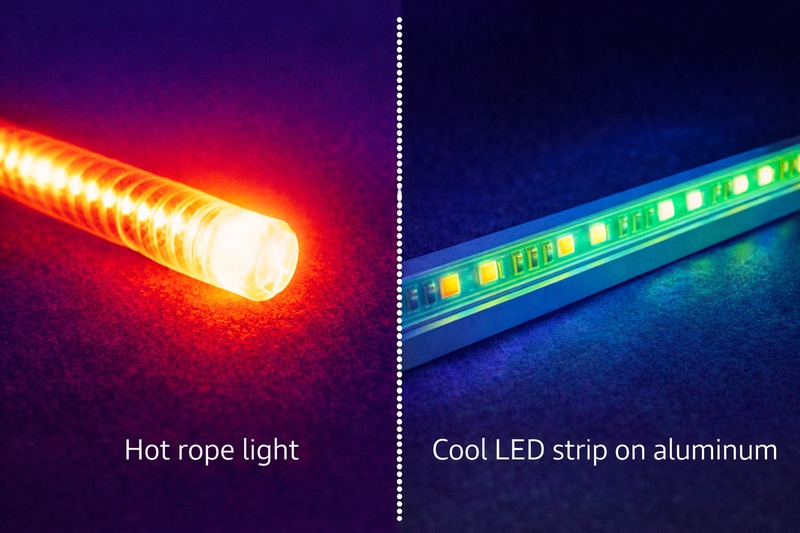
Rope lights are made of thick PVC that acts as a thermal insulator, trapping heat inside and cooking the LEDs to early death. Professional LED Strips use a copper PCB to dissipate heat, and when paired with aluminum channels, they run cool enough to last for 50,000+ hours.
The Greenhouse Effect in Rope Lights
Rope lights were originally designed for incandescent bulbs, where the filament got hot, but the goal was just temporary holiday use. When manufacturers switched to LEDs, they kept the same cheap PVC tube design. PVC (Polyvinyl Chloride) is a fantastic insulator. It keeps electricity in, but it also keeps heat in.
When you run an LED rope light, the diodes generate heat. That heat has nowhere to go. It gets trapped inside the tube, creating a "greenhouse effect6." Heat degrades the phosphor coating on the LED (turning the light blue or purple) and damages the internal wire bonds. This is why you see so many dead sections in rope lights after just one summer. The ambient outdoor heat combined with the trapped internal heat cooks the components.
Thermal Management in LED Strips
Professional LED strips are built on a PCB (Printed Circuit Board). As a factory, we pay very close attention to the thickness of this copper board (measured in ounces, typically 2oz or 3oz for high power). Copper is an excellent thermal conductor. It pulls the heat away from the LED chip and spreads it out along the length of the strip.
Furthermore, professional installers rarely mount a strip directly to wood or stone. They stick it into an Aluminum Profile7. This aluminum acts as a giant heat sink. It absorbs the heat from the strip and dissipates it into the air. This active thermal management8 keeps the LED junction temperature low. A cooler LED is a brighter LED, and more importantly, a longer-lasting LED. By moving away from plastic tubes to copper and aluminum, you are essentially upgrading from a toy to an industrial component.
Material Science: PVC vs. Silicone
Finally, let’s talk about the outer shell. Rope lights are almost exclusively PVC. PVC is cheap, but UV stability is poor. Under the US sun, it turns yellow and brittle within a year. Once it cracks, water gets in.
For our outdoor strips, we use IP68 Food-Grade Silicone9. As I mentioned in other articles, silicone is inorganic. It withstands high temperatures without melting and resists UV radiation without yellowing. While there are "Neon Flex" products that look like rope lights, they are actually silicone-encased LED strips, which is a superior technology that combines the look of a tube with the engineering of a strip.
| Feature | LED Rope Light | LED Strip Light | Longevity Impact |
|---|---|---|---|
| Material | PVC | Copper PCB + Silicone | Silicone outlasts PVC by years outdoor. |
| Heat Dissipation | Traps heat (Insulator) | Sheds heat (Conductor) | Heat is the killer of LEDs. |
| UV Resistance | Yellows/Cracks quickly | Excellent (Silicone) | Keeps light color consistent. |
| Repairability | Throw away | Section replacement | Strips are modular and serviceable. |
Conclusion
Rope lights are for Christmas trees; LED strips are for architecture. If you want to increase your project value and reduce callbacks, switch to High-Lumen, Silicone-Encased LED Strips mounted in aluminum channels. It is the only way to deliver the professional, permanent finish that high-paying clients expect.
-
Understanding light output is crucial for selecting the right lighting; this resource will enhance your knowledge on efficiency. ↩
-
Explore the advantages of Directional LED Strips for efficient lighting solutions that maximize brightness and minimize waste. ↩
-
Learn about PCBs in LED technology and their role in enhancing lighting efficiency and performance. ↩
-
Discover what high output means in LED lighting and how it can transform your space with superior brightness. ↩
-
Learn about the effectiveness of 3M VHB tape in securing lights, ensuring a clean and professional finish in your installations. ↩
-
Understanding the greenhouse effect in LED rope lights can help you choose better lighting solutions that last longer. ↩
-
Learn how using an Aluminum Profile can significantly improve heat dissipation and overall performance of LED strips. ↩
-
Explore how effective thermal management enhances LED performance and longevity, ensuring brighter and more durable lighting. ↩
-
Discover why IP68 Food-Grade Silicone is superior for outdoor LED applications, offering durability and UV resistance. ↩
Interested in Our LED Solutions?
Get professional consultation and customized LED lighting solutions for your projects. Contact our expert team today.
Related Articles

How Do You Build Profitable Custom Vehicle and RV Interior LED Rope Lights?
You lose RV installation contracts because your interior lights fail on rough roads. Standard strips show bright dots on glossy…

How to Perfect Bookshelf and Display Cabinet LED Rope Lighting?
You lose retail clients when bookshelves look incredibly dark. Ugly shadows hide expensive products inside display cabinets daily. You need…

How to Master Mirror and Vanity LED Rope Light Installation?
Your clients complain about ugly shadows in their bathroom mirrors. Bad lighting ruins expensive vanity designs. You lose future contracts…
