

LED Density in Rope Lights: Spacing and Appearance (Why “Dots” Are destroying Your Design)
Imagine walking into a multi-million dollar hotel lobby. The marble is Italian, the furniture is velvet, and the lighting… looks like a cheap string of Christmas lights stuck under the counter. The dreaded "spotting" effect—where you can see every single individual LED chip reflecting off the floor—is the hallmark of amateur lighting design. It turns a luxury space into a budget project instantly.
The key to a seamless, premium "neon" look lies in High-Density LED spacing. Traditional strips with 60 or 120 LEDs per meter create visible gaps (hotspots). To achieve a flawless, continuous line of light without diffusers, you must upgrade to COB (Chip-on-Board) technology with densities of 480, 630, or even 840 LEDs per meter, eliminating dark areas entirely.
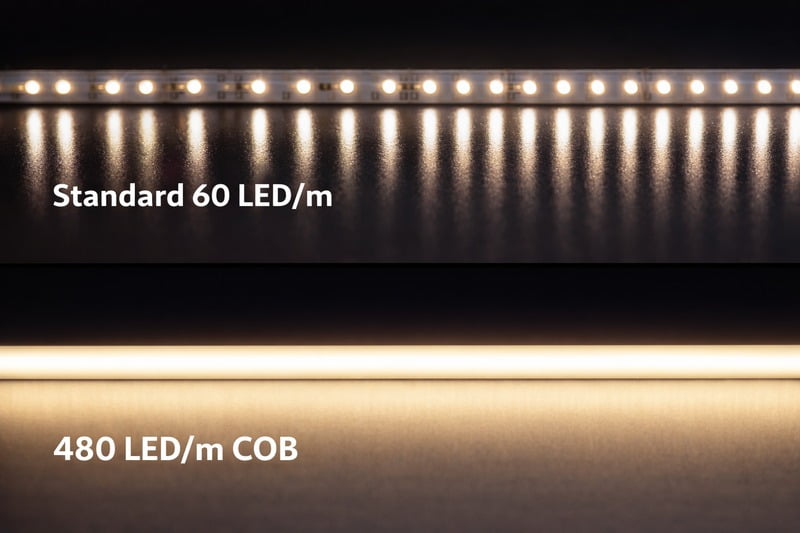
As someone who runs a factory producing thousands of kilometers of LED strips for the US and Japanese markets, I have had countless conversations with contractors who try to save fifty cents a meter by buying low-density strips, only to spend hundreds of dollars later on expensive aluminum diffusers to hide the dots. It is a false economy. Today, I am going to explain exactly how "Quantity of Lampwicks" (LED density) dictates the final appearance of your project, and why high-density COB is rapidly killing off the old SMD strips.
Why Do "Standard" LED Strips Look So Cheap?
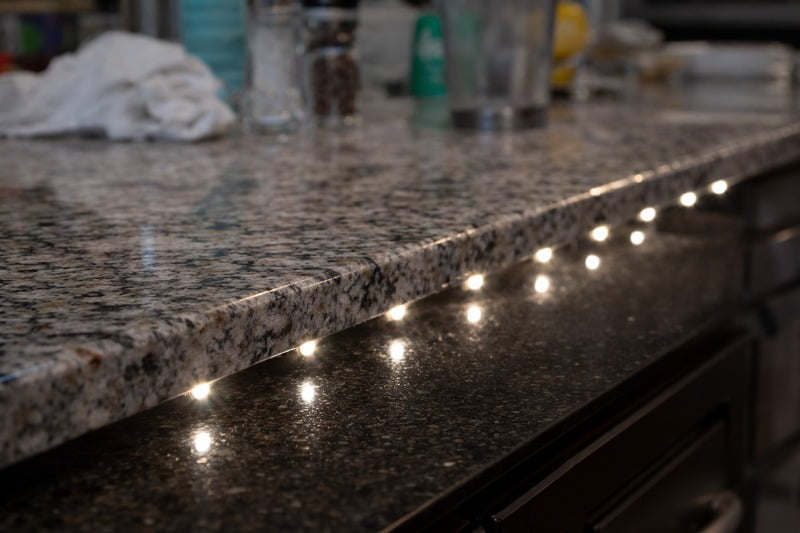
We have all seen it. You install a strip under a glossy quartz countertop. You turn it on, and instead of a glow, you get a reflection that looks like Morse code: Dot. Dot. Dot. Dark space. Dot. Why is this happening?
Standard SMD (Surface Mounted Device) strips typically space chips 10mm to 20mm apart. On a highly reflective surface like granite or glass, the physical distance between the light sources creates visible gaps. Unless you use a very deep aluminum channel with a thick milky cover (which reduces brightness), these "dots" are unavoidable with low-density strips.
The Physics of Pitch and Distance
In the lighting industry, we talk about "Pitch." This is the distance from the center of one LED chip1 to the center of the next.
The Old Standard (SMD 5050/2835):
- 60 LEDs/meter: The pitch is roughly 16mm. This is huge.
- 120 LEDs/meter: The pitch is roughly 8mm. Better, but still visible if the strip is close to the surface it is illuminating.
- The Flaw: Light spreads out in a cone shape (usually 120 degrees). If the chips are too far apart, the cones don’t overlap before they hit the surface. That gap between the cones is the "dark spot."
The Aesthetic Cost:
When a client (like a homeowner or a hotel manager) sees "dots," their brain interprets it as "temporary" or "unfinished." It looks like signage lighting rather than architectural lighting.
- Reflective Surfaces are Unforgiving: If you are lighting a jewelry display case with glass shelves, low density is a disaster. You will see 60 dazzling points of light blinding the customer, creating glare that makes it hard to see the diamond rings.
- The Expensive Fix: To fix this with old technology, you had to buy deep aluminum profiles. Deep profiles cost more money and take up more physical space in the cabinet.
My Factory Experience:
I regularly have customers ask, "Jeremy, why is your quote for the 480 LED/m strip higher than the 60 LED/m strip?"
I tell them: "Because you are buying a finished light fixture, not a component." With high density2, the strip is the smooth light. You don’t need to engineer a way to hide it. You are paying for the aesthetic result, not just the copper and silicon.
How Does COB Technology Eliminate the "Dark Area"?
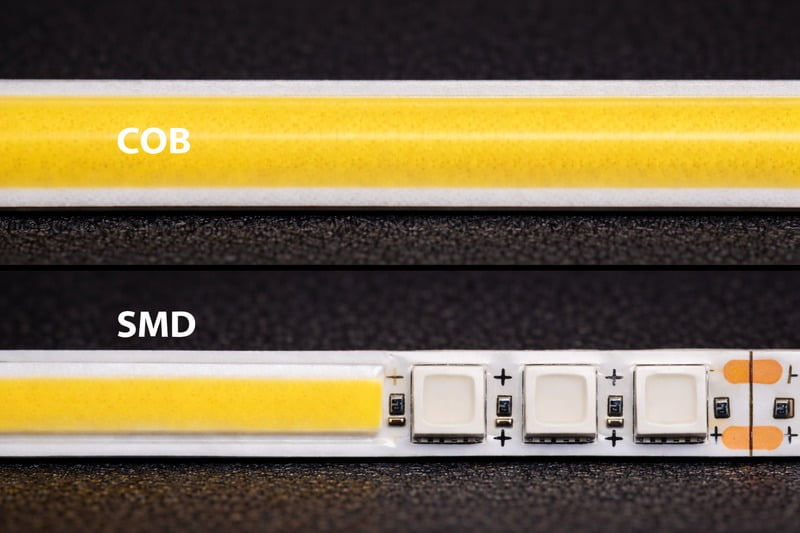
You want a line of light that looks like a laser beam or a glowing neon tube. You don’t want to see the yellow phosphor squares. Enter COB (Chip on Board), the technology that has completely changed our production lines in China.
COB technology mounts the LED chips directly onto the PCB and covers them with a continuous layer of phosphor silicone. Because there are no plastic housings separating the chips, we can pack 480 to 840 LEDs per meter. This creates a single, uniform light source with absolutely zero dark areas, even without a diffuser cover.
The "No Light Spots" Promise
If you look at our technical catalogs, you will see the phrase "no light spots3" and "no dark areas" repeated constantly. This isn’t just marketing; it is a description of the physical construction.
Density Breakdown:
- 480 LEDs/m: This is our standard for COB. That is one LED every 2mm.
- At this density, the light cones overlap immediately. Even if you place the strip 5mm away from a wall, you will see a smooth wash of light.
- 630 LEDs/m: Used for our RGBWC (5-in-1) strips. This insane density is required to mix 5 different colors (Red, Green, Blue, Warm White, Cool White) evenly. If we used low density here, you would see "rainbow separation" where the red chip looks red and the blue chip looks blue. With 630 LEDs/m, the colors blend instantly into a perfect pastel or white.
- 810 or 840 LEDs/m: This is the Formula 1 of LED strips. We use this for high-power vibrant RGB applications. The board is practically solid silicon.
The "Soft Light" Effect:
Because the COB strip is covered in a layer of yellow phosphor silicone, the light is naturally diffused before it even leaves the strip.
- Glare Reduction: The light is "soft." It doesn’t sting your eyes if you look directly at it, unlike the harsh point-source glare of an exposed SMD chip.
- High Light Transmittance: Even though it is diffused, the efficiency is still high. Our 480 LED/m strips achieve Ra90 (Color Rendering Index), meaning the light quality is museum-grade.
Visual Consistency:
Imagine bending a light around a curved reception desk.
- With SMD (Old style): You see the gaps widen as the strip bends.
- With COB (High Density): The excellent resistance to folding and bending4 means the light stays uniform. There is no "sense of LED bead particles." It looks like a flexible neon tube that you just peeled and stuck.
Does High Density Impact Flexibility and Cutting?
You are installing lights in a complex custom niche. You get to the end, and you need to cut the strip. With old strips, you had to cut every 4 inches, leaving a dark corner. Does packing 480 LEDs into a meter change how you cut and bend the light?
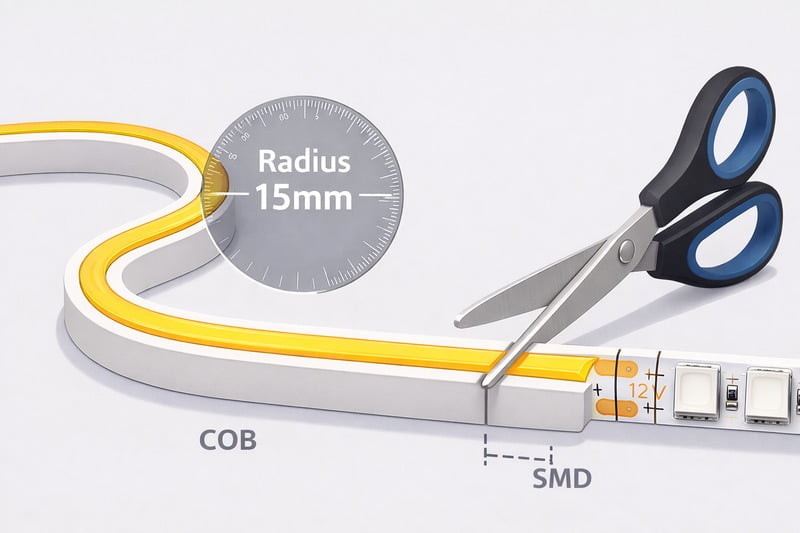
High-density strips offer superior precision. While a standard 24V strip cuts every 100mm, a high-density 480 LED/m COB strip can be cut every 50mm or even shorter (depending on voltage). Furthermore, the continuous phosphor coating acts as a structural reinforcement, allowing for tighter bending radii (R > 15mm) without the risk of cracking solder joints found in traditional chips.
Working with High Density on Site
One of the biggest fears my clients have is that these "fancy" COB strips are fragile. The opposite is true.
The Bending Advantage:
- Standard SMD: The chips are hard plastic blocks soldered to excessive copper pads. If you bend the strip too sharply, the solder joint snaps.
- COB High Density: The chips are microscopic. The entire top layer is flexible silicone.
- Spec Check: Our catalog rates them for a bending diameter of R > 15mm5. This means you can wrap them around a cylinder the size of a broom handle without damage.
- Warning: While flexible, you must follow the rule: "Please do not fold it in half" (like a piece of paper). That will snap the internal circuitry. Also, "Please do not bend it horizontally" (sideways). They flex up and down, not left and right.
Precision Cutting:
The density dictates the "Scissor Blades" (cut points6).
- 12V COB: Because the LEDs are so dense, the series circuit is physically short. You can often cut these every 10mm to 25mm. This is a dream for cabinet makers who need the light to fit perfectly inside a routed groove.
- 24V COB: Even at 24V, the cut points are often 50mm. Compare this to an old 24V SMD strip which might only cut every 166mm (6 inches!).
- Why this matters: No dark corners. If your shelf is 96cm long, you can cut the light at 95cm. With the old strips, you might have had to stop at 83cm, leaving huge dark gaps at the ends.
Installation Durability:
Because the chips are encapsulated, you don’t have to worry about knocking a chip off with your thumb during installation. On old strips, pressing too hard could de-solder an emitter. On high-density COB, the smooth surface protects the internals.
Can You Get High Density in RGB and Color Changing Strips?
For years, if you wanted smooth, dot-free lighting, you were stuck with a single color: White. If you wanted RGB color changing, you had to suffer through "pizza light" (red dot, green dot, blue dot). Has the technology finally caught up to the demand for colorful, seamless neon?
Yes. The latest generation of RGB and RGBW COB strips features incredible densities like 810 or 840 LEDs per meter. By packing Red, Green, and Blue chips microscopically close together under a single phosphor layer, these strips produce perfectly mixed colors instantly, allowing for seamless color-changing effects without the "skittles" look of older components.
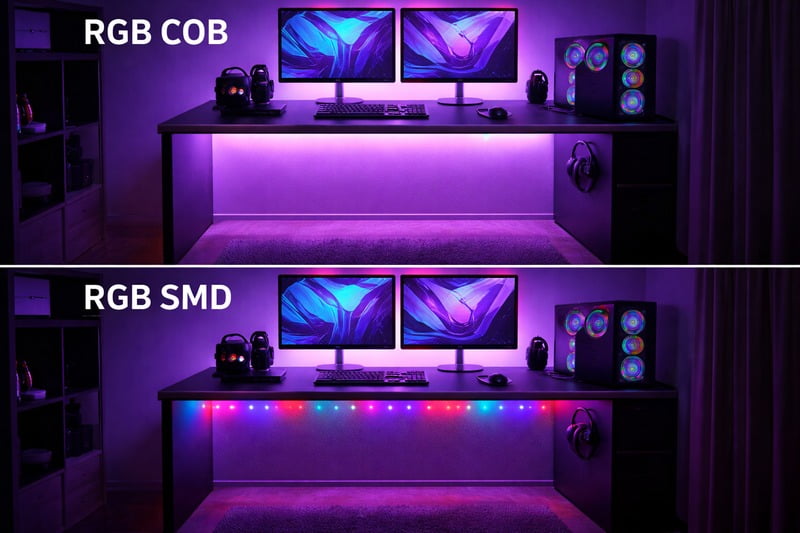
The 840 LED/m Revolution
In my catalog, you will see beasts like the RGB 840 LEDs/m7 strip with a 10mm board width. Let’s break down why this is a game-changer for commercial design and high-end residential gaming rooms.
The "Pizza" Problem:
Old RGB strips (SMD 5050) had three tiny diodes inside one plastic housing. You could physically see the separation. If you tried to make purple, you saw a red shadow and a blue shadow.
The High-Density Solution:
- Quantity of Lampwicks: With 810 or 840 LEDs per meter, we are alternating R-G-B-R-G-B so fast that the human eye cannot separate them.
- Power & Brightness: These aren’t toys. They pull 15W to 16W per meter (5W Red + 5W Green + 5W Blue).
- Board Width: To handle the heat of 840 chips, we use a 10mm wide PCB8. Do not try to find these in 5mm thin widths; they would melt.
Specialized Multi-Color Options:
We even produce DC-24V RGBWC (5-in-1) strips with 630 LEDs/m on a 12mm board.
- What is it? It has Red, Green, Blue, PLUS Warm White, PLUS Cool White.
- The Application: This is the ultimate "do it all" light for hotels. During the day, it’s a high-CRI 4000K task light. In the evening, it warms to 2700K. For the party event at night, it turns deep blue or vibrant red.
- The Look: Because of the high density, even when switching modes, it looks like a solid bar of changing color, not a flickering set of distinct bulbs.
Magic Color Chasing (Pixel COB):
We also offer "Magic Color Chasing Lights" (Model HC-10-5 or HC-10-12) with 160 LEDs/m that are addressable. While 160 isn’t as high as 480, combined with the COB phosphor, it creates a "snake" of light that moves smoothly, rather than the jerky block-movement of old pixel strips.
Is High Density Always the Right Choice? (The Voltage & Heat Factor)
So, high density looks better, bends better, and cuts better. Should you just buy 840 LEDs/m for every single project? Not so fast. There is a trade-off, and it usually involves heat and run length.
High-density strips generate more centralized heat due to the sheer number of chips packed into a small area. While efficient (producing roughly 100-130 lumens/watt), they require better thermal management. For very long runs (>10m), extremely high density can lead to voltage drop issues unless you use 24V or specialized constant-current designs.
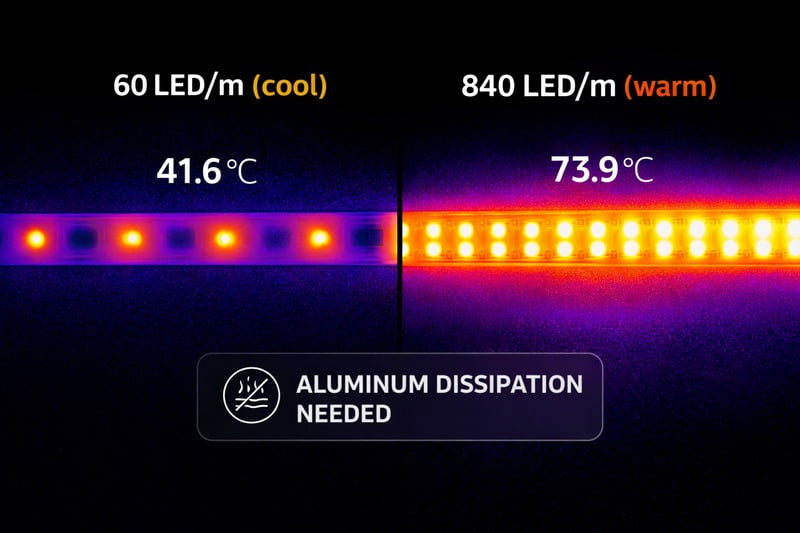
Balancing Aesthetics with Engineering
As a factory owner, I have to be honest: Higher density means more engineering responsibility for the installer.
Thermal Considerations:
- An 840 LED/m RGB strip9 is generating heat from 840 tiny points every meter.
- Even though COB is efficient, you must stick these to a heat sink. An aluminum profile is mandatory for anything over 10W/m. If you stick a high-density COB strip directly onto wood or drywall, the adhesive will eventually degrade from the warmth, and the strip will peel off.
Voltage Drop & Run Length:
- 5V High Density: We make a 5V COB strip10 (Model HC-04-5) with 480 LEDs/m on a tiny 4mm board.
- The Limit: Because it is 5V, you can’t run this long. Voltage drop hits hard on 5V. This is purely for strictly detailed model making or very short (1-2 meter) accents.
- 24V Standard: For room lighting, you need the 24V COB versions.
- These allow you to run 5 meters or even 10 meters (if powered from both ends) while maintaining that "solid line" look.
When Low Density is Okay:
- If you are putting the light in a cove located 30cm (12 inches) below the ceiling, you don’t need high density.
- The light has plenty of space to spread and mix before it hits the ceiling. You won’t see dots.
- In this specific case, you can save money by using a standard SMD strip.
- But: If the cove is tight (2cm gap), you must use COB high density.
Efficiency:
Our white COB strips (2700K-6500K) are surprisingly efficient, delivering 100-130 lumens per watt. Even though there are more chips, they are under-driven (running at low power individually), which actually helps lifespan.
Conclusion
The era of "dotted" LED lighting is over.
- Appearance: High-density COB strips (480+ LEDs/m) provide a seamless, dot-free neon look that elevates any space.
- Spacing: With pitch as tight as 2mm, you get uniform light even in shallow profiles.
- Color: New 810/840 LED/m RGB options allow for seamless color mixing.
Don’t let your project fail because of cheap-looking reflections. Spend the extra small percentage on High-Density COB; your client might not know the technical specs, but they will instantly feel the difference in quality.
-
Explore this link to understand how LED chips enhance lighting efficiency and aesthetics. ↩
-
Discover why high density in LED lighting is crucial for achieving a smooth and professional look. ↩
-
Understanding the ‘no light spots’ promise can enhance your knowledge of LED technology and its benefits. ↩
-
Exploring this topic reveals how design impacts LED functionality and visual appeal. ↩
-
Understanding the bending capabilities of COB LED strips can help you choose the right product for your project. ↩
-
Learning about cut points is essential for precise installation and avoiding dark corners in your lighting design. ↩
-
Explore this link to understand how RGB 840 LEDs/m can transform your lighting design with superior brightness and color blending. ↩
-
Learn why a 10mm wide PCB is crucial for heat management in high-density LED applications, ensuring longevity and performance. ↩
-
Explore the advantages of 840 LED/m RGB strips for efficient lighting solutions and design flexibility. ↩
-
Learn about the applications and benefits of 5V COB strips for detailed model making and accent lighting. ↩
Interested in Our LED Solutions?
Get professional consultation and customized LED lighting solutions for your projects. Contact our expert team today.
Related Articles

How Do You Build Profitable Custom Vehicle and RV Interior LED Rope Lights?
You lose RV installation contracts because your interior lights fail on rough roads. Standard strips show bright dots on glossy…

How to Perfect Bookshelf and Display Cabinet LED Rope Lighting?
You lose retail clients when bookshelves look incredibly dark. Ugly shadows hide expensive products inside display cabinets daily. You need…

How to Master Mirror and Vanity LED Rope Light Installation?
Your clients complain about ugly shadows in their bathroom mirrors. Bad lighting ruins expensive vanity designs. You lose future contracts…
