

Outdoor LED Rope Light Installation: Is Poor Weather Protection Ruining Your Projects?
You finish a stunning landscape lighting project, and the client is thrilled. Two months later, after the first heavy rainstorm, they call you screaming about dead sections and water inside the tubes. You are facing costly repairs and a damaged reputation. This is the nightmare of every installer who underestimates the elements.
Successful outdoor installation relies on selecting the correct IP rating—IP67 (Hollow Extrusion) for general exterior use or IP68 (Solid Extrusion) for underwater areas. Crucially, you must strictly follow the minimum bending radius of 15mm and properly seal all cut points with silicone end caps to prevent moisture ingress.
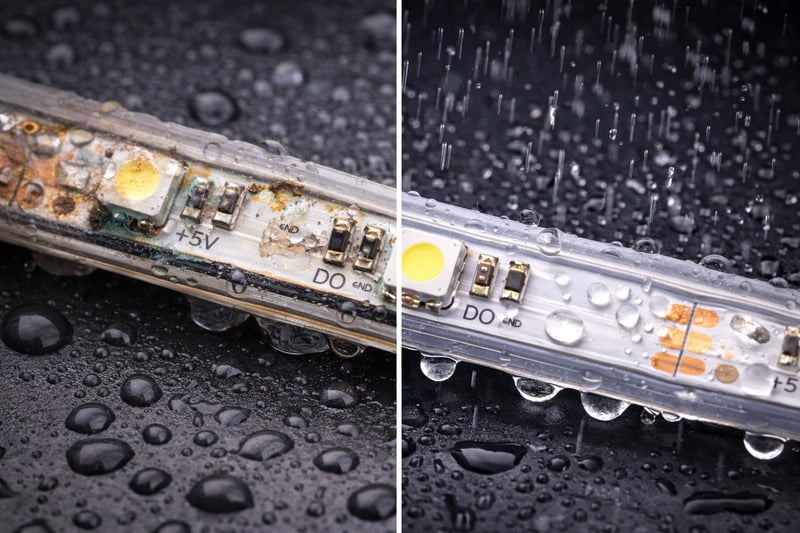
In my years running a factory in Shenzhen, I have inspected thousands of "defective" returns. The truth? 90% of them were not manufacturing defects; they were installation errors. Installers often treat outdoor strips like indoor ones, ignoring the limitations of the silicone casing or the physics of voltage drop. As your manufacturing partner, I want to help you stop losing money on callbacks. Let’s dig into the three critical areas where most US contractors get it wrong: IP selection, physical handling, and power stability.
Are You Choosing the Right Waterproofing Tier for the Environment?
Many buyers see "Waterproof" on a label and stop reading. This is a rookie mistake. In our industry, "Waterproof" breaks down into three very different technologies. If you use the wrong one, nature will destroy your lights. You need to know the difference between a coating and a suit of armor.
For outdoor usage, you must distinguish between IP65, IP67, and IP68. IP65 (Potting Compound) is only for splash protection and often degrades under UV. IP67 (Hollow Extrusion) is the standard for rain and snow exposure. IP68 (Solid Extrusion) is the only safe option for permanent submersion in pools or fountains.
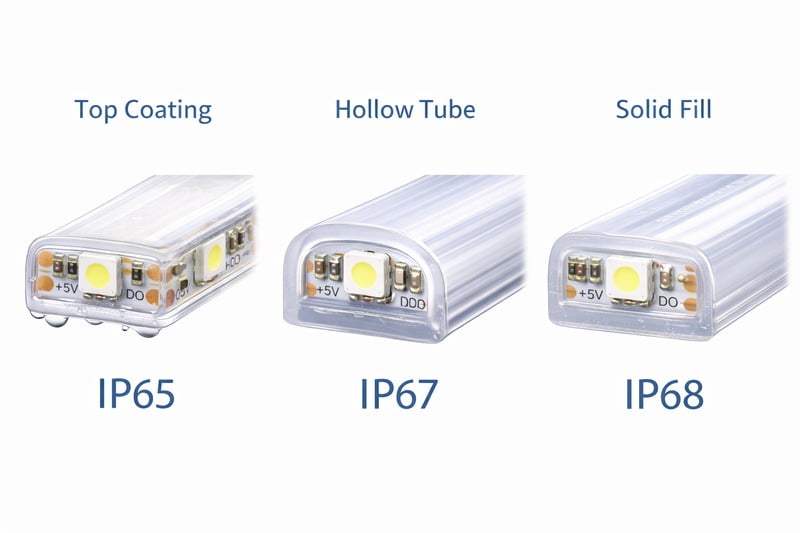
Let’s look at the technical specifications directly from our factory floor. We manufacture these differently, and understanding the build process will help you sell the right solution to your client.
The IP65 "Potting" Trap
1. The IP65 "Potting" Trap
In our catalog, IP65 is listed as "Potting Compound Waterproofing1." This is a surface drop of silicone over the PCB.
- Why it fails outside: It protects the top, but the back relies on 3M tape. Rain eventually loosens the tape, water gets behind the strip, and shorts the copper pads. Additionally, the potting layer is thin. Intense UV sunlight can eventually crack it.
- Verdict: Keep IP65 for bathrooms or under outdoor covered bars. Do not put it on a fascia board.
The IP67 "Hollow" Standard
2. The IP67 "Hollow" Standard
This is listed as "Waterproofing by Hollow Extrusion." We push the strip inside a silicone sleeve.
- Why it works: It creates a physical gap between the environment and the electronics. It is excellent for heat dissipation because air circulates inside.
- The Sizing issue: Note that adding this tube changes the dimensions. An 8mm strip becomes 10mm x 4.8mm. You must measure your aluminum channels to ensure they fit.
The IP68 "Solid" Shield
3. The IP68 "Solid" Shield
This is "Waterproofing by Solid Extrusion2." We fill the tube completely with silicone.
- The "Pool" Rule: There is no air gap for water to fill if the pressure rises. This is the heavy-duty option. However, it is heavier and harder to bend.
| IP Rating | Manufacturing Tech | Best Application | Dimension Change (Approx) |
|---|---|---|---|
| IP65 | Potting Compound | Kitchens, Bathrooms, Covered Patios | Minimal (Height increases) |
| IP67 | Hollow Extrusion | Building Facades, Rooflines, Gardens | Width 8mm -> 10mm |
| IP68 | Solid Extrusion | Swimming Pools, Fountains, Buried Floors | Width 8mm -> 12mm |
Critical Insight: Never use IP67 Hollow tubes underwater. The water pressure will eventually force its way through the end cap, fill the hollow tube, and boil correctly when the lights turn on. Only IP68 Solid Extrusion can withstand the pressure.
Is Improper Mechanical Handling Breaking Your Circuit Boards?
You hand a roll of high-end COB strip to your installer. Ten minutes later, he is forcing it around a 90-degree corner like it is a piece of copper wire. He just killed the product. LED strips are flexible, but they are not invincible.
Waterproof strips have strict mechanical limits due to the silicone casing. The bending diameter must be R > 15mm to avoid snapping the internal circuitry. Furthermore, you must never bend the strip horizontally (sideways) or fold it in half, as this will crack the PCB and cause permanent dark spots.
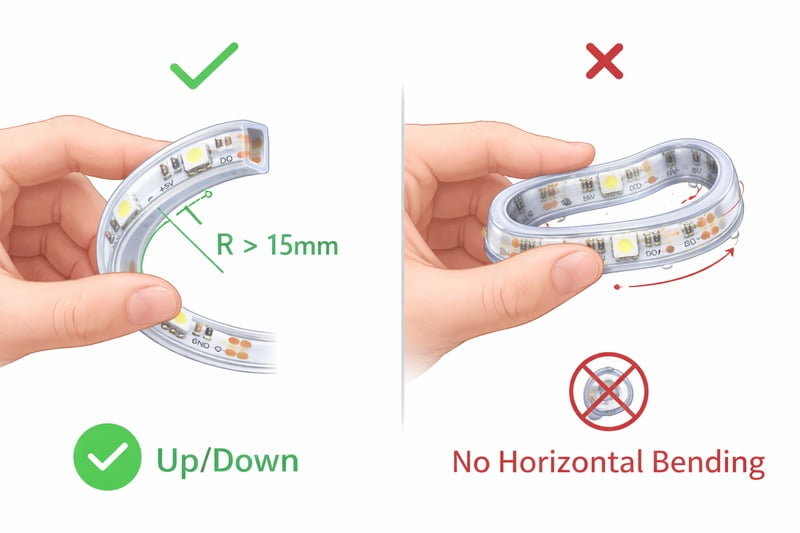
When we encase a strip in IP67 or IP68 silicone, we change its physics. It acts like a belt—it can wrap around your waist, but you can’t bend it sideways without buckling it.
The "R > 15mm3" Rule
The "R > 15mm" Rule:
All our technical data sheets emphasize a bending diameter of R > 15mm.
- What this means: The curve should not be tighter than a golf ball.
- The Consequence: If you pinch it tighter than 15mm, you put excessive tension on the solder joints connecting the LED chips to the resistor. In our COB strips, which have high density (up to 512 LEDs/m), these joints are microscopic. One pinch breaks the connection, and a 50mm section goes dark instantly.
The "No Horizontal Bending" Rule
The "No Horizontal Bending" Rule:
This is the most common cause of failure I see in the US market. Installers try to turn a flat corner on a deck without cutting the strip.
- The prohibition: Our specs clearly state: "Please do not bend it horizontally."
- The Logic: The circuit board is flat. Sideways pressure rips the copper traces apart.
- The Job Site Fix: If you need to turn a corner, you must cut the strip, solder jumper wires (or use a waterproof connector), and seal it. Do not force the curve.
The "Do Not Fold" Rule
The "Do Not Fold" Rule:
Never fold the strip in half like a piece of paper to store it. The crease affects the waterproofing layer.
- IP Integrity: severe folding causes the silicone extrusion to whiten or crack (we call this stress whitening). Once the silicone cracks, water enters, and your IP67 rating4 is gone.
Are Your Connections and Voltage Levels Sabotaging the System?
The lights are up, they are waterproofed, but when you turn them on, the end of the run looks orange and dim. Or worse, a week later, the breaker trips because water got into the one place you didn’t think about: the cut point. Outdoor power management is a different beast than indoor lighting.
To maintain consistent brightness outdoors, use 24VDC strips to minimize voltage drop over long distances. Equally important is resealing any field-cut strips. You must use neutral silicone glue and a fitted end cap at every cut point to restore the waterproof integrity, or the hollow tube will act as a straw for moisture.
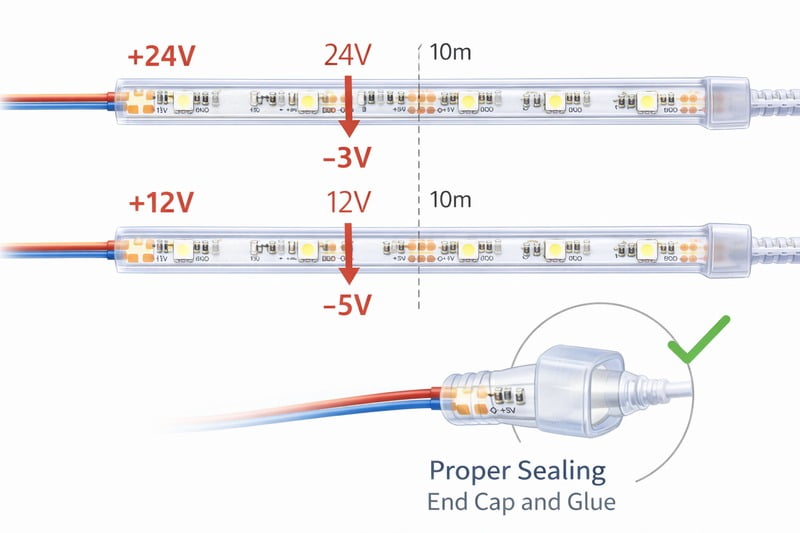
Outdoor projects usually involve long runs—fence lines, roof perimeters, or pool decks. This makes voltage and sealing your two biggest technical hurdles.
The Case for 24VDC[^5]
The Case for 24VDC:
While we sell 12V options, I strongly advise my B2B clients to specify 24VDC for any outdoor project.
- The Physics: 12V strips suffer from voltage drop effectively after 5 meters. If you run a 10-meter perimeter, the far end receives less voltage, causing the white light to look yellow or brown.
- The Solution: 24V pushes the current more efficiently. With our high-efficiency strips (often 14W-15W per meter5), 24V ensures the brightness at the start matches the brightness at the end.
The Sealing Protocol
The Sealing Protocol:
Cutting an IP67 hollow strip breaks the vacuum seal. The tube is now an open straw.
- Cut Correctly: Look for the scissor mark. On 24V strips, this is usually every 50mm (or sometimes 25mm depending on the chip density). Do not cut in the middle of a segment.
- Fill and Cap: You cannot just use electrical tape. You must inject clear, non-acidic silicone glue into the dedicated End Cap.
- Cure Time: Slide the cap over the cut end. Wipe away excess glue. Let it dry for 24 hours before exposing it to rain.
- Rhstriplighting Insight: If you rush the drying time, moisture trapped inside will evaporate when the LEDs heat up, fogging up the inside of the tube and reducing luminosity.
| Sourcing Checklist | Recommendation | Why? |
|---|---|---|
| Voltage | 24VDC | Prevents dimming on long outdoor runs. |
| Cut Interval | 50mm | Standard for 24V; easier to work with than shorter cuts. |
| Accessory | Silicon End Caps | Mandatory for every cut you make. |
| Accessory | Mounting Clips | Use screws, not just adhesive tape, for exteriors. |
Conclusion
Outdoor lighting is an unforgiving environment. To ensure your projects survive past the first season, you must move beyond the generic label of "Waterproof."
- Select IP67 Hollow Extrusion for rain and IP68 Solid Extrusion for water immersion.
- Respect the mechanical limits: R > 15mm bending radius and absolutely no horizontal twisting.
- Power your system with 24VDC to ensure consistent output.
At Rhstriplighting, we engineer our outdoor series to withstand these harsh conditions, provided they are installed with care. If you follow these tips, you won’t just be an installer; you’ll be the lighting expert your clients trust for the long haul.
-
Explore this link to understand the benefits and limitations of potting compounds in waterproofing applications. ↩
-
Learn more about solid extrusion waterproofing to see why it’s the best choice for high-pressure environments. ↩
-
Understanding the R > 15mm rule is crucial for maintaining LED strip integrity and preventing failures. ↩
-
Exploring the significance of an IP67 rating helps ensure your LED installations are waterproof and durable.
[^5: Explore this link to understand why 24VDC is recommended for outdoor projects, ensuring consistent brightness and efficiency. ↩ -
Learn about the impact of power consumption on LED performance, which is crucial for effective lighting solutions. ↩
Interested in Our LED Solutions?
Get professional consultation and customized LED lighting solutions for your projects. Contact our expert team today.
Related Articles

How Do You Build Profitable Custom Vehicle and RV Interior LED Rope Lights?
You lose RV installation contracts because your interior lights fail on rough roads. Standard strips show bright dots on glossy…

How to Perfect Bookshelf and Display Cabinet LED Rope Lighting?
You lose retail clients when bookshelves look incredibly dark. Ugly shadows hide expensive products inside display cabinets daily. You need…

How to Master Mirror and Vanity LED Rope Light Installation?
Your clients complain about ugly shadows in their bathroom mirrors. Bad lighting ruins expensive vanity designs. You lose future contracts…
