

Outdoor LED Rope Lights for Year-Round Decoration: Can One Strip Really Handle Every Holiday?
You dread the ladder. Every November, you risk your neck stapling plastic strings to your eaves, only to tear them down in January when the neighbors start complaining. It is a waste of labor, dangerous, and frankly, the cheap plastic tubing usually fails after one season anyway.
To achieve a permanent exterior lighting solution that works for Christmas, the Fourth of July, and everyday architectural accenting, you must switch to digital RGB+W COB Neon Flex. By utilizing IP67 hollow silicone extrusion and smart controllers, you can change your building from "Architectural Warm White" to "Holiday Color Chasing" instantly, eliminating the need for seasonal installation.
In my business supplying contractors across North America, the demand for "Permanent Holiday Lighting" has exploded. Homeowners and business owners want the versatility of color without the tacky look of temporary wires. However, most importers make critical mistakes by buying standard interior strips for exterior abuse. Let’s explore how to source the industrial-grade specs needed for year-round survival.
Why Do Most "Permanent" Outdoor Lights Fail in 6 Months?
I see the same warranty claims every spring. Buyers purchase IP65 "Waterproof" strips, glue them to a gutter, and by May, the covering has cracked, yellowed, and the lights are dead. The sun is actually a bigger enemy than the rain.
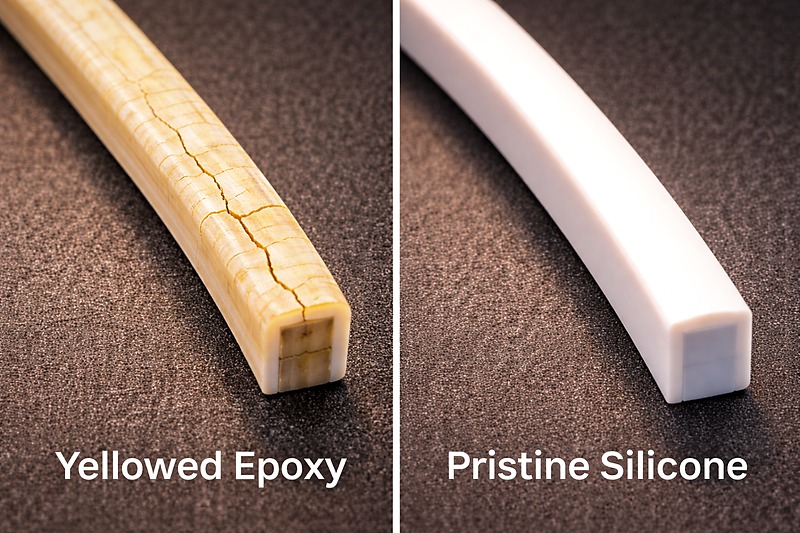
You must reject IP65 "Glue-Dropped" or "Epoxy" coatings for permanent outdoor installation. Instead, specify IP67 Hollow Silicone Extrusion. Silicone is chemically stable against UV radiation and will not yellow, while the hollow air gap allows the high-power LEDs to dissipate heat during hot summer nights, preventing premature burnout.
The Material Science of Longevity
When you source lighting for year-round exposure, you are fighting two forces: UV radiation and Thermal Expansion.
The Failure of Epoxy (IP65):
Standard waterproof strips use a process called "Glue Dropping." Manufacturers pour a liquid epoxy or PU (Polyurethane) over the circuit board.
- The Trap: It looks great out of the box. But PU has poor UV resistance. After 3 months in the sun, it turns brown (yellowing). This changes your bright white light into a dirty yellow glow.
- The Crack: Metal gutters and wood fascias expand and contract with temperature changes. Hardened epoxy does not stretch well. It eventually snaps, breaking the waterproof seal and killing the LED.
The Solution: Silicone Extrusion (IP67)1:
In our factory, we use food-grade silicone to create a sleeve.
- Chemical Stability: Silicone is inorganic. It is virtually immune to UV degradation2. We test our silicone sleeves in accelerated weathering chambers, and they remain clear for years.
- Thermal Breathing: Our high-end outdoor strips are housed in a Hollow Silicone Tube. This is critical. The air gap inside the tube acts as an insulator against direct sunlight heat but also allows the LED chips to "breathe."
- Bending Safety: Our datasheet explicitly warns about bending limits (usually Radius > 15mm). Silicone is flexible enough to handle these curves around corners without putting stress on the sensitive internal components.
| Material | UV Resistance | Heat Management | Life Expectancy (Outdoor) |
|---|---|---|---|
| Epoxy (IP65) | Poor (Yellows fast) | Poor (Traps heat) | < 1 Year |
| Solid PU (IP68) | Moderate | Good | 1-2 Years |
| Hollow Silicone (IP67) | Excellent (Stable) | Best (Air gap) | 5+ Years |
How Do You Avoid the "Dotted" Cheap Look?
Old-fashioned rope lights (the clear plastic tubes with tiny bulbs inside) scream "Temporary Decoration." They look like a string of pearls. For a permanent installation that adds value to a property, the light source must be invisible.
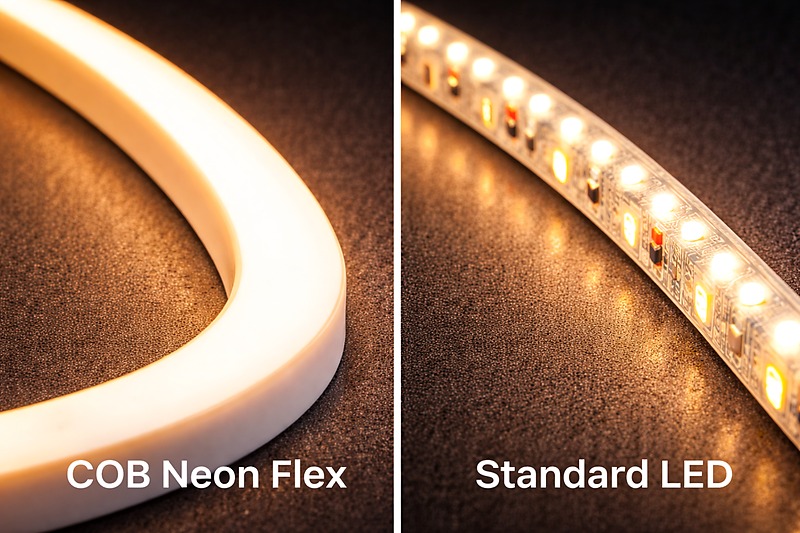
Upgrade to COB (Chip on Board) Neon Flex technology. With densities reaching 512 LEDs per meter, COB strips create a seamless, solid line of light with zero visible hotspots. This mimics the look of traditional glass neon but is durable enough to withstand hail and wind.
Density is the Key to Luxury
If you look at high-end commercial buildings or luxury homes, you never see the light bulb; you only see the light. This is the difference between "decorating" and "lighting design."
Why Density Matters:
In the past, we used SMD5050 chips, which were spaced out—maybe 60 chips per meter. This left a 1-inch gap between every light.
- The COB Difference: Our modern manufacturing mounts the chips directly to the board. We produce outdoor Neon Flex with 320, 480, or even 512 LEDs per meter3. This is so dense that the human eye cannot distinguish individual points of light.
- The "Neon" Effect: When you put 512 chips inside a milky white silicone diffuser, the result is a solid bar of pure light. When turned off, it looks like a sleek white architectural trim. When turned on, it glows uniformly.
Installation Precision:
One hidden benefit of high-density COB4 is the cutting unit.
- Old Rope Lights: You could only cut them every 18 or 36 inches. This was a nightmare for custom rooflines.
- Modern COB: Because the chips are so packed, our cut points are often every 50mm (2 inches) or sometimes even smaller. This allows your installation crew to trim the light exactly at the end of the gutter or fence post, resulting in a custom-fitted appearance that justifies a higher price point to your client.
How Can One Light Strip Do Both Christmas and General Lighting?
A bright red line on your roof looks great in December but terrible in April. If you sell a "permanent" system, it needs to be functional for security and architectural beauty 11 months out of the year.
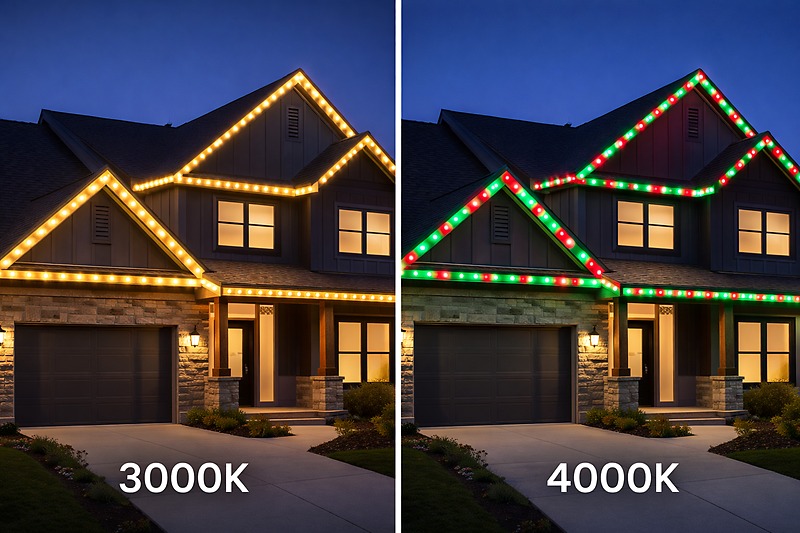
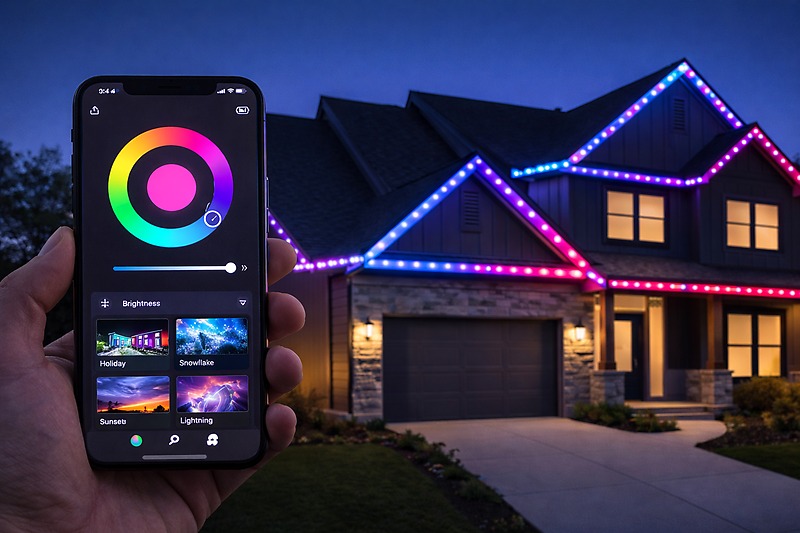
Specify RGB+W (Red, Green, Blue + White) or RGB+CCT chips controlled by a smart system. This specific hardware allows the user to display pure, high-CRI Warm White (3000K) for daily elegance, and switch to dynamic, animated color patterns for holidays via a smartphone app.
The Tech Behind the Versatility
You cannot just buy "RGB" strips. Standard RGB creates white by mixing red, green, and blue. This results in a "bluish" or "pinkish" white that looks cheap and fake. It ruins the architectural look of a home.
The RGB+W or RGB+CCT Advantage:
- Dedicated White Chip: Our RGBW5 strips contain a dedicated phosphor-coated white diode (usually 3000K or 4000K). When the client presses "Warm White" on their app, the colored chips turn off completely. The house is lit with true, high-quality white light that showcases stone and siding correctly.
- Digital Control (IC Chips): For the true "Holiday" experience, you need Addressable6 or Pixel strips (like WS2811 or UCS2904 protocols).
- Static vs. Dynamic: A standard strip is one color at a time. An addressable strip can be red-white-red-white (Candy Cane) or have a "chasing" meteor effect.
- The Controller: We pair these with Wi-Fi or Bluetooth mesh controllers. The homeowner can set a schedule: "Turn on Warm White at sunset. Switch to ‘Christmas Chase’ mode on December 1st. Switch to ‘Patriotic Flag’ mode on July 4th."
Sourcing Note: When ordering factory direct, ensure you ask for "RGBW with 3000K Warm White". Many factories default the white chip to "Cool White 6000K" because it is cheaper to make, but 6000K often looks too harsh for residential exteriors.
| Mode | Chip Used | Effect | Best For |
|---|---|---|---|
| Architectural | Dedicated White (W) | Classy, static, high CRI | Every day, Security |
| Holiday | RGB + IC Chip | Moving patterns, colors | Christmas, Halloween |
| Party | RGB (Music Sync) | Flashing to beat | Backyard BBQs |
How Do You Power 200 Feet of Roofline Without Voltage Drop?
The biggest technical headache with outdoor rope lights is voltage drop. If you try to run 12V LED strips around a whole house perimeter, the lights at the end will be dim and orange.
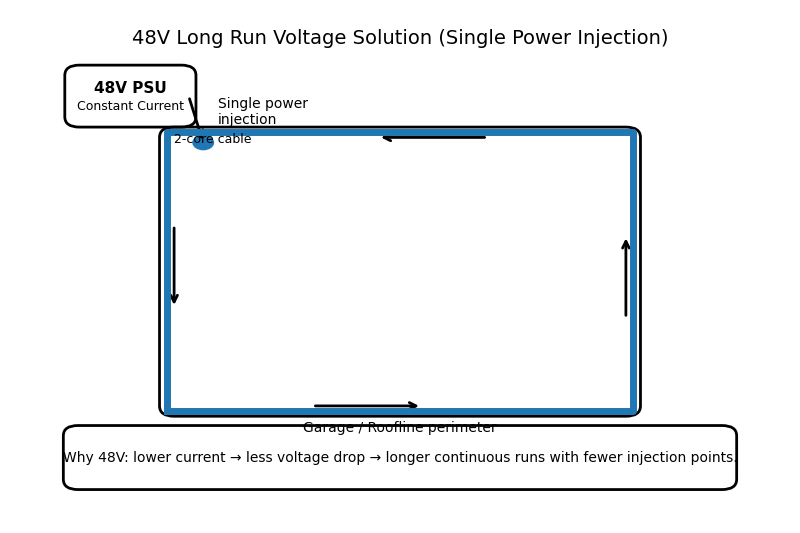
Utilize 24V or 48V Constant Current (CC) LED strips. Unlike standard tape, Constant Current circuitry regulates the power at every single LED group, allowing for continuous runs of up to 30 meters (100 feet) from a single power source, dramatically simplifying your wiring and waterproofing.
Reducing Labor and Leak Points
Every time you have to inject power, you need to:
- Run a high-voltage wire to that spot.
- Install a transformer/driver.
- Create a waterproof junction box connection.
On a second-story roof, this is expensive and difficult. Minimizing power points is the key to profit.
The Voltage Game:
- 12V Systems: Good for short runs (16 feet / 5 meters). Useless for rooflines unless you want to install a power supply every 16 feet.
- 24V Standard: Better. You can usually run about 32 feet (10 meters).
- Constant Current (CC) Technology7: This is what we manufacture for commercial and large residential projects. By adding IC regulators on the PCB, we can push 24V strips to 20 meters (65 feet) or 48V strips to 50 meters (164 feet) with no brightness loss.
The "One Plug" Solution:
Imagine wrapping an entire two-car garage and the front porch with one continuous line of light, powered by a single supply hidden in the garage. That is the power of Constant Current. It reduces installation time by 50% because you aren’t running parallel power wires everywhere.
Warning: Long runs mean high power. A 30-meter run of high-density RGBW neon8 might draw 400 Watts. Ensure your central power supply is industrial grade (like Mean Well HLG series) and has proper ventilation. Do not stuff a 400W driver into a tiny plastic box.
| Tech Spec | Max Single Run | Install Difficulty | Best Use |
|---|---|---|---|
| 12V Standard | ~16 ft | Hard (Many wires) | Indoor shelving |
| 24V Standard | ~32 ft | Medium | Small Patios |
| 24V Constant Current | ~65 ft | Easy | House Fronts |
| 48V Constant Current | ~160 ft | Easiest | Commercial Perimeters |
Conclusion
The market for year-round outdoor lighting is moving away from cheap, disposable products toward permanent architectural solutions. By sourcing IP67 Hollow Silicone for weatherproofing, High-Density COB for a neon-like finish, RGB+W for dual-purpose usage, and Constant Current systems for easy installation, you provide a product that justifies a premium price tag. Do not sell decoration; sell a permanent upgrade to the property’s value.
-
Explore the advantages of Silicone Extrusion (IP67) for outdoor lighting, including UV resistance and thermal management. ↩
-
Learn about UV degradation and its impact on outdoor lighting materials to make informed choices for longevity. ↩
-
Explore this link to understand how high-density LED configurations enhance lighting quality and design aesthetics. ↩
-
Learn about high-density COB technology and its advantages for precision lighting installations and custom designs. ↩
-
Explore the advantages of RGBW LED strips for achieving high-quality white light and enhancing your home’s aesthetics. ↩
-
Learn how addressable LED strips can create dynamic lighting effects, perfect for festive occasions and personalized ambiance. ↩
-
Explore this link to understand how Constant Current technology can enhance your lighting projects and reduce installation complexity. ↩
-
Discover the advantages of high-density RGBW neon lighting for your projects, including efficiency and aesthetic appeal. ↩
Interested in Our LED Solutions?
Get professional consultation and customized LED lighting solutions for your projects. Contact our expert team today.
Related Articles

How Do You Build Profitable Custom Vehicle and RV Interior LED Rope Lights?
You lose RV installation contracts because your interior lights fail on rough roads. Standard strips show bright dots on glossy…

How to Perfect Bookshelf and Display Cabinet LED Rope Lighting?
You lose retail clients when bookshelves look incredibly dark. Ugly shadows hide expensive products inside display cabinets daily. You need…

How to Master Mirror and Vanity LED Rope Light Installation?
Your clients complain about ugly shadows in their bathroom mirrors. Bad lighting ruins expensive vanity designs. You lose future contracts…
