

Permanent vs. Temporary LED Rope Light Holiday Installations: Why Are You Still Climbing Ladders?
We have all done the "January Walk of Shame." It is five degrees below zero, the wind is howling, and you are standing on a frozen ladder trying to pry plastic clips off your roofline. The joy of the holidays is long gone, replaced by the sheer misery of takedown. As a contractor or business owner, you know this cycle kills profitability—labor costs eat up your margins, and cheap PVC lights end up in a landfill.
To stop this annual waste of time and money, you must transition from temporary PVC rope lights to permanent Silicone LED Neon systems. By installing architectural-grade IP65/IP67 double-color silicone channels with RGB+W or Magic Color capabilities, you invest once for a system that serves as elegant warm white accent lighting for 300 days a year and transforms into a dynamic holiday display at the push of a button.
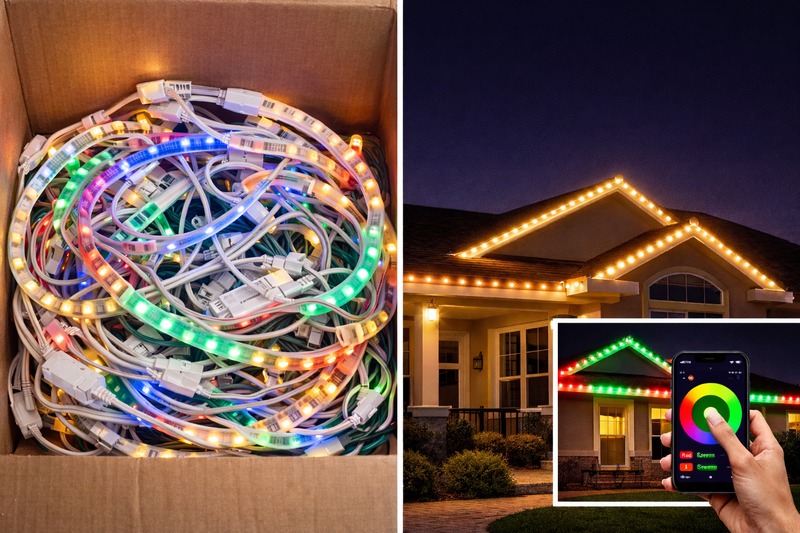
In my experience manufacturing for the US market, the smartest contractors are upselling "Permanent Holiday Lighting" as a home improvement asset, not just a seasonal decoration. It raises the property value and eliminates the ladder forever. Let’s break down the technical differences so you can explain the ROI to your clients.
The shift isn’t just about convenience; it is about materials science. Temporary lights are built to survive one season; permanent systems are built to survive the building itself. Understanding the distinct specifications of each approach will help you stop selling disposables and start selling infrastructure.
Why Do Temporary Lights Turn Yellow and Crack?
If you have ever pulled last year’s rope lights out of the attic, you know the disappointment. The clear plastic has turned a sickly yellow, and the tube feels stiff and brittle.
Temporary lights typically use standard PVC or Epoxy housings that degrade rapidly under UV exposure. For permanent installations, you must specify IP67 Silicone Extrusion or "Double-Color Silicone" housings. Silicone is chemically inert to UV radiation, meaning it will not yellow after years of sunlight, and it remains flexible and crack-resistant even in freezing temperatures down to -40°C.
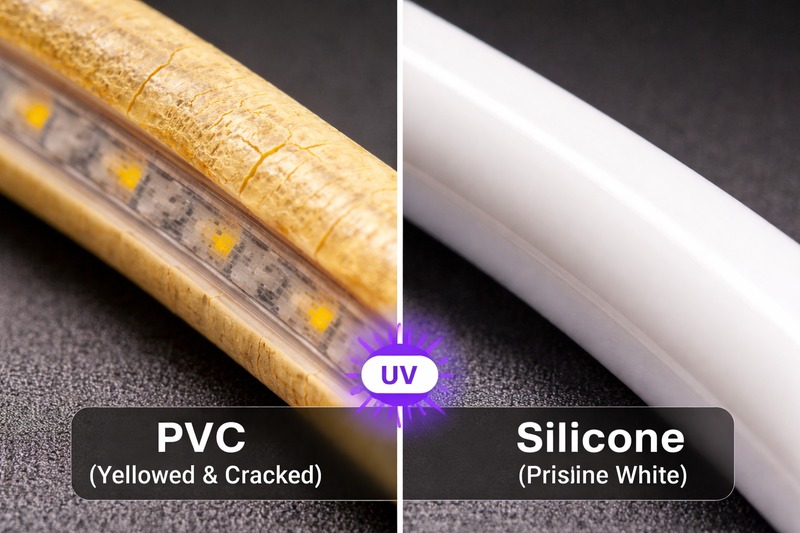
The Material Battle (PVC vs. Silicone)
When you sell a permanent install, you are selling durability. You cannot afford a warranty call in Year 2 because the casing cracked.
The "Temporary" Material: PVC & Epoxy
Most cheap big-box store lights use PVC.
- UV Damage: PVC hates the sun. It photodegrades, turning brown/yellow within one summer. This drastically alters the light color (making cool white look dirty).
- Temperature Failure: In the cold, PVC becomes rigid. If your house shifts or expands/contracts, the rigid plastic snaps.
- Waterproofing: These usually rely on glued end caps that fail when the glue becomes brittle.
The "Permanent" Solution: Silicone
Our factory focuses on IP65 and IP67 Silicone1 products.
- Double-Color Silicone2: We use a co-extruded "double-color" silicone process (White bottom, translucent top). This isn’t just a coating; it’s a solid, unified body.
- Thermal Stability: Silicone handles heat dissipation far better. Our COB strips inside these tubes can run at 100-110 Lumens/Watt efficiency without overheating because the heat escapes through the breathable silicone structure.
- Bend Radius: Even thick permanent silicone profiles maintain a bending diameter of R > 15mm. This flexibility ensures that as the building settles or temperature fluctuates, the light strip flexes rather than breaks.
Can One Light Strip Really Replace Your Landscape Lighting?
The biggest objection to "permanent Christmas lights" is that homeowners don’t want their house to look like a casino in July. They want classy, warm architectural lighting.
You must avoid standard "RGB-Only" strips that create a fake, bluish white. Instead, source RGB+W (Red, Green, Blue + Dedicated White) or CCT-adjustable LED strips. These allow you to run a pure, high-CRI 3000K warm white for daily architectural accenting, while reserving the color modes solely for holidays using the same installed hardware.
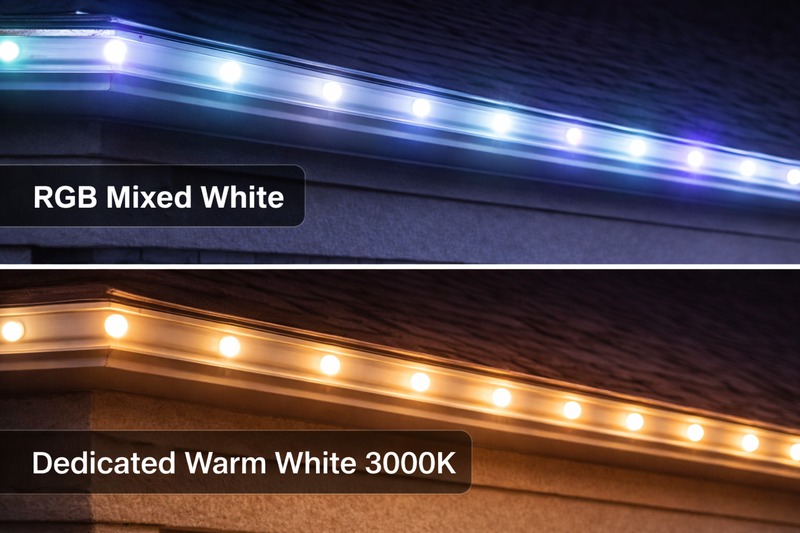
The Spectrum of Utility
A permanent system has to work harder than a temporary one. It needs to be a "hybrid" performer.
The "Daily Driver" Mode:
For 10 months of the year, this is architectural lighting.
- Color Temperature: You need a true 2700K or 3000K3 . This matches traditional incandescent exterior bulbs.
- CRI (Color Rendering Index): Our COB strips boast Ra90 . Standard Christmas lights are often Ra70 or lower. High CRI means your brick, stone, and siding colors look accurate and vibrant, not washed out.
The "Party" Mode:
For December, July 4th, or Halloween.
- RGB functionality: You can switch to vibrant colors instantly.
- Magic Color (RGB+IC): For the ultimate permanent setup, use RGB+IC strips4. These allow for chasing effects (like a candy cane moving pattern).
- Note: Our 12V IC strips have a "pixel" control every 50mm, while 24V versions might control every 100mm. For a roofline, this difference is negligible, but the effect prevents the installation from looking static and boring.
| Feature | Temporary String Lights | Permanent RGB+W / RGB+IC |
|---|---|---|
| White Quality | Typically Cool/Blueish | True 2700K/3000K (Ra90) |
| Function | Holiday Only | 365-Day Architectural Use |
| Control | Plug/Unplug | App/Smart Home Integration |
| Aesthetic | Wires visible | Hidden in Channel/Fascia |
How Do Power Requirements Differ for Permanent Installs?
Temporary lights are easy: string them together and plug them into an extension cord. Permanent installs involve long runs around the perimeter of a large home, where voltage drop becomes a killer.
Switch from 12V or 5V systems to 24V Constant Voltage or Constant Current systems. The higher 24V standard allows you to run lengths up to 10 meters (33 feet) or more without brightness fading at the end, reducing the need for multiple unsightly power injection points on the roof.
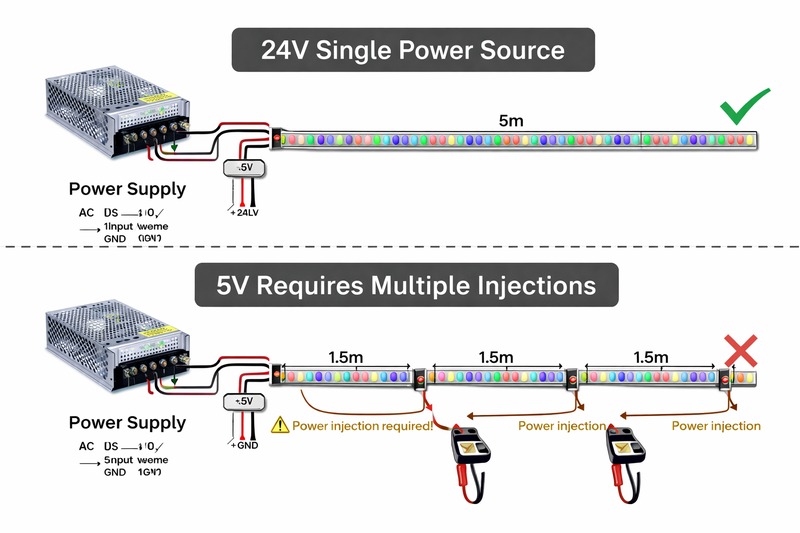
Electrical Infrastructure
Temporary lights are forgiving because they are short segments. Permanent lights are infrastructure.
Voltage Drop Explained:
- 5V/12V Limits: If you use a 5V "Magic Color" strip, you might need to inject power every 5 meters. This means running extra copper wire along the gutter—ugly and expensive.
- The 24V Advantage: Our data shows 24V strips maintain brightness over longer distances. For example, a 24V COB strip5 typically has a cutting unit of 50mm, compared to the denser cuts of 12V. This trade-off allows for longer continuous runs with less current (Amps), meaning less heat and thinner wires.
Power Supplies:
- Temporary: Cheap wall adapter.
- Permanent: You need a hardwired, waterproof driver (like Mean Well HLG6).
- Calculation: If you use our RGB+IC strip at 16W/meter, a 50-meter house perimeter needs 800 Watts. You normally install multiple 300W or 600W drivers in the garage or soffit. This requires planning, not just plugging in.
How Do Aesthetics and Visibility Differ?
Temporary lights are often just hung on the gutter face, wires dangling. They look cluttered during the day. A permanent install must be invisible when off.
Utilize "Nano" 4mm or slim-profile COB strips housed in color-matched aluminum channels. Our ultra-narrow 4mm PCB COB strips fit into tiny crevices or tracks facing downwards (soffit lighting), creating a wall-wash effect that eliminates the "string of dots" look and hides the hardware completely during daylight hours.
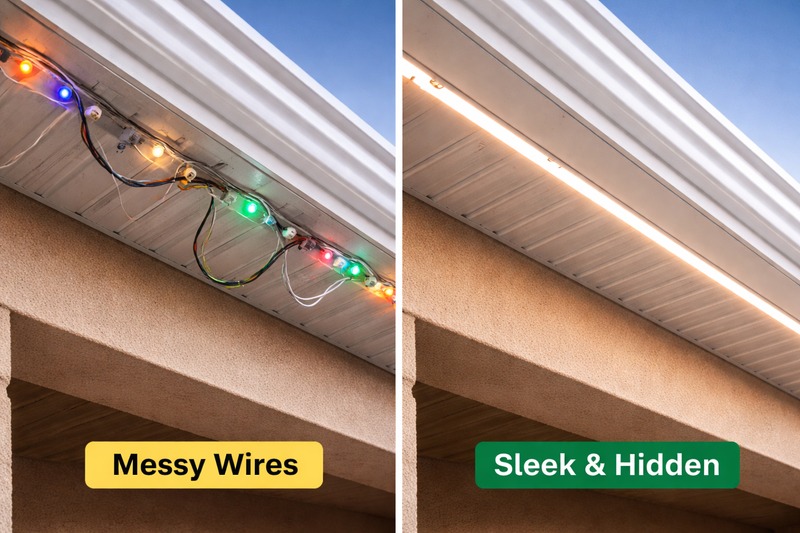
The "Invisible" Install
The goal of permanent lighting is "Light without the fixture."
The "Dotless" Look:
- Temporary: String lights are point sources. You see the bulb.
- Permanent: We recommend High-Density COB7 (480 LEDs/m). This creates a seamless "neon" line of light. There are "no dark areas" and "no sense of LED bead particles".
Size Matters:
- Standard Strip: usually 10mm or 12mm wide.
- Nano Strip: We manufacture a 4mm PCB width strip.
- Why use it? You can mount this mainly invisible strip behind the lip of a fascia board or in a tiny 6mm aluminum channel.
- Result: When the lights are off, the house looks normal. When on, the light washes down the wall, highlighting the texture of the stone or brick. This is high-end design, not just decoration.
Cutting Precision:
- Permanent installs must fit the building perfectly. Our 12V COB strips8 can be cut every 25mm, allowing you to terminate the light exactly at the corner of the eave for a custom-tailored look.
Conclusion
The difference between a temporary and a permanent installation is the difference between a toy and a tool. By choosing IP67 Silicone for longevity, RGB+W for year-round utility, 24V systems for reliable power, and High-Density COB for flawless aesthetics, you offer your clients a solution that solves their problem forever. Stop climbing ladders in January; build a system that lasts.
-
Understanding these ratings is crucial for selecting durable lighting solutions that withstand various environmental conditions. ↩
-
Exploring this topic will reveal how innovative materials enhance product performance and aesthetics in lighting. ↩
-
Understanding the difference can help you choose the right lighting for your space, enhancing ambiance and energy efficiency. ↩
-
Exploring this will reveal how RGB+IC strips can transform your lighting experience with dynamic effects and color versatility. ↩
-
Explore this link to understand how 24V COB strips can enhance your lighting efficiency and reduce heat. ↩
-
Learn about the Mean Well HLG driver to ensure your lighting setup is safe, efficient, and waterproof. ↩
-
Explore this link to understand how High-Density COB lighting can enhance your space with seamless illumination. ↩
-
Discover the benefits of 12V COB strips, including their precision cutting and design flexibility for permanent installations. ↩
Interested in Our LED Solutions?
Get professional consultation and customized LED lighting solutions for your projects. Contact our expert team today.
Related Articles

How Do You Build Profitable Custom Vehicle and RV Interior LED Rope Lights?
You lose RV installation contracts because your interior lights fail on rough roads. Standard strips show bright dots on glossy…

How to Perfect Bookshelf and Display Cabinet LED Rope Lighting?
You lose retail clients when bookshelves look incredibly dark. Ugly shadows hide expensive products inside display cabinets daily. You need…

How to Master Mirror and Vanity LED Rope Light Installation?
Your clients complain about ugly shadows in their bathroom mirrors. Bad lighting ruins expensive vanity designs. You lose future contracts…
