

Retail Display LED Rope Lighting: Is Your Lighting Scaring Away Customers?
We have all had that experience: walking into a retail store where the lighting feels harsh, clinical, or uneven. The merchandise looks dull, the shadows are distracting, and subconsciously, you just want to leave. Conversely, think of the last time you walked into a high-end jewelry store or a premium boutique. The light didn’t just illuminate the room; it seduced you. As a lighting contractor or a retail business owner, you know that in the age of Amazon, the physical retail experience must be perfect to survive.
To turn window shoppers into paying customers, you must upgrade from generic illumination to precision Retail Display LED Rope Lighting. By utilizing High-CRI (>90Pa) COB strips to render true colors, employing ultra-slim 4mm PCBs for invisible shelf integration, and leveraging high-luminous efficiency (up to 180lm/W) to cut operating costs, you create an immersive environment that highlights value and triggers the impulse to buy.
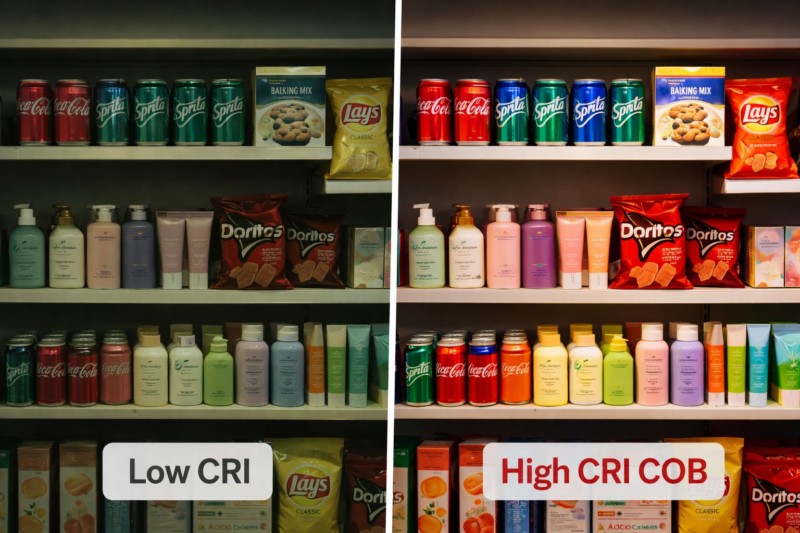
In my years manufacturing for the North American market, I have seen multimillion-dollar store fit-outs ruined by saving a few cents on LED strips. It is a tragedy. Retail lighting is not an expense; it is an investment in your sales conversion rate. Let’s dive into the specific technologies that will visually elevate your retail space.
The shift from traditional fluorescent tubes or spotted LED tape to modern linear lighting is transformative. But simply "adding more light" isn’t the solution. Quantity does not equal quality. We need to talk about the physics of color, the importance of concealment, and the psychology of attraction.
Why Is Color Rendering (CRI) the Most Critical Metric for Sales?
Most wholesale buyers look at the wattage first. That is a rookie mistake in retail. The most important number on your spec sheet is Ra (Color Rendering Index). If your light source cannot accurately reveal the true color of the fabric, food, or packaging, you are actively devaluing the product.
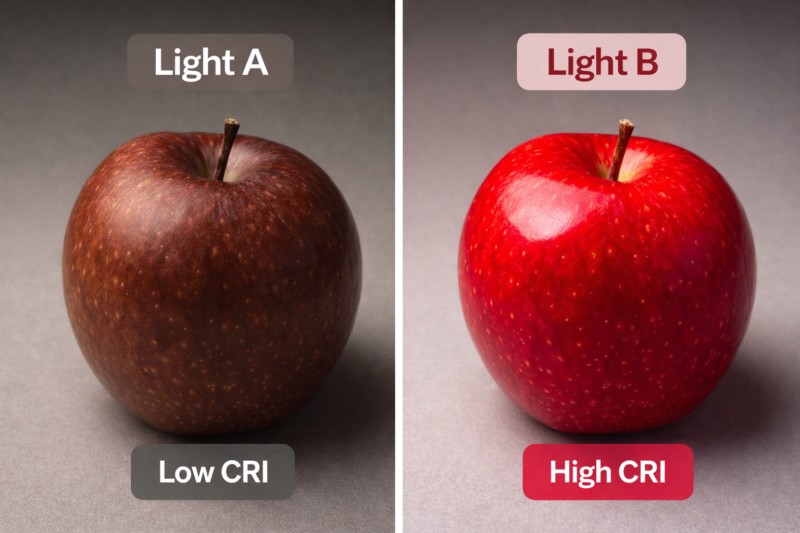
You must specify LED strips with a CRI of Ra90 or higher. Standard commercial lighting often hovers around Ra70 or Ra80, which casts a subtle grey or green tint that makes merchandise look "washed out." By switching to high-fidelity Ra90 COB strips, distinct reds, deep blues, and vibrant golds are revealed authentically, making the product appear more expensive and desirable to the consumer’s eye.
The Science of Visual Value
When we manufacture LED chips in my factory, the difference between a standard chip and a high-CRI chip comes down to the phosphor mix and the spectral output. But for your client, the difference is sales.
The "Muddy" Effect:
Lower quality LED strips (Ra70-80) are missing parts of the light spectrum, usually in the deep red (R9) values.
- The Result: A customer picks up a maroon shirt. Under poor light, it looks muddy brown. They put it back.
- The Fix: Our standard High-Performance COB strips1 are rated at Ra90. This creates a "Full Spectrum" effect closer to natural sunlight.
Color Temperature (CCT) Strategy:
CRI creates the quality, but CCT (Correlated Color Temperature) sets the mood. You cannot use the same white for every product.
- Gold and Bakeries (2700K – 3000K): Warm light enhances the yellow/red tones in gold jewelry, baked bread, and wood grain. It feels cozy and premium.
- Diamonds and Tech (5000K – 6000K): Cool white makes silver, diamonds, and electronics look crisp and futuristic.
- Clothing (3500K – 4000K): This is the neutral "sweet spot" that represents colors as they will look outdoors.
Consistency is King:
Nothing looks cheaper than a shelf where the left side is "Warm White" and the right side is "Pinkish White." This happens with poor binning.
- We use tight SDCM (Standard Deviation Color Matching)2 control.
- Using 24V COB strips minimizes voltage drop. If you use 12V on a long shelf, the voltage drop will cause the far end of the strip to shift color (often turning warmer or dimmer). A consistent 24V system keeps the brand colors identical across the entire store.
How Does "Dot-Free" COB Technology Elevate Brand Perception?
In the old days of LED tape (SMD 5050), you could see every individual diode. It looked like a string of Christmas lights. In a high-end retail display, seeing the light source is a design failure. The focus should be on the product, not the light bulb.
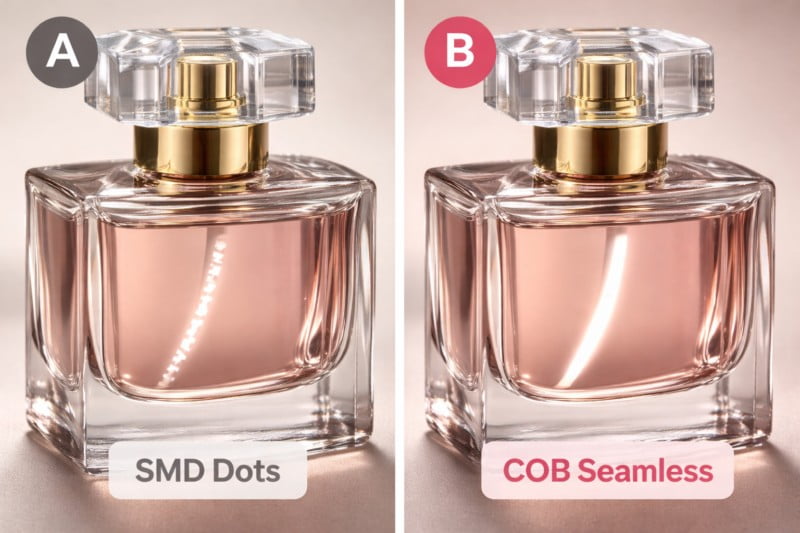
Abandon the "dotted" look of traditional SMD strips in favor of High-Density COB (Chip-on-Board) illumination. With 320 to 512 LEDs per meter and a continuous phosphor coating, COB strips create a seamless ribbon of light that eliminates the "string of pearls" reflection on glossy packaging or glass shelves, delivering a sophisticated, finished look akin to neon without the bulk.
Optical Purity in Display Cabinets
When lighting glass shelves, jewelry cases, or cosmetic counters, the reflection tells the customer everything they need to know about the store’s quality.
The Reflection Problem:
Standard strips (like the old 5050 SMD) have LEDs spaced 10mm or 20mm apart.
- The Issue: If you light a perfume bottle or a watch, the reflection on the glass surface shows distinct "dots." This visual noise distracts the eye and screams "cheap aftermarket upgrade."
- The Diffuser Fix (and why it fails): Installers try to hide this with deep aluminum channels and thick milky covers. This works, but it bulks up the fixture and cuts light output by 30%.
The COB Solution:
COB puts the chips directly on the board, extremely close together.
- Density: We produce strips with 480 LEDs/m or even 512 LEDs/m.
- Phosphor Layer: A layer of silicone phosphor covers the entire line.
- Result: The light leaves the strip as a solid bar. Even without a diffuser cover, there are no dots.
- Application: You can stick a raw COB strip on the underside of a glass shelf, and the light shining down will be perfectly uniform. This creates "No Dark Areas" and allows for a minimal footprint.
View Angle:
Standard SMD LEDs usually have a 120-degree beam angle. COB strips, due to the domed phosphor shape, often reach 180 degrees.
- This wider spread wraps light around the product more effectively, softening shadows and reducing the need for multiple light sources in a small cabinet gap.
| Feature | Standard 5050 Strip[^3 | High-Density COB3 |
|---|---|---|
| Appearance | Dotted (Pixelated) | Solid (Seamless) |
| Beam Angle | 120 Degrees | 180 Degrees |
| Reflections | Distracting Dots | Clean Lines |
| Diffuser Need | Mandatory | Optional |
Can Ultra-Slim Lights Fit into Contemporary Minimalist Shelving?
Modern retail design uses thin floating shelves and delicate joinery. A chunky 15mm wide aluminum channel destroys the aesthetic. You need lighting that disappears until it is turned on.
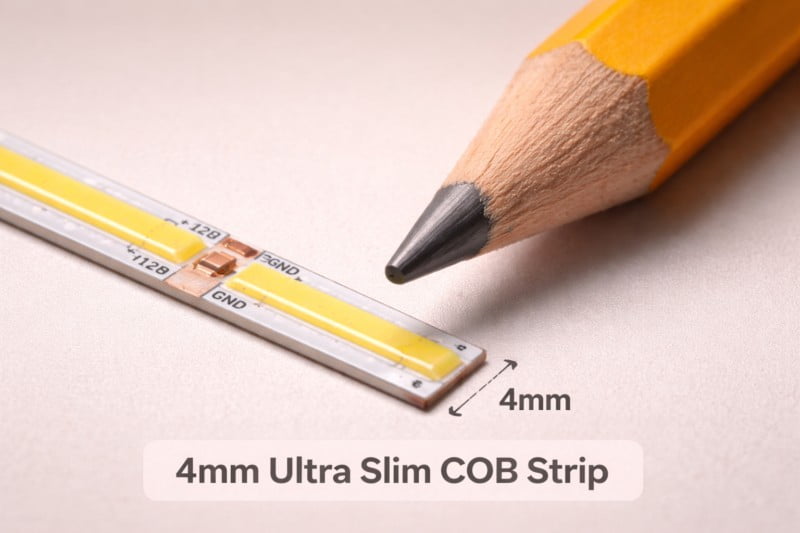
Utilize "Nano" series COB strips with ultra-narrow PCB widths of 4mm or even 2.7mm. These distinctively slim profiles can fit into routed grooves the width of a saw blade, allowing millwork contractors to embed high-intensity lighting directly into the edge of thin shelving or tight architectural reveals where standard 10mm strips simply physically cannot fit.
The Geometry of Concealment
As a manufacturer, I constantly push for smaller PCBs (Printed Circuit Boards) because designers push for invisible fixtures.
The Space Constraint:
Imagine a cosmetic display made of 1/4 inch acrylic.
- Standard Strip: A normal strip is 10mm or 12mm wide. It simply won’t physically fit on the edge.
- The "Nano" Fit: We manufacture high-performance COB strips with a 4mm PCB width4. This is tiny. A carpenter can use a standard router bit to create a small channel, lay the strip in, and it sits flush.
Precision Cutting:
Fitting into shelves requires exact lengths.
- The Waste Problem: If a shelf is 95cm wide, and your LED strip can only be cut every 10cm, you have to cut it at 90cm. That leaves 2.5cm of darkness on each side. Dark corners look unintentional and messy.
- The Precision Solution: Our 12V COB series features "Short-Cut" technology. We have cut points as small as 10mm to 12.5mm.
- Result: For that 95cm shelf, you can cut the light at 94.8cm. The light runs edge-to-edge. This "custom" look is what separates high-end retail from a DIY job.
Thermal Considerations:
You might worry that a 4mm strip gets too hot.
- Because we use Flip-Chip COB technology5, the electrical path is cleaner and generates less resistance heat than wire-bonded SMD chips.
- However, for 4mm strips, we always recommend adhering them to an aluminum surface (heat sink) to ensure that despite the small surface area, the heat dissipates effectively, maintaining that >36,000 hour lifespan.
How Do You Balance Brightness with Energy Costs?
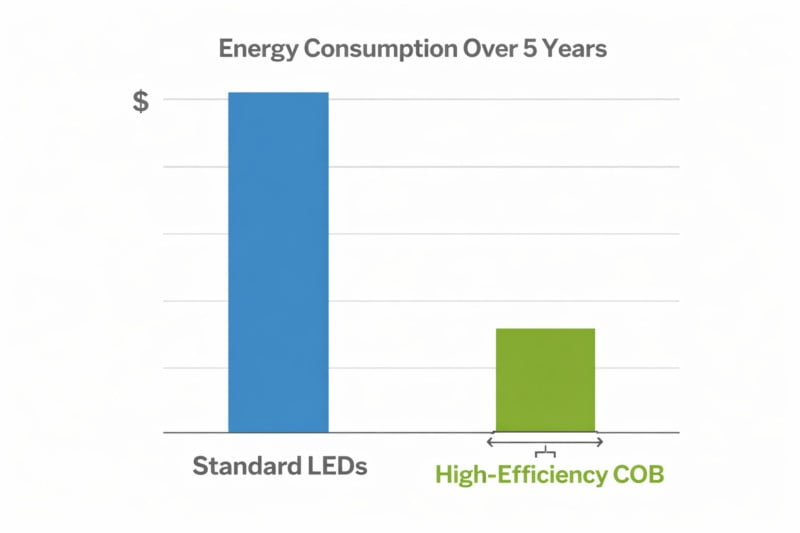
Retail lights run 12 to 14 hours a day. High brightness usually means a high electric bill. But in today’s market, efficiency is the lever that protects your margin.
Source High-Luminous Efficiency strips that deliver between 140lm/W and 180lm/W. By moving away from standard market efficiency (typically 80-100lm/W), you can achieve the dazzling high-lux levels required for retail attraction while reducing actual power consumption by up to 40%, drastically lowering the total cost of ownership for the store.
The Economics of Lumen/Watt
Let’s do the math that business owners care about: ROI.
The Wattage Trap:
Installers often think "I need bright lights, so I need high wattage." No. You need high Lumens (light output). Wattage is just the tax you pay to get the lumens.
- Scenario: You need 5,000 lumens to light a window display.
- Standard Efficiency (85 lm/W): You need nearly 60 Watts of power.
- High Efficiency6 (180 lm/W): You only need about 28 Watts of power.
- The Savings: You are getting the same brightness for less than half the electricity. Multiply that by 100 stores and 12 hours a day, and the savings are massive.
Heat = Waste:
High efficiency doesn’t just save money on the meter; it saves money on HVAC.
- Those extra 32 Watts in the example above? They turn into heat.
- In a small boutique with hundreds of meters of light, inefficient LEDs act like space heaters, forcing the air conditioning to work harder. Efficient strips run cooler.
Voltage for Efficiency:
For retail perimeter lighting (cove lighting), always use 24V or even Constant Current strips.
- Copper Loss: Sending power over long distances at low voltage (5V or 12V) causes resistance heating in the wires.
- 24V Advantage7: It is more efficient for transmitting power over the 5 to 10-meter runs found in store ceilings. It ensures that the watt you pay for actually reaches the LED to create light, rather than warming up the copper wire in the wall.
Can Dynamic Lighting Capture Foot Traffic?
In a busy mall or high street, a static window display effectively blends into the background. Motion triggers our evolutionary instinct to look.
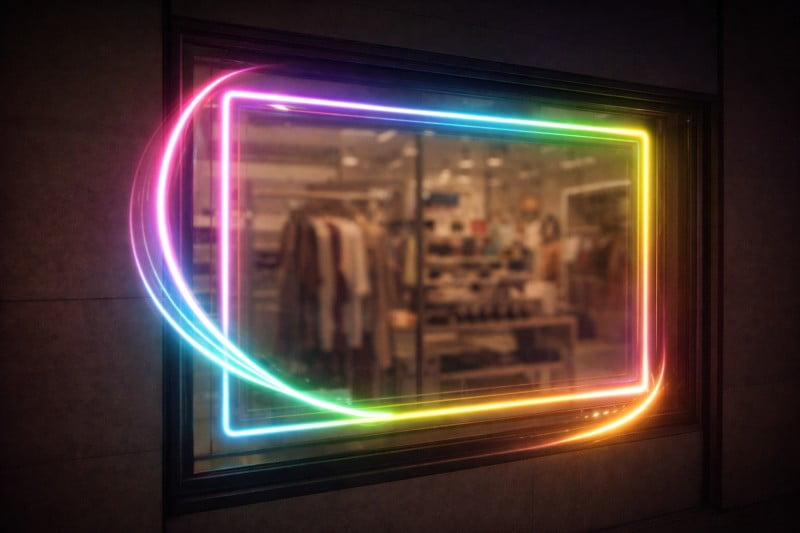
Deploy "Magic Color" (RGB+IC) rope lights for window perimeters and feature walls. By programming gentle, flowing motion effects—such as a "meteor" chase or a slow color breath—you create a kinetic visual hook that grabs peripheral vision from the street, physically turning heads and drawing potential customers toward the storefront.
Programmable Attraction
This is where lighting becomes marketing. "Magic Color" refers to Addressable RGB lighting.
The Tech:
Standard RGB strips change the whole strip to red, then green. Magic Color (using chips like WS2811 or UCS1903) treats groups of LEDs (pixels) independently.
- Resolution: In a 12V system, one pixel might be 50mm long (3 LEDs). In 5V, every single LED can be a pixel.
- The Controller: You don’t need complex DMX consoles anymore. Simple Bluetooth app controllers allow store managers to set the mood.
Strategic Application:
- The "Attractor" Mode: During slow hours or late at night, a fast-moving "chase" pattern outlines the window. It screams "We are here!"
- The "Brand" Mode: A slow, breathing pulse of the brand’s primary color (e.g., T-Mobile Magenta or Coca-Cola Red) builds brand reinforcement.
- Seasonal Agility: Valentine’s Day? Program a pink/red flow. St. Patrick’s Day? Green meteor. You change the store’s theme without buying new props.
Power and Safety:
- Magic Color strips can be power-hungry if you run them on "Static White" (100% brightness on Red, Green, and Blue channels).
- Efficiency Tip: Running dynamic patterns actually saves energy. In a "chase" pattern, 50% or more of the LEDs are off at any split second. You get high visual impact with lower average power draw than a static white light.
| Mode | Visual Impact | Energy Use | Best For |
|---|---|---|---|
| Static White | Standard Illumination | High | General Lighting |
| Static Color | Brand Reinforcement | Medium | Wall Washing |
| Meteor Chase | Maximal Attraction | Low | Street Facing Windows |
| Breathing | Subconscious & Calming | Medium | In-Store Features |
Conclusion
Retail lighting is the silent salesperson that never sleeps. It determines whether your product looks like a treasure or a bargain-bin item. By sourcing High-CRI (Ra90) COB strips to ensure color fidelity, utilizing Ultra-Slim 4mm PCBs for seamless integration, prioritizing High-Efficiency (180lm/W) chips to control operational costs, and deploying Magic Color dynamics to grab attention, you build a retail environment that sells. Don’t let your lighting be an afterthought; make it your competitive advantage.
-
Explore this link to understand how High-Performance COB strips can enhance product visibility and sales. ↩
-
Learn about SDCM to ensure consistent color quality in your lighting projects, crucial for brand integrity. ↩
-
Explore the advantages of High-Density COB LED strips for superior lighting solutions and enhanced visual appeal. ↩
-
Explore this link to understand how 4mm PCB width enhances design flexibility and performance in LED applications. ↩
-
Discover the benefits of Flip-Chip COB technology for better heat management and longer lifespan in LED lighting. ↩
-
Explore how High Efficiency lighting can significantly reduce energy costs and improve ROI for your business. ↩
-
Learn about the 24V Advantage and how it enhances power transmission efficiency, saving you money in the long run. ↩
Interested in Our LED Solutions?
Get professional consultation and customized LED lighting solutions for your projects. Contact our expert team today.
Related Articles

How Do You Build Profitable Custom Vehicle and RV Interior LED Rope Lights?
You lose RV installation contracts because your interior lights fail on rough roads. Standard strips show bright dots on glossy…

How to Perfect Bookshelf and Display Cabinet LED Rope Lighting?
You lose retail clients when bookshelves look incredibly dark. Ugly shadows hide expensive products inside display cabinets daily. You need…

How to Master Mirror and Vanity LED Rope Light Installation?
Your clients complain about ugly shadows in their bathroom mirrors. Bad lighting ruins expensive vanity designs. You lose future contracts…
