

RGB, RGBW, or Single Color: Which LED Strip is Right for Your Outdoor Project?
Your client wants a "resort-style" backyard that looks elegant 360 days a year, but they also just mentioned they want to host a massive Fourth of July party with red, white, and blue lights. Do you install static white lights for elegance, or color-changing strips for versatility? The wrong choice here either leaves money on the table or leaves you with a technical support nightmare.
For permanent architectural lighting, Single Color (3000K) is the gold standard for brightness and reliability. However, RGBW is the superior choice for luxury residential projects because it offers true Warm White for daily use and color options for holidays. Avoid standard RGB strips for landscape lighting, as they cannot produce a clean, pure white.
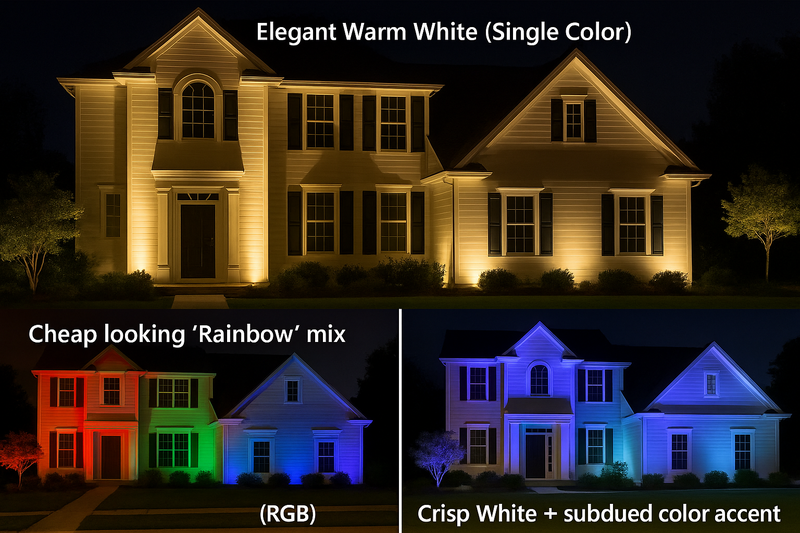
In my factory in Shenzhen, I manufacture miles of all three types every week. I see which ones get re-ordered by professionals and which ones end up in the clearance bin. Many distributors will try to sell you RGB as a "do-it-all" solution, but they aren’t the ones answering the phone when the "White" light looks purple and the customer refuses to pay. Let’s break down the technical differences so you can quote your next job with confidence and avoid the callbacks.
Why Do Landscape Architects Still Prefer Single Color Over RGB?
You might think "more colors equals more value," and for a cheap bar, you might be right. But top-tier lighting designers fundamentally disagree. When the goal is to highlight expensive architecture, stone, and trees, simplicity often wins. Why is "boring" single color still the bestseller in the professional market?
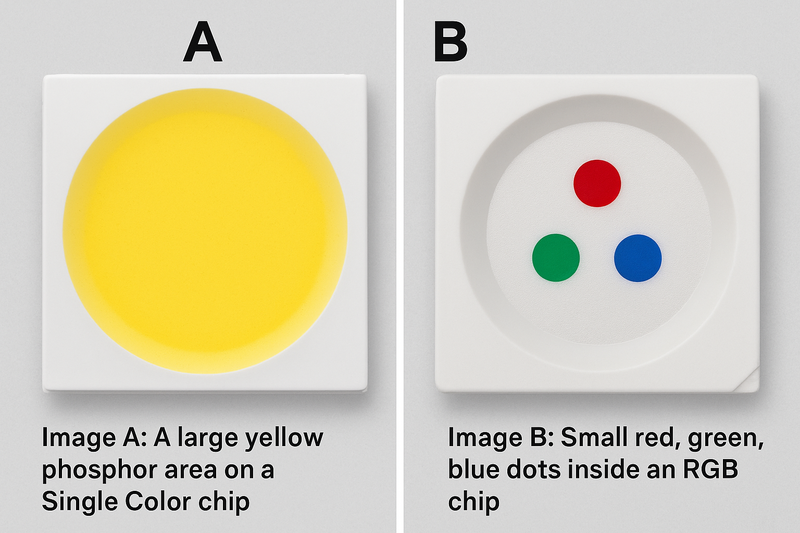
Single Color strips utilize the entire surface area of the LED chip for one purpose: brightness and tone quality. They offer 30% higher efficiency (lumens per watt) than multi-color chips and require simpler 2-wire cabling, drastically reducing the risk of voltage drop and connection failures in outdoor environments.
The Physics of Efficiency and Reliability
In the manufacturing world, we have a saying: "Complexity is the enemy of longevity." This is especially true for outdoor lighting buried in dirt or hidden under wet eaves. A Single Color LED (like a 2835 or 5050 chip)1 basically consists of a blue diode covered by a thick layer of yellow phosphor. This phosphor does the heavy lifting of converting blue energy into beautiful, broad-spectrum white light.
- Lumen Output: Because 100% of the chip’s surface area is dedicated to this one white spectrum, the output is immense. A high-end single color strip can easily push 1000+ lumens per meter2 without overheating. This is crucial when you are trying to wash a 20-foot wall or light up a large Oak tree.
- Thermodynamics: Single color strips are thermally efficient. They run cooler than RGB strips because they don’t have three tiny varying resistors fighting for space on the die. Heat is the killer of LEDs. By running cooler, single color strips maintain their brightness longer—often exceeding 50,000 hours (LM80 standard).
The Cabling Advantage
This is huge for you, Tom. Single color only needs 2 wires (+ and -). This implies thicker copper paths on the PCB and simple connectors. In a 100-foot outdoor run, every connection point is a potential failure point. Two wires are easy to waterproof. You can use standard twist-on wire nuts filled with silicone.
Furthermore, single color allows you to use straightforward dimmers (Triac or 0-10V) that integrate with Lutron, Control4, or Crestron systems seamlessly. If you want a "install it and forget it" solution for a client who travels a lot, Single Color is the only responsible choice.
| Feature | Single Color | RGB / RGBW | Benefit to Contractor |
|---|---|---|---|
| Wires | 2-Wire | 4 or 5-Wire | Faster install; less voltage drop risk. |
| Brightness | High (1000+ lm/m) | Medium (400-700 lm/m) | Requires fewer strips to light a tree. |
| White Quality | High CRI (90+) | Low CRI (RGB mixed) | Vegetation looks real, not plastic. |
| Failure Points | Low | High | Fewer warranty callbacks. |
Why Is Standard RGB a Trap for High-End Projects?
We have all seen it driving through a neighborhood: a house that looks like a cheap casino or a vape shop because the "White" light looks purple or blue. Why does standard RGB fail so hard at general illumination?
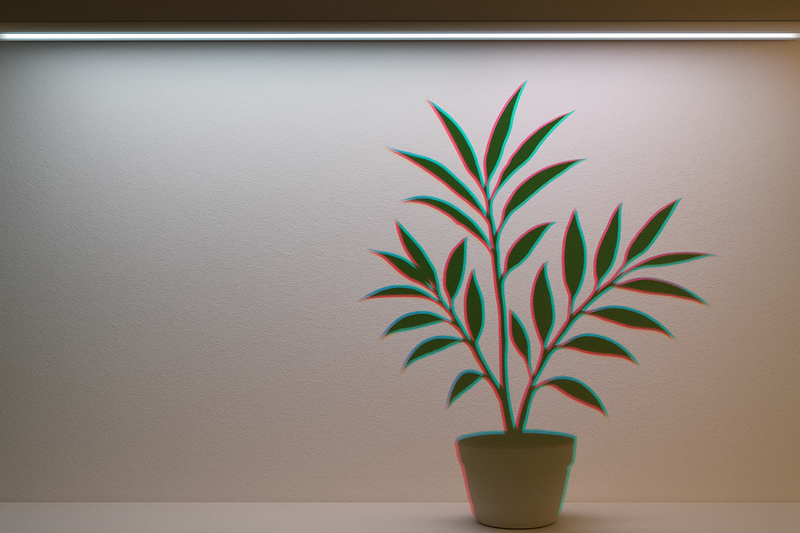
Standard RGB strips create "white" by mixing Red, Green, and Blue at 100%. This produces a cold, blueish "pseudo-white" with a terrible Color Rendering Index (CRI < 70). Furthermore, they create "Rainbow Shadows," where objects cast separated red, green, and blue shadows, ruining the architectural look.
The "Pseudo-White" Problem
I often have clients from the US ask, "Can I just buy RGB and set it to white when I don’t want colors?" My answer is always a hard NO. Here is the physics of why RGB fails at being white:
- Narrow Spectrum vs. Broad Spectrum: Real sunlight (and Single Color LEDs) produces a continuous spectrum of light. It contains cyan, orange, yellow, and violet wavelengths. RGB LEDs only produce three narrow spikes: Peak Red, Peak Green, Peak Blue.
- The Brain Trick: Your brain perceives the mix as white, but your eyes struggle to focus. It feels "hazy" or "clinical." It is usually around 6500K-7000K (very cold blue).
- CRI Disaster: Because RGB lacks amber and yellow wavelengths, wood looks grey and skin looks dead (CRI is usually around 60-70). If you light a redwood deck with RGB "White," you just wasted $20,000 on the deck usage.
The "Rainbow Shadow" Effect
This is the dealbreaker for architecture. Since the Red, Green, and Blue diodes are physically spaced millimeters apart inside the chip (or sometimes on separate chips), the light originates from three slightly different angles.
When you shine this on a sculpture, a column, or a plant, the shadows split. You will see a red shadow, a green shadow, and a blue shadow next to each other on the wall behind the object. It looks messy, cheap, and unintentional.
Use RGB only for: Signage, hidden coves in a bar, or under-cabinet toe kicks where shadows don’t matter. Never use it for primary landscape lighting where the source is close to the object.
| Issue | Explanation | Visual Impact |
|---|---|---|
| Spectrum Gap | Missing Yellow/Amber waves | Wood looks grey; faces look sick. |
| Color Separation | Diodes spaced apart | Multi-colored shadows on walls. |
| Kelvin Temp | Uncontrolled (>6500K) | Looks like a hospital or gas station. |
Is RGBW the Perfect Compromise for Modern Luxury?
Clients want it all: Classy warm lighting for 360 days a year, and crazy red/green colors for Christmas. How do you deliver both without installing two separate systems?
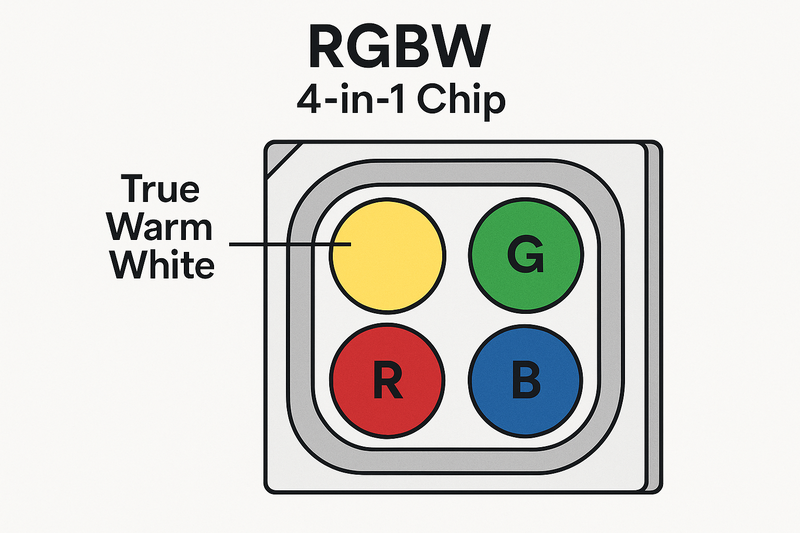
RGBW (Red, Green, Blue, + White) is the best solution for high-end residential. It adds a dedicated phosphor-coated White chip alongside the color chips. This allows you to produce a high-CRI, pure 3000K Warm White for daily use, while still offering full color saturation for holidays and events.
The "4-in-1" Chip Revolution
This is the product I export the most to California and Florida right now. The RGBW 4-in-1 chip (often the 5050 or 3838 package) solves the "Pseudo-White" problem we discussed above.
- The "W" Factor: You have to specify the Kelvin of the "W" when you order. Always choose Warm White (2700K or 3000K) for outdoor use. Never choose Cool White (6000K) for the "W" unless it is for a modern commercial building.
- Operation Mode: When the client hits "Warm White" on their phone app, the Red, Green, and Blue chips turn OFF. Only the White chip turns on. This gives you that perfect, high-CRI, shadow-free illumination that matches the rest of the landscape lights.
Pastel Colors: The Hidden Feature
This is a hidden benefit that designers love. You can mix the White with the colors.
- Red + White = Pink.
- Blue + White = Sky Blue/Ice Blue.
- Green + White = Lime/Mint.
Standard RGB cannot make these rich pastel tones. RGBW gives your client a palette of millions of sophisticated colors, not just the primary "crayon" colors.
The cost is obviously higher—usually about 20-30% more than standard RGB. But you are selling one system that does two jobs (Security/Architecture + Entertainment). The ROI for the client is massive because they don’t have to hire a Christmas light crew every year.
| Comparison | RGB System | RGBW System |
|---|---|---|
| Daily Use | Not usable (Blueish light) | Perfect (True 3000K) |
| Holiday Use | Good saturated colors | Better (Pastels + Saturation) |
| Brightness | Low | High (Dedicated White Chip) |
| Client Value | "Party Lights" | "Architectural + Party Solution" |
How Does the Wiring Complexity Change the Installation Price?
The strip is only half the battle. The real headache is the copper wire and the controller. Upgrading from Single Color to RGBW changes your entire wiring schematic and budget. Are you ready for the voltage drop?
Single Color creates a loop with 2 wires. RGB requires 4 wires. RGBW requires 5 wires. This drastically increases cabling costs and installation time. More importantly, 5-wire connectors are prone to water ingress. You must solder and shrink-wrap all outdoor RGBW connections to prevent corrosion failure.
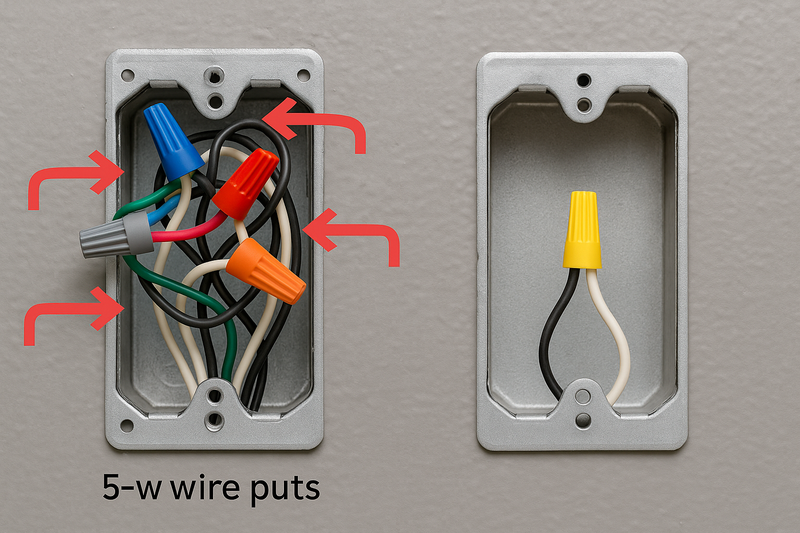
The Hidden Costs of Multi-Channel Lighting
When you quote an RGBW job, you cannot just look at the price of the strip. You have to look at the Copper and the Controllers3.
- Cable Thickness & Cost:
- For a Single Color 100ft run, you might run a heavy gauge 12/2 or 14/2 landscape wire to the start.
- For RGBW, you need 5 conductors (+, R, G, B, W). You cannot easily find 12-gauge 5-conductor wire at Home Depot. You have to order specialized stranded cable. It is expensive and thick.
- Voltage Drop4:
- RGBW strips can draw a lot of current when all channels are on (White + Colors). However, the copper pads on the strip itself are narrow.
- Rule of Thumb: You must inject power every 16 to 32 feet (5 to 10 meters) for 24V RGBW tape. If you don’t, the "White" at the end of the run will look pinkish or brownish because the voltage has dropped.
- This means running more parallel power lines alongside the strip.
Connection Reliability: Solder vs Clips
In my factory testing lab, we do salt spray tests.
- 2-pin connectors (Single Color) seal very well.
- 5-pin connectors (RGBW) are notoriously difficult to seal perfectly in the field. The pins are close together (often 0.1 inch pitch). One drop of water bridges the "Red" pin to the "+" pin, and suddenly your lights are stuck on Red forever.
- Mandatory Step: Do not use "clip-on" connectors outdoors for RGBW. Solder everything. Use marine-grade heat shrink with adhesive lining. If you don’t, you will be back in 3 months to fix a corroded joint.
| Component | Single Color Install | RGBW Install |
|---|---|---|
| Wire Type | Standard 12/2 or 14/2 | Specialized 18/5 or 20/5 |
| Power Injection | Every 32-50 ft | Every 16-32 ft |
| Connectors | Easy to waterproof | Hard (Solder required) |
| Controller | Simple Dimmer | RGBW Controller + Amplifiers |
| Labor Time | 1x | 3x |
What About "Digital" or Pixel Strips for Architecture?
You see them on YouTube: lights that chase, flow, and create rainbows. Clients call them "Dream Color" or "Chasing Lights." Should you put these permanently on a luxury home?
Addressable (Pixel) strips allow for chasing effects and dynamic patterns. However, they are commonly 5V or 12V, resulting in severe voltage drop issues. Furthermore, the data protocols (SPI) are extremely sensitive to interference and distance. Keep these for entertainment zones, not general architectural lighting.
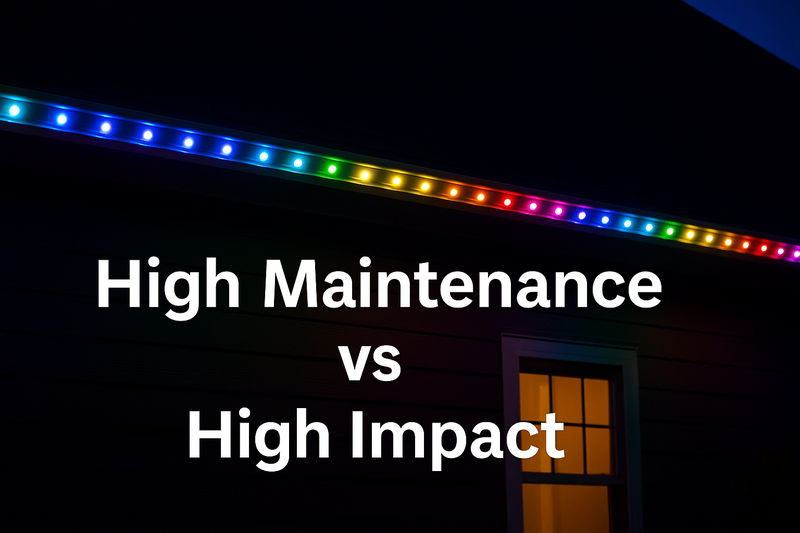
The Risk of the "Smart" Chip
Pixel strips (like WS2811, WS2812B, UCS1903) have a microchip embedded in the strip every few inches. This chip reads data and tells the LED what to do.
- Water Vulnerability: In a standard analog strip, if water touches the circuit, it might dim or short a section. In a Pixel strip, if water touches the Data Line anywhere, the signal corrupts. The lights will flicker uncontrollably like a disco strobe. Since there are chips everywhere, there are thousands of sensitive points.
- The "Data" Distance: The data signal from the controller weakens after about 15-20 feet of wire. If your controller is in the garage and the lights start at the roof peak (50 feet away), the lights won’t turn on. You need "Null Pixels" or data boosters to push the signal.
- One Out, All Out: In many older pixel types, if one chip dies in the middle of the run, the data stops passing through. The rest of the strip goes dark. It is too fragile for critical architectural use where you need 100% reliability.
Voltage Drop Nightmare
Most pixels operate at 5V or 12V.
- 24V (Analog Strip): Pushes power far, ideal for long runs around a house.
- 5V (Pixel Strip): Loses power after 10 feet. You have to inject power constantly. It creates a massive web of wiring that is hard to hide on a clean building facade.
My Verdict: Use Pixel strips for a dedicated "Party Zone," a bar, or holiday railing. Do not use them to uplight the house. Treat them as a toy, not a tool.
| Feature | Analog RGBW | Digital Pixel (Dream Color) |
|---|---|---|
| Control | Whole strip changes color | Individual LEDs change color |
| Voltage | 24V (Stable) | 5V / 12V (Drastic Drop) |
| Reliability | High | Low (One chip fails, all fail) |
| Best Use | Architecture / Landscape | Holiday / Signage / Bar |
Conclusion
Here is the bottom line for your business: Use Single Color (2700K or 3000K) for 80% of your landscape jobs to guarantee reliability, brightness, and easy installation. Upsell RGBW only for clients who demand holiday versatility and have the budget for complex 5-wire installation. Avoid standard RGB and Pixel strips for permanent outdoor installs—unless you enjoy fixing lights for free on the weekends.
-
Explore the advantages of Single Color LEDs for outdoor lighting, including efficiency and longevity. ↩
-
Learn how high lumen output enhances outdoor lighting effectiveness and visibility. ↩
-
Understanding the costs associated with Copper and Controllers is crucial for budgeting your RGBW lighting projects. ↩
-
Exploring Voltage Drop will help you ensure optimal performance and longevity of your RGBW lighting installations. ↩
Interested in Our LED Solutions?
Get professional consultation and customized LED lighting solutions for your projects. Contact our expert team today.
Related Articles

How Do You Build Profitable Custom Vehicle and RV Interior LED Rope Lights?
You lose RV installation contracts because your interior lights fail on rough roads. Standard strips show bright dots on glossy…

How to Perfect Bookshelf and Display Cabinet LED Rope Lighting?
You lose retail clients when bookshelves look incredibly dark. Ugly shadows hide expensive products inside display cabinets daily. You need…

How to Master Mirror and Vanity LED Rope Light Installation?
Your clients complain about ugly shadows in their bathroom mirrors. Bad lighting ruins expensive vanity designs. You lose future contracts…
