

Should You Use 12V or 24V LED Strips for Your Project?
You install a long, beautiful run of lighting in a ceiling soffit, but the end of the strip is noticeably dimmer than the beginning. The client is asking questions, and your flawless installation now looks amateurish.
While both 12V and 24V strips will light up, a 24V system is the superior professional choice for most applications. It allows you to create much longer, cleaner runs with less voltage drop, uses smaller gauge wires, and puts less strain on components, leading to a more reliable installation.
From my perspective as a manufacturer, the shift from 12V to 24V as the default standard for professionals has been clear. My most experienced clients in North America and Japan—the ones handling large residential projects and commercial fit-outs—almost exclusively specify 24V. They know that this choice isn’t just a number on a spec sheet; it’s the foundation for a more efficient, robust, and dependable lighting system. It simplifies wiring, reduces potential failure points, and ultimately delivers a better result for the end client. Let’s break down exactly why this is the case.
Why Does a 24V Strip Allow for Longer Runs?
You’re wiring a 30-foot cove, but your 12V strip starts dimming after only 15 feet. Now you’re forced to run a second power supply and complex wiring to the middle of the run, wasting time and money.
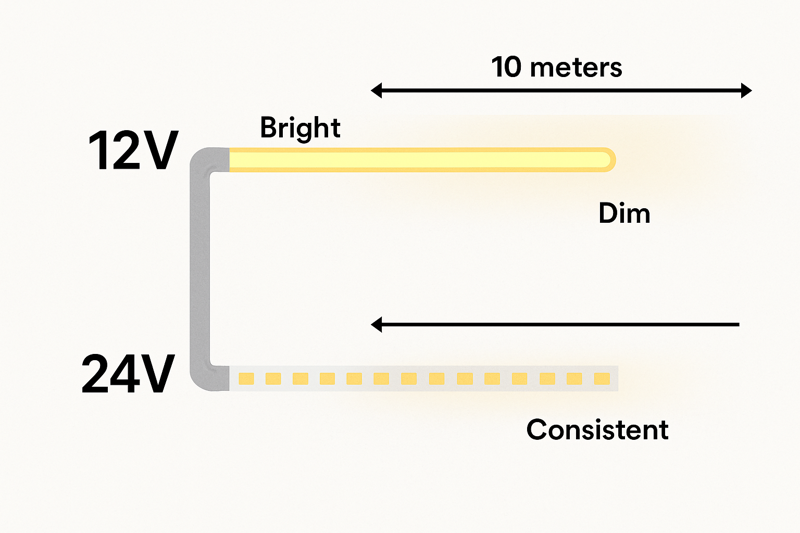
A 24V system allows for approximately double the run length of a 12V system before visible dimming occurs. This happens because 24V pushes electricity with less voltage drop, which is the gradual loss of electrical pressure along the length of the strip.
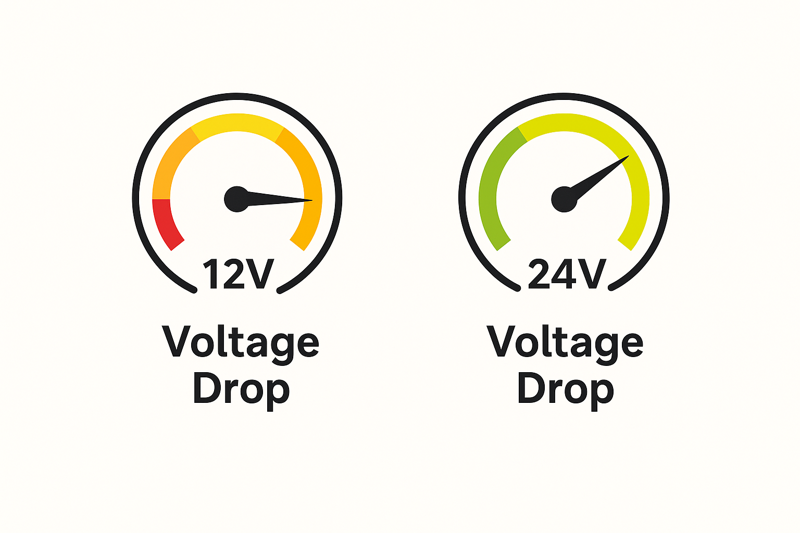
Voltage drop is the number one enemy of long LED strip runs. I’ve seen countless photos from installers asking why their lights are dimming, and the answer is almost always a run that is too long for the chosen voltage. For a professional like Tom, a client pointing out uneven light is a nightmare. It undermines their expertise. Understanding voltage drop isn’t optional; it’s the core electrical principle you must master to guarantee a uniform, professional-grade lighting installation every single time. 24V is your primary weapon in this fight.
What is Voltage Drop and Why Does it Matter?
Think of voltage as electrical "pressure." Just like water pressure decreases the further you get from the pump, electrical pressure (voltage) drops as it travels down the long copper path of an LED strip. The LEDs at the beginning of the strip get close to the full 12V or 24V, but the LEDs at the far end receive significantly less. Less voltage means less light.
- In a 12V System: This drop is very noticeable. As a rule of thumb, you can typically run a standard 12V LED strip1 for about 16 feet (5 meters) before the voltage drop2 becomes so severe that the light output at the end is visibly dimmer.
- In a 24V System: The physics of electrical power (Ohm’s Law) mean that a 24V system3 can push the same amount of power (watts) using half the current (amps) of a 12V system. Less current flowing through the same copper strip means significantly less voltage drop. This allows you to effectively double your maximum run length to about 32 feet (10 meters) before experiencing the same level of dimming.
A Practical Guide to Maximum Run Lengths
This table gives you a clear, practical starting point for planning your projects. These are conservative estimates for a "single-ended" power connection.
| Strip Voltage | Typical Max Run Length | Ideal Use Case | The Professional Advantage |
|---|---|---|---|
| 12V DC | ~16 feet / 5 meters | Short runs, automotive/marine applications, small accent pieces (e.g., single shelf, small display case). | Legacy compatibility. Useful where only a 12V source is available. |
| 24V DC | ~32 feet / 10 meters | The professional standard for residential and commercial architectural lighting (coves, under-cabinet runs, hallways). | Simplifies wiring on most common jobs by eliminating the need for extra power feeds. Saves time and labor. |
For a project requiring a 30-foot continuous run, a 12V strip is automatically the wrong choice. You would need to power it from the middle or run two separate power supplies. With a 24V strip, you can power it from one end and have a perfectly uniform line of light, dramatically simplifying your installation.
Is 24V More Efficient Than 12V?
Your client is eco-conscious and asks about the energy efficiency of your proposed lighting system. You know the strips consume the same wattage, but you’re not sure if one voltage is "greener" than the other.
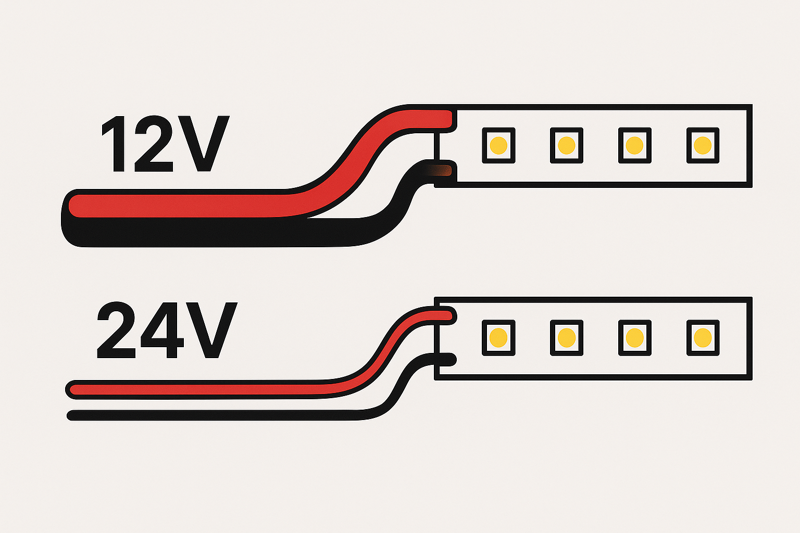
Yes, a 24V system is inherently more efficient than a 12V system. For the same power output (watts), 24V uses half the electrical current (amps). Less current leads to less energy lost as heat in the wiring, meaning more of your power is used to create light.
Efficiency is a key selling point for discerning clients. While two strips—one 12V and one 24V—with identical LED chips and density may be rated for the same wattage (e.g., 4.5 W/ft), the system efficiency is not the same. As a manufacturer, we see this in our lab testing. The energy savings come from the way power is delivered to the strip. Experienced installers leverage this fact to build more robust and cooler-running systems.
Understanding Current, Heat, and Efficiency
The relationship between power, voltage, and current is defined by the formula: Power (Watts) = Voltage (Volts) x Current (Amps). Let’s see how this plays out for a 96-watt installation.
- 12V System: 96W = 12V x 8A. The system needs to carry 8 amps of current.
- 24V System: 96W = 24V x 4A. The system needs to carry only 4 amps of current.
This difference in current is hugely important for three reasons:
- Reduced Resistive Power Loss4: All wires and copper traces have some electrical resistance. The energy lost to this resistance, which is converted into wasted heat, is calculated as: Loss (Watts) = Current² x Resistance. Since the loss is proportional to the square of the current, halving the current (by using 24V) reduces the power lost as heat by a factor of four. This is a significant improvement in overall system efficiency.
- Cooler-Running Components5: That wasted heat doesn’t just disappear. It heats up your wires, your connectors, and the LED strip itself. Heat is the number one enemy of electronics. A 24V system runs cooler, which puts less stress on every component in the chain, contributing to a longer lifespan for the power supply, connectors, and the LEDs themselves.
- Thinner and Cheaper Wiring6: The size (gauge) of wire you must use is determined by the amount of current it needs to carry safely. Because a 24V system uses half the current, you can often use a thinner (higher gauge, e.g., 20 AWG instead of 18 AWG) and less expensive wire for the connections between the power supply and the strip. Over a large project, this cost saving on copper wire can be substantial.
Efficiency Comparison Summary
| Factor | 12V System | 24V System | The Professional Advantage for Tom |
|---|---|---|---|
| Current (Amps) | High (e.g., 8A) | Low (e.g., 4A) | Less strain on all components. |
| Power Loss as Heat7 | High (proportional to Current²) | Low (4x less than 12V) | Better energy efficiency to sell to clients; cooler system operation improves lifespan. |
| Required Wire Gauge | Thicker (more expensive) | Thinner (less expensive) | Direct cost savings on project materials (especially copper wire). |
How Does Voltage Affect the Cut Points on an LED Strip?
You’re working on a detailed project with very precise measurements, like custom display shelving. You need to cut the LED strip to an exact length, but the cut marks on your 24V strip are too far apart.
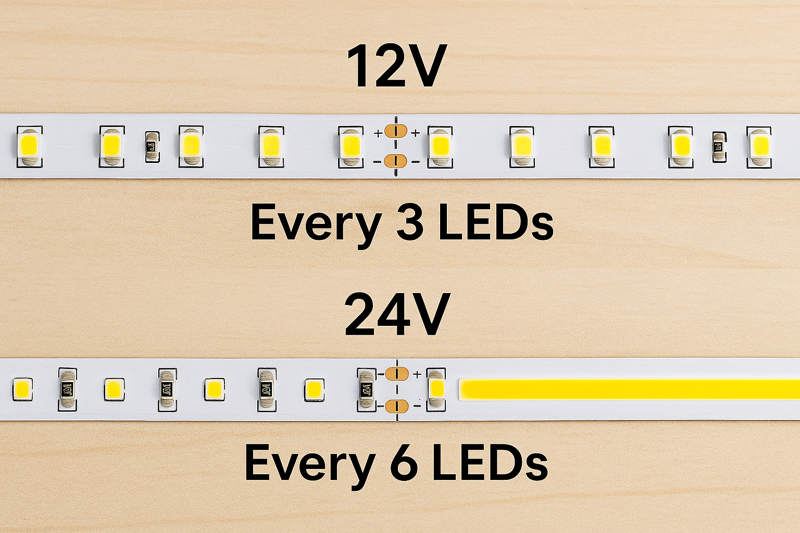
On a 24V strip, the cut points are typically twice as far apart as on an equivalent 12V strip. This is because the circuit is designed with LEDs grouped in series of 6, whereas a 12V strip groups them in series of 3.
This is the one notable trade-off of using 24V, and it’s a practical detail that every installer must be aware of. While 24V is superior for run length and efficiency, 12V offers greater precision for cutting. In our factory, the PCBs for 12V and 24V strips are designed differently to accommodate this electrical requirement. For most architectural applications like cove lighting, a 2-inch or 4-inch cut increment is perfectly fine. But for projects with intricate shapes or exact-fit requirements, this can be a deciding factor.
The Circuitry Behind the Cut Points
Every flexible LED strip is divided into small, independent circuits. This is why you can cut it and have the rest of the strip still work.
- 12V Strip Circuit8: The strip is divided into segments, and each segment contains 3 LEDs wired in series with a resistor. The components in this segment are designed to operate on approximately 12V. Therefore, you can cut the strip after every group of 3 LEDs. On a standard 60 LEDs/meter strip, this means you have cut marks about every 2 inches (5 cm).
- 24V Strip Circuit9: To operate on 24V, the engineers design the circuit with 6 LEDs wired in series with a resistor. This means you can only cut the strip after every group of 6 LEDs. On a standard 60 LEDs/meter strip, your cut marks will be about every 4 inches (10 cm).
When to Choose 12V for Cutting Precision
While 24V is my standard recommendation, there are specific scenarios where I advise my clients to use 12V specifically for its higher cutting resolution.
- Custom Millwork and Display Cases10: When you are integrating lighting into custom-built furniture, joinery, or retail displays where every inch matters, the shorter cut segments of a 12V strip are a major advantage. It allows you to get a much tighter fit without leaving a large unlit gap at the end.
- Backlighting Signage11: When creating halo-lit letters or logos, you often need to cut and solder many small pieces of strip to follow intricate curves. The higher granularity of 12V strips makes this process much easier and results in more even illumination around tight corners.
- Automotive and Marine (12V Native): This is the most obvious one. Most cars, RVs, and boats run on a native 12V DC system. Using a 12V strip simplifies the installation by allowing you to connect directly to the vehicle’s power source without needing a converter.
For a professional like Tom, it’s about having both options in your toolkit and knowing when the specific project requirements override the general rule of thumb.
Conclusion
For reliability, efficiency, and simplified wiring on most projects, 24V is the clear professional choice. However, always keep 12V strips in mind for short, precision-cut applications or when connecting to a native 12V power source.
-
Exploring the limitations of 12V LED strips can help you make informed decisions for your lighting projects. ↩
-
Understanding voltage drop is crucial for ensuring optimal performance in electrical systems, especially in LED installations. ↩
-
Discover the benefits of a 24V system, including longer run lengths and reduced voltage drop, for efficient lighting solutions. ↩
-
Understanding this concept can help you optimize your electrical systems for better efficiency and lower energy costs. ↩
-
Explore how maintaining lower temperatures can enhance the longevity and reliability of your electronic devices. ↩
-
Learn how using thinner wiring can save costs and improve efficiency in your electrical projects. ↩
-
Discover strategies to reduce power loss as heat, improving the efficiency of your electrical systems. ↩
-
Explore this link to understand the benefits of 12V circuits in LED lighting applications. ↩
-
Learn about the advantages of 24V circuits and how they can enhance your LED lighting projects. ↩
-
Discover expert tips on integrating LED lighting into custom furniture for a professional finish. ↩
-
Find out how to effectively use LED strips for backlighting signage to achieve stunning visual effects. ↩
Interested in Our LED Solutions?
Get professional consultation and customized LED lighting solutions for your projects. Contact our expert team today.
Related Articles

How Do You Build Profitable Custom Vehicle and RV Interior LED Rope Lights?
You lose RV installation contracts because your interior lights fail on rough roads. Standard strips show bright dots on glossy…

How to Perfect Bookshelf and Display Cabinet LED Rope Lighting?
You lose retail clients when bookshelves look incredibly dark. Ugly shadows hide expensive products inside display cabinets daily. You need…

How to Master Mirror and Vanity LED Rope Light Installation?
Your clients complain about ugly shadows in their bathroom mirrors. Bad lighting ruins expensive vanity designs. You lose future contracts…
