

Single Color vs RGB LED Rope Lights: Choosing the Right Option (Stop Ruining Your Ambience)
It is the most common complaint I hear from interior designers: "The lighting feels gimmicky." They walk into a high-end restaurant renovation, and instead of a warm, inviting glow, they are greeted by a cheap, purplish-white light or a flashing disco effect that belongs in a nightclub, not a fine dining establishment. Choosing between Single Color and RGB isn’t just about picking a color; it is about defining the purpose of the space.
The choice between Single Color and RGB determines the functional identity of your project. Use Single Color (2700K-4000K) for primary architectural illumination, task lighting, and high-CRI applications requiring true color rendering. Reserve RGB or RGBW for mood lighting, signage, and entertainment zones where dynamic atmosphere takes precedence over visibility.
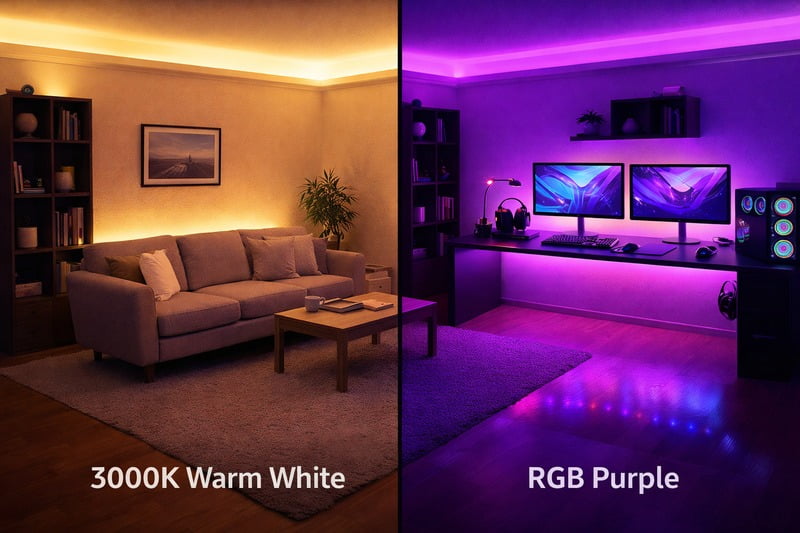
As a factory owner who ships containers of both types to North America every month, I see the purchase orders. I know that while RGB gets all the attention on Instagram, Single Color is the workhorse that pays the bills. However, the lines are blurring with new technology like RGBW and RGB+CCT. Let’s break down the engineering differences, the cost implications, and the specific use cases so you don’t install a party light where a reading light belongs.
Why Is Single Color Still the King of Commercial Design?
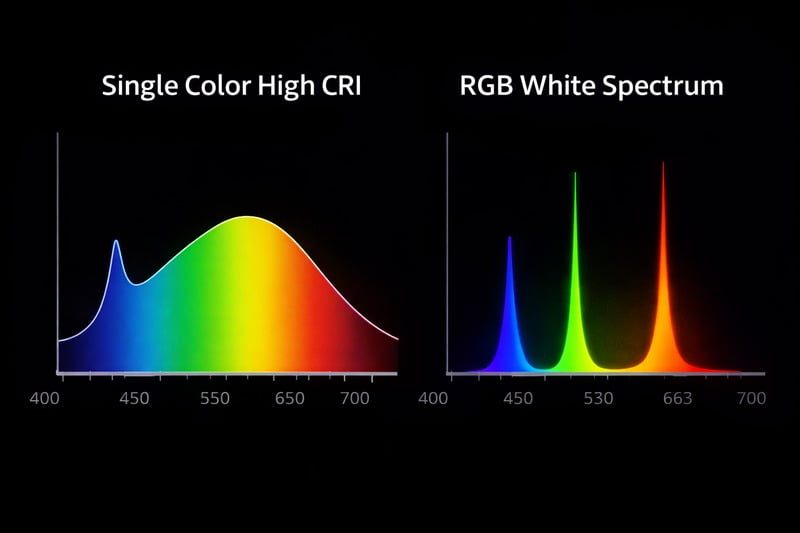
You might think, "Why buy white when RGB can make white?" This is the single biggest misconception in lighting. A "white" created by mixing Red, Green, and Blue is poor quality, low brightness, and terrible for your eyes. If you want luxury, you want dedicated Single Color phosphors.
Single Color LED strips utilize dedicated phosphor-coated chips to produce specific color temperatures (CCT) ranging from 1800K (Candlelight) to 6500K (Daylight). They offer superior lumen output (up to 140+ lm/W), higher Color Rendering Index (CRI >90), and better thermal stability than RGB mixed white, making them the only viable choice for general illumination.
The Science of "Real" White
In our factory, we treat Single Color and RGB as completely different product lines.
The Phosphor Advantage:
- Single Color Construction: We take a blue LED chip and coat it with a precise mixture of yellow pseudo-phosphors. The thickness and chemical composition of this coating determine if the light is 2700K (Warm) or 6000K (Cool).
- The Result: A broad, continuous spectrum of light. This is why our Single Color COB Series1 (Model HC-10-12) can achieve Ra90 or higher. It renders skin tones naturally and makes food look delicious.
- Efficiency: Single color is efficient. Our high-efficiency SMD series can hit 180 lumens per watt2. That means more brightness for less electricity.
The "RGB White" Problem:
- RGB Construction: To make white with RGB, you turn on the Red, Green, and Blue diodes at 100%.
- The Result: It looks white from a distance, but it creates "color fringing" shadows. If you hold your hand under it, your shadow will have red and blue edges. The CRI is usually terrible (Ra < 70).
- Brightness: It is dim. A standard RGB strip might only put out 300-500 lumens/meter. A Single Color strip easily pushes 1000-2000 lumens/meter.
Specific Use Cases for Single Color:
- Under-Cabinet Lighting: You need high CRI to see the true color of the food you are chopping.
- Office Lighting: You need 4000K to maintain focus and reduce eye strain.
- Retail Displays: You need high brightness to make jewelry or clothing sparkle.
CCT Options in Our Catalog:
We offer a massive range for Single Color:
- 1800K-2200K: Golden light/Candlelight (High-end bars).
- 2700K-3000K: Residential Warm White (Living rooms).
- 4000K: Commercial Natural White (Offices/Kitchens).
- 6000K: Cool Daylight (Jewelry/Clinical).
When Should You Commit to RGB (and When is it a Mistake)?
RGB is seductive. The ability to change your room from "Cyberpunk Pink" to "Ocean Blue" with a remote control is fun. But fun does not always equal functional. I have seen clients install RGB in a library and regret it immediately when they realized they couldn’t read a book.
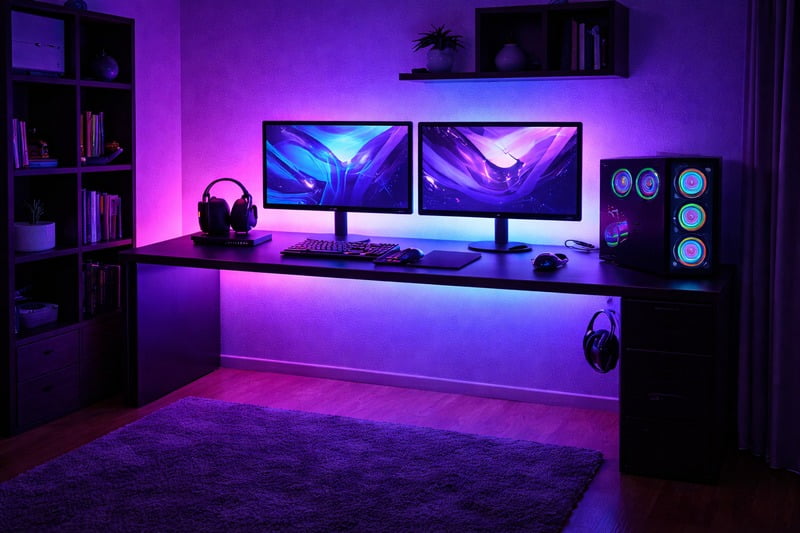
RGB (Red-Green-Blue) strips contain three diodes in one package, allowing for the creation of 16 million colors through color mixing. They are designed exclusively for accent lighting, mood setting, signage, and entertainment. They should never be used as the primary light source because they lack a true white spectrum and sufficient lumen density for task work.
The 3-in-1 Chip Architecture
When you look at our BG-115-5050-300 RGB series, you are looking at a 3-in-1 chip architecture.
How RGB Works:
Every "pixel" or chip contains three tiny crystals: Red, Green, and Blue. By varying the voltage to each crystal, we mix colors.
- Red + Green = Yellow
- Red + Blue = Magenta
- Blue + Green = Cyan
The Density Challenge:
- SMD RGB: Traditionally, RGB uses large 5050 chips. This leads to low density (usually 60 LEDs/m). This creates "spots" if not diffused capable.
- COB RGB: We now offer High-Density RGB COB3 (Model HC-10-24-S0840). This packs 840 LEDs per meter (280 Red, 280 Green, 280 Blue). This eliminates the spots and creates a seamless neon look, which is crucial for visible installations like bar counters.
The Power Consumption Trap:
- RGB is power-hungry. To get full brightness (White), you are powering three channels.
- Catalog Data: Our standard RGB strips draw about 14.4W per meter.
- Warning: If you only run the "Red" channel, you are creating heat in the resistor for the other channels depending on the circuit design, or simply underutilizing the power supply capacity.
Where RGB Fails:
- Vanity Mirrors: Doing makeup under RGB "White" is a disaster. You will walk outside and realize your foundation is the wrong shade because the light was missing parts of the color spectrum.
- Reading Nooks: The lack of true yellow/orange wavelengths strains the eyes.
Where RGB Excels:
- Signage: Backlighting channel letters.
- Hospitality: Changing a hotel exterior from green (St. Patrick’s Day) to red (Valentine’s Day).
- Sensory Rooms: For calming or stimulating effects.
The Best of Both Worlds: What is RGBW and RGB+CCT?
You want the party mode for Friday night, but you need the task lighting for Monday morning. Do you install two separate strips? No. You buy the hybrid solution that is rapidly taking over the high-end market: RGBW.
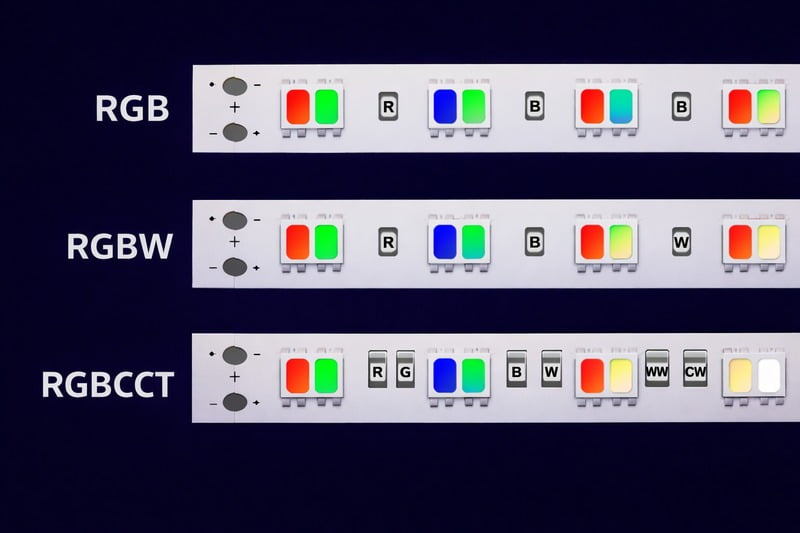
RGBW (Red-Green-Blue-White) adds a dedicated white phosphor chip alongside the color diodes, providing both saturated colors and high-quality white light in one strip. RGB+CCT (or RGBCCT) goes further by adding two white chips (Warm + Cool), allowing you to adjust the white temperature while also having full color control. This creates the ultimate all-in-one lighting solution.
The 4-Channel and 5-Channel Revolution
This is where the serious contractors make their money. By upselling to RGBW, you solve the "bad white" problem of standard RGB.
1. RGBW (4-in-1):
- The Tech: We integrate a dedicated White chip (usually 3000K or 6000K) into the package.
- The Benefit: You get a "Real White" with high CRI for general lighting. When you want color, you switch to the RGB channels.
- Catalog Spot: Look at our BG-213-5050 series. It is an RGB+W strip. It has 60 pcs/m (alternating RGB and White) or integrated 4-in-1 chips.
- Power: These are powerful, often pulling 19.2W/m because of the extra channel.
- The Tech: This is the beast. Red, Green, Blue, Warm White, Cool White.
- The Capability: Tunable White (2700K-6500K) for circadian rhythm lighting during the day + Full RGB for mood at night.
- The COB Advantage: We manufacture a DC-24V RGBWC COB Strip with 630 LEDs/m on a 12mm board.
- This is incredible tech. It mixes 5 colors without any spotting.
- It allows you to match the white light exactly to other fixtures in the room, then switch to party mode instantaneously.
Wiring Complexity:
- Single Color: 2 Wires (+, -). Easy.
- RGB: 4 Wires (+, R, G, B). Needs a controller.
- RGBW: 5 Wires. Needs a specialized controller.
- RGB+CCT: 6 Wires. Needs a pro-grade controller (like DALI or Zigbee 3.0).
- Advice: Do not buy RGB+CCT if you are not comfortable managing complex wiring and setting up advanced controllers.
Single Color vs RGB: Which One Requires More Maintenance?
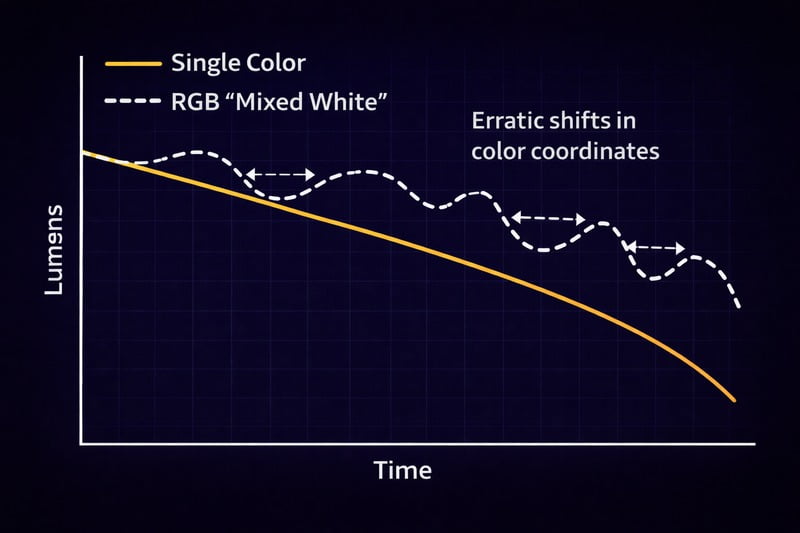
I shipped a container to a casino project in Las Vegas. Six months later, they called me saying the lights were "drifting." They used RGB to create a golden hue. The red channel degraded faster than the green, and their gold turned into a sickly lime green. This is the hidden cost of color mixing.
Single Color strips are inherently more stable and reliable over time. Because they use a single type of chip with consistent thermal properties, they age evenly. RGB strips rely on color mixing; if one color channel (usually Red) degrades faster due to heat, the resultant mixed color shifts visibly, requiring frequent recalibration or replacement.
Thermal Decay and Complexity
Reliability is the boring part of engineering that saves your reputation.
The "Red" Problem in RGB:
- Red LEDs rely on different chemical compounds (AlInGaP) than Blue and Green (InGaN).
- They react to heat differently. Red efficiency drops faster as temperature rises.
- If you run an RGB strip at 100% white inside a hot cove, the Red will dim faster than the Blue.
- Result: After 10,000 hours, your "White" will look very Blue/Green.
Single Color Stability:
- A 3000K Single Color strip uses Blue chips covered in phosphor.
- They all age at the exact same rate. The brightness might drop, but the color stays relatively consistent (within a few MacAdam ellipses).
- Factory Spec: Our Single Color SMD strips5 are rated for >36,000 hours lifespan.
Controller Failure Points:
- Single Color: Can run directly off a dimmable driver. Simple. Robust.
- RGB/RGBW: Requires a PWM (Pulse Width Modulation) controller6 between the driver and the strip.
- Point of Failure: Electronics fail before LEDs. By adding a controller, you are adding a component that can overheat, lose WiFi connection, or blow a capacitor.
- Recommendation: For critical infrastructure (hard-to-reach coves, high ceilings), use Single Color. For accessible areas where maintenance is easy, RGB is fine.
Cost Analysis: Is RGB Worth the Premium?
Tom, my client in Texas, bid on a 200-meter fence lighting job. He quoted Single Color. The client asked for RGB. Tom just multiplied the strip cost by 1.5x. He lost money on the job. Why? Because the strip cost is only a fraction of the RGB equation.
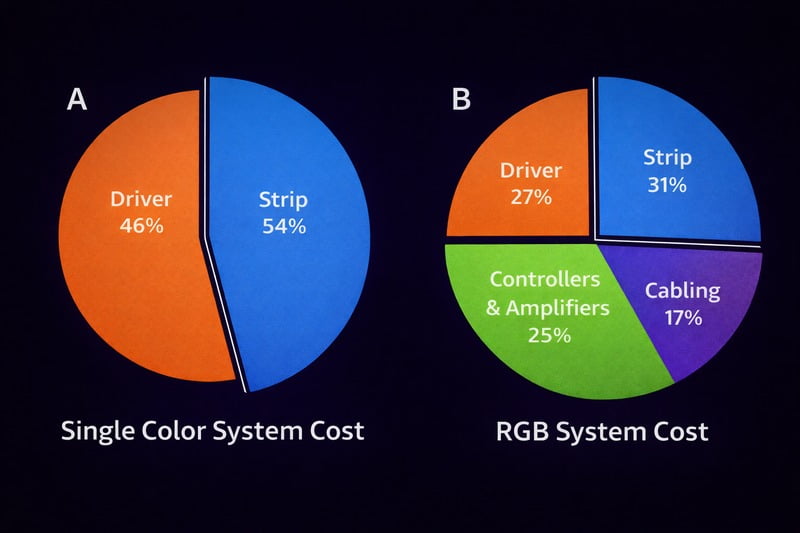
While the RGB strip itself may only cost 30-50% more than Single Color, the total system cost is often double or triple. RGB requires 4-channel controllers, amplifiers for long runs, more complex wiring (4-conductor vs 2-conductor), and often larger power supplies to handle the potential full-load draw.
The Hidden BOM (Bill of Materials)
Let’s do the math on a 20-meter run (approx 65 feet).
Option A: Single Color (24V COB)
- Strip: 20m x $X.
- Driver: 1 x 200W Dimmable Driver.
- Wire: 2-core wire (cheap).
- Installation: Fast. Solder 2 pads.
- Control: Uses a standard wall dimmer switches.
Option B: RGB (24V COB)
- Strip: 20m x $1.5X.
- Driver: 1 x 200W Non-Dimmable Driver (Power matches, but needs to be static voltage).
- Controller: You need an RGB Controller7 capable of handling 200W (approx 8 Amps). Most basic controllers handle 6 Amps. You now need a Signal Amplifier or a heavy-duty industrial controller ($$$).
- Wire: 4-core wire (more copper, harder to hide).
- Installation: Solder 4 tiny pads. High risk of bridging. Takes 3x longer.
- Remote: You need a handheld remote or a fancy glass wall panel.
The "Pixel" Factor:
If you go for Addressable RGB8 (Magic Color), the cost jumps again.
- Looking at our HC-12-12 Pixel COB, you get amazing chasing effects.
- But now you need a digital SPI controller, 3-pin specialized connectors, and programming time.
- Warning: Troubleshooting a data signal issue on a Pixel strip is a nightmare compared to troubleshooting a voltage issue on a Single Color strip.
My Advice:
Only sell RGB if the client puts a value on color. Do not throw it in as a "free upgrade." It is a completely different tier of installation labor.
Conclusion
The choice between Single Color and RGB is a choice between Illumination and Decoration.
- Choose Single Color (2700K-4000K) for 80% of your projects: Living rooms, kitchens, offices, and exterior architectural details. It provides the brightness, CRI, and reliability needed for visibility.
- Choose RGB for entertainment spaces: Game rooms, bars, advertising, and kids’ rooms.
- Choose RGBW/RGBCCT if you have a high budget and need versatile, multi-purpose spaces, but be prepared for the complex wiring.
If you are unsure, remember the golden rule of lighting design: Great white light always looks expensive. Bad colored light always looks cheap.
-
Explore the Single Color COB Series to understand its high CRI and efficiency, perfect for natural skin tones and food presentation. ↩
-
Learn about 180 lumens per watt to discover how it enhances brightness while saving electricity, crucial for energy-efficient lighting. ↩
-
Explore this link to understand how High-Density RGB COB technology enhances lighting solutions with seamless designs. ↩
-
Learn about the innovative RGB+CCT technology and its benefits for creating dynamic and customizable lighting environments. ↩
-
Explore the advantages of Single Color SMD strips, including their longevity and consistent color performance, ideal for reliable lighting solutions. ↩
-
Learn about PWM controllers and their role in LED lighting systems, crucial for understanding efficiency and potential failure points. ↩
-
Understanding RGB Controllers is crucial for effective lighting design, ensuring you choose the right one for your project. ↩
-
Exploring Addressable RGB can enhance your lighting projects with advanced features like chasing effects and customization. ↩
Interested in Our LED Solutions?
Get professional consultation and customized LED lighting solutions for your projects. Contact our expert team today.
Related Articles

How Do You Build Profitable Custom Vehicle and RV Interior LED Rope Lights?
You lose RV installation contracts because your interior lights fail on rough roads. Standard strips show bright dots on glossy…

How to Perfect Bookshelf and Display Cabinet LED Rope Lighting?
You lose retail clients when bookshelves look incredibly dark. Ugly shadows hide expensive products inside display cabinets daily. You need…

How to Master Mirror and Vanity LED Rope Light Installation?
Your clients complain about ugly shadows in their bathroom mirrors. Bad lighting ruins expensive vanity designs. You lose future contracts…
