

Solar Powered vs. Electric Outdoor LED Strip Lights: Which Should You Choose for a Professional Project?
Solar-powered LED strips sound like the perfect solution: no wiring, free energy, and easy installation. But you have a high-end project, and your professional reputation is on the line. Can a solar product truly deliver the performance your client expects?
For any professional or large-scale project, low-voltage electric LED strips are the only viable choice. Solar strips are suitable only for small, decorative accents where low brightness and inconsistent performance are acceptable. Electric systems offer superior brightness, 100% reliability, and the scalability needed for architectural and landscape lighting.
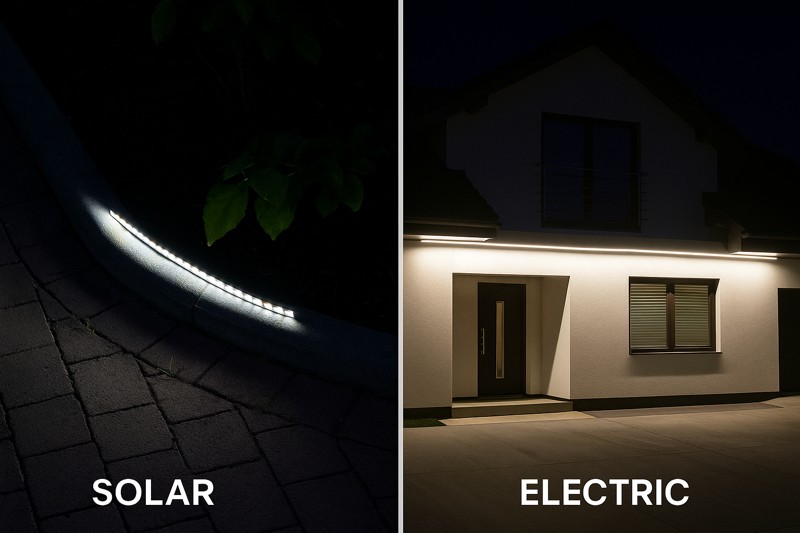
As a manufacturer, I see the appeal of solar. The concept is fantastic. But in my years of experience, I’ve learned that a successful lighting project depends on control and reliability—two things that are fundamentally compromised in a solar-powered system. For a professional buyer like Tom, whose business depends on flawless execution and happy clients, the choice between solar and electric isn’t just about the power source. It’s about choosing between a temporary novelty and a permanent, high-performance lighting solution. Let’s break down the technical realities.
Can Solar Strips Deliver Professional-Grade Brightness and Consistency?
You’ve installed a solar strip along a walkway. The first night, it looks okay for an hour or two, but then it rapidly dims. A few cloudy days later, it barely turns on at all. The light is weak and the color looks cheap, failing to properly illuminate the path as you designed.
No. Solar strips cannot deliver professional brightness because their power is severely limited by a small solar panel and a small battery. This results in very low lumen output and inconsistent performance that is entirely dependent on the weather, making them unsuitable for functional or architectural lighting.
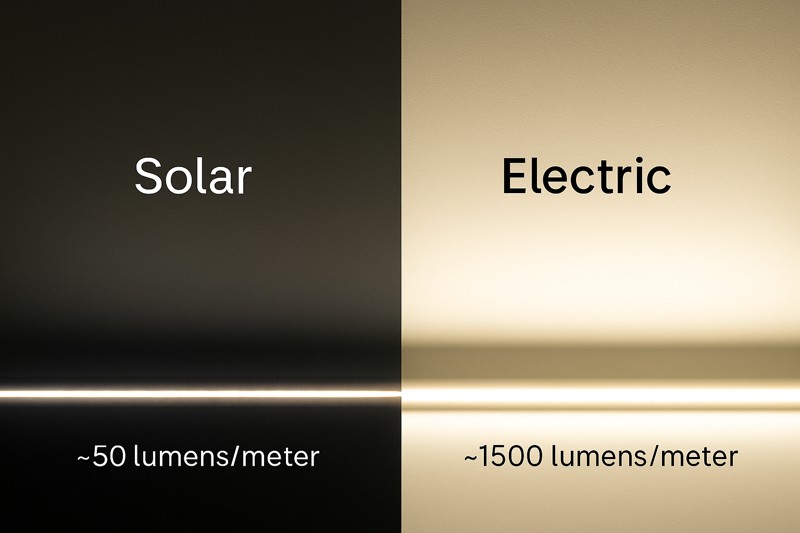
This is the most critical performance difference and it’s rooted in basic physics. The amount of light an LED strip can produce is directly related to the amount of power it consumes. A professional low-voltage system is connected to a reliable power grid, allowing us to engineer strips that are incredibly bright, producing 1,000, 1,500, or even 2,000+ lumens per meter to wash a tall wall or illuminate a large area. A solar product is a closed system. All the energy it can ever use must be collected by its small panel and stored in its small battery. This creates a permanent and unavoidable power bottleneck that dictates every other aspect of its performance.
A Deeper Dive into Power, Brightness, and Light Quality
Let’s break down why this power limitation makes solar a non-starter for serious projects.
-
The Lumen Deficit1: A typical consumer-grade solar LED strip might produce 50-100 lumens per meter. This is, at best, a faint decorative glow. A professional-grade 24V electric strip used for architectural uplighting will start at around 1,000 lumens per meter and go up from there. That’s a 10x to 20x difference in light output. You cannot substitute one for the other. Using a solar strip for a task that requires a professional electric strip is like trying to illuminate a football stadium with a handful of candles.
-
Inconsistent Performance2: A low-voltage electric system delivers the exact same power, and therefore the exact same brightness, every single night. Its performance is 100% predictable. A solar strip’s performance is a complete gamble. How bright will it be tonight? For how many hours will it stay on? The answer depends entirely on variables you cannot control: Was it a sunny or cloudy day? Was the solar panel partially shaded by a tree? Did leaves fall on it? This inconsistency is unacceptable for a client who expects their property to be perfectly lit from dusk until midnight, every single day.
-
Compromised Light Quality (CRI)3: To conserve every milliwatt of precious battery power, solar strip manufacturers must use the most electrically efficient LEDs they can find. Unfortunately, the highest efficiency LEDs are often those with a very low Color Rendering Index (CRI). They might be 70 CRI or even lower. This means the light they produce makes colors look flat, washed out, and inaccurate. A beautiful stone facade or a vibrant landscape will look dull and cheap under low CRI light. Professional electric strips use 90+ CRI LEDs as a standard, ensuring that the client’s property and materials look their absolute best.
| Feature | Solar Powered Strips | Low-Voltage Electric Strips4 |
|---|---|---|
| Brightness | Very Low (50-100 lumens/meter). Decorative glow only. | Very High (1000-2000+ lumens/meter). Professional grade. |
| Consistency | Poor. Entirely dependent on daily sun exposure. | Perfect. 100% consistent brightness every night. |
| Light Quality | Low CRI. (Typically <80 CRI). Makes colors look dull. | High CRI. (Typically 90+ CRI). Renders colors accurately. |
| Professional Use | Not Recommended. Fails to meet basic performance standards. | Mandatory. The only way to guarantee performance. |
What is the Real-World Reliability of Solar vs. Electric Systems?
The client calls you six months after the installation. Half of the solar lights you installed are no longer working. The plastic on the solar panels is cloudy and yellowed, and the batteries won’t hold a charge. Now you have to spend your time and money replacing cheap, failed products.
Solar LED strips have very low reliability due to multiple points of failure: a cheap, non-replaceable battery with a short lifespan (1-2 years), a low-quality solar panel that degrades in the sun, and poor quality electronics. An electric system with a commercial-grade power supply is orders of magnitude more reliable.
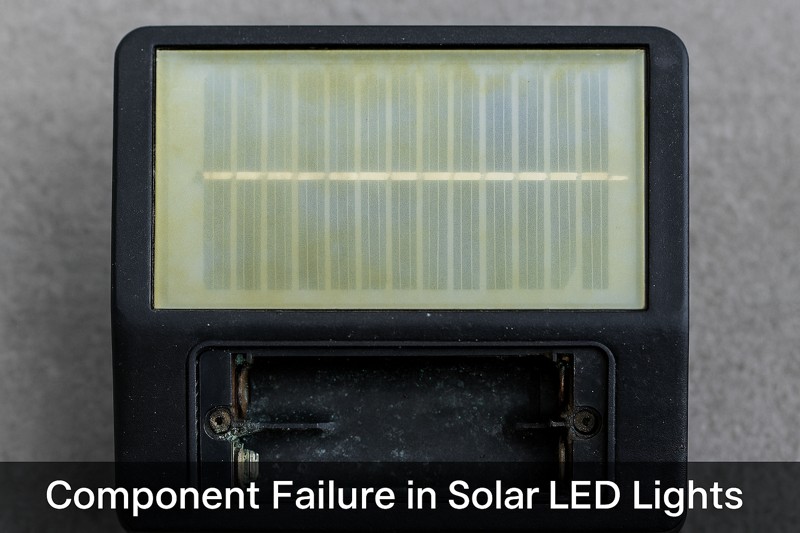
When a professional like Tom specifies a product, he’s not just thinking about how it looks on day one; he’s thinking about its total cost of ownership over five or ten years. An outdoor lighting system must be durable. It has to survive years of rain, snow, and intense UV exposure. This is where solar products, which are almost universally built to a low consumer price point, catastrophically fail. An all-in-one solar light is a collection of the cheapest possible components crammed into a plastic housing. It is a disposable product by design. A professional low-voltage electric system is an assembly of individual, high-quality, replaceable components designed to last for a decade or more.
A Deeper Dive into System Longevity and Durability
Let’s compare the core components of each system to understand the vast difference in long-term reliability.
-
The Power Source:
- Solar: The a a lithium-ion battery5. A low-cost lithium battery in an outdoor product that experiences extreme heat and cold cycles has a realistic lifespan of 300-500 charge cycles. This works out to about 1 to 2 years before it can no longer hold a meaningful charge and must be thrown away.
- Electric: The heart of the system is a commercial-grade LED power supply6 (driver). These are heavy-duty industrial components, often with a 5 or 7-year warranty, and a designed lifespan of over 50,000 hours. It is a stable, long-term piece of infrastructure.
-
The Light Source:
- Solar: The LED strip itself is often a cheap, epoxy-coated strip that will yellow and crack in the sun. The LEDs are overdriven when the battery is full and under-driven as it depletes, causing premature aging and color shifting.
- Electric: We use premium, IP67 silicone-extruded LED strips that are UV-stable and fully weatherproof. Paired with a constant-voltage power supply, the LEDs receive precisely regulated power, ensuring they operate at optimal temperature and achieve their full 50,000-hour rated lifespan.
-
Maintenance and Repair:
- Solar: The entire unit is a single, sealed piece of plastic. If the panel, battery, or circuit board fails, the entire fixture is garbage. There is no possibility of repair.
- Electric: The system is modular. If a component fails after many years of service, you can replace just that component. If a power supply fails in year eight, you replace the power supply. The LED strips remain. This modularity is the hallmark of a professional, sustainable system.
| Component | Solar Powered System | Low-Voltage Electric System |
|---|---|---|
| Energy Source | Low-quality Li-Ion battery (1-2 year lifespan). | Commercial-grade power supply (5-10 year lifespan). |
| Solar Panel | Cheap plastic, yellows and degrades quickly. | N/A (Powered by reliable grid). |
| LED Strip | Low-grade, epoxy-coated, prone to UV damage. | Premium, silicone-extruded, UV-stable. |
| Durability | Very Poor. A disposable product by design. | Excellent. A permanent, long-term installation. |
| Repairability | None. The entire unit must be replaced. | Fully Modular. Individual components can be replaced. |
How Do Solar and Electric Systems Scale for Large Projects?
You’ve been hired to light a 100-foot-long retaining wall, the facade of a two-story building, and 200 feet of garden pathways. How could you possibly achieve a cohesive, powerful, and centrally controlled lighting design using dozens of individual, disconnected solar lights?
Solar LED strips are impossible to scale for large or cohesive projects. Each unit is a separate, uncontrollable system. A low-voltage electric system is infinitely scalable. You can power hundreds of feet of strip from a single power source and control the entire project from a single switch or smart controller.
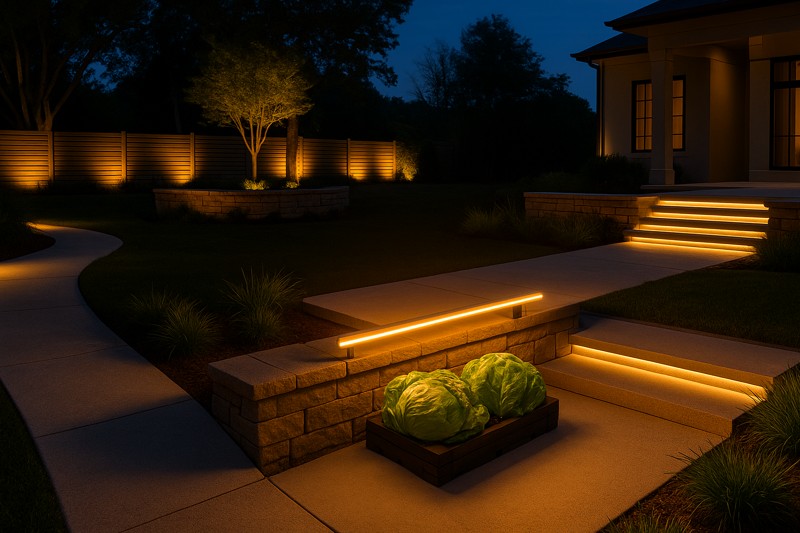
This is the final, decisive advantage of a professional electric system. Modern lighting design is about creating a complete, unified experience. It’s about ensuring all the lights turn on at the same time, have the exact same color temperature and brightness, and can be controlled together. A project that uses ten separate solar lights is not a "lighting system." It is just ten individual lights that happen to be in the same yard, each doing its own thing based on how much sun it got that day. A low-voltage electric system allows the designer to treat the entire property as a single canvas. This level of control and scalability is not a luxury; it is the fundamental requirement of professional landscape and architectural lighting.
A Deeper Dive into Installation, Control, and Scalability
Let’s examine the practical differences when you move beyond a single small installation.
-
Length and Power Limitations:
- Solar: A typical solar strip is 10 to 20 feet long. That’s it. You cannot connect them together. If you need to light a 50-foot wall, you would need three separate, mismatched systems.
- Electric: We manufacture LED strips in long reels. With a properly sized 24V power supply and amplifiers, you can create continuous, unbroken runs of light hundreds of feet long, all with perfectly even brightness from start to finish.
-
- Solar: There is no central control. Each solar light has its own photoreceptor. One light in a shadow might turn on at 5:00 PM, while one in the sun turns on at 5:30 PM. There is no way to synchronize them or control them manually.
- Electric: The entire system is wired back to a central point. This means you can control everything with a single switch, dimmer, timer, or smart controller. You can have the entire property’s lighting system turn on at the exact moment of sunset, dim to 50% at 10 PM, and turn off at midnight. You can integrate it with smart home systems like Alexa or Zigbee for full automation.
-
- Solar: Your design is limited by where you can place a solar panel to get 6-8 hours of direct sun. You cannot light the north side of a building, under a dense tree canopy, or under a covered patio.
- Electric: You can put light anywhere you can run a low-voltage wire. This gives you complete creative freedom to execute your design vision without compromise.
Conclusion
While solar is a fascinating technology, it is not a professional lighting solution. For performance, reliability, and control, a low-voltage electric system is the only choice. It’s the only way to guarantee a result that will satisfy your clients and protect your reputation for years to come.
-
Understanding the lumen deficit helps in choosing the right lighting for your project. ↩
-
Explore how performance variability can impact your lighting needs and project outcomes. ↩
-
Learn why CRI matters for color accuracy and aesthetic appeal in lighting. ↩
-
Discover the advantages of low-voltage electric strips for reliable and high-quality lighting. ↩
-
Understanding the lifespan of lithium-ion batteries can help you make informed decisions about energy storage solutions. ↩
-
Explore the advantages of commercial-grade LED power supplies for long-term reliability and performance in lighting systems. ↩
-
Understanding centralized control can help you optimize your lighting setup for efficiency and convenience. ↩
-
Exploring design freedom will reveal how to maximize creativity and functionality in your lighting projects. ↩
Interested in Our LED Solutions?
Get professional consultation and customized LED lighting solutions for your projects. Contact our expert team today.
Related Articles

How Do You Build Profitable Custom Vehicle and RV Interior LED Rope Lights?
You lose RV installation contracts because your interior lights fail on rough roads. Standard strips show bright dots on glossy…

How to Perfect Bookshelf and Display Cabinet LED Rope Lighting?
You lose retail clients when bookshelves look incredibly dark. Ugly shadows hide expensive products inside display cabinets daily. You need…

How to Master Mirror and Vanity LED Rope Light Installation?
Your clients complain about ugly shadows in their bathroom mirrors. Bad lighting ruins expensive vanity designs. You lose future contracts…
