

UV-Resistant LED Rope Lights: Are You Losing Money on Faded Outdoor Projects?
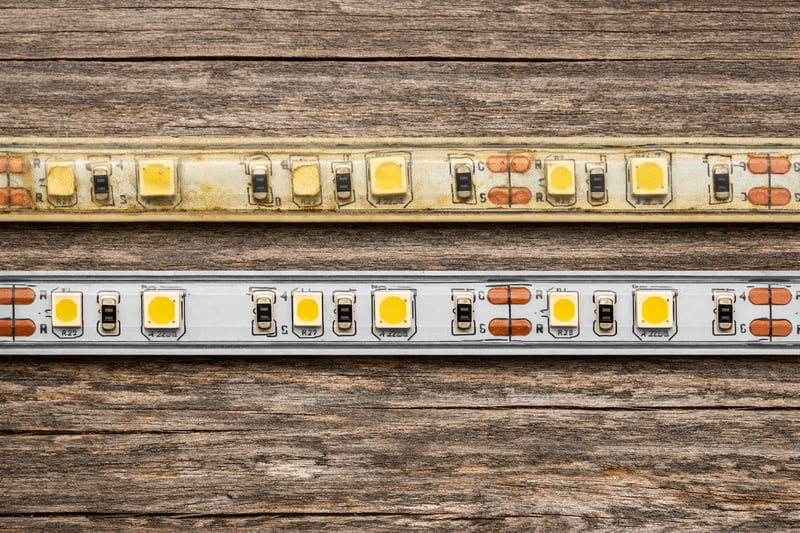
You install beautiful outdoor lighting for a building facade. Six months later, the bright white light turns into a sickly yellow. Your client demands a full refund.
Standard coatings degrade rapidly under direct sunlight. To prevent yellowing and cracking, you must use true UV-resistant silicone materials. You should specify IP67 hollow extrusion or IP68 solid extrusion with high-quality silicone for any exterior applications.
I am Jeremy Hou, the owner of Rhstriplighting in China. I speak with buyers like Tom from the United States every week. Tom buys lights, puts his brand on them, and sells them to contractors. He used to lose money in the summer. His outdoor strips turned yellow and cracked under the sun. He blamed our industry. I told him the truth. The real problem is the cheap waterproof casing. Many factories use cheap materials to save costs. These materials survive rain but die under sunlight. You need a trusted factory partner to solve this. Let me show you how to source the right products and protect your projects.
How Does Sunlight Destroy Cheap Waterproof Coatings?
You think a waterproof label means the product is safe outdoors. Sun exposure is actually much more damaging than water. Are you paying for the wrong protection?
Many suppliers use epoxy resin or cheap polyurethane for IP65 potting compound waterproofing. UV light breaks down the chemical bonds in these cheap plastics. The material turns brown, blocks the light output, and becomes hard.
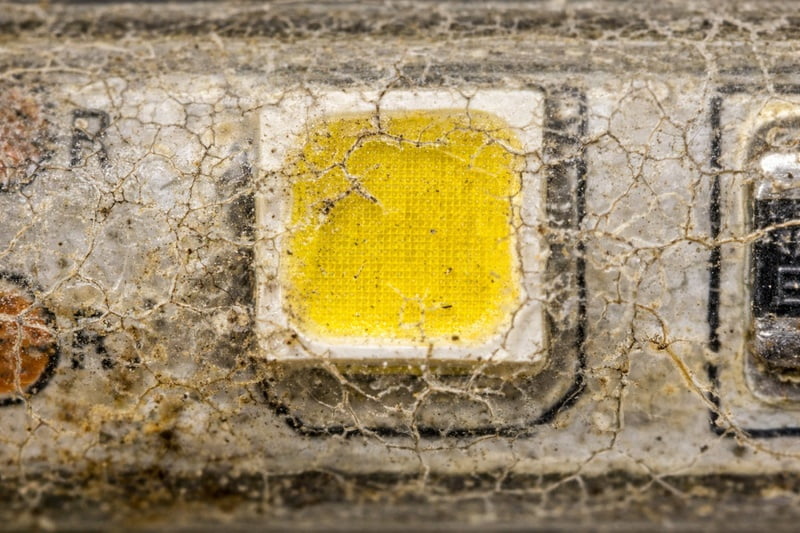
The Chemical Breakdown Process
When you install lights on a roof, the sun hits them all day. Ultraviolet rays carry high energy. This energy hits the waterproof layer. If the layer is a cheap IP65 potting compound, the chemical structure fails. The long polymer chains break into smaller pieces. This causes the clear material to change color. We call this yellowing1. Yellowing blocks up to forty percent of your light. Your 4000K natural white light will look like dirty yellow light.
The Hardening and Cracking Risk
UV damage also removes the flexibility of the material. A new flexible strip is soft. A sun-damaged strip feels like dry pasta. In our factory, we test these cheap materials. After three months of strong UV exposure, they become brittle. When the wind blows or the temperature drops at night, the hard plastic cracks. Once it cracks, the waterproof seal is gone. Water enters the circuit board. The lights fail completely.
The Silicone Solution
To fix this, we use pure silicone extrusion2. Silicone has a different chemical structure. UV rays pass through high-quality silicone without breaking its bonds. It stays soft. It stays clear. It costs a little more from the factory, but it saves your profit.
| Material Type | Reaction to UV Light | Lifespan Outdoors | Risk Level |
|---|---|---|---|
| Epoxy Resin | Turns yellow quickly, hardens | 3 to 6 months | Very High |
| Polyurethane | Slow yellowing, loses clarity | 12 to 18 months | High |
| Pure Silicone | Remains clear, stays flexible | Over 5 years | Low |
Which IP Rating Actually Survives Direct Sun Exposure?
You see IP65, IP67, and IP68 on a product sheet. You pick the cheapest one for your outdoor signs. Why do they keep failing on your job sites?
IP65 potting compound is not suitable for direct sunlight. You must upgrade to IP67 waterproofing by hollow extrusion or IP68 waterproofing by solid extrusion to guarantee UV resistance and weather durability.
The Weakness of IP65 Potting
Many clients buy IP65 because it is cheap. IP65 means we drop a layer of compound on top of the bare strip. The back uses adhesive tape. This is bad for outdoor use. The sun heats the tape. The tape melts. The strip falls down. More importantly, this top layer is thin. The UV rays cook the thin layer easily. I tell my clients to use IP65 only for indoor applications like kitchens.
The Reliability of IP673 Hollow Extrusion
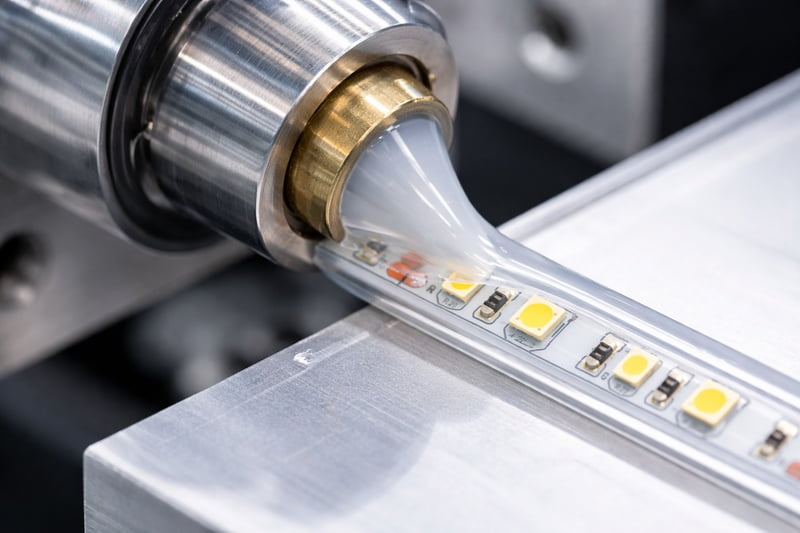
For building facades and outdoor illuminated signs, IP67 is our standard. We make IP67 waterproofing by hollow extrusion. The LED strip sits inside a silicone tube. The tube protects the entire circuit board. The silicone tube is thick. It blocks physical dirt and ignores UV rays. There is air inside the tube. This air helps the LED chips release heat. Heat also destroys LEDs. The silicone tube keeps the heat low and the UV out.
The Power of IP684 Solid Extrusion
Sometimes Tom has projects near the ocean or underwater. For this, we use IP68 waterproofing by solid extrusion. We fill the entire silicone tube with more liquid silicone. There is no air inside. This is the ultimate protection. It blocks continuous water pressure. It also provides a massive shield against the sun. Both IP67 and IP68 from our factory use high-quality silicone to resist yellowing.
| Waterproof Rating | Manufacturing Method | UV Resistance Level | Best Application |
|---|---|---|---|
| IP65 | Potting compound | Poor | Indoor bathrooms, cabinets |
| IP67 | Hollow extrusion | Excellent | Outdoor roofs, billbaords |
| IP68 | Solid extrusion | Perfect | Pools, heavy sun exposure |
Does Mechanical Handling Affect the UV Protection Layer?
Your worker forces the strip to bend around a sharp corner. The light works perfectly that day. Why does that exact corner fail and rot two months later?
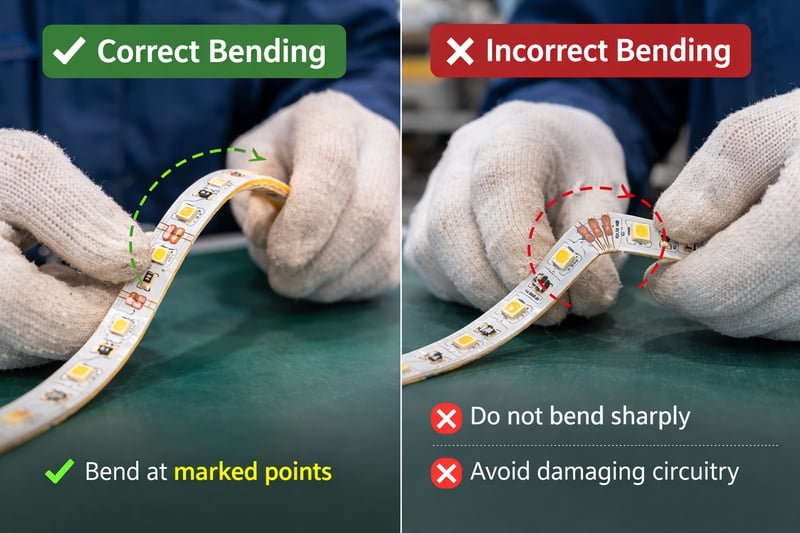
Improper handling creates invisible micro-cracks in the silicone. You must respect the bending diameter of R > 15mm and never bend the strip horizontally. Cracks let water in and speed up sun damage.
The Bending Diameter Limit
Our silicone is strong against the sun, but it has physical limits. We print strict warnings on our schematics: the bending diameter5 must be R > 15mm. If you bend it tighter, you stretch the outer curve of the silicone too much. The silicone becomes thin at the bend. Thin silicone loses its UV protection ability6. The sun bakes that thin spot. Eventually, it tears open. You must treat the strip with care during installation.
The Horizontal Bending Ban
I have seen many failed returns from contractors. They try to bend the strip left or right on a flat surface. Our rule is clear: please do not bend it horizontally. The circuit board is flat. The FPC double sides copper inside will break. The silicone casing will warp and detach from the internal edges. This creates air pockets. Sunlight heats these air pockets. The pressure builds up and damages the outer layer.
The Danger of Folding
Some workers fold the extra strip in half to pack it away. Please do not fold it in half. A sharp fold creates a permanent crease in the silicone. A crease is a weak point. When you finally put the strip outside, the UV rays attack the weak point first. The crease turns yellow much faster than the rest of the strip. It becomes brittle and snaps. Good handling preserves the factory-grade protection.
| Handling Action | Factory Rule | Consequence of Breakage |
|---|---|---|
| Curving up/down | R > 15mm | Silicone thins, UV attacks |
| Bending left/right | Do not bend horizontally | Copper breaks, casing warps |
| Storing the strip | Do not fold in half | Creases cause fast sun damage |
Can Internal Heat Accelerate the Sun Damage Outside?
You buy the best UV-resistant silicone. The sun hits it all day. You turn it on at night. Why does the silicone still degrade faster than you expect?
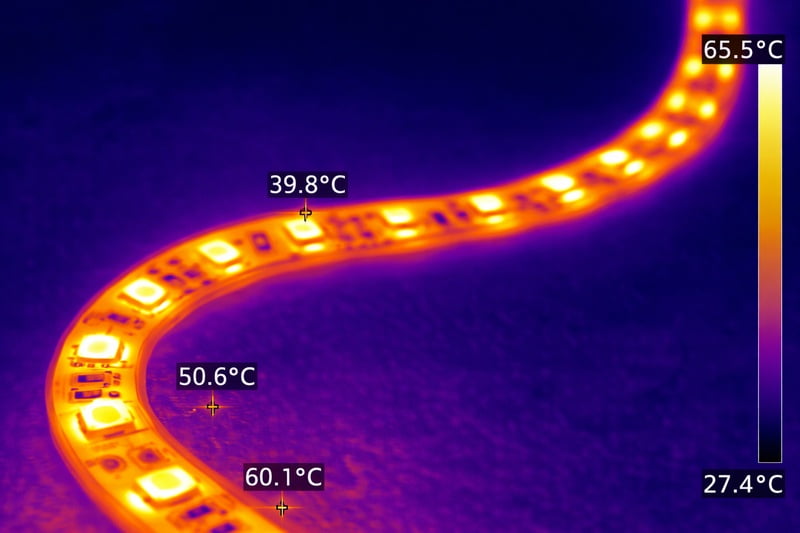
Internal heat from the LED chips combines with external UV heat to stress the silicone. You must use efficient chips, 24VDC circuits, and good copper boards to keep internal temperatures low.
Voltage and Consistency
Voltage matters for heat. Many buyers use 12VDC. For long outdoor runs, 12VDC causes high current at the start of the strip. High current means high heat. Heat softens the silicone from the inside. When the sun hits it from the outside the next day, the material breaks down faster. We recommend 24VDC7 for outdoor projects. 24VDC keeps the current lower and more stable. The heat goes down. The silicone stays strong.
High Efficiency Chips
Our COB high-density flexible strip light features soft light and no light spots. More importantly, it features high luminous efficiency8. For example, some of our strips reach 140 to 150 lumens per watt. High efficiency means the chip turns more power into light and less power into heat. Less heat means the waterproof casing works in a cooler environment. This drastically extends the life span beyond 36000 hours. The sun is hot enough. Do not let your LEDs add more heat.
Quality Copper Boards
The circuit board is the foundation. We use FPC double sides copper. Thick copper pulls heat away from the LED chips. It spreads the heat evenly across the strip. Cheap strips use thin single-sided copper. The heat stays concentrated in one spot. That spot gets hot, the silicone above it weakens, and the sun destroys that exact section. Good base materials protect the outer materials.
| Component | Our Standard | Cheaper Alternative | Result on Silicone |
|---|---|---|---|
| Voltage | 24VDC | 12VDC | Less heat, longer life |
| Copper Board | FPC double sides | Single thin side | Even heat spread |
| Light Efficiency | 140-150 lm/w | 80 lm/w | Cooler operation |
Conclusion
Sunlight is a bigger threat to outdoor lighting than rain. You must choose pure silicone options like IP67 hollow extrusion or IP68 solid extrusion. Always respect the physical bending rules and use high-efficiency 24VDC systems to reduce overall heat.
-
Understanding yellowing helps in choosing better materials for longevity and performance. ↩
-
Exploring this will reveal how silicone can enhance durability and clarity in lighting solutions. ↩
-
Explore the advantages of IP67 waterproofing, especially for outdoor use, to ensure durability and reliability in your projects. ↩
-
Learn about IP68 solid extrusion and its unmatched protection against water pressure and UV rays, ideal for extreme environments. ↩
-
Understanding bending diameter is crucial for maintaining the integrity and longevity of silicone products. ↩
-
Exploring UV protection in silicone can help you choose the right materials for outdoor applications. ↩
-
Explore why 24VDC is recommended for outdoor LED projects to reduce heat and extend the lifespan of your lights. ↩
-
Learn about high luminous efficiency and how it impacts energy consumption and heat generation in LED lighting. ↩
Interested in Our LED Solutions?
Get professional consultation and customized LED lighting solutions for your projects. Contact our expert team today.
Related Articles

How Do You Build Profitable Custom Vehicle and RV Interior LED Rope Lights?
You lose RV installation contracts because your interior lights fail on rough roads. Standard strips show bright dots on glossy…

How to Perfect Bookshelf and Display Cabinet LED Rope Lighting?
You lose retail clients when bookshelves look incredibly dark. Ugly shadows hide expensive products inside display cabinets daily. You need…

How to Master Mirror and Vanity LED Rope Light Installation?
Your clients complain about ugly shadows in their bathroom mirrors. Bad lighting ruins expensive vanity designs. You lose future contracts…
