

Warm White vs Cool White LED Rope Lights for Different Spaces (Stop Choosing the Wrong “White”)
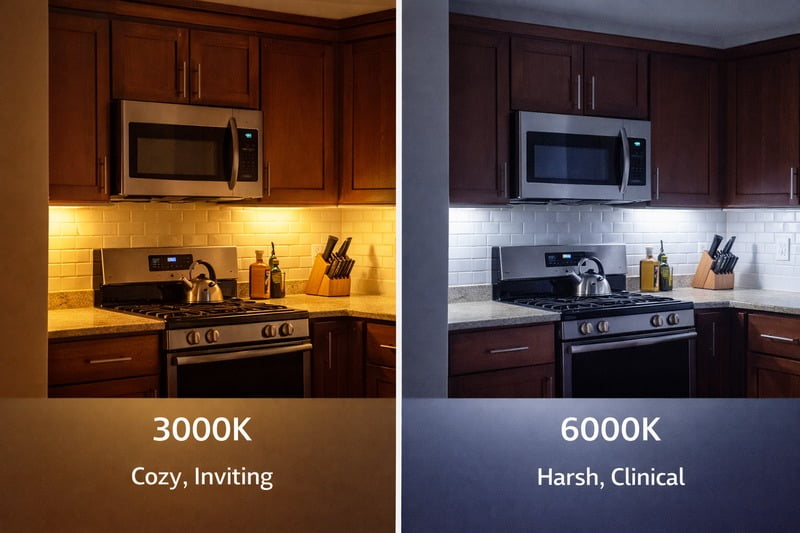
You finish a luxury kitchen renovation. The cabinets are walnut, the countertops are quartz, and the appliances are stainless steel. You flick the switch, and the room turns into a sterile, blueish operating room. The client hates it. You used Cool White where you should have used Warm White, and now you have to rip it all out. Lighting color temperature is not just a preference; it is the emotional language of architecture.
The choice between Warm White (2700K-3000K) and Cool White (4000K-6000K) defines the function of a space. Use Warm White for hospitality, residential living areas, and spaces requiring relaxation and intimacy. Reserve Cool White for offices, commercial retail displays, jewelry cases, and task-heavy environments where focus and clarity are paramount.
As a factory owner in China who manufactures thousands of kilometers of LED tape every year, I see the orders coming in from all over the world. I can tell you exactly what kind of projects my clients are working on just by looking at the Kelvin ratings they order. In this article, I will break down the science of Color Temperature (CCT), when to use which specific Kelvin, and why getting this wrong can cost you thousands in reworked labor.
What Exactly Do the Kelvin Numbers (2700K vs 6000K) Mean?
Clients often say, "I want the bright white." But "bright" refers to lumens, not color. When they say "bright," they usually mean "crisp," which is Cool White. Or they mean "cozy," which is Warm White. If you don’t translate their vague words into precise Kelvin numbers, you are gambling with the final result.
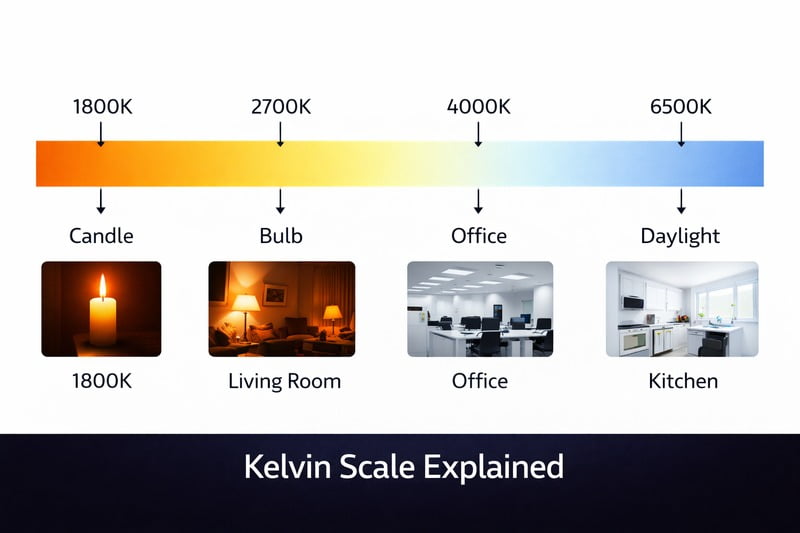
Kelvin (K) is the unit used to measure the color temperature of light. Lower numbers like 2000K and 2700K represent "Warm" light with yellow/orange tones, mimicking fire or sunsets. Higher numbers like 5000K and 6500K represent "Cool" light with blue/white tones, mimicking daylight at noon. 4000K is the "Neutral" sweet spot often used in commercial spaces.
The Spectrum in Our Catalog
In my manufacturing facility, we don’t just guess. We mix phosphors precisely to hit specific binning targets. Let’s look at the standard options available in our High-Efficiency LED Strip1 series.
The Warm End (Relaxation):
- 2000K – 2200K: This is "Candlelight" or "Golden Light."
- Best for: High-end whiskey bars, hotel lounges, and exterior decorative facades where you want a deep, amber glow. It creates intimacy.
- Technical: In our COB HC-10-12 series, this provides a lower contrast but extremely high atmosphere.
- 2700K: The classic "Incandescent" replacement.
- Best for: Living rooms, bedrooms, and restaurants. It matches the color of old-school light bulbs perfectly. It makes skin tones look healthy.
- 3000K: The "Modern Warm."
- Best for: This is my seller for residential projects. It is warm, but cleaner than 2700K. It doesn’t look as "yellow" against white walls.
The Neutral Zone (Work & Balance):
- 4000K: We call this "Natural White2" or "Commercial White."
- Best for: Kitchens (for chopping food), offices, showrooms, and bathrooms.
- Why: It eliminates the yellow cast without turning blue. It is the most honest light. If you are painting a room, use 4000K to see the true paint color.
The Cool End (Focus & Alertness):
- 5000K: "Daylight."
- Best for: Industrial warehouses, art studios, and some retail graphic printing shops.
- 6500K: "Cool Daylight."
- Best for: Jewelry stores (makes diamonds sparkle), fish tanks, and clinical settings like hospitals.
- Warning: Do not use 6500K in a bedroom. The blue light suppresses melatonin and will keep your client awake at night.
Why Is Warm White (2700K-3000K) the Standard for Residential?
Imagine relaxing on your sofa with a glass of wine. Now imagine doing that under the harsh glare of a convenience store light. It feels wrong. Our biology is wired to associate warm light with sunset and relaxation. Fighting biology with Cool White in a home is a design failure.
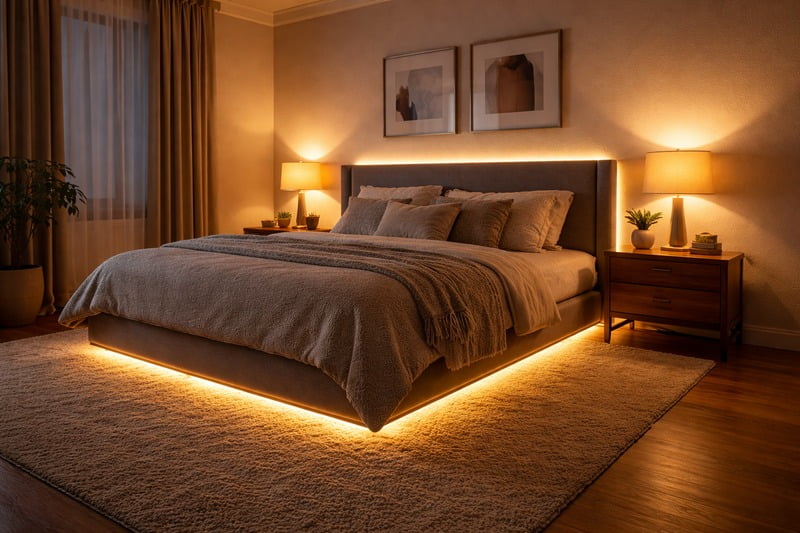
Warm White (2700K-3000K) triggers relaxation. It softens sharp architectural lines and blends well with wood grains, fabrics, and skin tones. For residential applications, specifically in living rooms and bedrooms, Warm White creates a welcoming, cozy environment that encourages rest, making it the non-negotiable standard for "home" lighting.
The Physics of "Cozy"
Why does Warm White3 feel better in a home? It comes down to CRI4 and Material Reflection.
Interaction with Materials:
Most homes use warm materials:
- Wood Floors: Oak, Walnut, Cherry.
- Furniture: Leather, Beige fabric, Velvet.
- The Clash: If you shine 6500K (Blue-White) light onto Oak (Orange-Brown) wood, the wood looks dull and greenish. The colors clash.
- The Harmony: If you shine 3000K (Yellow-White) light onto wood, the grain pops. The warmth amplifies the natural beauty of the timber.
The "High Efficiency" Factor:
Some contractors avoid Warm White because they think it is dimmer.
- Fact: In the past, warm LEDs were less efficient than cool ones.
- Current Tech: Look at our HC-10-12-S0480 series.
- The 4000K version emits high lumens.
- The 3000K version is almost identical in output perception to the human eye for general task usage.
- We achieve Ra90 (CRI 90) across the board. This means even our warm light renders colors accurately.
Where to Stick to Warm (My Recommendations):
- Under Cabinet (Toe Kick): Use 2700K. It acts like a night light on the floor.
- Cove Lighting: Use 3000K. It bounces off the white ceiling and returns as a soft, sun-like glow.
- Wardrobe: Use 3000K. You want to see how your clothes look in normal evening conditions.
When is Cool White (4000K-6000K) the Better Choice?
You are lighting a jewelry display case. If you use Warm White, the diamonds look yellow and dirty. You lose the sale. Or you are lighting a modern minimalist kitchen with glossy white cabinets. Warm light turns them cream. Cool White is the tool of precision, cleanliness, and modernization.
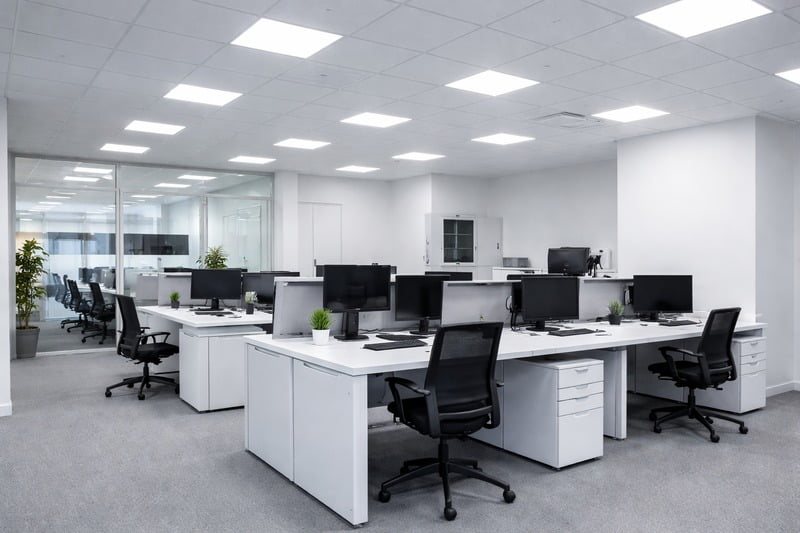
Cool White (4000K+) visually expands spaces and signifies cleanliness. It is essential for modern minimalist designs, commercial retail (especially silver and diamonds), and task areas like garages or workshops. 4000K is the ideal transition point, offering a clean look without the harsh blue tint of 6000K.
Precision and "Pop"
Cool white is not about comfort; it is about performance.
The "Jewelry Store" Effect (6000K-6500K):
- Diamonds and Silver reflect blue light better than yellow light.
- To make a stone "sparkle" with fire, you need the high-energy wavelengths of 6000K-6500K.
- My Product: I sell a lot of High Density COB 6500K5 to display cabinet manufacturers. They want the light to be intense and white so the product stands out.
The "Modern Kitchen" (4000K):
- If your client has a white marble island (Carrara or Calacatta), Warm light will make the grey veining look muddy.
- 4000K keeps the marble looking crisp white.
- Task Lighting: When you are chopping vegetables with a sharp knife, you need high contrast. 4000K6 provides better visual acuity than 2700K.
Industrial and Office (5000K):
- Studies show that cooler light suppresses melatonin (the sleep hormone).
- In an office or factory, you want workers to be alert.
- 5000K mimics noon sunlight. It keeps the energy level high.
Warning on "Blue Hazard":
- While 6500K is bright, it can feel harsh.
- Standard cheap strips often drift into 7000K+ which looks totally blue and cheap.
- My factory ensures precise binning. Our 6500K is a pure, icy white, not "smurf blue".
Can You Use Both? (The Power of CCT Tunable)
What if the client wants a bright, productive kitchen for cooking at 5:00 PM, but a cozy, dim cocktail space at 9:00 PM? Do you install two sets of lights? That is the old way. The new way is "Tunable White" (CCT Adjustable), and it is the fastest-growing category in my warehouse.
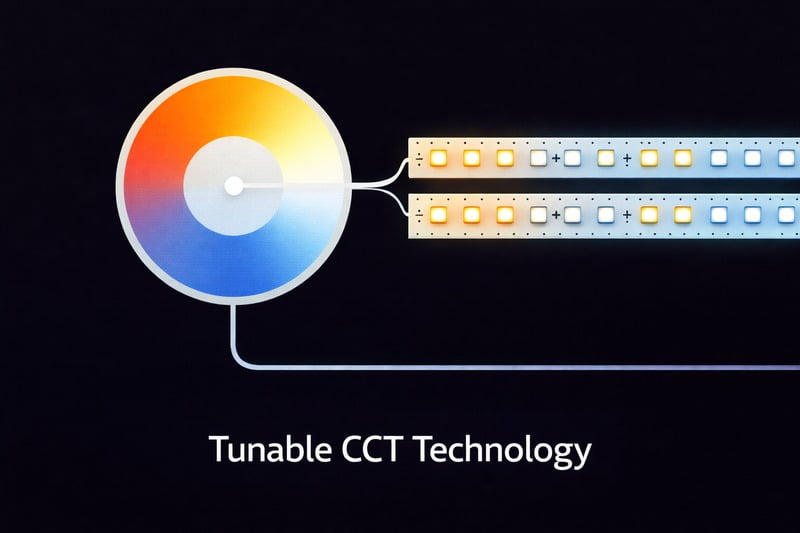
Tunable White (Linear CCT) strips combine Warm and Cool chips on a single board, allowing you to adjust the temperature from 2700K to 6500K via a remote or smart home system. This technology aligns indoor lighting with circadian rhythms—cool for daytime focus, warm for evening relaxation—providing the ultimate flexibility for multi-purpose rooms.
The 2-in-1 Solution
If you are unsure what the client wants, or if the space changes function, sell them CCT Tunable7 strips.
How it Works:
- Look at our IP65 waterproof light strip with black edge and double-color silicone.
- It has Quantity of Lampwicks listed for different Kelvin ratings.
- Essentially, we pack a 2700K chip8 and a 6500K chip right next to each other (or combined in a COB line).
- The Controller: You use a CCT controller.
- 0% Warm + 100% Cool = 6500K.
- 100% Warm + 0% Cool = 2700K.
- 50% Warm + 50% Cool = Approx 4000K.
The Cost vs. Benefit:
- Yes, it costs slightly more than a single-color strip.
- But it solves the "Indecisive Client" problem.
- Story: I had a contractor, Tom, who installed 4000K in a customer’s high-end bathroom. The wife hated it; said it was too clinical for a bath. Tom had to replace it all. If he had used Tunable White, he could have just handed her the remote and said, "Adjust it to your liking." He would have saved $500 in labor.
Wiring Requirements:
- Remember, Single Color is 2 wires (+, -).
- CCT Tunable is usually 3 wires (+, Warm, Cool).
- You need a compatible CCT controller. Do not try to wire this to a standard dimmer switch.
Does Color Temperature Affect Waterproofing and Location?
You might think Kelvin has nothing to do with where you put the light. But putting a warm, yellow light at the bottom of a blue swimming pool looks like… well, like dirty water. And putting a cool white light on a red brick patio makes the brick look dead. The environment dictates the Kelvin.
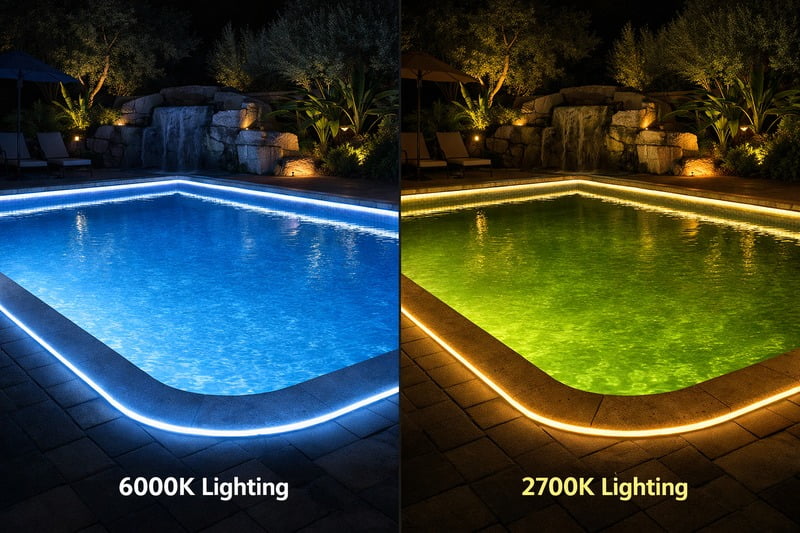
Water and outdoor materials change how light is perceived. For swimming pools (IP68), Cool White (6000K+) creates a pristine blue "aqua" look, while Warm White can make water appear murky. Conversely, for landscape lighting on brick, stone, or foliage brightness, Warm White (3000K) enhances the natural earth tones. Always match the Kelvin to the material you are illuminating.
Outdoor Dynamics
Waterproofing doesn’t change color temperature, but the application9 of waterproof strips requires specific Kelvin choices.
Swimming Pools (IP68):
- We make IP68 waterproofing10 by solid extrusion strips suitable for underwater use.
- Recommendation: Always go 4000K or higher (6000K) for pools.
- Why: Water absorbs red wavelengths first. Warm light (high red content) gets absorbed, leaving a dull look. Cool light (high blue content) penetrates water and makes the pool liner look vibrant blue.
Outdoor Facades (IP65/IP67):
- Illuminating a modern concrete building? Use 4000K to match the grey slate.
- Illuminating a red brick Victorian house? Use 2700K-3000K.
- Vegetation: For trees, 3000K is usually best. It makes the green leaves look natural. 4000K can make trees look artificial, like plastic.
The "Black Edge" Advantage:
- We offer an IP65 waterproof light strip with black edge.
- While the color temperature (e.g., 4000K) is important, the black edge helps hide the ugly white PCB board when the light is off during the day. This is crucial for outdoor aesthetic installs where the strip is visible.
Technical Spec for Outdoors:
- Outdoor runs are often long.
- Use 24VDC instead of 12VDC to prevent voltage drop over long garden runs.
- Ensure the Kelvin matches your garden spikes and wall sconces. Mixing 3000K garden lights with 6000K strip lights looks chaotic.
Conclusion
Choosing between Warm and Cool White is about defining the feeling of the space.
- Go Warm (2700K-3000K) for homes, restaurants, and lounges where comfort is king.
- Go Cool (4000K-6000K) for offices, hospitals, jewelry stores, and modern kitchens where focus is reliable.
- Go Tunable if you want the luxury of having both.
Don’t let a simple Kelvin number ruin your expensive design. Using the right High Efficiency LED Strip with the correct color temperature is the difference between a satisfied client and a callback.
-
Explore the advantages of High-Efficiency LED Strips for energy savings and enhanced lighting quality. ↩
-
Learn how Natural White light can improve visibility and ambiance in various settings. ↩
-
Exploring the benefits of Warm White can transform your living space, creating a cozy and welcoming atmosphere. ↩
-
Understanding CRI helps you choose lighting that enhances color accuracy, making your home more inviting and visually appealing. ↩
-
Explore this link to understand how High Density COB 6500K enhances product display and visual appeal. ↩
-
Discover why 4000K lighting is ideal for kitchens, ensuring your marble surfaces look their best. ↩
-
Explore the advantages of CCT Tunable lighting to understand how it can enhance flexibility and client satisfaction in various spaces. ↩
-
Learn about the importance of the 2700K chip in creating warm lighting environments, perfect for residential and commercial spaces. ↩
-
Understanding the application of waterproofing can enhance your lighting projects, ensuring optimal performance and aesthetics. ↩
-
Exploring IP68 waterproofing will reveal its advantages for underwater lighting, ensuring durability and effectiveness in aquatic environments. ↩
Interested in Our LED Solutions?
Get professional consultation and customized LED lighting solutions for your projects. Contact our expert team today.
Related Articles

How Do You Build Profitable Custom Vehicle and RV Interior LED Rope Lights?
You lose RV installation contracts because your interior lights fail on rough roads. Standard strips show bright dots on glossy…

How to Perfect Bookshelf and Display Cabinet LED Rope Lighting?
You lose retail clients when bookshelves look incredibly dark. Ugly shadows hide expensive products inside display cabinets daily. You need…

How to Master Mirror and Vanity LED Rope Light Installation?
Your clients complain about ugly shadows in their bathroom mirrors. Bad lighting ruins expensive vanity designs. You lose future contracts…
