

Waterproof LED Rope Lights: IP65, IP67, IP68 Ratings Explained (Are You Still Buying the Wrong “Waterproof”?)
You win a bid for a luxury pool deck renovation. The specs call for "waterproof" lighting. You buy a highly-rated "waterproof" strip from Amazon, install it under the coping, and three weeks later, half the LEDs are dead and the other half are flickering green. The client is furious. Why? Because "Waterproof" is a marketing term, not an engineering spec. If you don’t know the difference between IP65 potting and IP68 solid extrusion, you are gambling with your reputation.
The IP rating system defines resistance to dust and water. IP65 (Potting Compound) protects against low-pressure jets, ideal for kitchens and bathrooms. IP67 (Hollow Extrusion) handles heavy rain and temporary immersion, perfect for outdoor fascias. IP68 (Solid Extrusion) provides permanent underwater protection for swimming pools and fountains.
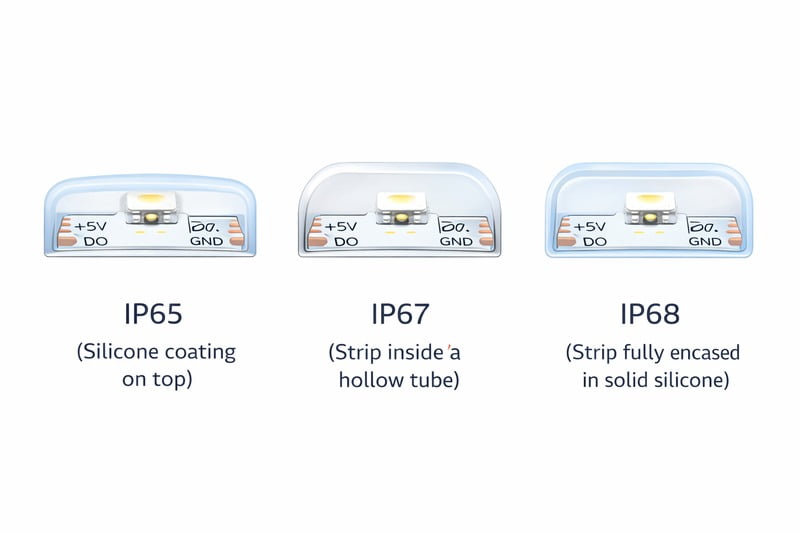
In my factory in Shenzhen, I see the damage reports come in from distributors who used the wrong rating for the wrong application. They try to save $2 per meter by using an IP65 kitchen strip on a garden walkway, and then they wonder why the humidity killed the circuit board. As a B2B manufacturer, I’m going to pull back the curtain on how we actually manufacture these ratings (Potting vs. Hollow vs. Solid Extrusion) so you can specify the exact product that will survive your project’s environment.
What Does IP65 Actually Protect Against? (The "Splash" Zone)
Clients often ask, "Can I put this IP65 strip outside?" My answer is always a qualified "Yes, but…" IP65 is the most misunderstood rating. It feels rubbery and safe, but it has a fatal flaw if you expose it to the wrong elements for too long. It is designed for splashes, not storms.
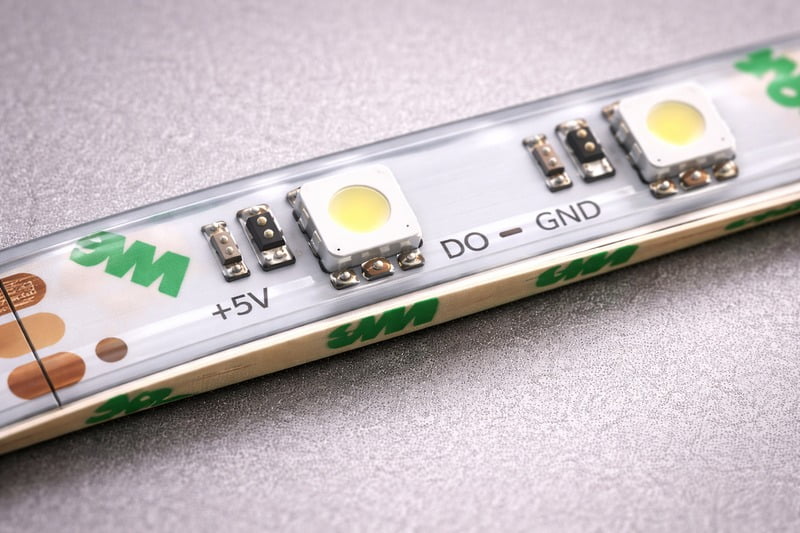
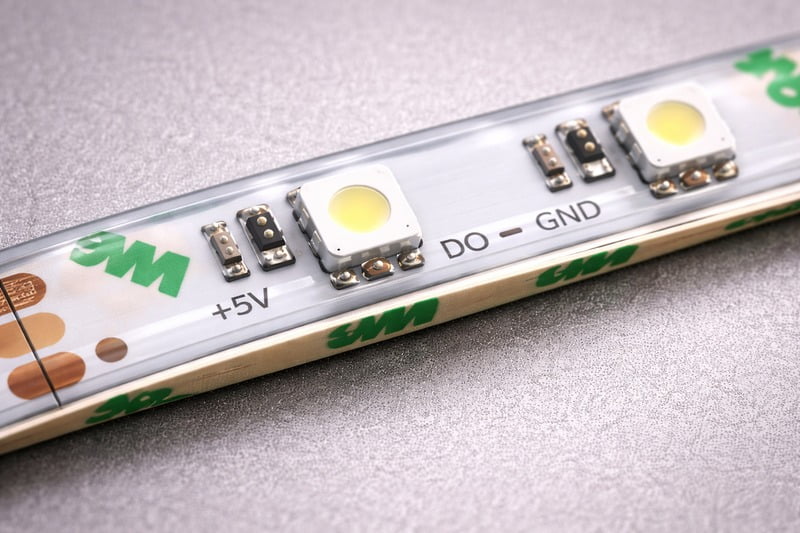
IP65 waterproofing uses a "Potting Compound" method where a layer of silicone or PU glue is dropped onto the top of the PCB. This protects the LEDs from dust and water spray from any direction (like a kitchen sink sprayer) but leaves the back of the strip exposed (using 3M tape). It is breathable but not submersible.
The Potting Compound Process
In my factory, we call this the "Surface Drop" method. It is the entry-level waterproofing standard for our COB and SMD series1.
How We Make It:
- We take the raw PCB (IP20).
- We run it through a machine that dispenses a liquid silicone or Polyurethane (PU) gel over the top.
- It cures into a protective bubble.
The Pros:
- Heat Dissipation: Because the back is exposed copper, it sticks directly to the aluminum profile. Heat escapes easily.
- Flexibility: It remains very flexible.
- Cost: It is the cheapest waterproof option.
The Cons (The "Yellowing" Trap):
- Many factories use cheap Epoxy resin. After 6 months of UV exposure, it turns yellow and cracks.
- My Factory Standard: We use high-grade Silicone2. It stays clear.
- The Backside Weakness: The adhesive tape on the back is NOT waterproof. If water gets behind the strip (e.g., condensation on a cold wall), it can short out the copper pads.
Where to Use IP65:
- Kitchen Under-Cabinet: Protects against steam from the kettle or sauce splashes.
- Bathroom Mirrors: Protects against humidity.
- Bar Counters: Protects against spilled drinks.
- Never use this for an exposed pergola. The sun will eventually degrade the top layer, and the rain will get behind it.
When Do You Need IP67? (The "Rain" Defense)
You are lighting the exterior façade of a building. It’s going to rain, snow, and get blasted by wind. IP65 isn’t enough because the 3M tape on the back will peel off when it gets wet. You need a jacket. You need IP67.
IP67 waterproofing utilizes a "Hollow Extrusion" technique. The LED strip is inserted into a pre-formed, hollow silicone tube, sealed with end caps. This creates a 360-degree barrier that can withstand heavy rain, snow, and temporary submersion (up to 1 meter for 30 minutes), making it the standard for general landscape lighting.
The Hollow Tube Advantage
Technically, IP67 means the strip is housed inside a "Casing."
The Manufacturing difference:
- We extrude a long, hollow silicone sleeve.
- We thread the LED strip through it.
- We inject silicone glue into the end caps to seal them.
The "Hollow" Benefit:
- Repairability3: In some designs, you can actually slide the strip out if it fails (though difficult).
- Weight: It is lighter than solid extrusion.
- Cost: It is cheaper than IP68 because it uses less silicone material.
The Heat Issue:
- Because there is air inside the tube, heat transfer is not perfect. The air acts as an insulator.
- My Advice: Do not run high-wattage (14W/m+) strips in IP67 tubes unless they are mounted on metal to help cooling.
The Installation "Gotcha":
- The Weak Point: The end caps.
- If you cut the strip to size on the job site, you break the seal.
- You must re-seal the cut end with acidic-free silicone glue and a new end cap. If you just wrap it in electrical tape, water will get in. Once water gets inside a hollow tube, it has nowhere to go. It sits there, boils when the light turns on, and steams the LEDs to death.
Why is IP68 the Only Choice for Pools? (The "Solid" Shield)
I refused a warranty claim last week. A contractor put IP67 hollow tube lights inside a swimming pool. The pressure of the water eventually forced liquid through the microscopic gaps in the end cap. The strip died. For underwater use, there is no compromise. You need solid mass.
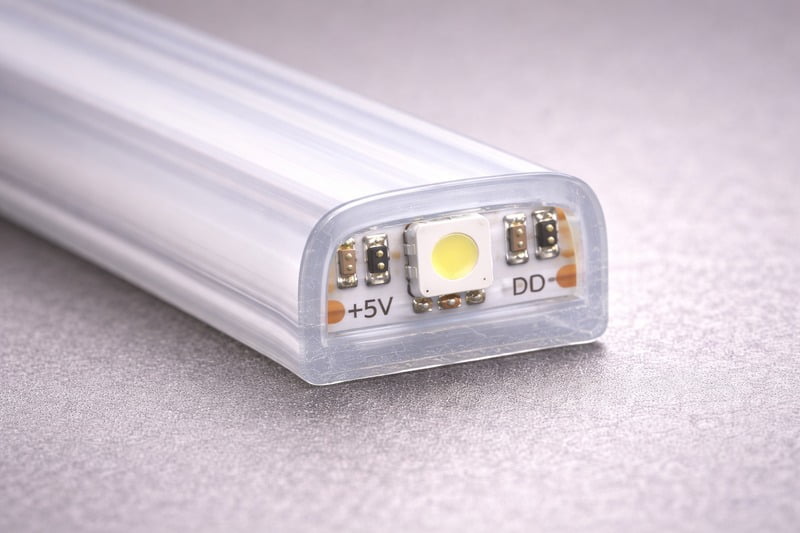
IP68 waterproofing employs "Solid Extrusion" technology. Unlike the hollow tube, molten silicone is extruded directly over and around the LED strip, filling every single gap and eliminating air pockets. This creates a solid, pressure-resistant brick of light that is permanently submersible in chlorinated or salt water.
The Solid Extrusion Technology
This is the premium tier of our catalog. In the specs, you will see this listed as "IP68 waterproofing by solid extrusion4."
How We Make It:
- The LED strip goes into a mold during the silicone injection process.
- The silicone bonds chemically to the PCB.
- There is zero air inside.
Why It survives Swimming Pools:
- Pressure Resistance: Because there is no air pocket, water pressure cannot "crush" the tube or force entry. It is solid.
- Chemical Resistance: We use specialized silicone that resists chlorine and saltwater corrosion. Regular PVC (used in cheap strips) becomes brittle and cracks in chlorine.
- Color Shift: Be aware—the thick solid silicone acts like a lens. It usually shifts the color temperature slightly cooler. A 3000K chip might look like 3200K once encased.
The "Neon" Effect:
- Many of our IP68 Solid products also feature a milky diffuser layer on top.
- This creates a "Dot-Free" neon look, which is very popular for pool perimeters.
Installation Warning:
- Just like IP67, the weak point is the connection.
- For pools, orders should be factory molded. Tell me the exact length you need (e.g., 15 meters). We will solder perfectly waterproof connectors at the factory.
- Do not cut IP68 strips underwater. You cannot seal them effectively in the field for underwater use.
Technical Specs: Bending, Voltage, and Dimensions
You might think, "It’s rubber, I can bend it however I want." Wrong. When we encase these strips in thick silicone for waterproofing, we change their mechanical properties. If you bend them incorrectly, you snap the circuit board inside the rubber, and the light dies.
Waterproof strips have physical limitations. Generally, the bending diameter must be R > 15mm according to our factory schematics. Crucially, most extrusions (IP67/IP68) only bend vertically (up/down). Bending them horizontally (sideways) will crack the internal PCB. Also, dimension creep occurs; an 8mm PCB becomes 10mm or 12mm wide once waterproofed, affecting profile fit.
 15mm icon.”>
The Spec Sheet Reality
Let’s look at the data from our COB and SMD Waterproof Series to ensure you buy the right accessories.
1. Dimensions Change Everything:
- A standard IP20 strip is usually 8mm or 10mm wide.
- Once we apply IP67 Hollow Extrusion5, that 8mm strip becomes 10mm x 4.8mm (Width x Height).
- If you have a narrow aluminum channel that is exactly 10mm wide, the IP67 strip might not fit because of the tolerance. Always measure your channel.
- IP68 Solid Extrusion is often even bulkier, sometimes 12mm wide.
2. Voltage Matters for Outdoors:
- For outdoor waterproof runs, I always recommend 24VDC.
- Why? You are usually running longer lengths (garden perimeters).
- 12VDC suffers voltage drop too fast.
- Our catalog lists Power options like 5W/10W/15W per meter. For an encased IP68 strip, stick to 10W/m or lower. The heat cannot escape the solid silicone as easily as open air. If you overdrive it to 15W, you shorten the lifespan.
3. The Bending Rules (R > 15mm):
- Our documents clearly state: "Please do not fold it in half. Please do not bend it horizontally."
- The R > 15mm meant the radius of the bend must be at least 15mm (about the size of a large coin).
- If you crease it like a piece of paper, you break the copper traces.
4. Cutting Intervals:
- Waterproofing blurs the visibility of cut points.
- On IP67 and IP68, we usually mark the outside of the silicone with a black line.
- Verify the cutting length in the brochure. For 24VDC, it is often every 50mm. For 12VDC, it might be 25mm. Miss the cut point, and you ruin a whole section.
Conclusion
Waterproofing isn’t just about keeping water out; it’s about matching the engineering to the environment.
- IP65: For Kitchens and humidity. (Potting Compound).
- IP67: For Garden rain and snow. (Hollow Tube).
- IP68: For the Pool and fountains. (Solid Extrusion).
Don’t let a $50 saving on the wrong IP rating cost you a $5,000 reputation hit. At Rhstriplighting, we manufacture all three types using high-grade silicone that resists yellowing and cracking. Send me your project details, and I will tell you exactly which rating will survive the warranty period.
-
Explore this link to understand the significance of COB and SMD series in waterproofing technology. ↩
-
Discover why high-grade Silicone is preferred for waterproofing and how it outperforms other materials. ↩
-
Understanding repairability can help you make informed decisions about LED strip maintenance and longevity. ↩
-
Explore this link to understand the benefits and applications of IP68 waterproofing, crucial for durable LED installations. ↩
-
Explore this link to understand the benefits and applications of IP67 Hollow Extrusion in waterproof lighting. ↩
Interested in Our LED Solutions?
Get professional consultation and customized LED lighting solutions for your projects. Contact our expert team today.
Related Articles

How Do You Build Profitable Custom Vehicle and RV Interior LED Rope Lights?
You lose RV installation contracts because your interior lights fail on rough roads. Standard strips show bright dots on glossy…

How to Perfect Bookshelf and Display Cabinet LED Rope Lighting?
You lose retail clients when bookshelves look incredibly dark. Ugly shadows hide expensive products inside display cabinets daily. You need…

How to Master Mirror and Vanity LED Rope Light Installation?
Your clients complain about ugly shadows in their bathroom mirrors. Bad lighting ruins expensive vanity designs. You lose future contracts…
