

What Power Supply Mistakes Cause Outdoor LED Strip Projects to Fail?
Many outdoor LED strip projects look fine at first. Then the dimming starts, the far end turns weak, the power supply runs hot, or the whole system fails much earlier than expected.
The most common power supply mistakes are choosing no safety margin, ignoring voltage drop, using the wrong voltage, using indoor-rated units outdoors, and underestimating cable and connector loss. If I size the system like a real project instead of a simple number, I avoid most failures.
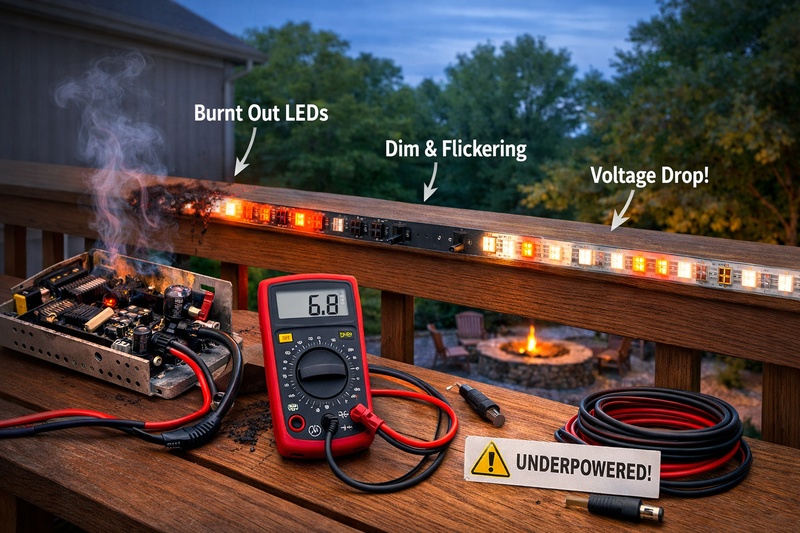
When I look at failed outdoor strip lighting jobs, I rarely see one single dramatic mistake. I usually see several small wrong choices stacked together. A power supply that looked “close enough” becomes overloaded. A long run that looked bright during testing becomes dim at the far end. An indoor power supply gets exposed to moisture. Then the installer blames the strip. In many cases, the real problem started at the power planning stage.
Why are outdoor LED strip power supplies easier to get wrong?
Outdoor projects often punish small mistakes faster than indoor projects. The conditions are harsher, and the system has less room for guesswork.
Outdoor LED strip projects are easier to get wrong because heat, moisture, long cable runs, voltage drop, enclosure limits, and waterproof requirements all add stress to the system. For a broader system view, I also recommend reading How Do You Power Outdoor LED Strip Lights Correctly?.
Why the environment changes the whole calculation
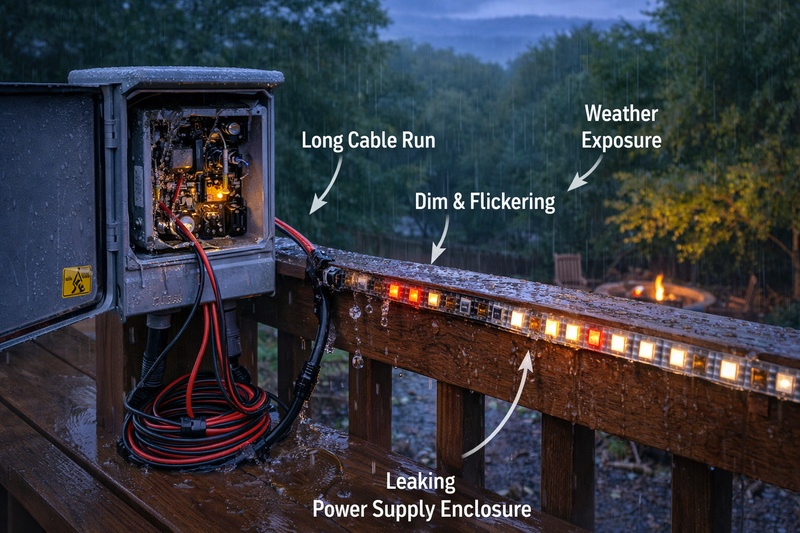
When I plan an indoor shelf light, the setup is usually short, protected, and easy to test. Outdoor work is different. The strip may run along a railing, façade, garden edge, sign frame, or deck perimeter. That changes everything. Cable runs become longer. Connectors may sit in humid areas. The power supply may be hidden in a box with poor airflow. The enclosure may protect from rain but trap heat. The actual site may also have more dust, more temperature movement, and more physical stress than a simple indoor job.
This is why outdoor power supply planning1 should never be based only on strip wattage. I need to think about operating conditions, not only electrical labels. A 100W load in a clean indoor cabinet is not the same as a 100W load in a warm exterior enclosure. If I ignore this, I may choose a unit that works in theory but struggles in real use.
Why first testing can mislead me
One of the most dangerous moments in a project is the first power-on. Everyone relaxes because the strip lights up. But startup brightness is not proof of a correct system. It only proves that power reached the strip at that moment. It does not prove that the voltage is stable at the far end. It does not prove the power supply has enough margin. It does not prove the enclosure will stay cool. Outdoor systems often fail later, not in the first minute.
Why this matters to buyers and contractors
A wrong power supply decision is not just an electrical mistake. It becomes a business mistake. A contractor loses time on rework. A distributor faces complaints. A project owner loses confidence. A lighting designer sees the intended visual effect break down. This is why I treat the power supply as part of the design, not as a cheap add-on that I can choose at the end.
| Outdoor factor | Why it matters | What I check |
|---|---|---|
| Long run length | Increases voltage drop risk2 | Feed points and voltage choice |
| Heat and sun | Raises unit stress | Enclosure and headroom |
| Moisture and splash | Requires better protection | Environment rating |
| Cable and connector loss | Adds hidden electrical loss3 | Real path, not paper path |
| Poor ventilation | Traps heat around PSU | Mounting location and airflow |
My view
When I size an outdoor power system, I assume real conditions will be less kind than my first estimate. That mindset helps me choose safer, more stable designs.
What happens when I choose a power supply with no safety margin?
A power supply can match the strip load on paper and still be the wrong choice in real outdoor use.
Yes. Choosing a power supply with no safety margin is one of the most common reasons outdoor LED strip systems run hot, become unstable, or fail early. For outdoor projects, I want headroom, not a perfect-looking paper match.
Why exact matching is a weak habit
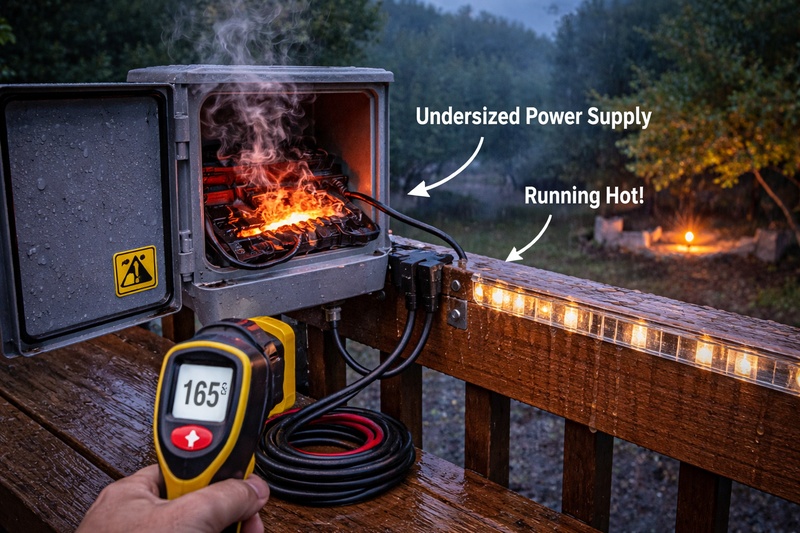
A common mistake looks logical at first. If the strip load is 96W, someone buys a 100W power supply4. They think the system is efficient because nothing is oversized. I do not like this habit. A power supply is not safer because it is tightly matched. In many real outdoor projects, that tight match becomes the beginning of heat stress5 and shorter life.
The reason is simple. Labels do not describe the full job. The cable has loss. Connectors have loss. Outdoor temperature may rise. Enclosures may hold heat. The strip may not always behave like a lab sample. So when I choose a power supply with almost no headroom6, I leave no room for reality.
What kind of margin I prefer
I usually want extra capacity. In many normal projects, I prefer roughly 20% to 30% headroom. I do not treat this as a rigid law, but it is a good design habit. If the environment is hotter, more enclosed, or more demanding, I become more conservative. The goal is not to buy the biggest unit possible. The goal is to avoid forcing the unit to live at its edge.
What failure looks like when the margin is too small
The power supply may still work at first. But later I may see heat rise, output stability7 weaken, or lifespan shorten. In some cases, the unit may cycle, shut down, or age faster than expected. The project may then show random dimming or inconsistent behavior that people wrongly blame on the strip.
Why buyers still do this
They often do it because the lower wattage option costs a little less. But the saved amount is usually tiny compared with the cost of troubleshooting, replacing parts, or explaining failure to a client. For me, the smarter saving is preventing the problem before the job is finished.
| Strip load | Weak choice | Better habit | Why |
|---|---|---|---|
| 72W | 72W PSU | 100W PSU | Better operating margin |
| 96W | 100W PSU | 120W to 150W PSU | Lower stress outdoors |
| 144W | 150W PSU | 200W PSU | Better long-term stability |
My rule
If the selected power supply looks too exact, I slow down and ask whether I am designing for a spreadsheet or for a real outdoor project.
Why does ignoring voltage drop create dim and uneven outdoor runs?
A strip can look bright near the feed point and still perform badly across the full run. That is where many outdoor jobs start to disappoint.
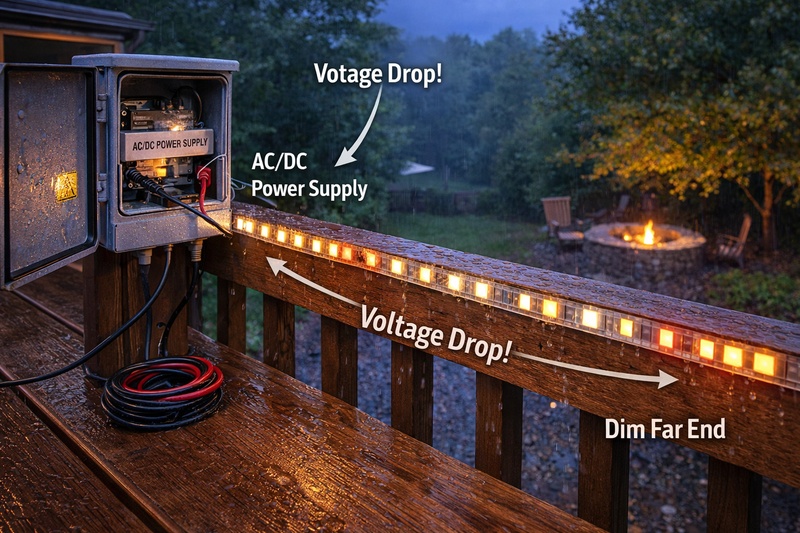
If I ignore voltage drop, the far end of the strip can dim, shift color, or lose output consistency. Long outdoor runs, high watt density, and thin wire make the problem worse. Outdoor projects often need longer straight lines than indoor ones. That is also why it helps to review What is the Maximum Length You Can Run an Outdoor LED Strip? before finalizing the layout.
What voltage drop8 really looks like
Voltage drop is not always dramatic. Sometimes it is obvious. The far end is dim. But often it appears in softer ways. White light becomes uneven. CCT looks different near the end. RGB mixing changes. A client may not know the word “voltage drop,” but they know the installation looks wrong. For a decorative project, that is already a failure.
Why outdoor layouts are vulnerable
Outdoor projects often need longer straight lines than indoor ones. That may be a railing, a cornice, a sign border, a path edge, or a fence line. Longer distance increases resistance problems. If the strip is high power and the system voltage is low, the issue becomes even stronger. This is why I do not judge outdoor strip runs by eye alone. I judge them by layout, load, and distance.
What I do instead
I check total run length, watts per meter, system voltage, cable size, and how many feed points the layout really needs. If a single-end feed is too optimistic, I add power injection9 or split the load. I plan this before installation because trying to rescue a dim line after the job is finished is always more painful.
Why people blame the wrong component
When the far end is weak, some people think the strip is poor quality. But the strip may be fine. In many cases, the real fault is that the system never delivered proper voltage across the full run.
| Voltage drop mistake | Visible result | Better approach |
|---|---|---|
| One long single-feed run | Far end dims | Add injection or split run |
| High-power strip over long distance | Uneven brightness | Shorter sections or higher voltage |
| Thin feed wire | Extra loss | Use proper wire size |
| No layout planning | Random weak spots | Plan feeds before install |
My view
I do not think of voltage drop as a minor technical detail. In long outdoor strip projects, it is one of the main things that decides whether the lighting looks premium or cheap.
Some systems work harder than necessary because the voltage choice was based on habit, not on the real job.
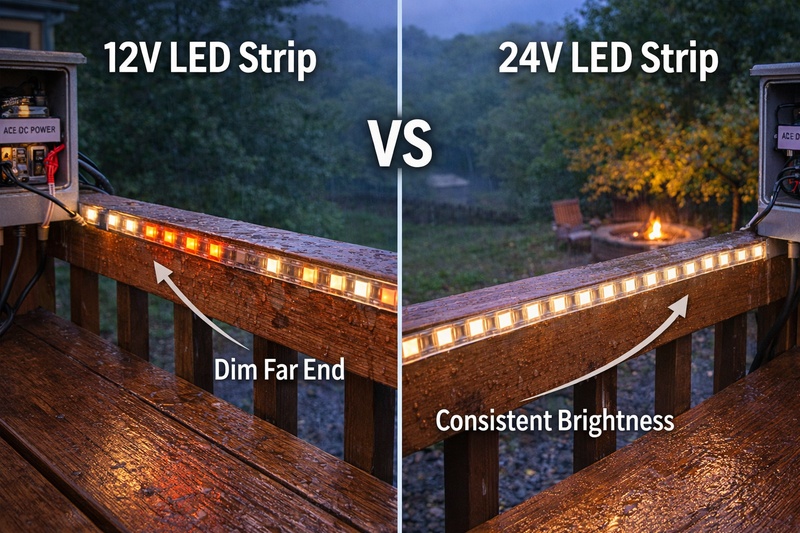
Using 12V for longer outdoor runs can increase voltage drop and reduce system stability. For many linear outdoor projects, 24V is easier to manage and gives more consistent results.
Why this decision matters
Many buyers and installers are comfortable with 12V. It is familiar and widely available. But familiarity is not the same as suitability. In longer outdoor runs, 12V systems carry more current for the same power. That increases the chance of drop and uneven output. It does not mean 12V is always wrong. It means I should not choose it by reflex.
When 12V still works well
I still use 12V in short runs, small custom pieces, and some low-voltage applications. If the run is compact and the layout is controlled, 12V can be completely fine. The mistake is not using 12V. The mistake is using it in a project where 24V would reduce design stress and improve consistency.
Why 24V often makes outdoor planning easier
With 24V, current is lower for the same power. That helps reduce loss and makes longer runs easier to manage. I still need good design habits, but I get more room to work with. That is why 24V often becomes the safer choice in façade, deck, railing, and perimeter projects.
Why this mistake hides so well
A 12V strip may still turn on and look fine on a table test. That is why the mistake survives into the project. But once the system is installed across a long outdoor run, the weakness becomes visible.
| Project type | 12V suitability | 24V suitability | My usual choice |
|---|---|---|---|
| Short decorative run | High | High | Either can work |
| Medium outdoor run | Medium | High | Usually 24V |
| Long outdoor perimeter | Low to Medium | High | Usually 24V |
| High-density strip run | Medium | High | Usually 24V |
My decision habit
If the run is long and consistency matters, I do not start from “Can 12V work?” I start from “Which voltage gives the system more stability?”
Why is using an indoor-rated power supply outdoors such a serious mistake?
Correct wattage does not save the project if the power supply is wrong for the environment.
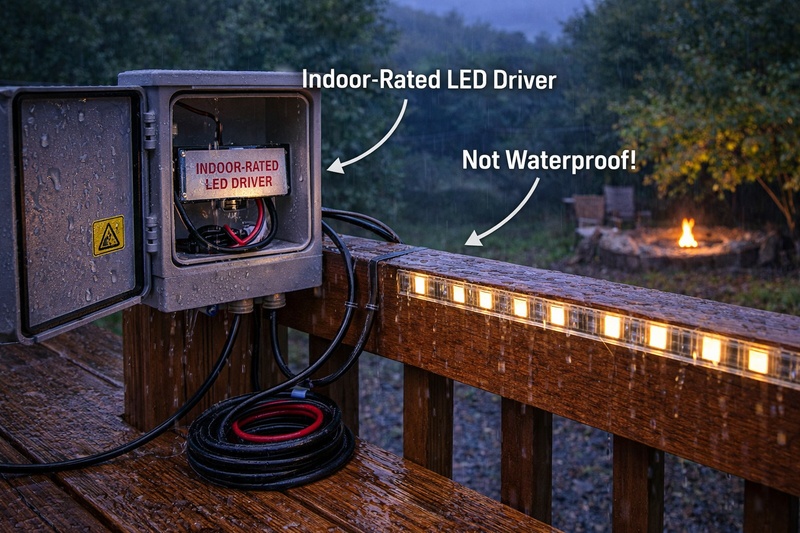
An indoor-rated power supply can still fail outdoors even if the wattage is correct. Moisture, humidity, dust, poor ventilation, and heat make environment rating just as important as electrical sizing.
Why wattage is not the full answer
Some buyers choose a power supply by wattage only. But before that, it still helps to confirm whether the whole strip system is actually suitable for exterior use by reviewing Can LED Strip Lights Be Used Outdoors?. If the strip needs 150W, they look for 150W. But that is only one part of the decision. Outdoor systems also need environmental suitability. A driver that is fine inside a dry cabinet may struggle or fail in a humid or hot outdoor condition.
What I review in outdoor use
I look at exposure level, enclosure quality, airflow, humidity, splash risk, and nearby heat sources. I do not assume that “inside a box” automatically solves the problem. A bad box can trap heat and create a new failure point.
Why this mistake happens so often
It happens because the power supply is usually hidden. People focus on visible elements like the strip and profile, then treat the driver like a commodity part. But the hidden parts often decide whether the project keeps working.
What better practice looks like
I match the unit to the environment, then match the installation method to the unit. A correct outdoor driver placed in a poor hot enclosure can still struggle. A good product still needs a sensible location.
| Mistake | Risk created | Better habit |
|---|---|---|
| Indoor PSU in humid area | Corrosion and early failure | Use outdoor-suitable unit |
| Indoor PSU in sealed hot box | Heat buildup | Improve ventilation or change unit |
| No environment review | Wrong product for site | Check real conditions first |
| Wattage-only selection | Hidden reliability risk | Size and rate correctly |
My rule
I never treat the outdoor environment as a side detail. If the power supply cannot survive where it is installed, the project is weak before it even starts.
Why do cable loss, connectors, and layout complexity get ignored?
The strip is only one part of the electrical path, but many people calculate as if it were the whole system.
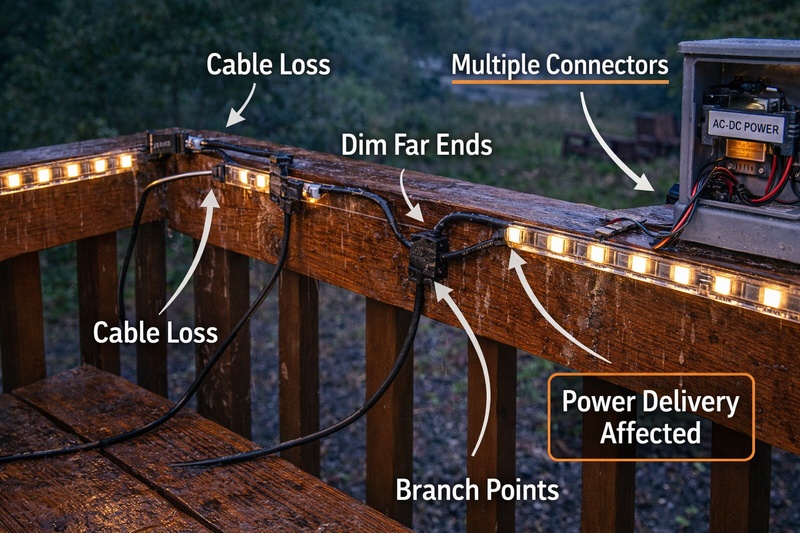
Cable resistance, connectors, branch points, and layout complexity are often ignored because they are not obvious in simple wattage math. But in real outdoor systems, these small factors can create meaningful performance problems.
Why simple calculations miss real losses
A basic formula like watts per meter times total meters is useful, but it is only the beginning. Real installations also include the cable from the power supply to the strip, joins between strip sections, branch points, corner transitions, and connection hardware. Each of these adds small losses. A few small losses together can become a visible problem.
Why connectors deserve more respect
Connectors are convenient, but they are not invisible in electrical terms. If the project includes extra joins or extension sections, I also recommend reading How Do You Connect and Extend Outdoor LED Strips? before locking in the final wiring plan. Every added join can create a little resistance. In a small short job, that may not matter much. In a larger outdoor installation, it can add up.
Why layout changes the real load path
A straight run is simple. A branched system around corners, rails, signs, or architectural details is different. If I do not map the actual route, I do not really understand the project. I only understand a simplified version of it.
How I plan better
I ask:
- where is the power supply mounted?
- how long is the feed cable?
- how many connectors are in the path?
- where are the branches?
- where is power injection needed?
This gives me a real project view instead of a catalog view.
| Ignored factor | What it causes | Better planning habit |
|---|---|---|
| Long feed cable | Extra loss | Count the full path |
| Too many connectors | Resistance buildup | Minimize unnecessary joins |
| Branch layout | Uneven performance | Plan balanced feeds |
| Complex route | Wrong power assumption | Map layout before sizing |
My point
If I only calculate the strip and ignore everything around it, I am not calculating the project. I am only calculating part of the problem.
Why is startup brightness a misleading sign that the system is correct?
The strip turns on, everyone smiles, and the mistake survives into the final installation.
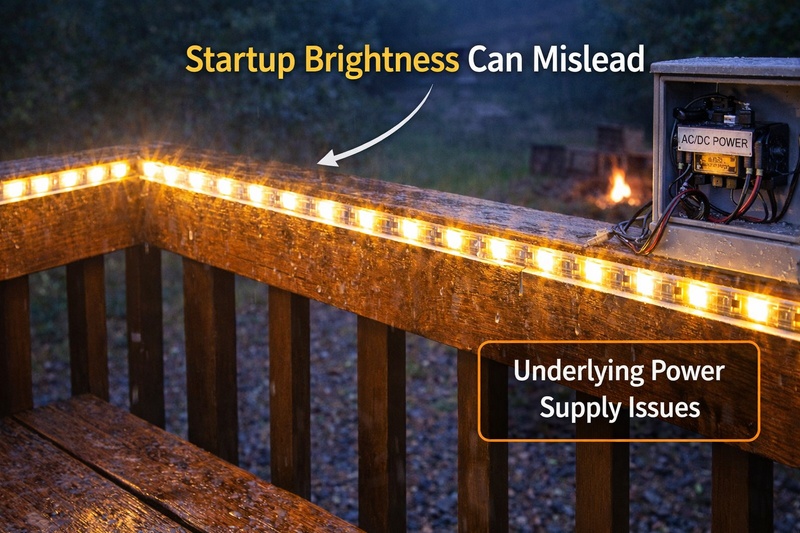
Startup brightness proves only that the strip can light up once. It does not prove correct voltage across the run, enough power supply margin, good thermal behavior, or long-term outdoor reliability.
Why this test fools people
A quick power-on is emotionally satisfying. The light works, so everyone wants to move on. But many problems only appear under heat, time, and full load. The far end may dim later. The driver may get too hot later. The enclosure may trap too much heat later. A startup test is useful, but it is not enough.
What I check instead
I want to see:
- brightness across the full run
- temperature after some operating time
- behavior under full expected load
- enclosure heat conditions
- stability after the system has been on
Why delayed problems are still design problems
If a failure appears after two hours instead of two minutes, it is still a planning problem. Outdoor systems should be judged by operating behavior, not by first impression.
What standard I trust more
I do not ask only whether the strip lights up. I ask whether it stays stable, cool enough, and visually even under real use conditions.
| Weak test method | Why it fails | Better test |
|---|---|---|
| Quick startup only | Misses heat and stability issues | Run under real conditions |
| Check only near feed point | Misses far-end drop | Check the full run |
| Indoor bench test | Ignores outdoor environment | Review site conditions too |
| “It lights up” conclusion | Not enough evidence | Test margin and consistency |
My standard
A correct system is not one that powers on. A correct system is one that performs well after real operating stress.
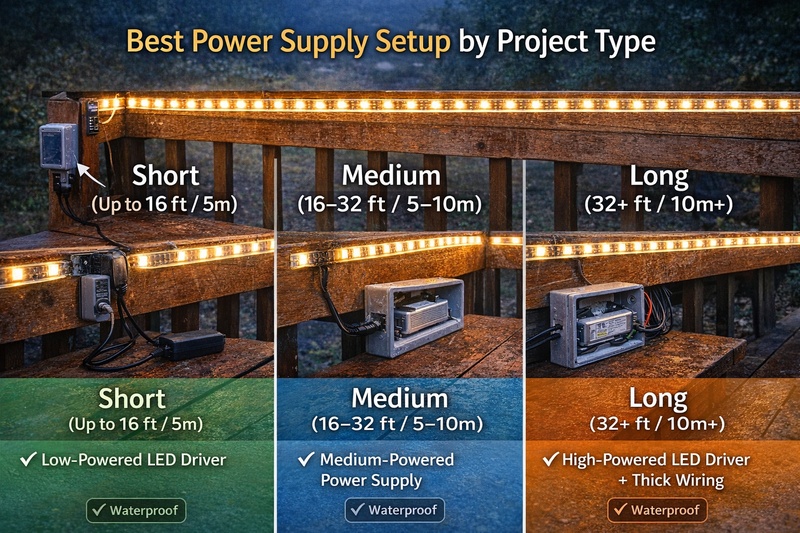
What power supply setup works better for different outdoor project types?
Not every outdoor strip project needs the same power strategy. The setup should match the run, the load, and the environment.
Short decorative runs can use simpler power setups. Longer, exposed, or commercial outdoor projects need more headroom, better voltage planning, better layout control, and stronger environmental protection. I also like to match the driver plan with the right strip specification, so What Should You Look For in an Outdoor LED Strip Light? is a useful companion guide here.
Short decorative outdoor run
This is the easiest type. The load is usually lower and the cable path is shorter. I still want margin and proper environmental suitability, but the system is simpler.
Medium outdoor linear project
Now I become more careful. I review voltage choice, run length, margin, and feed layout more seriously. This is where small planning mistakes start to matter.
Long façade, railing, or perimeter project
This type demands respect. I usually prefer 24V, stronger headroom, power injection planning, and careful review of cable loss. I also pay much more attention to enclosure heat and the actual installation environment.
Commercial or contractor-driven project
These projects need repeatable results. I want a design that is easier to install correctly and less likely to cause service calls later.
| Project type | Better setup habit | Why |
|---|---|---|
| Short decorative run | Basic headroom + correct environment rating | Simple but safe |
| Medium outdoor run | More margin + voltage review | Reduces hidden weakness |
| Long linear outdoor run | 24V + injection planning | Better consistency |
| Commercial project | Conservative and repeatable design | Lower callback risk |
My recommendation
I do not try to force every project into one formula. I match the power strategy to the project type. That is how I reduce risk before the installation becomes expensive to fix.
FAQ
Power supply problems often come from small assumptions that were never checked carefully.
The best outdoor power setup comes from correct sizing, correct voltage, correct environmental protection, and realistic planning for the full system.
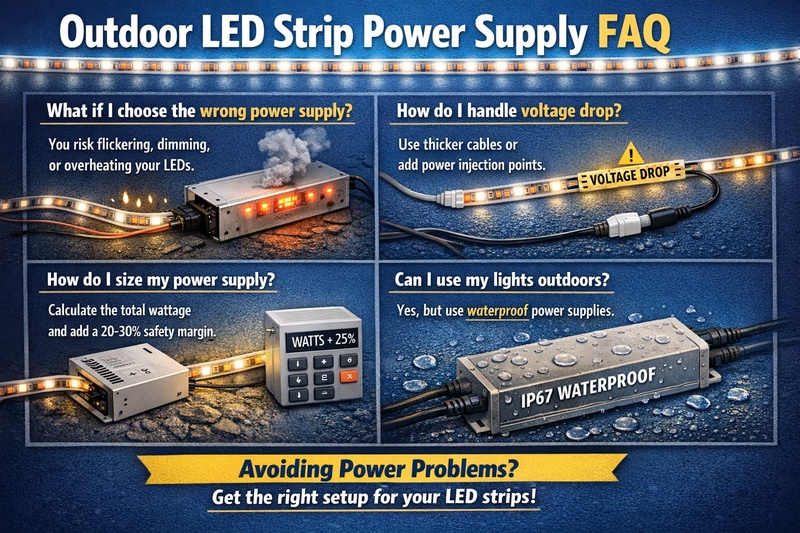
How much safety margin should I leave for an outdoor LED strip power supply?
I usually want some headroom, often around 20% to 30%, depending on the load, environment, and project complexity.
Is 24V always better than 12V for outdoor LED strips?
Not always. For short runs, 12V can still work well. But for longer outdoor runs, 24V is often easier to manage and gives better consistency.
Can I use an indoor power supply outdoors if it is inside a box?
Sometimes the box helps, but I still need to think about humidity, airflow, heat buildup, and actual site conditions.
Why does the far end of my outdoor LED strip look dim?
That is often a voltage drop issue caused by long runs, poor voltage choice, thin cable, or missing power injection.
Is startup brightness enough to prove the system is correct?
No. A strip can light up at first and still have serious margin, heat, or voltage problems.
Conclusion
Small power supply mistakes can quietly ruin outdoor LED strip projects. And if the buyer is still comparing cost against long-term reliability, Are Premium Outdoor LED Strip Lights Really Worth the Extra Cost? is also worth reading. When I size with margin, choose the right voltage, respect the environment, and plan the real layout, I remove most of the avoidable failure before it starts.
-
Understanding outdoor power supply planning is crucial for ensuring reliable and efficient lighting systems in challenging environments. ↩
-
Minimizing voltage drop risk is essential for maintaining performance in long cable runs, ensuring your lighting system operates effectively. ↩
-
Learning about hidden electrical loss can help you optimize your installations, improving efficiency and reducing energy waste. ↩
-
Understanding power supply selection can prevent overheating and extend equipment lifespan. ↩
-
Explore solutions to prevent heat stress and ensure your systems run efficiently. ↩
-
Learn how headroom affects performance and reliability in electrical systems. ↩
-
Discover the significance of output stability for the longevity and performance of your devices. ↩
-
Understanding voltage drop is crucial for ensuring proper lighting performance. Explore this link to learn more about its impact. ↩
-
Power injection can solve dimming issues in lighting. Discover how it works and its benefits for your projects. ↩
Interested in Our LED Solutions?
Get professional consultation and customized LED lighting solutions for your projects. Contact our expert team today.
Related Articles

How Do You Build Profitable Custom Vehicle and RV Interior LED Rope Lights?
You lose RV installation contracts because your interior lights fail on rough roads. Standard strips show bright dots on glossy…

How to Perfect Bookshelf and Display Cabinet LED Rope Lighting?
You lose retail clients when bookshelves look incredibly dark. Ugly shadows hide expensive products inside display cabinets daily. You need…

How to Master Mirror and Vanity LED Rope Light Installation?
Your clients complain about ugly shadows in their bathroom mirrors. Bad lighting ruins expensive vanity designs. You lose future contracts…
