

Why Does Your Cove Lighting Look Like a Cheap Disco Instead of a High-End Hotel?
You invest in expensive crown molding and hire painters to create the perfect ceiling finish, only to turn on the lights and see uneven, spotted reflections that ruin the entire effect. It is heartbreaking to see.
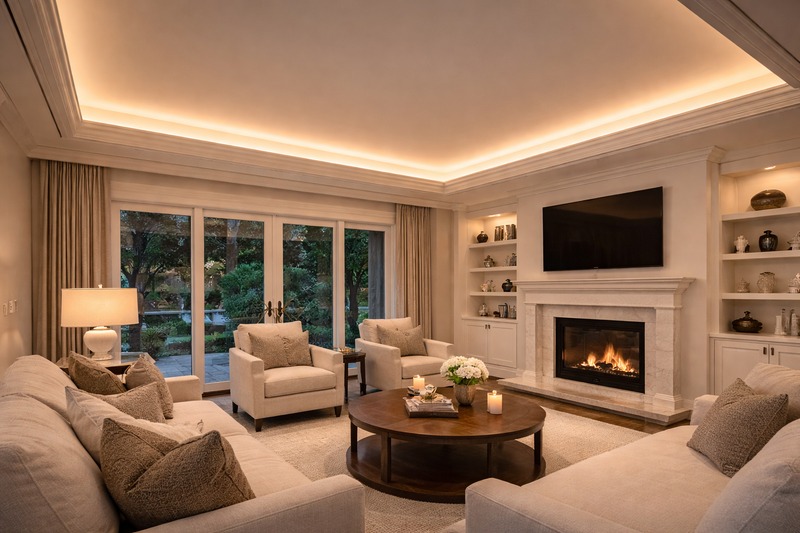
Cove lighting is the technique of directing light upwards onto the ceiling to create indirect, ambient illumination. To achieve a luxurious, seamless glow, you must avoid traditional round rope lights and choose High-Density LED Strips or COB (Chip on Board) lights, ensuring the light source is positioned deep enough to hide the individual diodes from view.
In the LED industry, we have a saying: "The fixture is the hardware, but the light is the software of the room." In my factory, I see two types of orders for cove lighting. The first type is the cheap, 110V round PVC rope light. It is heavy, turns yellow over time, and flickers. The second type is the modern 24V COB strip. As a manufacturer who wants you to succeed, I am going to explain why "Rope Light" is often the wrong term for the result you actually want, and how to design your ceiling to handle the heat and voltage realities of modern LEDs.
Can You Eliminate the Ugly "Dots" on Your Ceiling?
Glossy paint finishes on ceilings act like mirrors. If you use the wrong type of light, your ceiling will reflect every single LED chip, creating a "string of pearls" look that screams low quality.
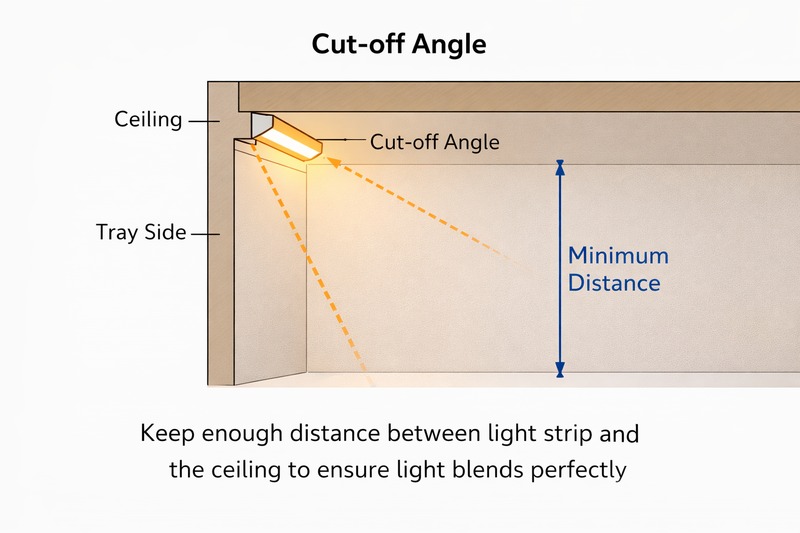
To solve the "dotting" or "spotting" effect, you must use COB (Chip on Board) LED strips or use an aluminum profile with a milky diffuser. Alternatively, adjusting the distance between the light strip and the ceiling surface allows the light to spread naturally before it hits the paint.
The Physics of Reflection
I have analyzed thousands of returns and complaints. 90% of the time, the customer blames the light for being "broken" because it looks dotty. It is not broken; it is physics. A traditional "Rope Light" has LEDs spaced about 1 inch (2.5 cm) apart inside a clear tube. The clear tube acts as a lens, focusing those dots. When you throw that light onto a semi-gloss ceiling, you see the dots.
How to Calculate the "Blending Distance1"
In our testing lab, we use a simple ratio. If you want a smooth line of light, the distance from the LED to the ceiling (the throw distance) must be equal to or greater than the distance between the LEDs. Since you cannot easily move the ceiling, you must change the light.
- The Old Way: Standard SMD 5050 Strip (60 LEDs/meter). You need at least 3 inches of clearance to blend the dots.
- The Jeremy Way: COB Strip (480 LEDs/meter). The chips are so close they look like a solid yellow line. You can place this just 0.5 inches from the ceiling, and it will still look smooth.
The Material Difference: PVC vs. Silicone
Many older "rope lights" use PVC plastic. PVC is cheap, but it degrades under UV light and heat. After two years in a warm cove (heat rises, remember?), the clear tube turns yellow. This shifts your beautiful 3000K warm white light into a sickly greenish-yellow.
I always recommend Silicone Extrusion2. Silicone handles high temperatures (up to 200°C) without yellowing. If you are building a permanent home, do not save $50 on PVC lights only to replace them in 24 months.
| Light Type | Chips Per Meter | Blending Distance Needed | Factory Verdict |
|---|---|---|---|
| Old Rope Light | 30 – 36 | > 10 cm (4 inches) | outdated logic. |
| SMD 5050 Strip | 60 | > 5 cm (2 inches) | Good for high ceilings. |
| COB Strip | 480+ | 1 cm (0.5 inch) | Best for tight spaces. |
Will You Need to Repaint Your Ceiling to Fix Wiring Errors?
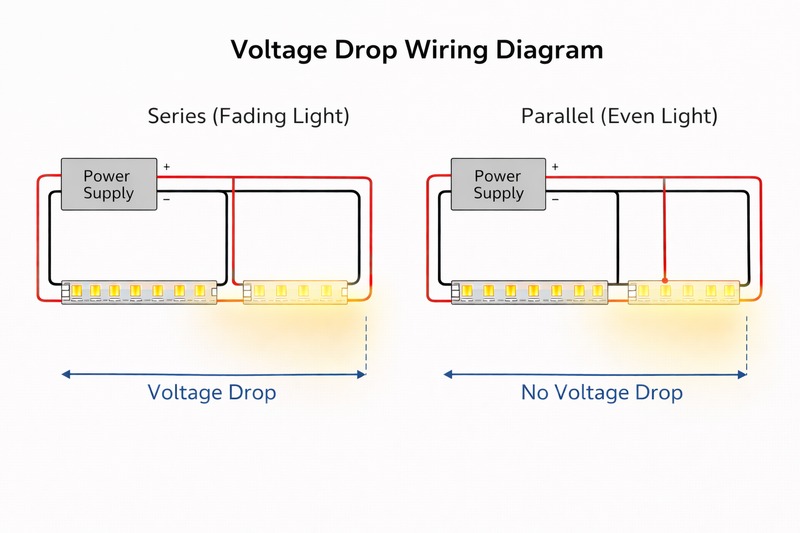
The biggest nightmare in ceiling lighting is voltage drop. You install 40 feet of light, and the end of the run is dim and orange compared to the start, forcing you to rip everything out.
Cove lighting usually requires long continuous runs of light, often exceeding 16 feet (5 meters). To avoid uneven brightness, you must use 24V DC Constant Current strips or 110V driverless rope lights, which allow for longer runs without losing intensity at the far end.
The "Constant Current" Solution
Standard LED strips are "Constant Voltage." This means the copper on the circuit board carries the current. As you go further down the strip, the resistance builds up, voltage drops, and the light dims.
In my factory, we produce a special product for coves called Constant Current (CC) Strip3.
These strips have tiny IC chips on the board that regulate the power at every single LED group.
Why does this matter to you?
With a standard strip, you can only run 5 meters (16 feet) before you need to inject power again. In a ceiling cove, running new power wires is difficult and ugly.
With my Constant Current strip, you can run 20 meters (65 feet) on a single power connection. You can light an entire master bedroom perimeter with one plug.
The 110V Temptation vs. The 24V Reality
Many American contractors love 110V Driverless Rope Lights4. You just plug them into the wall. No big power supply box to hide.
However, I must warn you about two things as a manufacturer:
- The Flicker: 110V AC lights cycle at 60Hz. Some people are sensitive to this manufacturing frequency and can see a subtle strobing. It causes headaches.
- The Cutting Unit: 110V lights usually have a cutting unit of 0.5 meters (20 inches). If your wall is 15 feet and 3 inches long, you cannot cut the light to fit exactly. You will have a dark spot or a folded light.
24V strips can be cut every 2 inches. They fit perfectly. They require a driver (transformer), but the light is stable, smooth, and healthy for your eyes.
Heat Dissipation in Enclosed Spaces5
Coves trap heat. Heat rises. If you use a high-power strip (over 10 Watts/meter) without an aluminum channel, the adhesive tape will fail. The glue gets soft, and the strip peels off.
For coves, avoid high wattage. You want atmosphere, not a reading light. Stick to 5 Watts/meter to 8 Watts/meter6. It stays cool enough that you often don’t even need an aluminum profile, saving you money.
| Voltage System | Max Run Length | Cutting Precision | Risk Factor |
|---|---|---|---|
| 12V DC | 5 Meters | High (every 1 inch) | Voltage drop is severe. |
| 24V DC (CC) | 20 Meters | High (every 2 inches) | Best balance. |
| 110V AC | 50 Meters | Low (every 20 inches) | Flicker & Shock risk. |
Is Your Living Room Too Cold or Too Warm?
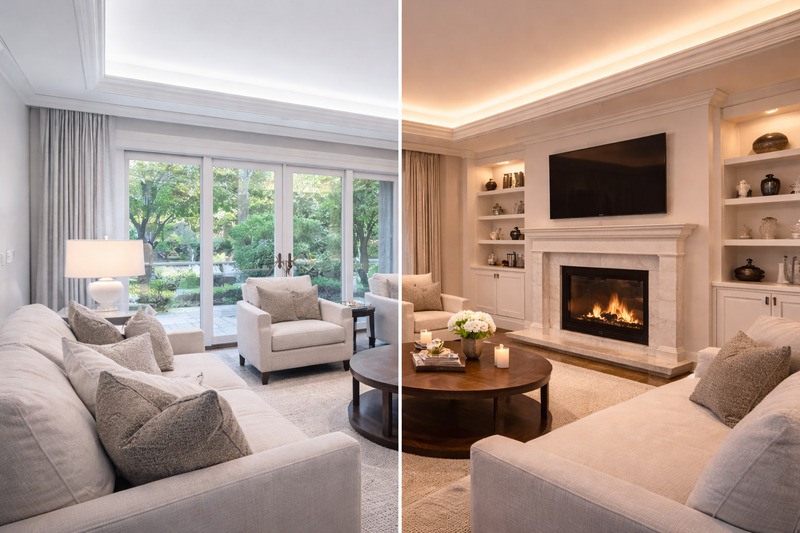
Selecting the wrong color temperature is the most common design mistake. A stark white light (6000K) makes a living room feel like a hospital, while a light that is too orange (2200K) can make it feel dirty.
For residential cove lighting, the ideal color temperature is typically between 2700K (Warm White) and 3000K (Soft White). However, the newest trend is "Tunable White" or CCT-adjustable strips, which allow you to change the color based on the time of day using a remote or phone app.
The "Binning" Nightmare
Have you ever bought two rolls of paint, and they were slightly different shades of white? LEDs have the same problem. We call it "Binning."
In the factory, we sort LEDs into "MacAdam Ellipses."
If you buy cheap rope lights from Amazon, you are likely getting "5-Step" binning. The start of the rope might look pinkish, and the end might look greenish.
For cove lighting, where the light washes a white geometric surface, color consistency is critical. You must demand 3-Step MacAdam7 or better. This ensures the human eye cannot see the difference between chips.
Why "Dim-to-Warm8" is the Future
In the past, when you dimmed an incandescent bulb, it got warmer and more orange. LED lights do not do this naturally; they just get gray and dull.
However, we now manufacture Dim-to-Warm strips.
When these are at 100% brightness, they are a crisp 3000K. As you dim them down for movie night, they automatically shift to 1800K (candlelight).
This mimics the biological response to sunset. It helps you produce melatonin and sleep better.
I strongly suggest this for bedroom coves. It costs about 20% more than standard strips, but the effect on your lifestyle and comfort is massive.
RGB vs. White
I often get asked about RGB (Color Changing) lights for coves.
Here is my honest take: Unless you are building a gaming room or a home theater, skip the RGB.
99% of the time, you will leave it on Warm White.
RGB chips often produce a terrible, fake-looking white light (we call it "Rainbow White9"). If you really want color, buy RGB+W10 (RGB plus a dedicated White chip). This gives you the party colors when you want them, but a true, high-quality white for daily use.
| Technology | Behavior | Best Application |
|---|---|---|
| Static White | One fixed color (e.g., 3000K). | Hallways, Kitchens. |
| Tunable White | Adjustable 2700K – 6500K. | Living Rooms (Day/Night). |
| Dim-to-Warm | Gets warmer as it dims. | Bedrooms & Dining. |
| RGB+W | Colors + True White. | Home Theaters. |
Conclusion
Great cove lighting relies on geometry and physics, not just buying a roll of lights. Use COB strips to eliminate dots, choose 24V Constant Current to ensure even brightness across the room, and consider Dim-to-Warm technology to align your home’s atmosphere with your body’s natural rhythm.
-
Understanding Blending Distance is crucial for achieving smooth lighting effects; this resource will help you master the concept. ↩
-
Explore the advantages of Silicone Extrusion for lighting, including durability and heat resistance, to make informed choices for your projects. ↩
-
Explore the advantages of CC strips for longer runs and consistent lighting without dimming. ↩
-
Learn about the potential issues with 110V lights, including flicker and cutting limitations. ↩
-
Discover effective strategies for heat management to ensure longevity and performance of LED strips. ↩
-
Understand why this wattage range is perfect for creating atmosphere without overheating. ↩
-
Understanding 3-Step MacAdam can help you choose lighting that ensures color consistency and enhances your space. ↩
-
Explore how Dim-to-Warm technology can improve your sleep quality and create a cozy atmosphere in your home. ↩
-
Discover why Rainbow White is often undesirable and how to avoid it for better lighting quality. ↩
-
Learn about RGB+W lighting to enjoy vibrant colors while maintaining high-quality white light for everyday use. ↩
Interested in Our LED Solutions?
Get professional consultation and customized LED lighting solutions for your projects. Contact our expert team today.
Related Articles

How Do You Build Profitable Custom Vehicle and RV Interior LED Rope Lights?
You lose RV installation contracts because your interior lights fail on rough roads. Standard strips show bright dots on glossy…

How to Perfect Bookshelf and Display Cabinet LED Rope Lighting?
You lose retail clients when bookshelves look incredibly dark. Ugly shadows hide expensive products inside display cabinets daily. You need…

How to Master Mirror and Vanity LED Rope Light Installation?
Your clients complain about ugly shadows in their bathroom mirrors. Bad lighting ruins expensive vanity designs. You lose future contracts…
