

How Can You Use LED Strip Lights for Effective Security?
A client’s property is shrouded in darkness, punctuated only by a few harsh, isolated lights. This creates deep shadows along walls and walkways—perfect hiding spots for a trespasser. Your client feels vulnerable, and you know there’s a better way than just adding more ugly floodlights.
Use linear LED strips to create a continuous wall of uniform, shadow-free light along building perimeters, under eaves, and down pathways. This eliminates hiding spots completely. For an active deterrent, integrate them with motion sensors that trigger a sudden, bright illumination.
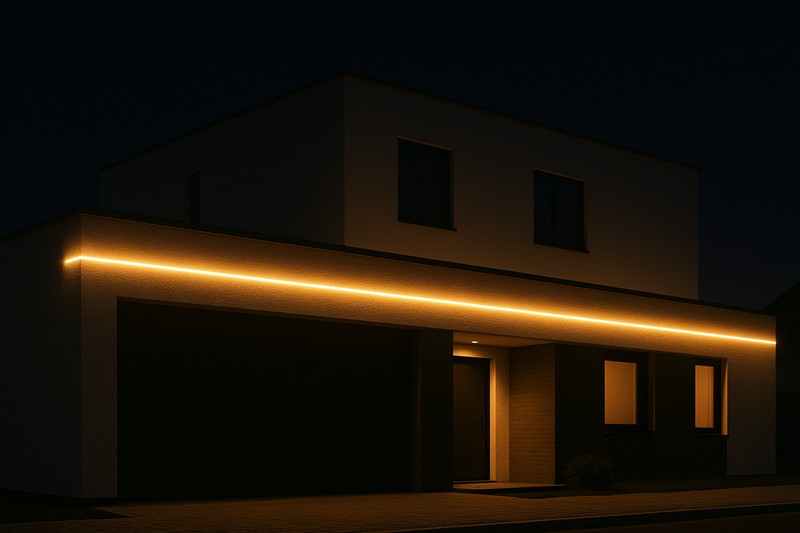
From my experience as a manufacturer, security lighting has evolved beyond simple motion-activated floodlights. Those create what I call the "spotlight effect"—one bright area and even deeper surrounding shadows. This can actually reduce visibility. For a professional like Tom, the goal is to design a system that offers comprehensive, reliable security. LED strip lights are a unique tool for this. They allow you to wash entire surfaces in light, removing the element of surprise that intruders rely on. It’s not just about seeing an intruder; it’s about creating an environment where they know they will be seen from the moment they step foot on the property.
How Do LED Strips Actively Deter Intruders?
You install a powerful floodlight to scare people away, but instead, it creates a stark contrast between light and dark. You’ve inadvertently given intruders perfect cover in the deep shadows just feet away from the light.
LED strips deter intruders by creating broad, even fields of light that eliminate shadows. This "wall of light" effect makes it impossible for someone to approach a building’s perimeter or windows undetected, removing the element of surprise.
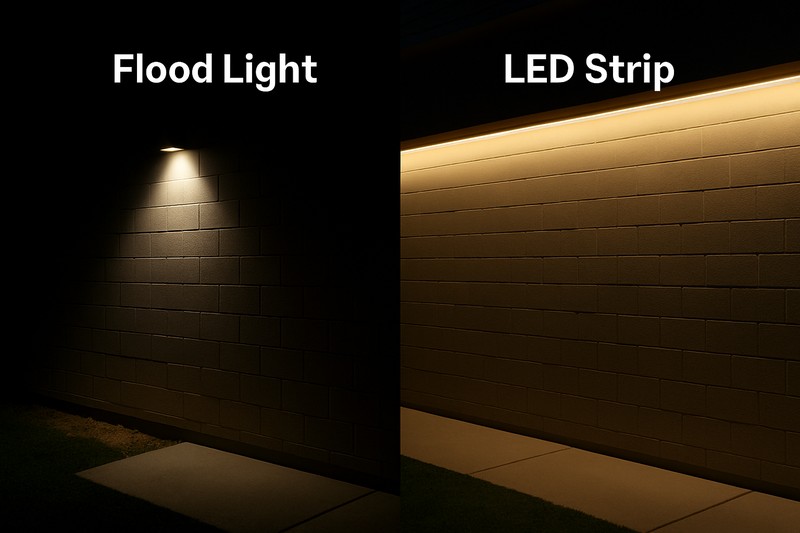
The core of effective security lighting is not just illumination, but the quality of that illumination. It’s a strategic tool. The most fundamental principle is eliminating anonymity, because intruders thrive in darkness and concealment. Traditional security lights often fail spectacularly at this. By redesigning how we apply light to a building’s exterior, we can create a powerful psychological barrier that stops a potential intrusion before it even begins.
The Psychology of Uniform Illumination
The deterrent effect of LED strips is primarily psychological. An intruder’s main advantage is stealth. They rely on moving from shadow to shadow, approaching a building undetected. When you install a continuous LED strip under a roof soffit, it doesn’t just light the ground; it washes the entire vertical surface of the wall in a seamless gradient of light. This technique, which I call "Perimeter Grazing1," highlights the wall’s texture and, more importantly, exposes anyone standing against it. There are no dark spots next to windows or doors. There is no place to hide. This environment creates a feeling of total exposure. An intruder who sees a property bathed in clear, uniform light understands that they are visible from every angle, from the street, and from the neighbors’ houses. This constant visibility is a far more powerful deterrent than a sudden, startling floodlight that they can simply duck away from. They are more likely to abandon the attempt and move on to an easier, less illuminated target.
Comparing Point Source vs. Linear Source Lighting
To understand why this works, we need to compare the light sources. A traditional floodlight bulb is a "point source." All its light emanates from a single, small point. This creates high-contrast light that casts very sharp, dark, and elongated shadows behind any object, be it a column, a bush, or a corner of the building. These shadows are a security flaw. An LED strip is a "linear source2." The light emanates from a long line of individual diodes spaced closely together. This distributes the light evenly along an entire axis. The result is an incredibly soft, diffused light3 that "wraps" around objects, preventing the formation of harsh shadows. The difference is night and day, literally. One creates a scene of high anxiety with pockets of danger, while the other creates a scene of calm, comprehensive visibility. For a professional buyer like Tom, explaining this fundamental difference in light physics to a client is a powerful way to justify the choice of a linear lighting solution over outdated, ineffective floodlights.
| Lighting Type | Light Distribution | Shadow Creation | Deterrent Effect |
|---|---|---|---|
| Traditional Floodlight | Point Source (Concentrated) | High (Creates deep, harsh shadows) | Low to Medium. Startles intruder but provides hiding spots. |
| Wall Pack Light | Semi-Diffused Point Source | Medium (Softens some shadows but still has dark spots) | Medium. Better coverage but still incomplete. |
| Outdoor LED Strip Light | Linear Source (Distributed) | None (Washes surfaces in even light) | High. Eliminates all hiding spots, creating a powerful psychological barrier. |
Where Are the Most Strategic Places to Install Security LED Strips?
You have reels of LED strip, but you’re not sure where to place them. Randomly lighting up areas is inefficient and ineffective. You need a clear strategy to cover the property’s most vulnerable points.
Focus on three key zones: building perimeters (under eaves and soffits), access points (around doors and windows), and circulation routes (along pathways, stairs, and fence lines). This creates layers of security.
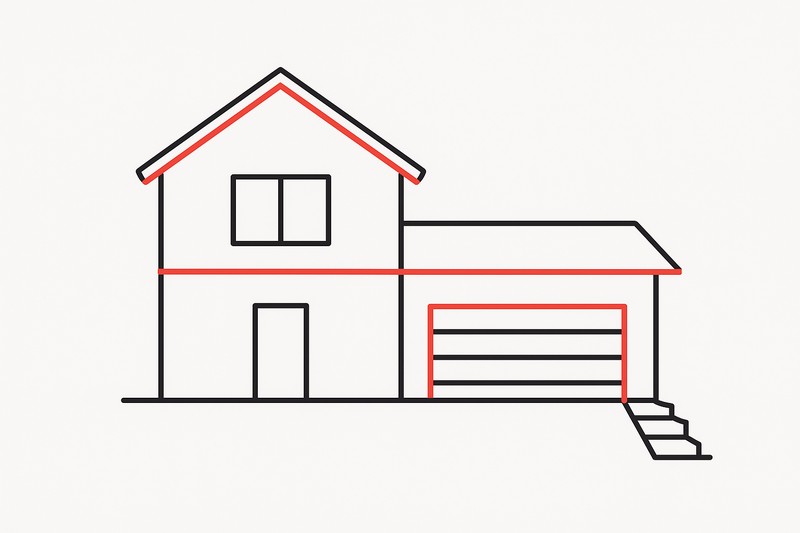
A successful security lighting plan is not just about placing lights; it’s about creating overlapping fields of illumination, leaving absolutely no dark zones for an intruder to exploit. It’s a systematic approach. From a practical installation standpoint, here is how I advise clients like Tom to layer the lighting on a property. Thinking in layers ensures that every potential approach to the building is covered, making the entire property a less appealing target.
Layer 1: Securing the Building Envelope
The first and most critical layer is the building itself. The most vulnerable areas are the walls, which contain the windows and doors. The number one priority is installing a continuous run of high-output, IP67-rated LED strips4 directly under the soffits or eaves along the entire perimeter of the building. This is the application that creates the "wall of light" effect we discussed. It protects every ground-floor window and door simultaneously. For architects and designers, aesthetics matter. I recommend using a surface-mount aluminum channel5 with a frosted diffuser. This protects the strip, helps with heat dissipation, and creates a clean, finished line of light instead of showing visible dots from the LEDs. This single application does more for security than a dozen scattered floodlights.
Layer 2 & 3: Highlighting Access and Movement
The second layer focuses specifically on key access points. This includes not just the front door, but the garage door, back doors, and any low-level windows that are particularly vulnerable. Framing these areas with light removes any chance for an intruder to work on a lock or a window pane in the dark. For example, a strip installed in a channel above the garage door illuminates the entire area in front of it. The third layer addresses circulation. You must illuminate how people—both welcome and unwelcome—move through the property. This means embedding strips into the risers of deck stairs (which also doubles as a safety feature), running them along the top or bottom rail of a fence, or installing them along the edge of the primary walkway from the street to the house. By lighting these paths, you make it impossible for someone to approach the building without being clearly visible during their entire journey.
| Zone | Specific Location | Security Goal |
|---|---|---|
| 1. Building Perimeter | Under eaves, soffits, and rooflines | Eliminate shadows against walls; protect windows and doors. |
| 2. Access Points | Above garage doors, framing doorways, under window sills | Directly illuminate areas vulnerable to forced entry6. |
| 3. Circulation Routes | Along walkways, on stair risers, under deck railings | Track movement across the property from the boundary to the building. |
What Features Make an LED Strip Good for Security?
Not all LED strips are created equal. You know you need one that’s bright and weatherproof, but what specific technical details separate a consumer-grade decorative strip from a professional security-grade solution?
For security, prioritize high brightness (over 1000 lumens/meter), a neutral to cool color temperature (4000K-5000K) for clear visibility, a high Color Rendering Index (CRI >90) for accurate color identification, and robust IP67/68 weatherproofing.
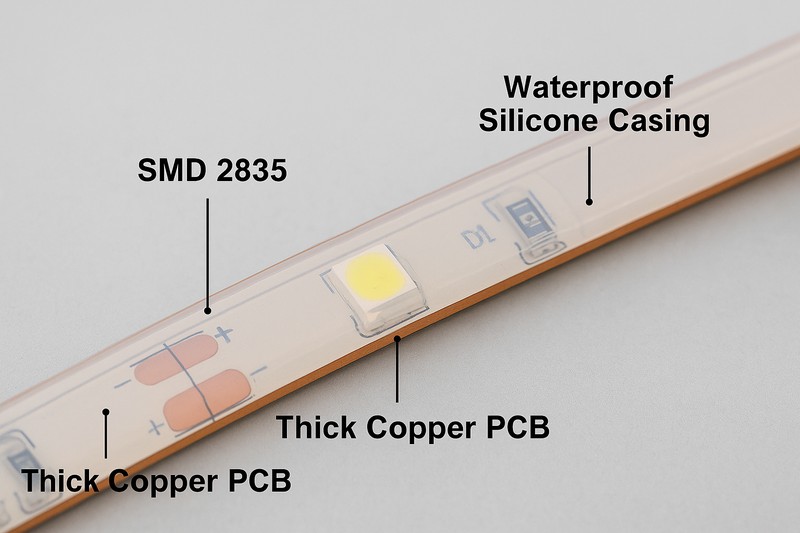
As a manufacturer, these are the exact specifications we discuss with professional buyers like Tom who are sourcing for projects where performance and reliability are non-negotiable. The devil is in the details, and understanding these technical specifications is what allows you to deliver a truly effective and lasting security solution for your clients.
Brightness and Color: The Core of Visibility
First is brightness, measured in lumens. Decorative accent lighting might only be 300-500 lumens per meter. This is not enough for security. For effectively washing a wall and illuminating the ground from a typical one-story eave (around 10-12 feet high), I recommend a minimum of 1000 lumens per meter. For a second-story installation, you’ll need a higher output, closer to 1500-2000 lumens/meter, to ensure sufficient light reaches the ground. This is easily achieved with high-density strips7 using quality chips like the SMD 2835. Next is color temperature (CCT). While warm light (2700K-3000K) is inviting for patios, it’s not ideal for security. The human eye perceives cooler light as brighter, and it renders details more sharply in the dark. A CCT of 4000K8 (neutral white) or 5000K (cool white) provides crisp, clear illumination that is excellent for modern security cameras, which are often optimized for this light spectrum.
Color Accuracy and Durability: The Professional Details
A crucial, and often overlooked, specification is the Color Rendering Index (CRI)9. A low CRI light source makes colors look washed out and unnatural. For security, a high CRI of over 90 is vital. I frame this to my clients as an "evidential quality" feature. It means that if an incident occurs, the security camera footage will accurately capture the true color of a person’s clothing or their vehicle. This detail can be the difference-maker in a police investigation. Finally, durability is a security feature in itself. A light that fails creates a vulnerability. That’s why we insist on IP67 rated strips10 encased in high-grade, UV-stabilized silicone, not cheap epoxy or PU glue which will yellow and crack. The foundation of the strip should be a thick, 2-ounce or 3-ounce copper PCB (Printed Circuit Board). This helps manage heat effectively, which is essential for the longevity of the LED chips, ensuring the system performs reliably for years.
How Do You Ensure Your Security Lighting Lasts for Years?
You install a brilliant security lighting system for a client. It looks great. One year later, you get a call. A section is out. A connection failed. Now there’s a dark spot on their perimeter—a critical security failure.
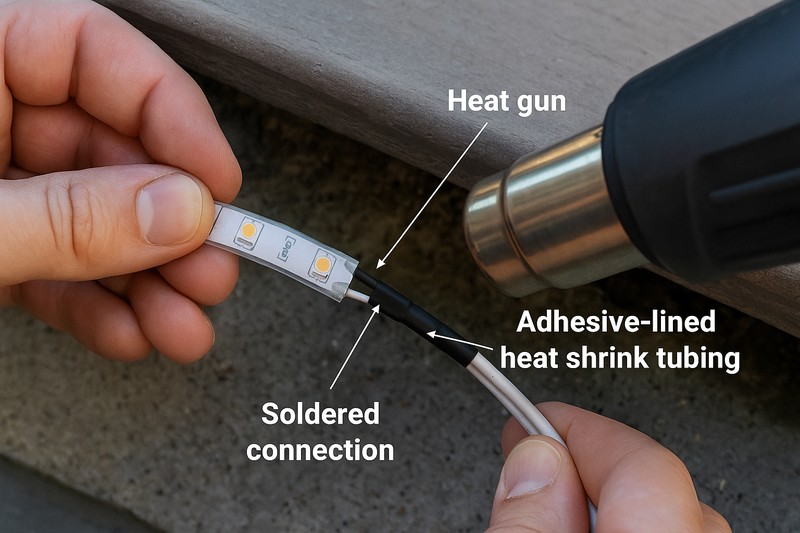
Durability comes from a professional-grade system approach. Use IP67 or IP68 rated strips made with UV-resistant silicone. All connections must be soldered and sealed with adhesive heat shrink. Finally, use a high-quality, UL-listed, IP67 power supply.
In a security application, reliability is not a feature; it is the entire point. A failed light is a failed system. As a supplier to the demanding North American market, I stress to my clients that the product’s longevity is determined equally by the quality of the components and the quality of the installation. A security system has to perform flawlessly through the worst weather imaginable.
Beyond the IP Rating: Material Selection is Key
The IP rating (e.g., IP67) is just the starting point. It tells you the strip is protected against dust and temporary water immersion, but it doesn’t tell you how it’s protected or for how long. The material of the strip’s casing is the first line of defense. Many low-cost strips use a cheap epoxy resin or PU glue coating. These materials are not UV stable. After a year of sun exposure, they will turn yellow, become brittle, and crack. This allows moisture to seep in and cause the LEDs to fail. For any serious outdoor project, especially security lighting, we only produce and recommend strips encased in high-grade, UV-stabilized silicone. Silicone remains flexible in extreme cold, it doesn’t yellow or cloud from sun exposure, and it provides a durable, long-lasting waterproof barrier for the electronics inside.
The Critical Role of Connectors and Power Supplies
The second major point of failure in any outdoor LED strip installation is the connections. Those cheap, plastic, clamp-style solderless connectors you can buy online are designed for indoor, temporary use. They are guaranteed to fail outdoors. Moisture will inevitably wick inside the connector through capillary action, corrode the copper contact points, and the light will fail. For every security installation, there is no substitute for a properly soldered connection. Soldering creates a solid, permanent electrical bond. After soldering, that connection must be sealed with dual-wall, adhesive-lined heat shrink tubing. When heated, this tubing shrinks and a special adhesive lining melts, creating a completely waterproof, rock-solid seal around the joint. Finally, the power source is the heart of the system. Never use a cheap, non-certified indoor power supply. For security, you must use a properly sized, Class 2, UL-listed (or ETL-listed) power supply with its own IP67 rating. This ensures it’s safe, reliable, and built to withstand the elements.
Conclusion
Move beyond outdated floodlights to a modern security solution. LED strips provide superior, shadow-free illumination that acts as a powerful deterrent. By choosing professional-grade products and installing them strategically, you create a genuinely safe and secure environment for your clients.
-
Explore this concept to understand how it enhances security through effective lighting. ↩
-
Learn about the advantages of linear source lighting for safety and ambiance in outdoor spaces. ↩
-
Find out how soft, diffused light can improve visibility and reduce anxiety in outdoor environments. ↩
-
Explore how these LED strips enhance security and visibility around buildings. ↩
-
Learn about the advantages of using aluminum channels for LED installations. ↩
-
Discover effective lighting strategies to deter intruders and enhance safety. ↩
-
Explore how high-density strips improve lighting efficiency and effectiveness, especially for security applications. ↩
-
Learn why a CCT of 4000K provides optimal visibility and detail for security cameras, enhancing safety. ↩
-
Understanding CRI is crucial for ensuring accurate color representation in security footage, enhancing safety and reliability. ↩
-
Discover the significance of IP67 ratings in ensuring durability and reliability in outdoor lighting solutions. ↩
Interested in Our LED Solutions?
Get professional consultation and customized LED lighting solutions for your projects. Contact our expert team today.
Related Articles

How Do You Build Profitable Custom Vehicle and RV Interior LED Rope Lights?
You lose RV installation contracts because your interior lights fail on rough roads. Standard strips show bright dots on glossy…

How to Perfect Bookshelf and Display Cabinet LED Rope Lighting?
You lose retail clients when bookshelves look incredibly dark. Ugly shadows hide expensive products inside display cabinets daily. You need…

How to Master Mirror and Vanity LED Rope Light Installation?
Your clients complain about ugly shadows in their bathroom mirrors. Bad lighting ruins expensive vanity designs. You lose future contracts…
