

How Do You Choose the Right Dimming Method for LED Strip Lights?
Dimming sounds simple until the project is installed and the lights flicker, buzz, or refuse to go below 30%. Most LED strip dimming failures are not caused by the strip itself — they start with a mismatch between the dimming method and the rest of the system.
For contractors, specifiers, and lighting designers, choosing the right dimming method is one of the most overlooked decisions in LED strip projects. The strip may perform perfectly on the bench, but once it connects to the wrong dimmer or control protocol, the result can range from annoying flicker to a complete system redesign.
This guide explains the main LED strip dimming methods — PWM, 0-10V, TRIAC, and DALI — and helps you decide which one fits your project based on installation type, budget, control requirements, and compatibility.
Why dimming method matters more than dimming range
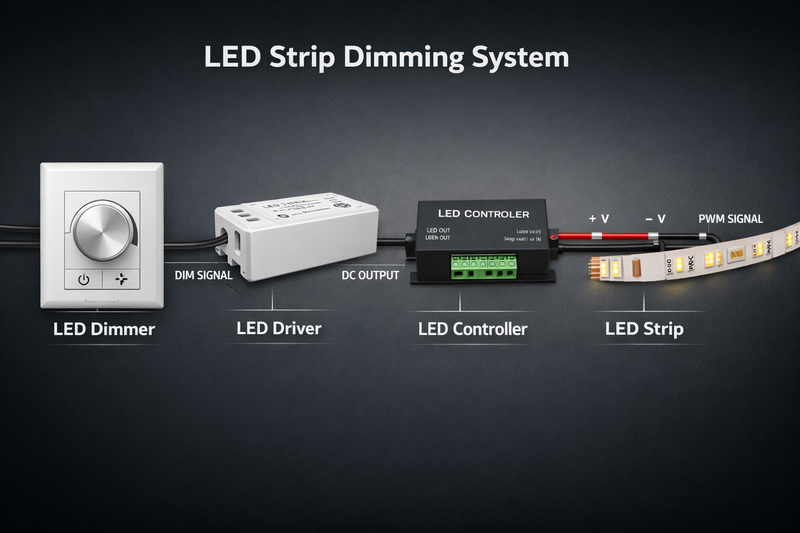
Most LED strip spec sheets list a dimming range like “0–100%.” That number tells you almost nothing about real-world performance. What actually matters is how the dimming signal reaches the driver or controller, and whether the components in the system are designed to work together.
A TRIAC dimmer paired with a constant-voltage LED driver that was not designed for phase-cut dimming will often produce visible flicker below 40% brightness. A PWM controller running at the wrong frequency can create an audible buzz. A 0-10V system installed without proper signal wiring may dim unevenly across zones.
In our experience, roughly half of all dimming complaints in LED strip projects come from protocol mismatches — not from defective products. The strip, driver, and dimmer each work fine individually, but together they fail because the dimming method was chosen based on price or habit rather than system compatibility.
Understanding the differences between dimming methods before specifying components prevents costly field troubleshooting later.
PWM dimming: the default for most low-voltage LED strip projects
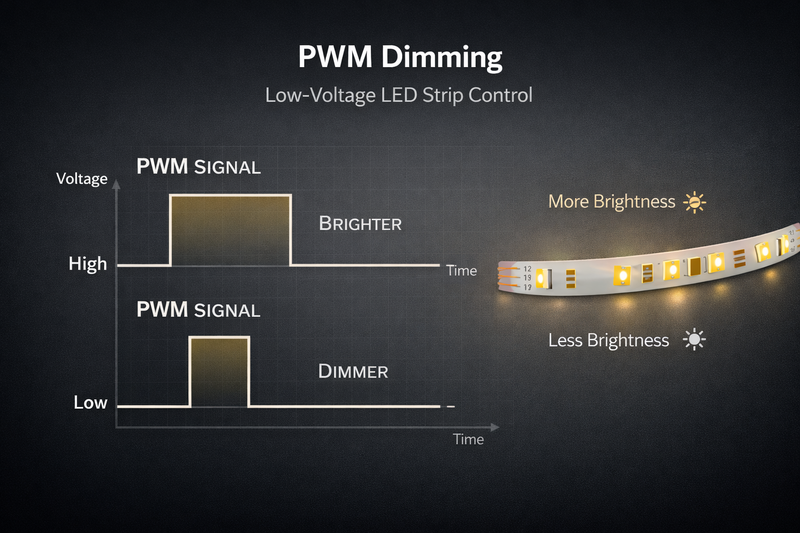
PWM (Pulse Width Modulation) is the most common dimming method for 12V and 24V LED strip systems. It works by rapidly switching the LED power on and off at a fixed frequency, and adjusting the ratio of on-time to off-time to control perceived brightness.
At 50% PWM duty cycle, the LEDs are on for half of each cycle and off for the other half. Because the switching happens fast enough — typically 500 Hz to 25 kHz — the human eye perceives this as a smooth reduction in brightness rather than blinking.
Why PWM is popular for LED strips
PWM dimming has several practical advantages for strip light projects:
- Smooth dimming to very low levels. A well-designed PWM controller can dim LEDs down to 1% or lower without color shift or flicker.
- No driver compatibility concerns. PWM dimming happens on the low-voltage side, between the power supply and the strip. The power supply itself does not need to be “dimmable.”
- Color consistency. Because the LEDs are either fully on or fully off during each cycle, the color temperature stays stable across the dimming range. This matters for architectural and retail applications where color rendering accuracy is critical.
- Wide availability. PWM controllers are available at every price point, from basic knob dimmers to wireless and DMX-compatible units.
When PWM becomes a problem
PWM is not always the best choice. At lower frequencies (below 1 kHz), some people can perceive flicker, especially in peripheral vision. This is called the stroboscopic effect[2] and it can be a compliance concern in workplaces and healthcare environments.
For long LED strip runs — especially 10 meters or more — the PWM signal wire needs to carry the full LED current, which means heavier gauge cables and careful layout planning. In large commercial installations, running PWM signals over long distances can also introduce voltage drop issues.
We usually recommend PWM for residential, retail, and hospitality projects under 15 meters per zone where the controller is located near the power supply. For larger systems, 0-10V or DALI often makes more sense.
0-10V dimming: the simple analog standard for commercial projects
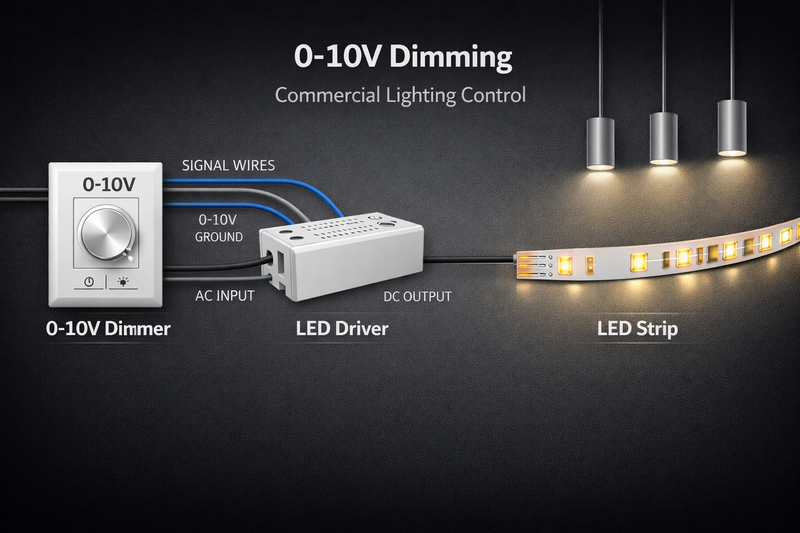
0-10V is one of the oldest dimming protocols, and it remains widely used in commercial and architectural lighting. The dimmer sends a low-voltage analog signal (0 to 10 volts DC) to the LED driver, which adjusts its output accordingly. At 10V, the driver runs at full output. At 0V, it dims to minimum or turns off, depending on the driver design.
How 0-10V works with LED strips
Unlike PWM, which controls dimming on the low-voltage strip side, 0-10V dimming controls the driver output directly. This means the LED driver must be specifically designed for 0-10V input — you cannot use a standard constant-voltage power supply.
The system requires two separate wiring paths: the main power wiring to the driver, and a separate pair of low-voltage signal wires from the dimmer to each driver. The signal wires carry almost no current, so they can be thin and run long distances without significant loss.
Advantages of 0-10V for LED strip projects
- Clean integration with building management systems. Many commercial BMS platforms support 0-10V as a standard control protocol.
- Long signal runs. Because the control signal is low-current, it can run 50 meters or more without degradation — far beyond what PWM can manage reliably.
- Simple wiring. Two extra wires per zone. No data protocol, no addressing, no programming.
- Proven reliability. 0-10V has been used in commercial buildings for decades. Electricians understand it.
Limitations to know
The main drawback of 0-10V is that it is a one-way signal with no feedback. The dimmer tells the driver what to do, but the driver cannot report its status back. There is also no standardized behavior at the low end — some 0-10V drivers dim smoothly to 1%, while others bottom out at 10% or turn off abruptly at 0V.
In our experience, the low-end dimming behavior varies significantly between driver manufacturers. If smooth dimming below 5% is important for your project, request dimming curve documentation from the driver supplier before specifying.
0-10V is a strong choice for office lighting, retail, warehouse, and any commercial space where simple zone dimming is needed without complex programming.
TRIAC dimming: using existing wall dimmers with LED strips
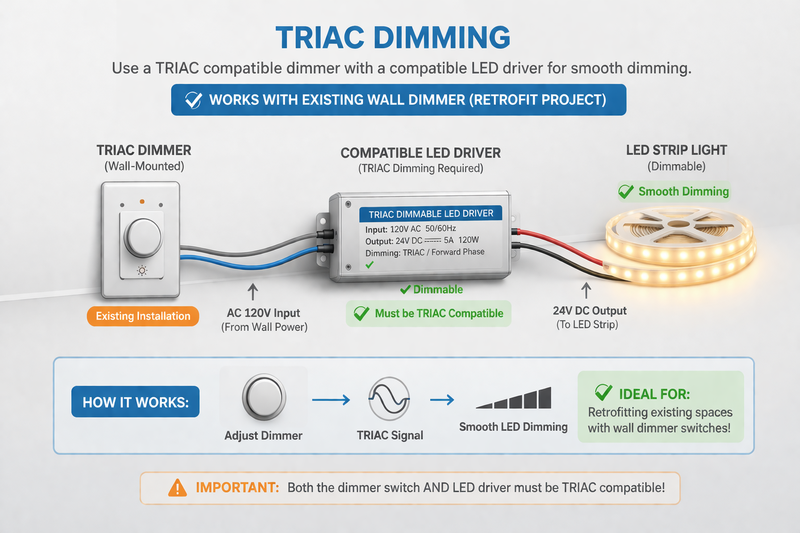
TRIAC (Triode for Alternating Current) dimming is the technology behind most traditional wall dimmers — the rotary or slider switches already installed in millions of homes and commercial spaces. TRIAC dimmers work by cutting a portion of each AC waveform cycle, reducing the power delivered to the load.
Why TRIAC is tempting for LED strip projects
The biggest advantage of TRIAC dimming is infrastructure reuse. If a building already has TRIAC wall dimmers installed, using TRIAC-compatible LED drivers means the existing switches can stay in place. No new wiring, no new controls, no rewiring the wall box.
This makes TRIAC the default choice for renovation projects and residential retrofits where the client wants to keep their existing dimmers.
Why TRIAC is the most problematic dimming method for LED strips
TRIAC dimmers were originally designed for incandescent and halogen loads — resistive loads that draw significant current and behave predictably. LED drivers are electronic loads with very different electrical characteristics, and the interaction between a TRIAC dimmer and an LED driver is often unpredictable.
Common problems include:
- Flicker at low brightness. Many TRIAC dimmers have a minimum load requirement. A single LED strip zone may not draw enough power to keep the TRIAC circuit stable, causing visible flicker.
- Buzzing. The chopped AC waveform can cause components in the LED driver to vibrate audibly.
- Limited dimming range. TRIAC dimming with LED drivers often only works reliably between 20% and 100%. Below 20%, flicker and dropout become common.
- Compatibility lottery. Not all TRIAC dimmers work with all LED drivers. Even products that both claim “TRIAC compatible” may not perform well together. The Lighting Research Center[4] has documented this issue extensively.
Making TRIAC work
If TRIAC dimming is required, use a driver that explicitly lists the specific TRIAC dimmer models it has been tested with. Avoid mixing dimmer and driver brands without checking compatibility tables. And always test a sample setup before committing to a full installation.
We see TRIAC dimming work well in small residential projects with quality components. For anything larger or more demanding, PWM or 0-10V is usually a better path.
DALI dimming: the professional protocol for complex projects
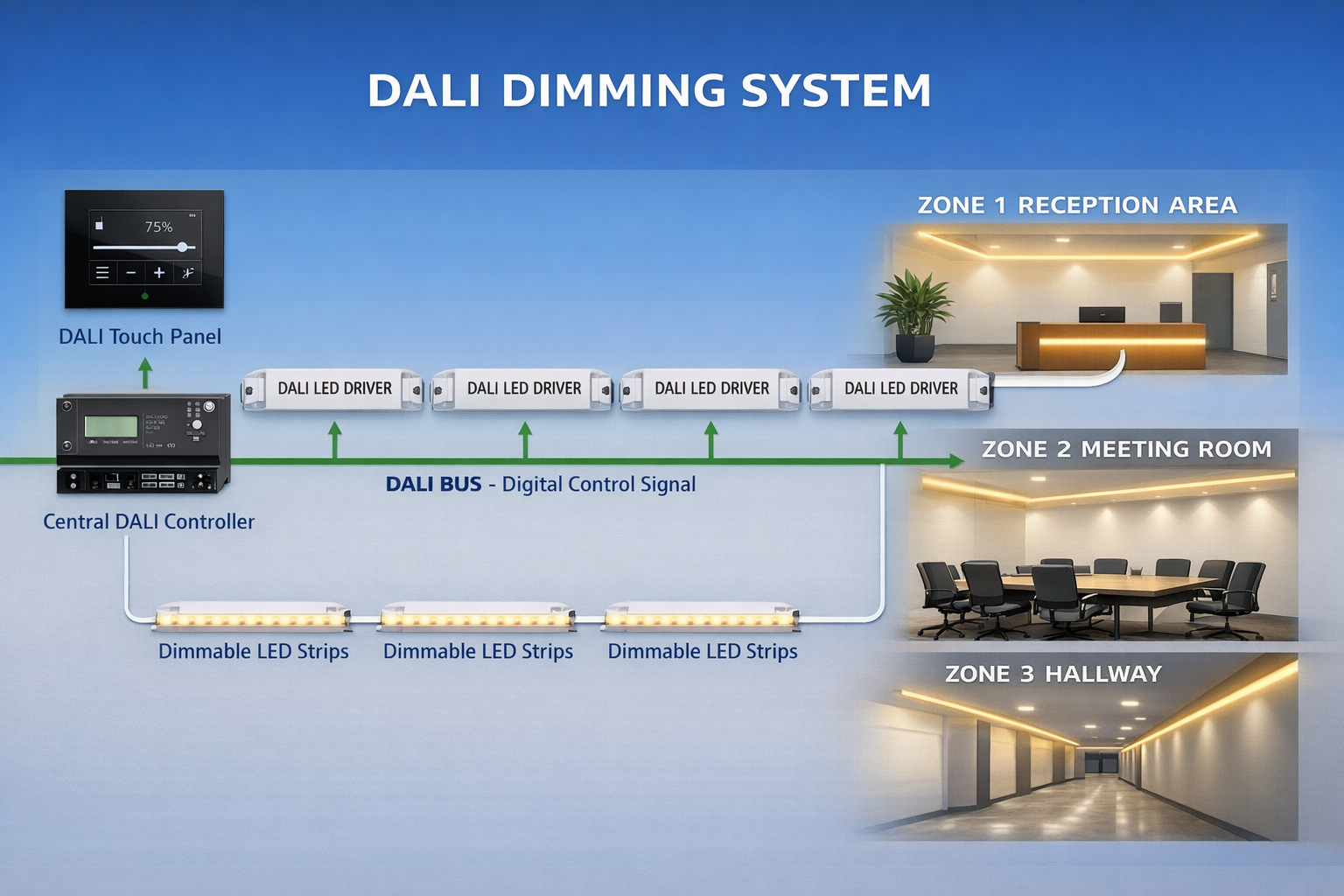
DALI (Digital Addressable Lighting Interface) is a digital dimming protocol designed specifically for building lighting control. It is an international standard (IEC 62386)[3] that allows individual addressing, grouping, and scene programming for every luminaire in a system.
How DALI works with LED strips
Each DALI-compatible LED driver has a unique address on the DALI bus. A DALI controller can communicate with up to 64 individual drivers on a single bus, sending commands to specific addresses, groups, or broadcast to all. The communication is bidirectional — the controller can query each driver for status, fault reports, and actual dimming level.
For LED strip installations, each zone typically has its own DALI driver. The strip itself does not need to be “DALI compatible” — the intelligence sits in the driver.
When DALI is the right choice
DALI is overkill for a simple residential cove light. But for these project types, it is often the only practical option:
- Large commercial spaces with dozens or hundreds of independently controlled zones
- Projects requiring scene programming — preset lighting scenes that change by time of day or occupancy
- Buildings with centralized lighting management — integration with BMS, occupancy sensors, and daylight harvesting
- Projects requiring compliance reporting — DALI’s bidirectional communication enables energy monitoring and maintenance alerts
Cost and complexity considerations
DALI drivers cost more than standard or 0-10V drivers — typically 30–60% more per unit. The system also requires a DALI controller, programming time, and sometimes a commissioning specialist. For a 10-zone residential project, the added cost and complexity is rarely justified. For a 200-zone office tower, DALI’s management capabilities pay for themselves in operational efficiency.
In our experience, DALI becomes cost-effective when a project has more than 30 individually controlled zones or when integration with building automation is a hard requirement.
Wireless and smart dimming: convenience vs reliability
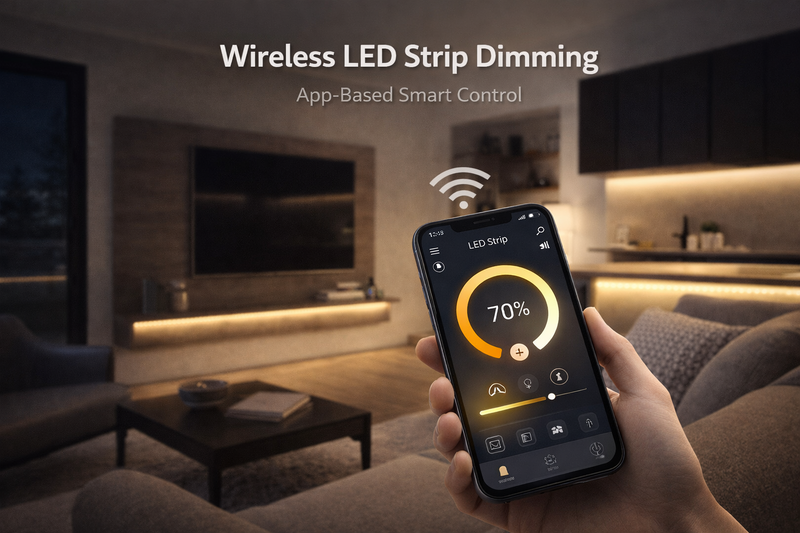
Wireless dimming systems — including Zigbee, Bluetooth Mesh, Wi-Fi, and proprietary RF — are growing rapidly in both residential and commercial markets. They eliminate control wiring entirely and allow smartphone or voice control.
Where wireless dimming works well
- Residential projects where running extra control wires is impractical or too expensive
- Rental properties and temporary installations where permanent wiring changes are not allowed
- Retrofit projects where adding new wiring to existing walls is the main budget concern
- Smart home ecosystems where the client already uses platforms like Home Assistant[6], Apple HomeKit, or Google Home
Where wireless dimming becomes a risk
For commercial projects, wireless dimming introduces reliability concerns that wired protocols avoid:
- Signal interference in buildings with dense Wi-Fi, Bluetooth, or RF environments
- Latency — wireless dimming commands may have noticeable delay compared to hardwired systems
- Firmware dependency — some wireless systems require cloud connectivity or regular firmware updates to maintain functionality
- Scalability limits — most wireless mesh networks handle 30–50 devices well but can struggle with larger installations
For any project where lighting reliability is critical — hospitality, healthcare, retail — we recommend using wireless dimming only as an optional overlay on top of a wired system, not as the primary control method.
How to match dimming method to project type
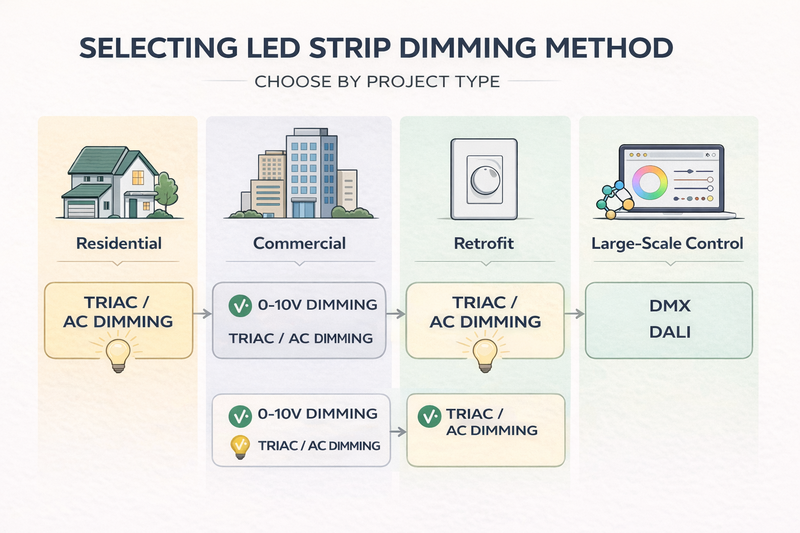
Choosing the right dimming method depends on the project context, not just the strip or driver specifications. Here is a practical decision framework:
Residential cove, cabinet, or accent lighting (under 15m):
PWM is the simplest and most reliable choice. Use a quality PWM controller with a frequency above 1 kHz. If the home already has TRIAC wall dimmers that must stay, specify a TRIAC-compatible driver and test before full installation.
Small commercial or hospitality (10–30 zones):
0-10V is the practical middle ground. Simple wiring, reliable performance, and compatible with most commercial electrical practices. Add wireless control as an optional overlay if the client wants app-based adjustments.
Large commercial, office, or institutional (30+ zones):
DALI is the professional standard. The upfront investment in DALI drivers and programming pays back through zone-level control, energy monitoring, and integration with building management systems.
Renovation or retrofit with existing infrastructure:
Start with what is already in the wall. If TRIAC dimmers exist and the project is small, use TRIAC-compatible drivers. If the building has a 0-10V or DALI system, specify matching drivers to connect into the existing control infrastructure.
Temporary or rental installations:
Wireless dimming (Zigbee or Bluetooth Mesh) is the most practical option when no permanent wiring changes are allowed.
Common dimming mistakes to avoid in LED strip projects
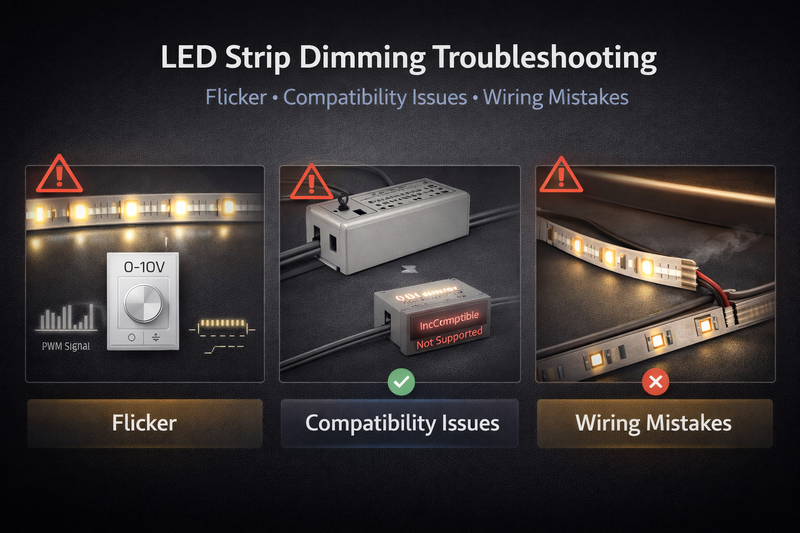
Even with the right dimming method selected, several common mistakes can still cause problems:
Mixing incompatible components. The number one cause of dimming issues. Always verify that the dimmer, driver, and strip are tested and rated to work together. Do not assume “dimmable” on a spec sheet means compatible with your specific dimmer.
Ignoring minimum load requirements. TRIAC dimmers and some 0-10V drivers have minimum wattage thresholds. A single short LED strip run may not meet the minimum, causing flicker or failure to dim. Check minimum load ratings before specifying.
Running PWM signals over long distances. PWM works by switching current on and off rapidly. Over long cable runs, the signal degrades. Keep PWM controllers within 5 meters of the power supply, and use appropriate cable gauge for the current load.
Specifying without testing. Always build a one-zone sample before committing to a full order. Test the full dimming range, check for flicker at low levels, listen for buzzing, and verify smooth dimming transitions. What works on paper does not always work on the wall.
Overlooking dimming curve differences. Linear dimming and logarithmic dimming feel very different to the human eye. If smooth, natural-feeling dimming is important, ask the driver or controller manufacturer about their dimming curve profile. The IES[5] provides guidelines on perceptually uniform dimming for architectural applications.
Frequently asked questions
Can I use a regular wall dimmer with LED strip lights?
Only if the LED driver is specifically rated for TRIAC or leading-edge dimming, and the dimmer model has been tested with that driver. Most standard wall dimmers were designed for incandescent loads and may cause flicker, buzzing, or limited dimming range with LED drivers.
What PWM frequency should I look for to avoid flicker?
Above 1 kHz for most applications. For video or camera environments, 25 kHz or higher is recommended to avoid banding in recordings. The IEEE 1789 standard provides detailed flicker guidelines[1].
Is 0-10V dimming compatible with smart home systems?
Not directly. 0-10V is an analog protocol without digital communication. However, many smart home platforms offer 0-10V interface modules that bridge the gap, allowing app control while keeping 0-10V reliability at the driver level.
How much does a DALI system add to project cost?
Typically 30–60% more per driver compared to standard drivers, plus the cost of a DALI controller and commissioning. For projects with fewer than 20 zones, the added cost is hard to justify. For larger installations, the operational benefits usually outweigh the upfront premium.
Can I mix dimming methods in the same project?
Yes, and it is common in larger projects. For example, DALI may control the main ceiling zones, while PWM handles decorative accent strips in a different area. The key is to keep each dimming system independent and avoid cross-protocol conflicts.
Conclusion
The right dimming method is not about finding the most advanced technology — it is about matching the control protocol to the project requirements, budget, and installation constraints. PWM handles most low-voltage strip projects reliably. 0-10V works for straightforward commercial zones. TRIAC makes sense only when existing infrastructure demands it. DALI earns its cost in large, complex systems.
Before specifying any dimming system for an LED strip project, define the number of zones, the required dimming range, the existing infrastructure, and the control integration needs. Then choose the method that fits — and always test a sample before the full rollout.
Notes
- IEEE 1789 Recommended Practices for Modulating Current in High-Brightness LEDs
- U.S. Department of Energy overview on flicker in solid-state lighting
- DALI Alliance technical and standards information
- Lighting Research Center resources on lighting performance and compatibility
- IES illumination standards and technical guidance
- Home Assistant documentation for smart lighting integrations
Interested in Our LED Solutions?
Get professional consultation and customized LED lighting solutions for your projects. Contact our expert team today.
Related Articles
What Should You Include in an LED Strip Light RFQ to Get the Right Quote the First Time?
Many LED strip light quote problems start before the factory replies. A buyer sends a short inquiry such as “Need…

What Power Supply Mistakes Cause Outdoor LED Strip Projects to Fail?
Many outdoor LED strip projects look fine at first. Then the dimming starts, the far end turns weak, the power…

How Do You Build Profitable Custom Vehicle and RV Interior LED Rope Lights?
You lose RV installation contracts because your interior lights fail on rough roads. Standard strips show bright dots on glossy…
