

What Should You Include in an LED Strip Light RFQ to Get the Right Quote the First Time?
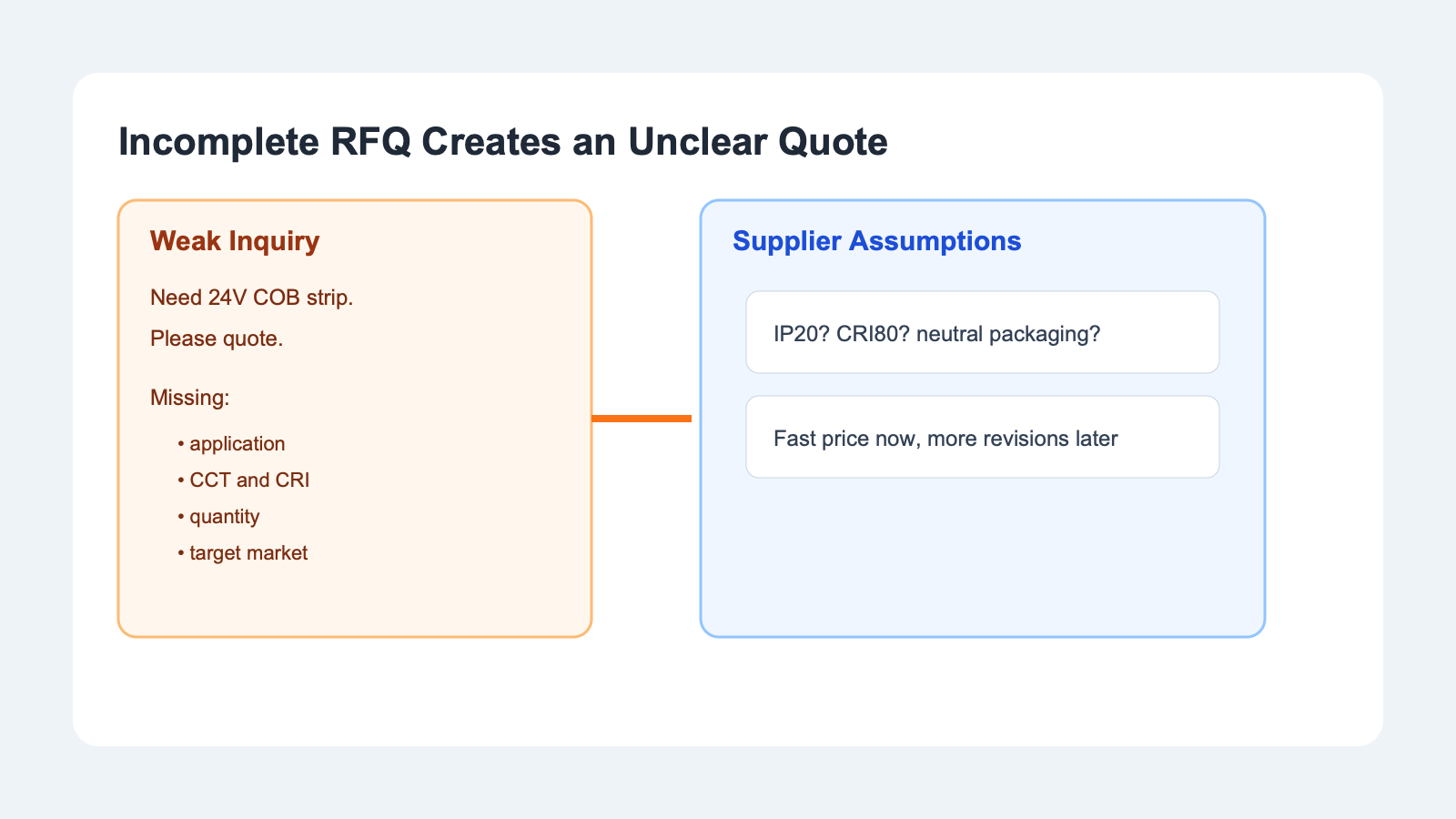
Many LED strip light quote problems start before the factory replies. A buyer sends a short inquiry such as “Need 24V COB strip, please quote,” then receives a price that looks usable but does not match the real application, market, compliance needs, or packaging requirement.
To get the right quote the first time, an LED strip light RFQ should include the application, installation environment, electrical target, light quality requirements, size limits, control method, certifications, quantity, packaging, and delivery terms. That gives the supplier a real specification to quote against instead of a guess.
A weak RFQ does not just slow down communication. It changes the logic behind the quote.
That is why this matters so much in B2B buying. When the RFQ is incomplete, the supplier has to make assumptions about the strip type, waterproof structure, performance level, accessories, and compliance scope. The reply may come back quickly, but it is often only a provisional number built on missing context.
Many buyers think asking for a quick price first saves time. In practice, it often creates a less accurate quote and more revisions later.
Why the first RFQ matters more than many buyers expect
LED strip products can look similar in a short product description while being very different in actual use. Two products may both be described as 24V COB LED strip, but still differ in wattage, brightness, CRI, PCB width, IP protection, bend performance, certification status, reel length, and packaging format.
If the RFQ does not define those points clearly, the supplier will quote based on its own assumptions. That is risky for importers, distributors, contractors, and OEM buyers because the first quote often becomes the reference point for sampling, approval, budgeting, and internal comparison.
In B2B sourcing, the value of a good RFQ is not only better pricing. It is that multiple suppliers are quoting against the same requirement, which makes comparison more reliable.
That is the real procurement advantage. A good RFQ does not only improve one supplier conversation. It improves the buyer’s ability to compare multiple offers on the same commercial and technical basis.
What information every LED strip RFQ should include
A good LED strip RFQ does not need to be long. It needs to be specific.
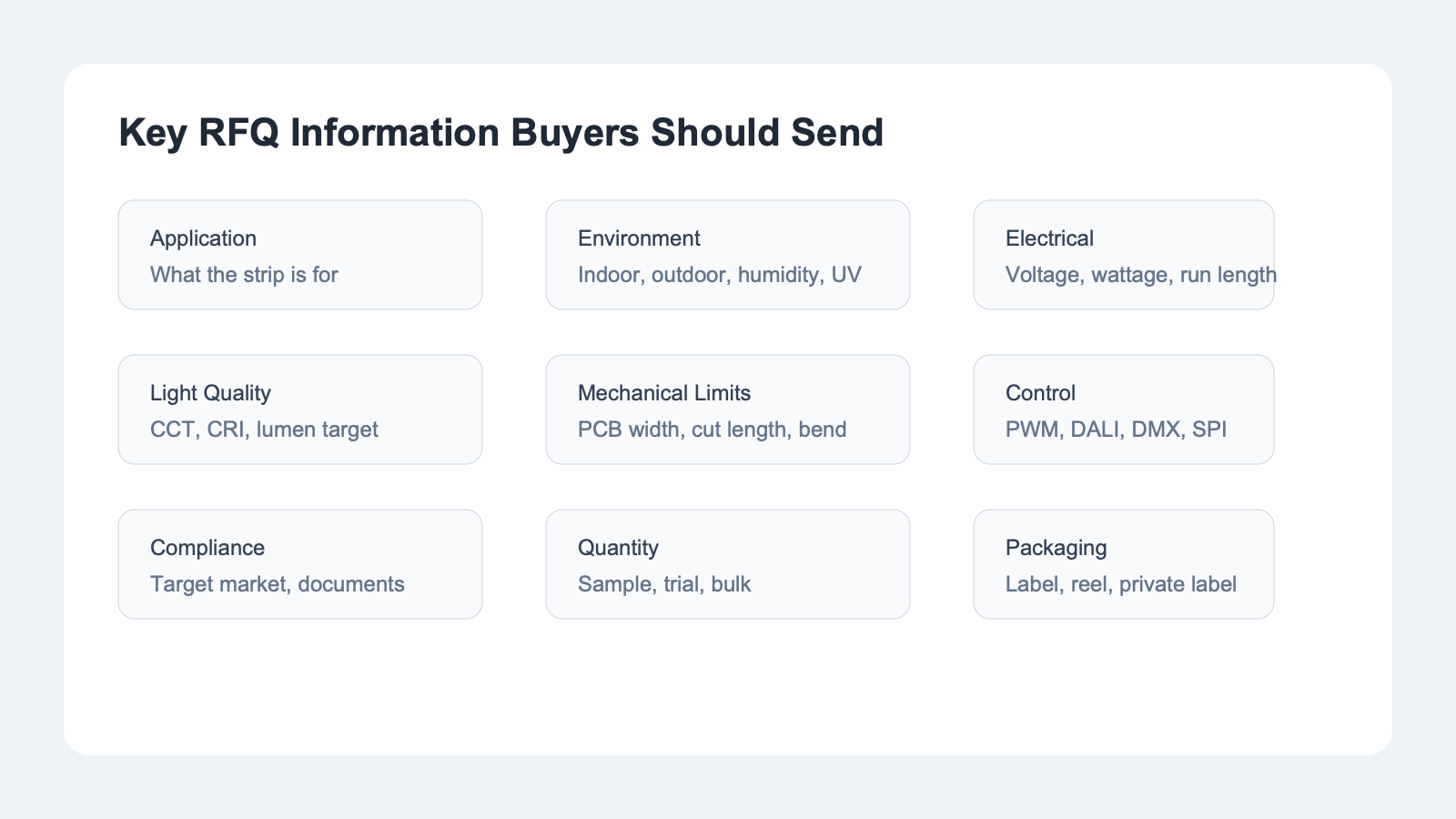
At minimum, it should cover these eight areas:
- Application — what the strip is for
- Installation environment — where and how it will be used
- Electrical specification — voltage, power, run length
- Light quality — CCT, CRI, color type, brightness target
- Physical limits — PCB width, cut length, bend or profile constraints
- Control requirements — dimming, controller, protocol
- Commercial requirements — quantity, trade term, delivery timing
- Compliance and packaging — certifications, labels, branding, documents
If one or two of these sections are missing, the supplier can still reply. But the quotation becomes less dependable because key assumptions are hidden inside it.
Start with the application, not the product name
The application should be the first part of the RFQ because it gives meaning to the specification.
A supplier needs to know whether the strip is for retail shelf lighting, mirror lighting, signage, hospitality joinery, vehicle interior use, cabinet lighting, or exterior facade outlining. The same nominal product category is not always suitable for every project.
Useful application details include:
- project type
- end use
- direct-view or hidden installation
- indoor or outdoor use
- whether dot-free appearance is required
- whether the strip must bend around corners or curves
- whether the project is a standard order or custom/OEM program
For example, “Need 24V COB strip price” is weak. A much better RFQ would be:
- 24V COB LED strip for visible retail shelf lighting
- installed in shallow aluminum profile
- dot-free effect required
- indoor dry environment
- 3000K preferred
- EU retail rollout project
That small change already improves the quote logic.
Define the environment clearly so the supplier does not guess protection level
The installation environment affects waterproof structure, materials, adhesive choice, durability, and sometimes even the recommended voltage and accessories.
Terms like “outdoor,” “bathroom,” or “commercial use” are too broad on their own. Exterior under a canopy is different from direct rain exposure. A vanity mirror is different from a wet spa area. Vehicle interior use is different from fixed cabinet installation.
Useful environmental details include:
- indoor or outdoor
- dry, humid, wet, or washdown area
- direct UV exposure or not
- high heat or low temperature conditions
- vibration or movement
- dust, salt air, or chemical exposure
- hidden or exposed installation
- continuous-use or short-term decorative use
If the environment is unclear, the supplier may quote the wrong IP structure or the wrong material system. For buyers, that creates avoidable sampling and revision work later.
Give the electrical target in a way the factory can quote
Voltage alone is not enough. The RFQ should describe the basic electrical target and layout expectation.
The supplier should know:
- system voltage
- target wattage per meter
- total required length
- maximum single run length
- whether power injection is expected
- whether the project prioritizes short cutting intervals or longer continuous runs
- whether driver or power supply should be quoted as well
This is especially important when the project may work better with one voltage than another. In longer linear installations, 24V often makes power distribution easier to manage. In compact applications, 12V may still be the better choice because of cut-length requirements. If the RFQ does not state the voltage clearly, the supplier may quote a strip that fits the category but not the project.
State light quality in measurable terms
Light quality requirements are often written too loosely in first inquiries. That creates unnecessary risk.
Instead of “warm white” or “high bright,” the RFQ should use measurable requirements wherever possible.
Useful optical details include:
- CCT: 2700K, 3000K, 4000K, and so on
- CRI target: CRI 80, CRI 90+
- lumen target if known
- single color, tunable white, RGB, RGBW, or addressable type
- dot-free appearance required or not
- color consistency expectation for repeat orders
A better inquiry is not “Need warm white strip.” It is:
- 24V COB LED strip
- 3000K
- CRI 90+
- dot-free effect for visible shelf lighting
- stable color consistency required across repeat orders
That gives the supplier a real performance target that can be quoted and sampled properly.
Include the mechanical limits before sample stage, not after
One of the most common B2B mistakes is quoting the product correctly in electrical terms but too late discovering that it does not fit the actual installation.
The strip may be too wide for the profile, too thick after waterproofing, too stiff for the bend, or cuttable only at intervals that do not match the project layout.
That is why the RFQ should include the main physical constraints:
- maximum PCB width
- maximum finished width after waterproofing
- required cut length or short cutting interval
- bend direction or bend radius requirement
- profile or channel size limit
- mounting surface type
- lead wire length and exit direction
- connector requirement if relevant
These are not minor details. In many projects, they decide whether the quoted strip is actually usable.
Tell the supplier how the strip will be controlled
If the strip will be dimmed, matched to an existing system, or used in a color-changing installation, the RFQ should define the control logic clearly.
Key control details include:
- on/off only
- PWM dimming
- TRIAC
- 0–10V
- DALI
- DMX
- SPI or other addressable protocol
- existing controller or driver brand/model if compatibility matters
- whether the supplier should quote strip only or the complete system
This prevents a common quoting problem: the strip is technically correct, but the control assumption is wrong.
For example:
- RGBW strip for hospitality project
- DMX control required
- quote strip only and complete control solution separately
That is a much more useful RFQ than simply asking for “RGBW strip price.”
Add compliance, quantity, and packaging before pricing starts
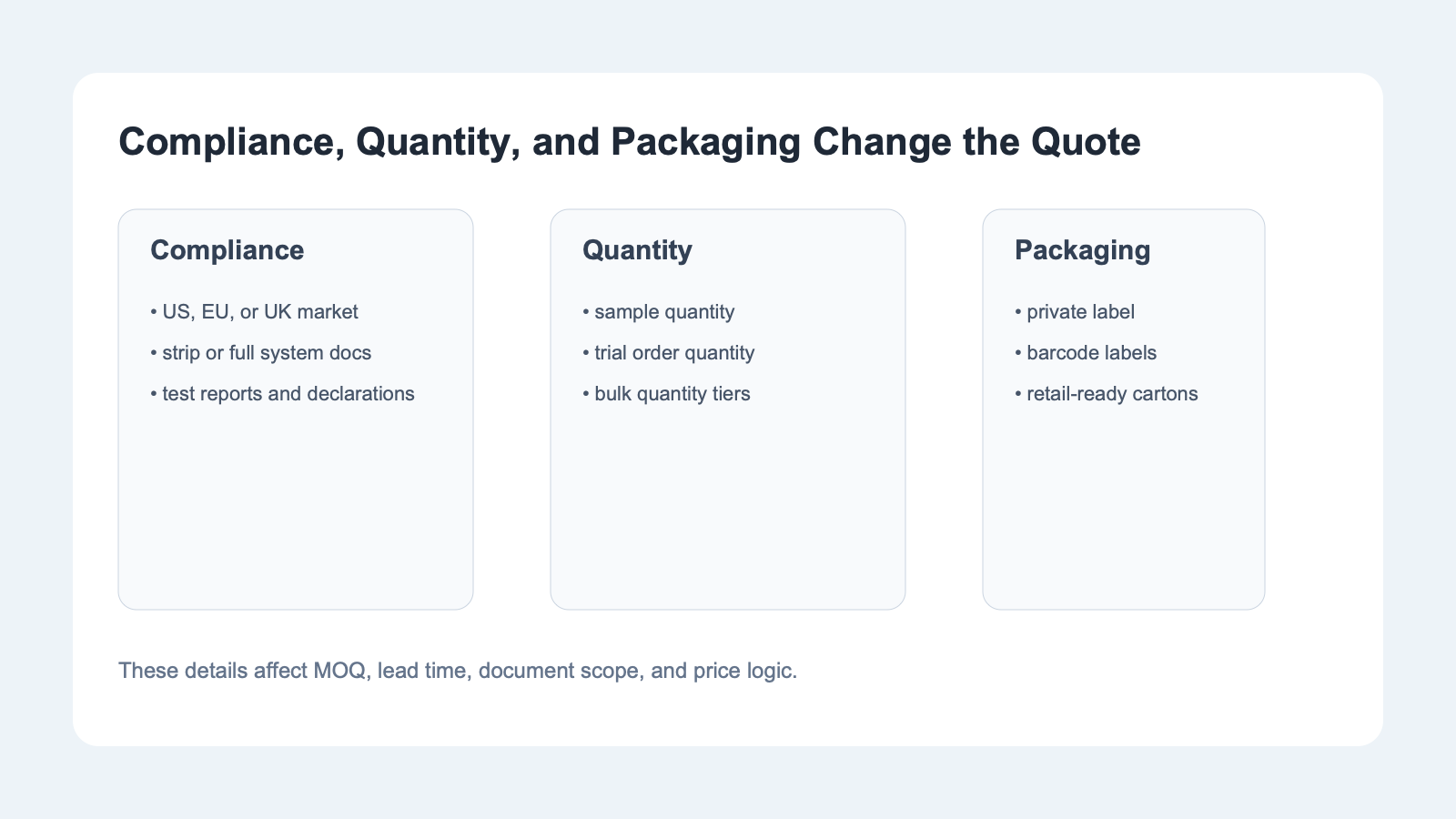
For B2B buyers, these three areas often decide whether the quote is commercially usable.
Compliance
The RFQ should state the target market and any required certifications or documents. A supplier needs to know whether the goods are for the US, EU, UK, or another market, and whether the requirement applies to the strip only or the complete system.
Where relevant, buyers can naturally refer to external standards and compliance frameworks such as LED tape and strip lighting system guidance[1], lighting testing and certification[2], or RoHS compliance requirements[3].
Quantity
A supplier cannot give a meaningful B2B quote without quantity context. The RFQ should distinguish between:
- sample quantity
- trial order quantity
- bulk order quantity
- forecast annual demand if available
- quantity by SKU
A practical request is:
- quote sample price, 500m price, and 2000m price
- quote FOB Shenzhen
- show tooling or custom packaging costs separately if needed
Packaging
If the project needs private label packaging, barcode labels, custom reel labels, inner box printing, or retailer-ready packaging, that should be included in the first RFQ. Packaging affects MOQ, cost, and lead time. If it appears only after the first quotation is approved, the pricing often needs to be revised.
A practical LED strip light RFQ template
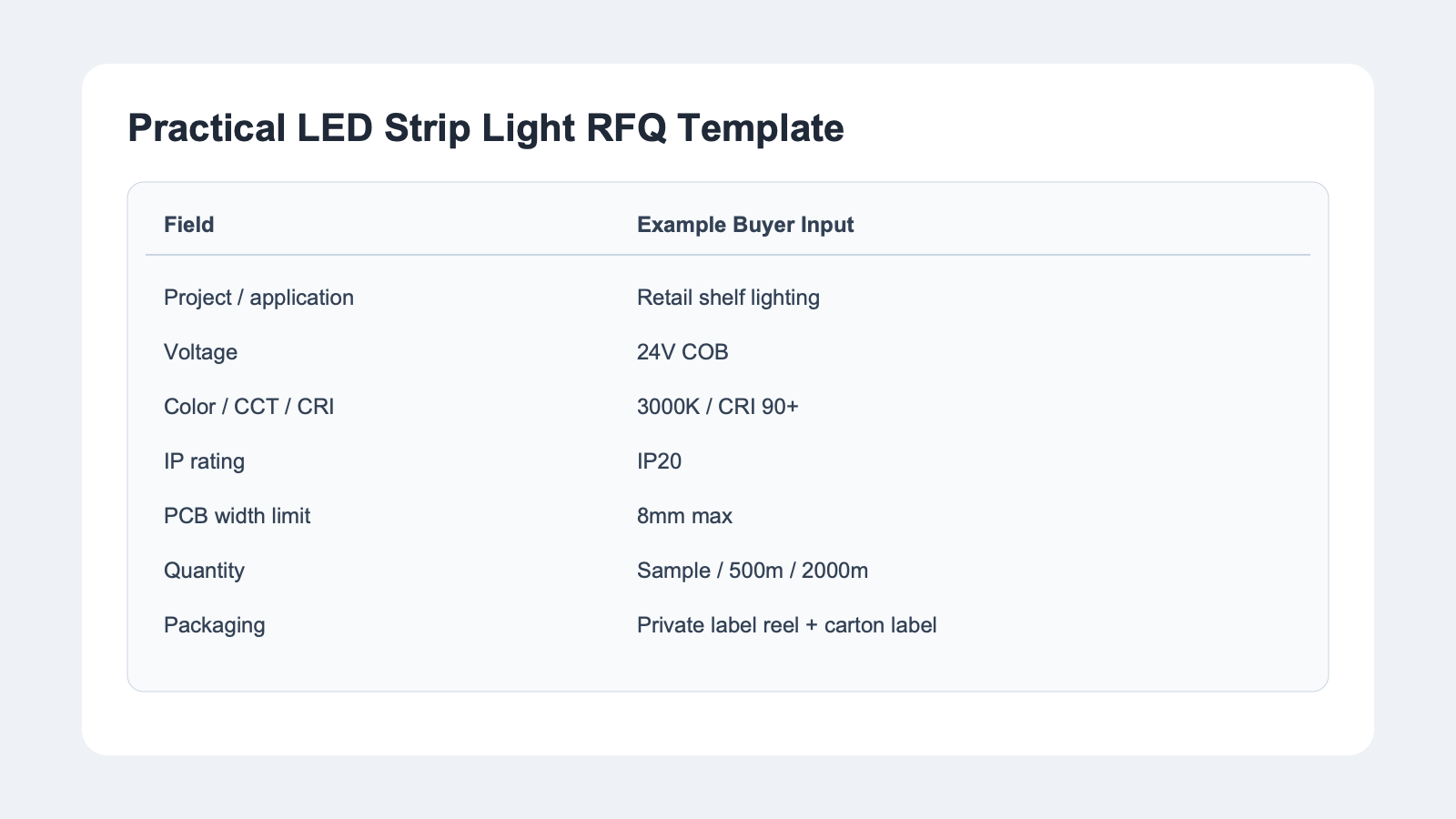
Below is a simple structure buyers can use:
| RFQ Item | Buyer Input |
|---|---|
| Project / application | |
| End market | |
| Installation environment | |
| Indoor / outdoor | |
| Voltage | |
| Wattage per meter | |
| Brightness / lumen target | |
| Color / CCT / CRI | |
| IP rating required | |
| PCB width / size limit | |
| Required cut length | |
| Bend or mounting requirement | |
| Control / dimming system | |
| Required certifications | |
| Strip length per reel | |
| Sample quantity | |
| Bulk quantity | |
| Packaging requirement | |
| Trade term | |
| Target delivery time | |
| Attachments included |
This is enough for most B2B LED strip quote requests. It is structured, practical, and easy for both humans and AI systems to interpret.
FAQ
What is the most important part of an LED strip light RFQ?
The most important part is the application plus the real installation environment. Without that context, the supplier may quote a technically possible product that still does not fit the project.
Should I include certifications in the first RFQ?
Yes. If the product will be imported, distributed, or used in a regulated commercial project, compliance requirements should be stated from the beginning.
What if I do not know every technical detail yet?
Send the best information you have, but clearly separate fixed requirements from items where supplier recommendation is acceptable.
Should I ask for one price only?
No. It is better to request separate pricing for samples, trial orders, and bulk quantities.
Do packaging requirements really belong in the RFQ?
Yes. For OEM, distribution, and retail-ready programs, packaging is part of the product requirement, not just a late-stage add-on.
Takeaway
If I want the right LED strip light quote the first time, I should not send only a product name and ask for price.
A strong RFQ gives the supplier a complete requirement: application, environment, electrical target, light quality, physical limits, control method, compliance, quantity, packaging, and delivery terms. That makes the quote more accurate, easier to compare, and more useful for real B2B purchasing decisions.
References
[1] NEMA — LED tape and strip lighting system guidance
https://www.nema.org/standards/view/solid-state-lighting-for-led-tape-and-strip-lighting-systems
[2] UL Solutions — Lighting testing and certification
https://www.ul.com/services/lighting-testing-and-certification
[3] European Commission — RoHS compliance requirements
https://environment.ec.europa.eu/topics/waste-and-recycling/rohs-directive_en
Interested in Our LED Solutions?
Get professional consultation and customized LED lighting solutions for your projects. Contact our expert team today.
Related Articles

What Power Supply Mistakes Cause Outdoor LED Strip Projects to Fail?
Many outdoor LED strip projects look fine at first. Then the dimming starts, the far end turns weak, the power…

How Do You Build Profitable Custom Vehicle and RV Interior LED Rope Lights?
You lose RV installation contracts because your interior lights fail on rough roads. Standard strips show bright dots on glossy…

How to Perfect Bookshelf and Display Cabinet LED Rope Lighting?
You lose retail clients when bookshelves look incredibly dark. Ugly shadows hide expensive products inside display cabinets daily. You need…
