

Why Do Your Outdoor LED Strips Turn Yellow and Fail in the Sun?
Your client’s stunning outdoor lighting project looks old and yellow after one summer. Now you face an expensive callback to replace a failed, brittle light strip, destroying your profit margin.
Most LED strips fail because their protective coatings, typically epoxy or polyurethane, are not UV-stable. Sunlight breaks down these materials, causing them to yellow, crack, and fail. True UV resistance comes from using inherently stable materials like high-quality silicone from the start.
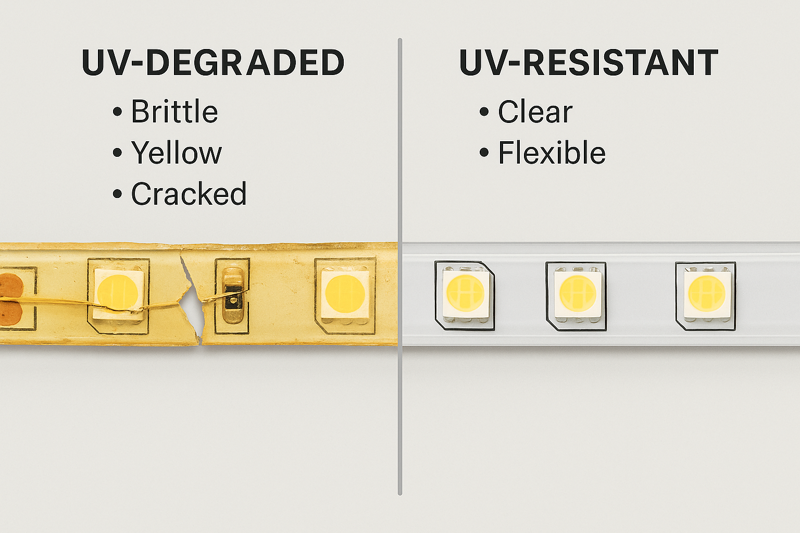
As a manufacturer, I’ve seen thousands of LED strips from job sites all over the world. The number one reason for the premature failure of an outdoor installation isn’t water, it’s the sun. An invisible force is constantly attacking the materials you install, and if you choose the wrong product, you are guaranteeing it will fail. Understanding how this process works is the key to selecting products that protect your work, your reputation, and your bottom line. This guide will show you why strips fail and how to choose one that will last.
Why Do Cheaper ‘Waterproof’ Strips Fail So Quickly in the Sun?
You secured a big project and found a great deal on some "outdoor-rated" IP65 LED strips. You saved money on the materials, but just a year later, the client calls to complain. The lights look awful and sections have failed.
Cheaper IP65 strips use an epoxy or polyurethane top-coat. These materials are not UV-stable. Sunlight makes them hard, yellow, and brittle. Temperature changes cause them to crack, allowing water to enter and destroy the electronics inside. They are a false economy.
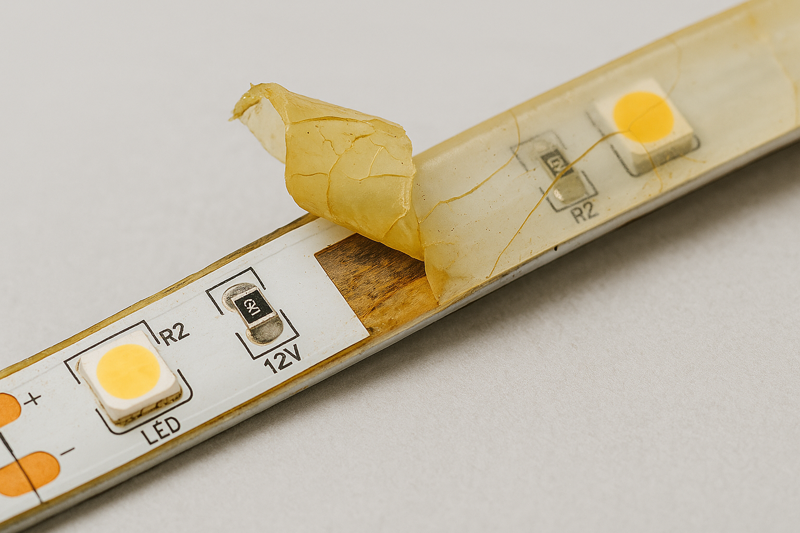
This is the most common trap I see professionals fall into. A product is marketed as "water-resistant" or "for outdoor use," but it’s made with materials that were never designed to survive in direct sunlight. At my factory, we often test competitor products. We take these cheap, epoxy-coated IP65 strips and leave them on our roof for a few months. The results are always the same. They rapidly transform from clear and flexible to a yellow, cloudy, and rigid mess. This isn’t just a cosmetic problem; it’s the beginning of a total structural failure that will inevitably lead to the lights going out for good.
A Deeper Dive into Material Failure
Let’s look at the step-by-step process of how an inferior material leads to a failed installation. It’s a predictable chain of events.
-
The Process of Photodegradation1
The technical term for what the sun does is photodegradation. High-energy UV radiation from the sun contains enough energy to physically break the long polymer chains that make up plastics like epoxy and polyurethane (PU).
- Yellowing2: The initial, most visible sign. As the polymer chains break, their structure changes, which alters how they reflect light. This causes the clear material to take on a yellow or brownish tint, which ruins the color quality of the light output.
- Embrittlement: As more bonds break, the material loses its flexibility. It becomes hard and rigid, like old plastic left in the sun.
- Cracking: The strip is installed on a surface that expands and contracts with temperature. The now-brittle epoxy cannot flex with this movement. The stress builds until micro-cracks form all over the surface.
- Water Ingress3: These cracks are an open invitation for moisture. Rain and humidity get inside, bypass the "waterproof" coating, and directly attack the LED chips and solder joints, causing corrosion and electrical failure.
-
It’s Not Just a Theory – It’s a Guarantee
As a business owner, you want predictability. I can predict with 100% certainty that an epoxy-coated strip will fail in direct sunlight. It’s just a matter of how quickly. In high-UV environments like North America, you will see significant yellowing in less than a year. This is why a slightly higher initial investment in the right material pays for itself many times over by avoiding the cost of a complete replacement job.
| Feature | Cheaper Epoxy/PU Coating | Professional Silicone Material4 |
|---|---|---|
| Initial Appearance | Clear and glossy | Clear and matte/satin |
| After 1 Year in Sun | Noticeably yellow and cloudy | Remains perfectly clear |
| Flexibility | Becomes rigid and brittle | Stays flexible in heat and cold |
| Failure Mode | Cracks, allowing water entry | Maintains waterproof seal |
| Expected Lifespan | 1-2 years before failure | 5-10+ years |
How Are Truly UV-Resistant LED Strips Constructed?
You need a solution that will last. A product you can install with total confidence, knowing it will look and perform perfectly for years without frustrating and unprofitable callbacks to fix failed materials.
Truly UV-resistant strips are built using a full silicone extrusion process. A thick jacket of high-quality, inherently UV-stable silicone is formed around the LED strip, completely encasing it. This material is immune to UV radiation and will not yellow, crack, or degrade over time.
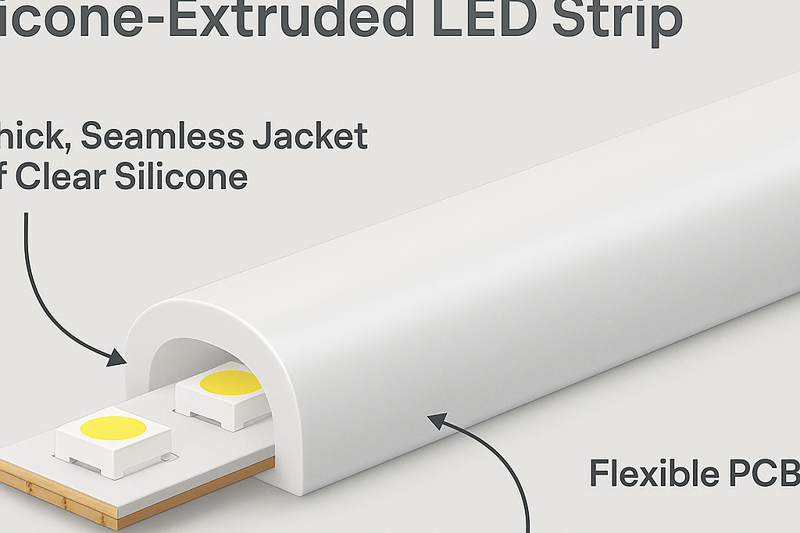
The difference between a professional-grade outdoor strip and one that will fail is not a coating; it’s the core material of its housing. You cannot add "UV resistance" to a material like epoxy. You must start with a material that is naturally immune to the sun’s effects. That material is silicone. Our entire process for producing outdoor-rated strips is built around this principle. We don’t just pour a coating on top of an indoor strip. We take the finished circuit board and feed it through an extrusion machine that forms a solid, seamless jacket of pure, UV-stable silicone around it. This creates a product that is fundamentally different and vastly superior.
A Deeper Dive into Silicone Extrusion5
Let’s explore why this manufacturing process results in a product that can withstand the elements for a decade or more.
-
What is Silicone?
Silicone is a synthetic polymer that is very different from carbon-based plastics like polyurethane and epoxy. Its backbone is made of repeating silicon-oxygen bonds (Si-O), which are extremely strong and stable. The energy in UV radiation is not high enough to break these powerful bonds. This is why silicone is used in demanding applications from medical devices to aerospace seals – it’s incredibly durable and resistant to environmental stress.
-
The Extrusion Advantage
Extrusion is a process that creates a seamless, uniform profile.
- No Seams, No Glues6: We are not gluing two pieces together or pouring a liquid on top. The silicone jacket is formed as a single, homogenous piece around the strip. This means there are no seams to fail and no layers to peel apart (delaminate).
- Thick, Robust Protection7: The extrusion process creates a thick, substantial wall of silicone. This provides excellent physical protection against impacts, abrasions, and punctures, in addition to its weather resistance.
- Superior Thermal Management8: Silicone is also a better thermal conductor than epoxy. It actively helps to draw heat away from the LED chips and dissipate it into the surrounding environment. Cooler LEDs last longer and maintain their color consistency better over their lifespan.
This commitment to using the right material and the right manufacturing process is what separates a product designed to last from one designed to be cheap.
| Construction Method | Material Used | UV Resistance | Long-Term Reliability |
|---|---|---|---|
| Top-Coating | Epoxy or Polyurethane (PU) | Poor | Fails within 1-2 years due to cracking and yellowing. |
| Silicone Tube | PCB inside a hollow silicone tube | Good | Better, but air gaps can trap moisture/condensation. |
| Silicone Extrusion | Solid, seamless silicone jacket | Excellent | The professional standard for durability and longevity. |
Can You Protect a Non-UV Strip from the Sun?
You’re wondering if you can save some money by using a cheaper, non-UV strip inside an aluminum channel with a diffuser. Is this a clever professional shortcut, or are you just delaying the inevitable failure?
While an aluminum channel with a diffuser offers some protection, it absolutely does not make a non-UV strip suitable for outdoor use. Many diffusers do not block all UV light, and reflected UV will still cause degradation. Channels are for mounting, not a substitute for proper material selection.
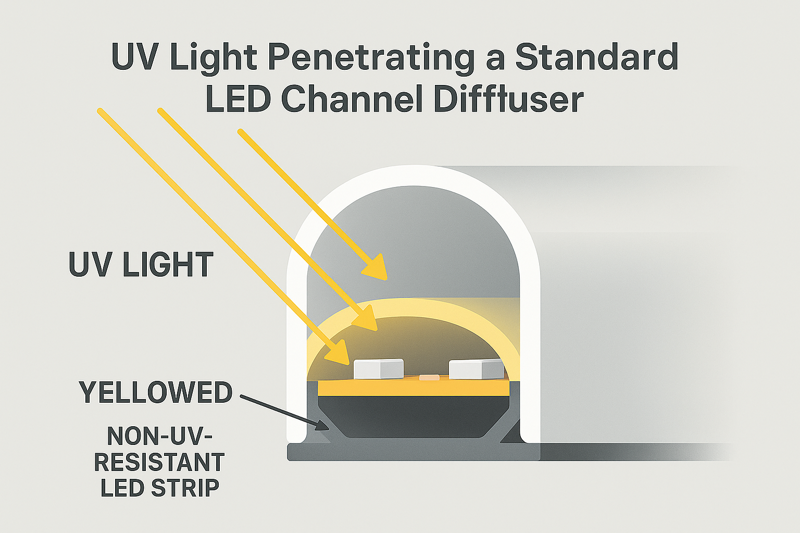
This is a question I get often from installers trying to be resourceful. The logic seems sound: put a physical barrier between the sun and the strip. Unfortunately, it’s a flawed strategy that provides a false sense of security. The primary purpose of an aluminum channel is to provide a straight, secure mechanical mounting and to act as a heat sink. The diffuser is primarily for creating a smooth, dot-free line of light. While they offer a small degree of UV protection, it is nowhere near enough to protect a vulnerable material like epoxy or polyurethane from long-term degradation.
A Deeper Dive into Why This Method Fails
Let’s break down the technical reasons why a channel cannot "fix" a non-UV-resistant strip.
-
Diffusers Are Not UV Blockers
Most standard diffusers provided with aluminum channels are made from polycarbonate (PC) or PMMA. While they may have some UV-inhibiting properties, they are not designed to block 100% of UV radiation. A significant amount of UV energy will still pass through and strike the strip. Over time, the diffuser itself can also yellow and become brittle from UV exposure, compounding the problem.
-
The Power of Reflected and Indirect UV
UV light doesn’t just travel in a straight line from the sun. It scatters in the atmosphere and reflects off surfaces. A significant portion of the UV exposure an installation receives is indirect. UV light will reflect off the ground, a wall, or a deck surface and bounce up under the diffuser. It will enter the channel from the sides. Even on a cloudy day, there is a large amount of ambient UV radiation. A simple plastic cover cannot protect the strip from this multi-directional assault.
-
The Right Way to Use Channels
The professional approach is to combine the best of both worlds. You use a high-quality, IP67-rated, silicone-extruded UV-resistant strip and install it inside a high-quality aluminum mounting channel.
- The strip provides the fundamental weather and UV proofing.
- The channel provides a secure, permanent mount, protects the strip from physical impacts (like from a broom or pressure washer), and acts as a crucial heat sink to extend the life of the LEDs.
- The diffuser provides the desired aesthetic, blending the light and hiding the individual LED chips.
This system approach is how you build an installation that is truly "set it and forget it." Don’t try to make one component do a job it wasn’t designed for.
Conclusion
The sun is the ultimate test of any outdoor product. To prevent fading, yellowing, and degradation of your LED strip lights, the solution is simple: start with a product made from UV-stable silicone. This is not an upgrade; it is a professional requirement.
-
Understanding photodegradation is crucial for selecting materials that withstand UV exposure, ensuring longevity. ↩
-
Explore the causes of yellowing to make informed choices about material durability and aesthetics. ↩
-
Learn about the impact of water ingress on LED systems to prevent costly failures and ensure reliability. ↩
-
Discover why professional silicone materials outperform cheaper options, ensuring better performance and longevity. ↩
-
Discover how Silicone Extrusion enhances product durability and longevity, making it a preferred choice in various industries. ↩
-
Understand the significance of No Seams, No Glues in silicone manufacturing for enhanced durability and reliability. ↩
-
Explore how Thick, Robust Protection in silicone extrusion safeguards products against environmental stress and damage. ↩
-
Learn about the advantages of Superior Thermal Management in silicone, ensuring better performance and longevity for your devices. ↩
Interested in Our LED Solutions?
Get professional consultation and customized LED lighting solutions for your projects. Contact our expert team today.
Related Articles

How Do You Build Profitable Custom Vehicle and RV Interior LED Rope Lights?
You lose RV installation contracts because your interior lights fail on rough roads. Standard strips show bright dots on glossy…

How to Perfect Bookshelf and Display Cabinet LED Rope Lighting?
You lose retail clients when bookshelves look incredibly dark. Ugly shadows hide expensive products inside display cabinets daily. You need…

How to Master Mirror and Vanity LED Rope Light Installation?
Your clients complain about ugly shadows in their bathroom mirrors. Bad lighting ruins expensive vanity designs. You lose future contracts…
