
IP Rating Guide for LED Strip Lights: IP20 vs IP65 vs IP68 Explained
Why IP Rating Is the First Decision You Must Make
Lighting designers who have been in the industry long enough have seen the same failure pattern repeat itself: a beautifully specified LED strip installation, commissioned on time, starts flickering within six months. Traces corrode. Solder joints oxidise. The contractor is called back, the strips are replaced, and the post-mortem reveals the same root cause every time—the wrong IP rating was specified for the environment.
IP (Ingress Protection) rating, defined by the IEC 60529 international standard, describes how well an enclosure—in this case, the LED strip’s protective coating—resists the entry of solid particles and liquids. Getting this right is not a matter of preference. It is an engineering requirement that determines whether your installation survives its first year or its tenth.1
This guide gives you a complete, specification-ready understanding of the three ratings you will encounter on almost every LED strip project: IP20, IP65, and IP68. We cover what each rating actually tests, where the standard leaves room for manufacturer variability, what the common specification errors look like in the field, and how to match rating to environment reliably.
How the IP Rating System Works
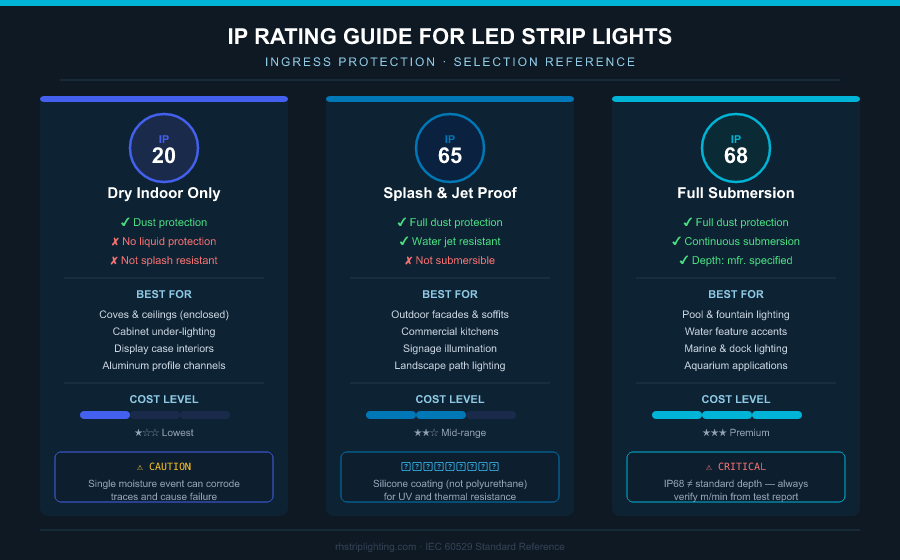
The IP code consists of two digits. The first digit (0–6) rates protection against solid objects, from large surfaces down to fine dust. The second digit (0–9) rates protection against moisture, from dripping water to high-pressure steam jets. For LED strip specification, the second digit is almost always the critical variable.
| Second Digit | Protection Claimed | IEC 60529 Test Method |
|---|---|---|
| 0 | No liquid protection | None |
| 1 | Dripping water (vertical) | Drip rate 1 mm/min, 10 min |
| 2 | Dripping water up to 15° tilt | As above, 4 orientations |
| 3 | Spraying water up to 60° | Spray nozzle, 5–10 min |
| 4 | Splash from any direction | Oscillating spray, 10 min |
| 5 | Water jet from any direction | 12.5 L/min nozzle at 3 m, 15 min |
| 6 | Powerful water jet | 100 L/min nozzle at 3 m, 3 min |
| 7 | Immersion up to 1 m/30 min | Submerged 1 m deep for 30 min |
| 8 | Continuous submersion | Manufacturer-defined depth and duration |
Notice the critical distinction at digit 8: the IEC 60529 standard explicitly states that for IPX8, the manufacturer defines the test conditions. This is where many specifiers are caught off-guard—IP68 does not mean a universal depth or duration. Two strips both labeled IP68 may have been tested at 1 metre for 30 minutes or at 3 metres continuously. Both pass. Both carry the same label.2
IP20: The Right Choice for Dry Enclosed Installations
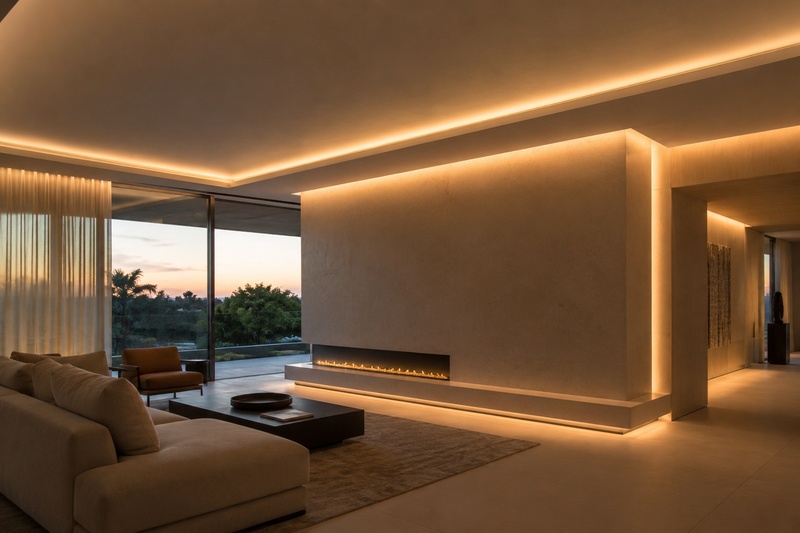
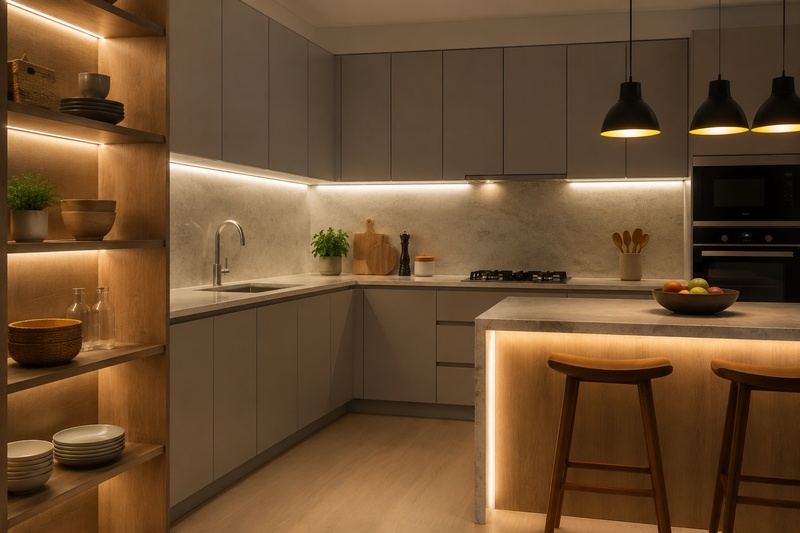
IP20 strips carry no moisture protection whatsoever. The LED chips, phosphor layers, solder joints, and copper traces are fully exposed to the environment. This is not a design flaw—it is the correct design for enclosed, climate-controlled indoor spaces where moisture ingress is physically prevented by the installation itself.
Where IP20 Is Correct
- Architectural cove lighting behind drywall. The drywall, painted plaster, or GRG (glass-reinforced gypsum) enclosure provides the environmental protection. The strip never sees moisture.
- Cabinet and millwork under-lighting. Inside a sealed cabinet, an IP20 strip is never exposed to splash, condensation, or cleaning products.
- Aluminum extrusion channels with sealed end caps. A properly terminated LED extrusion profile with an opaque or diffuser end cap is its own IP-rated enclosure. The strip inside does not need independent IP rating.
- Display case interior lighting. Museum cases, retail jewelry cases, and temperature-controlled display environments are effectively sealed enclosures.
- Concealed ceiling tile integration. LED strips integrated into suspended ceiling grids in commercial spaces where plenum conditions are controlled.
Where IP20 Will Fail
The failure threshold for IP20 is surprisingly low. A single cleaning event with a wet mop reaching a skirting board channel, condensation forming on a cold surface near the strip, or steam migration from an adjacent kitchen space is enough to begin corrosion. Galvanic corrosion on copper traces starts immediately upon moisture contact and is often invisible until the strip fails.
If you have any doubt about whether a space will maintain permanently dry conditions—specify up. The cost difference between IP20 and IP65 is small relative to the cost of replacement.
IP65: The Commercial Workhorse for Damp and Wet Locations

IP65 strips have a first solid-particle digit of 6 (total dust protection) and a liquid digit of 5 (water jet resistant). In practice, this means the LED surface and all solder points are sealed with a continuous conformal coating—either silicone or polyurethane—applied over the top of the assembled strip.
The coating withstands a 12.5 litre-per-minute water jet from a nozzle held at 3 metres distance, applied from any direction for 15 minutes. This exceeds what any cleaning hose, rain exposure, or condensation drip will deliver in normal use.
Where IP65 Is Correct
- Exterior soffit and facade lighting. Rain-exposed surfaces where the strip is mounted horizontally or at an angle in a profile. Water runs off; the coating handles any direct contact.
- Commercial kitchen toe-kick and under-counter lighting. Mop water and cleaning product splash are within the IP65 test parameters. Pressure hosing at close range is not—check the actual cleaning protocols before specifying.
- Retail exterior signage illumination. Face-lit signs exposed to rain, including those washed down periodically.
- Bathroom ambient and task lighting. In bathroom zones outside the shower enclosure (typically Zone 2 in European classifications), IP65 is both the code minimum and appropriate specification.
- Landscape and garden path lighting. In protected channels or at grade level where rain and irrigation spray are the primary moisture sources.
The Silicone vs. Polyurethane Problem
Both silicone-coated and polyurethane-coated strips carry the IP65 designation, and this is where a great deal of premature field failure originates. The two coatings have dramatically different environmental tolerances:
| Property | Silicone Coating | Polyurethane Coating |
|---|---|---|
| Operating temperature range | –40°C to +120°C | –20°C to +80°C |
| UV resistance | Excellent (10+ year exterior life) | Fair (may yellow and crack in 2–5 years) |
| Flexibility over temperature cycles | Maintains elasticity | May crack and delaminate |
| Chemical resistance | Good | Moderate |
| Cost premium | Higher | Lower |
For any exterior application or any installation that will experience wide seasonal temperature variation, specify silicone coating explicitly. Polyurethane-coated IP65 strips installed outdoors in climates with more than 60°C annual temperature swing frequently show cracking and delamination of the coating within two to three seasons—at which point the IP rating is void and the strip is effectively IP20.
The U.S. Department of Energy’s Solid-State Lighting program has documented that coating quality and application method are the primary determinants of long-term IP65 reliability, exceeding the influence of LED chip quality in outdoor installations.3
The Lumen Output Trade-Off
IP65 conformal coatings introduce an optical attenuation layer over the LEDs. For silicone, this averages 5–8% luminous output reduction versus an equivalent IP20 strip. For polyurethane, it is typically 8–12%. For critical photometric calculations—particularly grazing or wall-wash applications where precise illuminance levels are specified—this attenuation must be factored in at the design stage, not discovered during commissioning.
IP68: Full Submersion for Underwater Applications
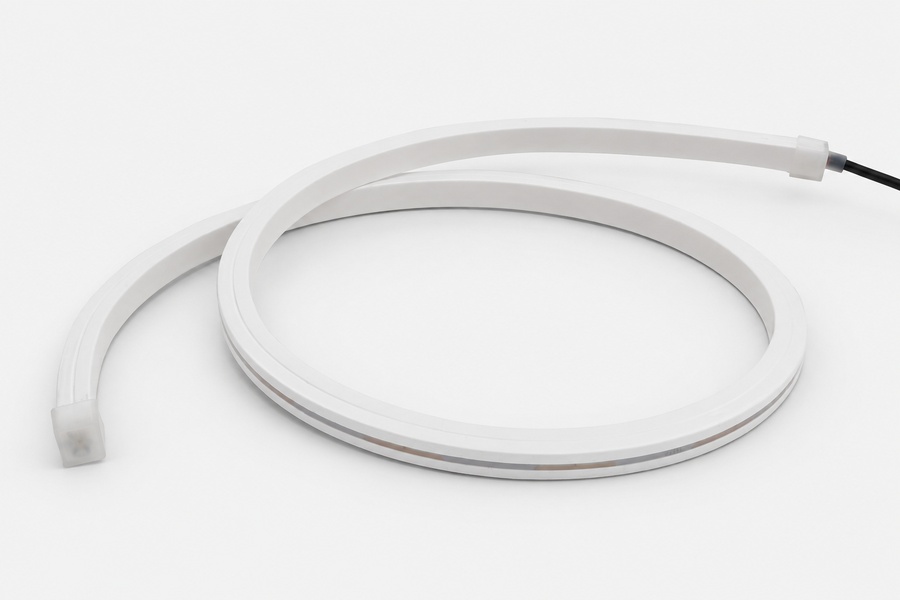
IP68 strips are constructed differently from IP65 products—they are not simply more heavily coated. Genuine IP68 strips are either fully encapsulated in a seamless silicone tube (extruded over the assembled strip) or potted in epoxy resin that fills all voids and encapsulates the entire assembly. The result is a mechanically continuous, waterproof enclosure rather than a surface coating.
Where IP68 Is Required
- Swimming pool perimeter and underwater lighting. Both permanently submerged and tidal-zone applications. Regional electrical codes in North America (NEC Article 680), Europe (IEC 60364-7-702), and Australia/NZ (AS/NZS 3000) require wet-location rated fixtures for pool environments.
- Decorative water features and fountain illumination. Including both permanently submerged elements and those subject to wave action and splash from pump systems.
- Marine and dock lighting. Salt-water environments require marine-grade IP68 specifications—standard freshwater IP68 ratings may not adequately address chloride ingress under long-term saltwater exposure.
- Aquarium and vivarium lighting. Both the submerged lighting and the splash-zone lighting above the water line benefit from IP68 in enclosed tank environments.
Understanding IP68 Depth Ratings
This cannot be stated firmly enough: before specifying any IP68 strip for a pool or submersion application, obtain the test certificate—not just the product specification sheet. The test certificate will state the exact depth and duration under which the product was tested. Common test parameters include 1 m/30 min, 1 m/24 hours, 2 m/continuous, and 3 m/continuous. A pool application requiring code compliance at 1.5 m depth cannot be served by a strip tested only to 1 m.4
Installation Considerations for IP68
The weakest point in any IP68 installation is invariably the termination. The encapsulated strip itself may be rated to 3 metres, but where the strip must be cut, terminated, or connected to power supply wiring, the joint must be protected to the same standard. Options include:
- Waterproof quick-connect IP68 connectors (rated and tested, not assumed)
- Direct solder joints with marine-grade heat-shrink tubing (dual-wall, adhesive-lined)
- Epoxy-filled junction boxes sealed at the correct IP rating
A common and expensive mistake is using standard IP20 terminal blocks inside a conduit run, where condensation accumulates over years, corrodes the terminals, and causes intermittent failures that are nearly impossible to trace without dismantling the installation.
Common Specification Errors and How to Avoid Them
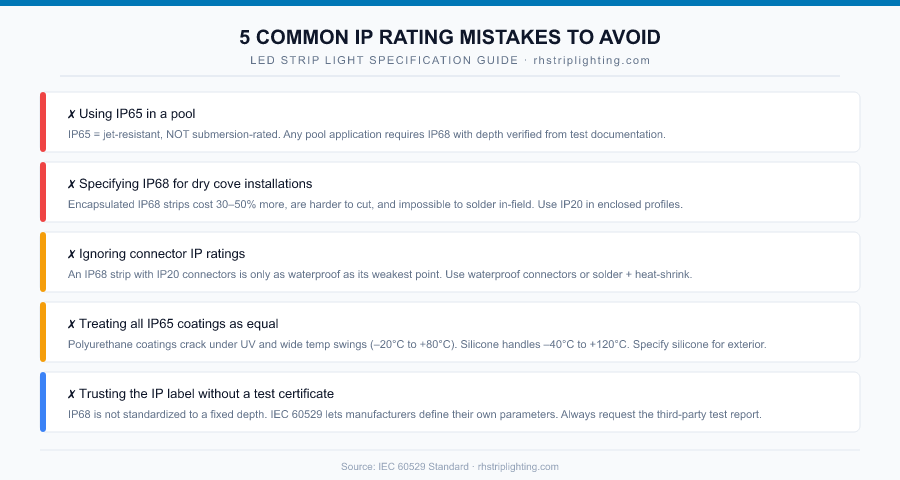
The five errors illustrated above represent the majority of IP-related LED strip failures encountered in the field. Of these, the most expensive and most preventable is the IP68 depth assumption: specifying “IP68” without obtaining the test depth documentation, then installing in a pool application where the required depth exceeds what was tested. The resulting insurance and warranty exposure when a fixture fails in a pool environment is substantial.
The second most common is the IP65 coating type error—specifying IP65 without specifying silicone coating for exterior applications. On a large facade project, replacing a full perimeter of cracked and delaminating polyurethane-coated strips after two seasons represents a significant loss of project margin and client trust.
Quick Selection Reference
| Installation Environment | Appropriate IP | Additional Requirement |
|---|---|---|
| Enclosed dry indoor cove | IP20 | — |
| Open indoor space, no moisture | IP20 | — |
| Indoor bathroom (outside shower zone) | IP44 min, IP65 preferred | — |
| Commercial kitchen floor/wall level | IP65 | Confirm cleaning hose PSI |
| Outdoor, rain-exposed, no direct hosing | IP65 | Silicone coating for exterior |
| Outdoor, pressure-washed surfaces | IP65 (confirm nozzle PSI) | Silicone coating mandatory |
| Shower interior (Zone 1) | IP65 minimum | Check local electrical code |
| Pool perimeter or underwater | IP68 | Verify test depth from certificate |
| Marine / saltwater environments | IP68 marine grade | Specify chloride resistance |
| Temporary outdoor event structures | IP65 min | Check takedown/storage conditions |
FAQ
Can I use an IP65 strip outdoors if it never rains heavily in my region?
IP65 is appropriate for any outdoor application where direct submersion does not occur. Even in arid climates, outdoor installations face condensation cycles, dew, irrigation overspray, and cleaning. IP20 is not appropriate for any outdoor location.
Do LED Neon Flex strips need separate IP rating consideration?
Yes. LED Neon Flex products have their own IP ratings based on their silicone extrusion construction. Most LED Neon Flex products are IP65 or IP67 rated as manufactured, but termination points still require attention. Our LED Neon Flex range specifies IP rating for each product variant.
My pool contractor says any IP68 will work. Is that right?
No. IP68 has no single fixed depth. Your contractor must verify the test depth from the product’s third-party test certificate and confirm it meets or exceeds the installation depth plus any regulatory margin required by your regional electrical code.
Does IP rating affect the light output warranty?
Generally, yes. Most manufacturers’ warranties specify that IP ratings are voided by improper installation—for example, using IP65 in a submersion application or installing IP20 in a humid environment. Review warranty terms carefully before specifying a lower IP rating than the environment requires.
What is IPX, and how does it relate to standard IP ratings?
IPX ratings omit the first digit—meaning the solid particle rating was not tested or is not relevant to the application. IPX5, for example, means water-jet resistant but no solid particle test was performed. For most LED strip specifications, full IP ratings (both digits) should be required from suppliers.
Recommended Products
Match Your IP Rating to the Right Strip
| IP Rating Needed | Recommended Product Line |
|---|---|
| IP20 — dry indoor installations | Indoor Single Color SMD LED Strip · Indoor Single Color COB LED Strip |
| IP65 — outdoor / wet locations | Outdoor LED Strip & Neon Solutions |
| IP68 — submersion / pool | Outdoor Rated Strip Solutions (request IP68 spec sheet) |
| Neon Flex — exterior architectural | LED Neon Flex — Top Bend, Side Bend, 360° |
All RH Strip Lighting products come with full IP test documentation. Contact us to request certificates before ordering for critical applications.
References
- International Electrotechnical Commission, IEC 60529: Degrees of Protection Provided by Enclosures (IP Code), Edition 2.2, 2013. ↩
- IEC 60529, Clause 14.2.8: “The manufacturer shall state the conditions under which the equipment has been tested and to which the designation IPX8 applies.” ↩
- U.S. Department of Energy, Office of Energy Efficiency & Renewable Energy, LED Lighting Basics, Solid-State Lighting Program. ↩
- Underwriters Laboratories, UL 8750: Standard for LED Equipment for Use in Lighting Products; see also NFPA 70 NEC Article 680 for pool and fountain lighting requirements. ↩
Need waterproof LED strip or neon flex for an outdoor project?
Tell RH Strip Lighting your installation environment, IP rating target, run length, voltage, and control requirements. We can recommend waterproof LED strips, LED neon flex, power supplies, and accessories.
Request a Project or Trade Quote
Sourcing for an installation project, resale or OEM production? Share your requirements below. You can discuss project samples before committing to a bulk order.
Related Articles
LED Strip Lighting for Indoor Plant Walls: Accent Light or Grow Light?
Specify LED lighting for indoor plant walls without confusing visual brightness with plant needs. Review PPFD, DLI, controls, moisture, and…
LED Strip Lighting After a Power Outage: Designing a Reliable Restart
Plan LED strip power restoration beyond total watts. Review driver inrush, switching limits, restart scenes, and commissioning before project handover.

Why LED Strip Lights Buzz When Dimmed: A Guide for Quiet Spaces
Diagnose LED strip buzzing without guessing. Review drivers, PWM controls, mounting resonance, and low-level acoustic acceptance for quiet interiors.