
Why Your LED Strip Samples Pass QC But Bulk Orders Don’t Match
Why Your LED Strip Samples Pass QC But Bulk Orders Don’t Match
This is one of the most common problems in LED strip sourcing. A buyer approves a sample because the color looks right, the brightness is consistent, and the finish appears clean. Then the bulk order arrives, and something is wrong. The strip may be slightly greener, slightly dimmer, or simply less consistent from reel to reel.
From the factory side, this usually does not happen because one person made a single mistake. It happens because the sample and the bulk order were not controlled to the same standard. Buyers often assume that a sample represents the production reality. In many cases, it only represents the best-case version of that product on one specific day.
If you import 5,000 to 50,000 meters at a time, you need to treat sample approval and bulk production as two different risk points. The sample is only the start. What matters is whether the factory can reproduce the approved sample under normal production conditions, with normal material availability, and under a written tolerance standard.
Why approved samples and bulk production often diverge
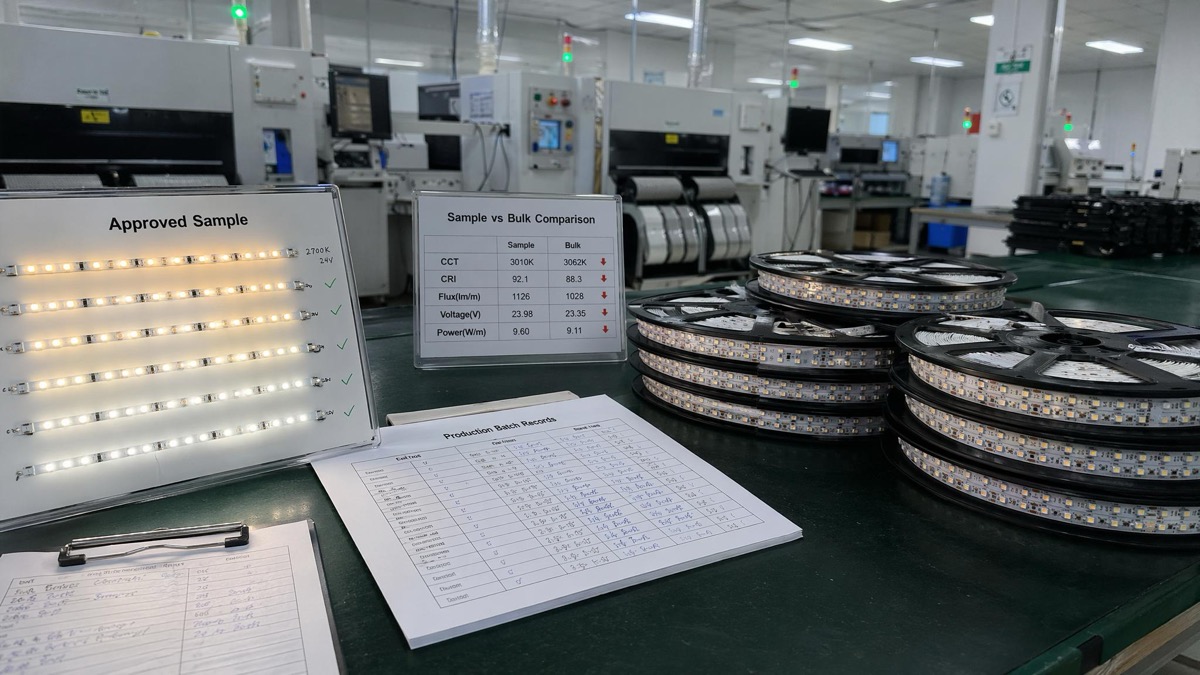
In practice, four technical and operational issues cause most mismatches between samples and mass orders. All four are common in the LED strip industry, especially when the buyer does not lock the production specification in writing.
1. Sample reels are often built from selected LED bins
When a factory prepares samples for a potential customer, it usually has flexibility. The team can pull LEDs from a tighter color bin, select cleaner PCB stock, and assign more attention to assembly. That sample may genuinely reflect what the factory can make. But it does not always reflect what they will make for a 10,000-meter order.
Bulk production is driven by inventory and throughput. If the factory is short on the exact LED bin used for sampling, it may substitute from another nearby bin that is still considered acceptable internally. The difference may be small on paper, but visible in the installed product, especially when your customer compares it directly against previous stock or against another light source.
For importers, this is the first mistake: approving a hand-picked sample without asking whether the same LED bin will be reserved for production.
2. QC on samples is usually stricter than QC on bulk orders
Factories know that samples are sales tools. They are inspected more carefully because one defective sample can lose the order. Bulk production is different. Once the order is confirmed, internal QC often shifts to an acceptance-range mindset instead of a best-piece mindset.
That means the sample may be checked reel by reel, while the production lot is checked by batch sampling. A slightly uneven phosphor coat, a small lumen drop, or mild color drift may not fail the factory’s internal release standard. Yet the same variance would have been rejected during sample preparation.
This is not always dishonest. Sometimes it is simply the result of an internal QC standard that is broader than the buyer expects. The problem is that buyers rarely ask to see the actual production acceptance criteria before placing the order.
3. Phosphor coating tolerances stack across batches
Even when the factory uses nominally the same LED type, production variation can still create visible differences. White LED performance depends heavily on phosphor consistency. Small differences in phosphor coating and process control can shift color temperature, tint, and output.
On a sample reel, the variance may be low because the material comes from one narrow production lot. On a large order, the factory may consume multiple incoming LED batches. Each batch may be within the chip supplier’s tolerance, but the cumulative effect can still create a mismatch between reels or between the approved sample and the finished shipment.
This matters most when the buyer is sourcing white strip for retail shelving, architectural linear lighting, hospitality, and any project where adjacent runs are compared visually. A small lab-acceptable variance can become a commercial problem after installation.
4. The factory may change chip supplier without telling you
This is the issue buyers underestimate the most. If the originally sampled chip is not available at the target price or lead time, some factories switch to another supplier or another chip family without formally notifying the customer. They may still describe the strip by wattage, CCT, or lumen range, so the paperwork looks similar. But the optical behavior can change.
Two 2835 chips from different suppliers can behave differently in tint stability, efficacy, thermal performance, and dimming response. The strip can still “pass” a basic outgoing inspection while no longer matching the approved sample well enough for your market.
If the supplier change happens between sample stage and production stage, the buyer usually discovers it only after the goods arrive.
Why this matters more on bulk commercial orders
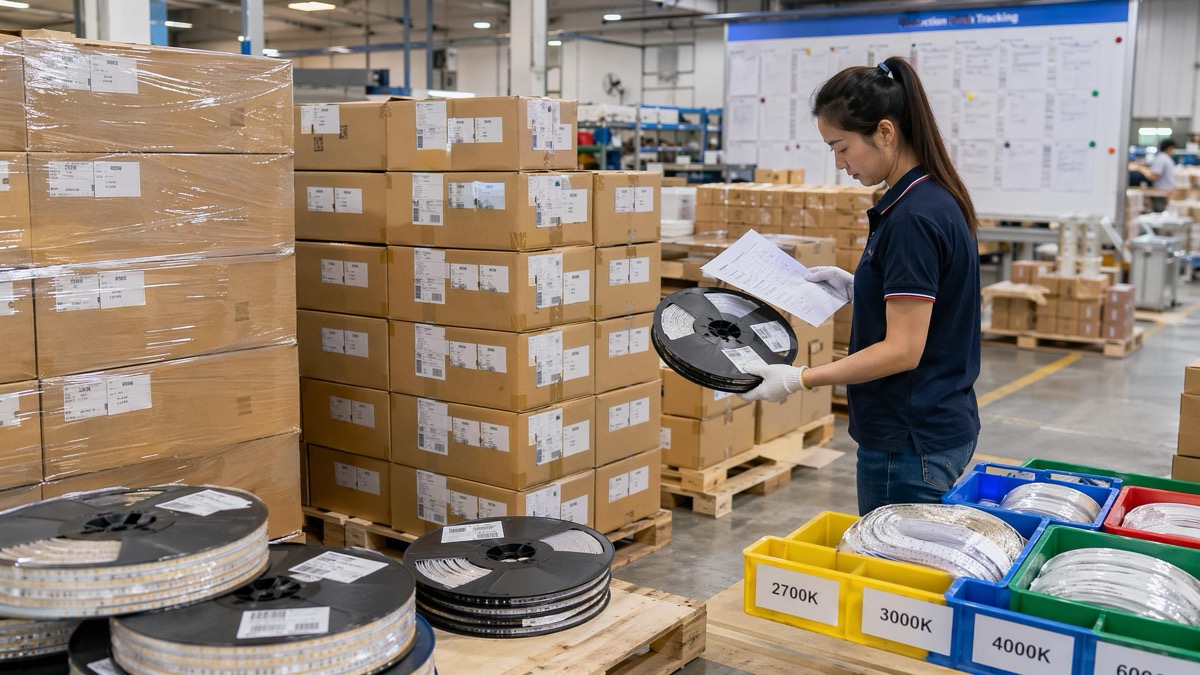
For a consumer buying five reels online, this may be an annoyance. For an importer or distributor, it becomes a margin and relationship problem.
- Your customer may compare new stock against old stock and reject the shipment.
- Your warehouse may have mixed inventory that cannot be sold into the same project.
- Your incoming inspection team may need to separate reels by visual shade difference.
- Your sales team may lose credibility because the item code stayed the same while the product changed.
- You may absorb replacement, discount, and return costs that wipe out the original price advantage.
That is why the real issue is not whether the factory can produce a good sample. The real issue is whether the factory can repeatedly produce within a defined tolerance across time and across large volumes.
How buyers should protect themselves before bulk production starts
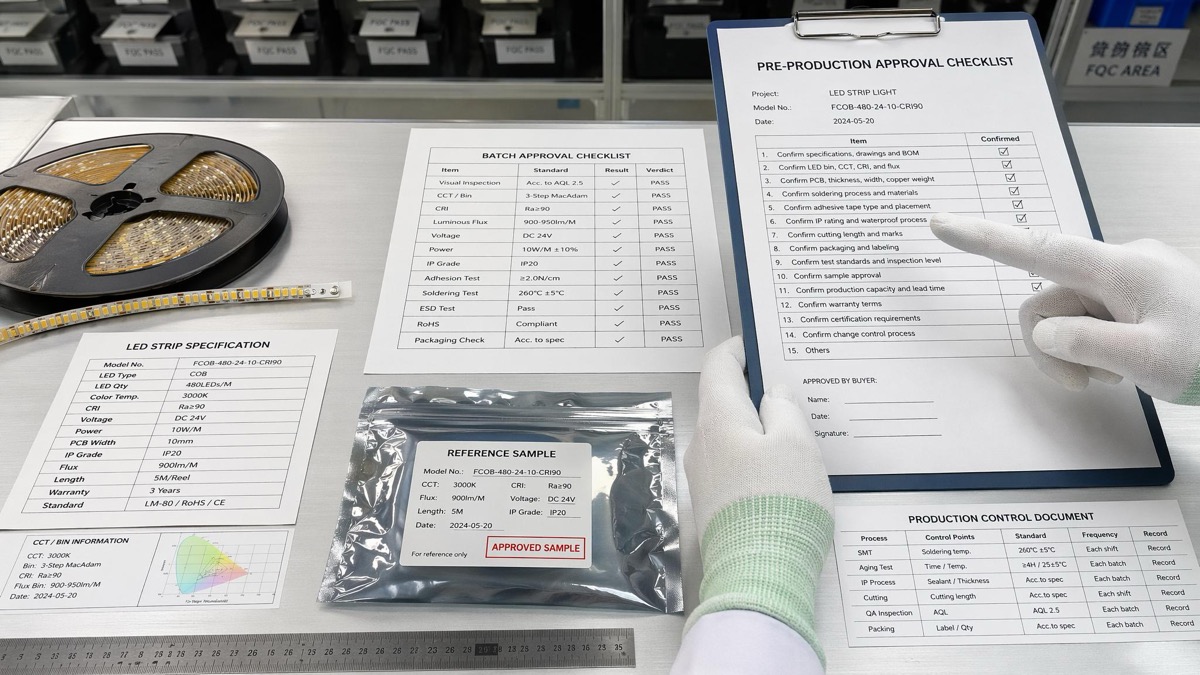
The fix is not to demand perfection in vague terms. The fix is to control the production reference, the tolerance, and the evidence that the shipment matches the agreement.
Require a production sample, not only a pre-production sample
Many buyers approve an early sample made before materials are fully allocated. That is not enough. You should also require a production sample pulled from the actual bulk run or from the exact materials reserved for the run.
A true production sample answers the important question: what will the finished shipment really look like under normal manufacturing conditions?
For higher-risk orders, ask the factory to send a short production reel or cut sample after line setup and before the full batch is completed. This costs time, but it is far cheaper than disputing a full container after arrival.
Specify binning tolerance in writing
If color consistency matters, do not rely on informal statements such as “same as sample” or “close to original.” State the binning tolerance in a measurable way. For white strip, a written requirement of MacAdam step 3 or tighter is a practical starting point for many commercial applications.
If your application is especially sensitive, specify both the target CCT range and the maximum allowable chromaticity deviation from the approved reference sample. The tighter the requirement, the more important it is to confirm that the factory and its LED supplier can actually control to that level at your required volume.
What matters here is not the exact wording alone. What matters is that both parties are working from a shared technical standard that can be tested.
Request a batch COA with every shipment
Each shipment should be supported by a batch COA or equivalent production test record. At minimum, the document should identify the production batch and confirm the measured values that matter to your purchase decision, such as CCT, voltage, power, and basic optical consistency data.
A COA will not eliminate all disputes, but it forces traceability into the process. If a problem appears, you can tie the delivered goods to a specific production batch instead of arguing in general terms about whether the goods are “different.” That changes a subjective complaint into a traceable quality discussion.
Lock in a right-to-reject clause
Many buyers spend time on sampling but ignore the contract language that matters when things go wrong. If the agreement does not define rejection rights tied to measurable variance, the supplier has room to argue that the goods are still commercially acceptable.
Your purchase terms should state that the buyer has the right to reject the shipment, or the non-conforming portion of the shipment, if the delivered product exceeds the agreed variance from the approved sample or written specification. The clause should not be vague. It should tie directly to your documented tolerance.
Without this, your leverage usually disappears once the goods ship.
What to ask a factory before you release the order

Before paying the deposit, buyers should ask direct questions and insist on direct answers.
- Which exact LED chip supplier and bin will be used for production?
- Will the production lot use one LED batch or multiple batches?
- What is the factory’s outgoing QC standard for color and lumen variance?
- Can the factory provide production-sample approval before final packing?
- What batch traceability documents will be included with the shipment?
- What happens contractually if the delivered lot exceeds the agreed tolerance?
Serious manufacturers can answer these questions clearly. Weak suppliers usually answer in generalities.
Where buyers go wrong
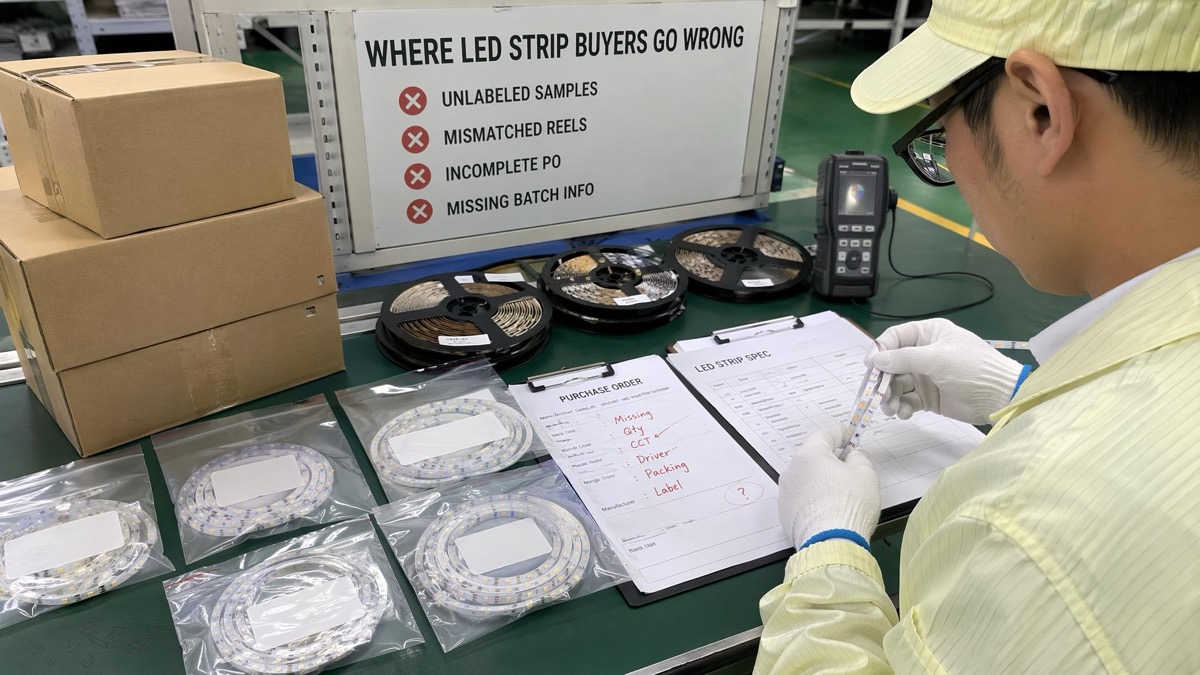
The most common buyer error is assuming that a sample is a promise. It is not. A sample is evidence of capability, but only under the conditions that produced that sample. If you do not lock those conditions into your production agreement, the factory can still deliver something different while claiming it is equivalent.
The second error is focusing only on defects. Bulk orders do not need to be visibly defective to create a claim problem. A shipment can be electrically functional and still commercially wrong because it no longer matches the approved reference closely enough for your market.
The third error is waiting until arrival to check consistency. By that stage, the most useful control points are already gone.
FAQ
Why do factories send better samples than what they ship in bulk?
Samples are often built from hand-picked materials under closer attention. Bulk production runs on inventory availability and throughput. Without a written production specification, the factory has no contractual obligation to reproduce the same conditions.
What is a reasonable color tolerance to write into the purchase contract?
For commercial white strip in visible installations, MacAdam step 3 is a practical benchmark. For tighter applications such as retail display or hospitality, step 2 is worth requesting. Anything wider than step 4 creates real risk of visible mismatch across a large installation.
Does requesting a pre-production sample slow down delivery?
Usually it adds 5 to 10 days. That is short compared to the cost of resolving a bulk mismatch after arrival. Most factories that understand quality control will support this without friction. Resistance to pre-production sampling is itself a signal worth noting.
The bulk order is only as good as the controls you set before it starts
If you want bulk LED strip orders to match approved samples, do not rely on goodwill or verbal assurances. Require a production sample. Write the binning tolerance into the order, ideally at MacAdam step 3 or tighter where the application requires it. Ask for a batch COA with every shipment. Put a right-to-reject clause in the contract if variance exceeds the agreed limit.
These steps will not remove every sourcing risk, but they shift the process from opinion to control. That is the difference between buying a sample and buying a repeatable product.
Recommended Products
Request a Project or Trade Quote
Sourcing for an installation project, resale or OEM production? Share your requirements below. You can discuss project samples before committing to a bulk order.
Related Articles

LED Strip Lighting for Indoor Plant Walls: Accent Light or Grow Light?
Specify LED lighting for indoor plant walls without confusing visual brightness with plant needs. Review PPFD, DLI, controls, moisture, and…

LED Strip Lighting After a Power Outage: Designing a Reliable Restart
Plan LED strip power restoration beyond total watts. Review driver inrush, switching limits, restart scenes, and commissioning before project handover.

Why LED Strip Lights Buzz When Dimmed: A Guide for Quiet Spaces
Diagnose LED strip buzzing without guessing. Review drivers, PWM controls, mounting resonance, and low-level acoustic acceptance for quiet interiors.