
The Real Landed Cost of Importing LED Strips from China: What Buyers Get Wrong
The Real Landed Cost of Importing LED Strips from China: What Buyers Get Wrong
Many buyers compare LED strip suppliers using one number: unit price per meter. On paper, this looks rational. If Factory A quotes USD 0.80 per meter and Factory B quotes USD 1.10 per meter, Factory A appears cheaper. But importers who buy at scale know that the invoice price is only one part of the cost structure.
The real buying decision is based on landed cost per usable meter. That means the total cost to get compliant, saleable product into your warehouse, adjusted for the losses and delays that happen in real sourcing.
This is where many importers get caught. A low quoted price can produce a higher actual cost once freight, duties, inspection, rework, financing, and inventory buffering are included. The cheaper quote can also create more management time, slower turnover, and more stock risk.
If you buy LED strip in commercial volumes, you should calculate true landed cost the same way you would evaluate any repeat industrial component: total acquisition cost divided by usable output.
Why the quoted unit price is incomplete
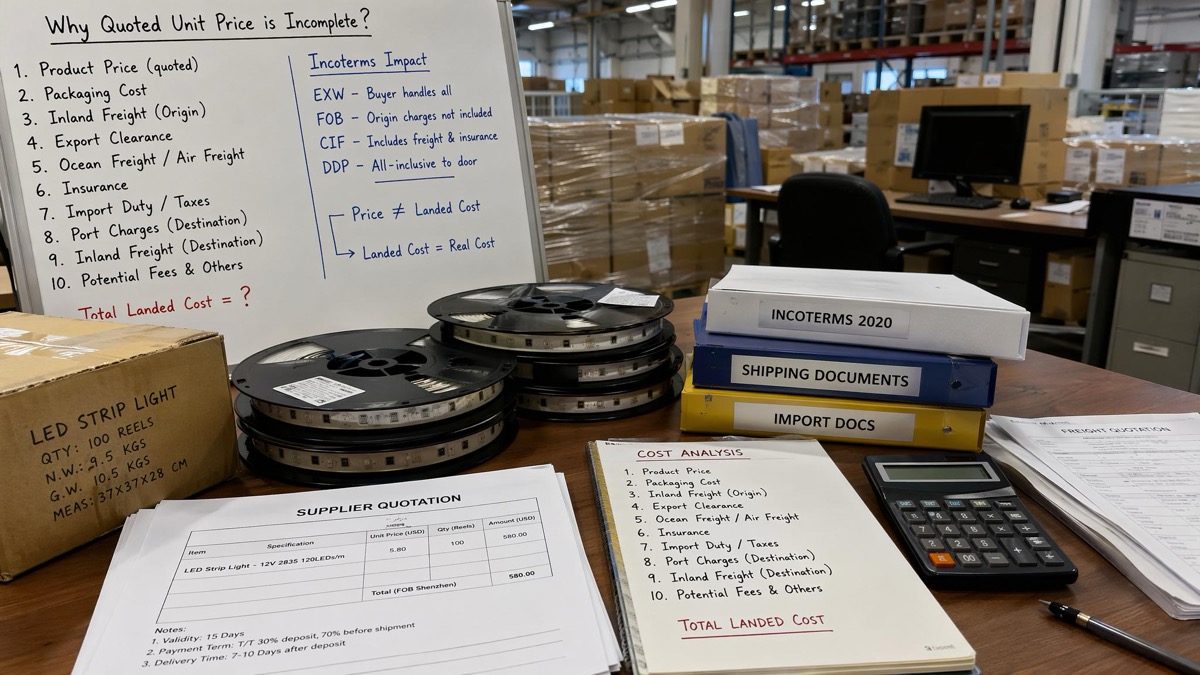
The factory price usually reflects ex-works logic, or at best a simplified FOB number. It tells you what the goods cost before the real import process begins. That may be useful for shortlisting suppliers, but it is not enough to choose between them.
A strip priced at USD 0.80 per meter can still be the more expensive sourcing decision if it brings higher logistics cost, more compliance cost, higher fallout, and more working capital pressure. Conversely, a strip quoted at USD 1.10 per meter may end up cheaper if it clears compliance faster, fails less in inspection, and requires less safety stock.
The cost categories buyers usually underestimate
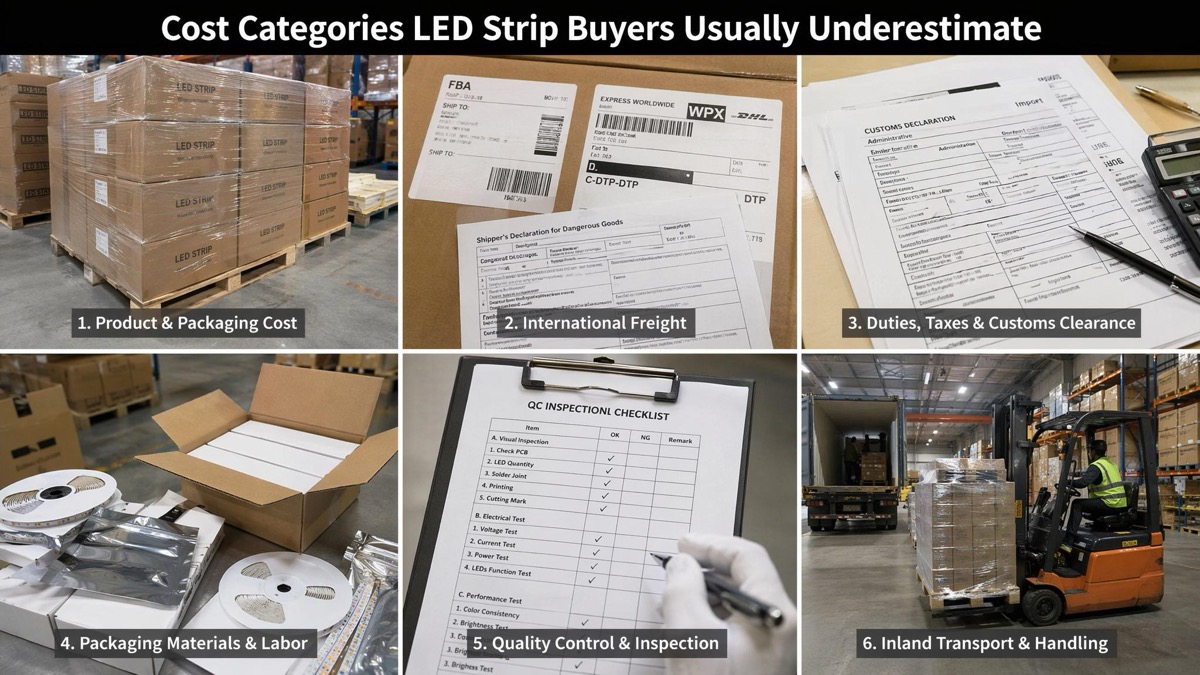
1. Ocean freight and port fees
Freight is not just the container booking. Buyers also need to consider local port charges, terminal handling, documentation fees, customs brokerage, pallet handling, inland transfer, and sometimes demurrage or detention if customs or warehouse scheduling causes delay.
On low-cost strip products, these logistics charges can materially change the delivered cost per meter. This is especially true when packaging is inefficient, reel count per carton is low, or shipment planning is poor. A factory with better carton design and denser packing can lower freight cost per meter even when the product price is higher.
Freight volatility also matters. Buyers often model shipping using last quarter’s rates, then act surprised when the next booking differs. If your margin is thin, your landed-cost model needs a freight sensitivity buffer.
2. Import duty depends on classification
Many buyers use a rough duty assumption instead of confirming the applicable HS classification and local treatment. That is risky. Depending on how the product is declared, strip lights may attract different duty treatment or supporting documentation requirements.
This matters across the US, Europe, and Australia because the classification logic, valuation approach, and secondary fees are not always identical. A small mistake in HS code or product description can change duty payable, trigger extra review, or create downstream compliance problems.
Before comparing suppliers, confirm the expected HS code with your broker and make sure you are comparing like with like. Otherwise your cost sheet may be wrong before the goods even leave China.
3. Compliance testing is a real cost, not a footnote
Importers often ask whether a product has UL, CE, or ETL, but they do not price the compliance burden properly. Sometimes the factory has relevant documentation. Sometimes it has partial paperwork. Sometimes the test report is outdated, product-specific details do not match, or the certification only covers one configuration and not the version you want to buy.
If you need a new test, a new listing variation, or additional document review, that adds both cost and lead time. It can also delay revenue because the stock cannot be sold into the intended channel until the paperwork is in place.
Compliance cost should therefore include direct testing expense, documentation review, engineering revision time, and the value of the lead-time delay.
4. Incoming inspection is part of the landed cost
Every serious importer inspects goods on arrival, whether internally or through a third party. That inspection has a cost per order. It includes labor, sampling, test equipment, reporting, quarantine handling, and the administrative work of resolving claims.
Buyers sometimes treat inspection as overhead that does not belong in the product cost. That is a mistake. If one factory consistently requires more intensive checking because performance is less stable, that extra inspection burden is part of the true sourcing cost of that supplier.
5. Rejection and rework rates hit hardest on first orders
First orders are rarely the cleanest orders. The product may be usable overall, but still require sorting, relabeling, connector correction, packaging changes, or credit negotiation. These are real costs.
Even a 3 to 5 percent quality fallout rate can eliminate an apparent unit-price advantage. When the product is cheap but the management burden is high, the real cost rises fast. Buyers who ignore first-order fallout often end up rewarding the wrong supplier during supplier selection.
6. Payment terms create a financing cost
The standard 30 percent deposit is often treated as normal and therefore invisible. But it is not free. The deposit locks capital before the goods are shipped, and the balance is usually paid before or at shipment, while revenue comes much later.
If lead time is 45 days and transit plus clearance adds more time, your cash can be tied up for a long period before the inventory turns. That financing burden belongs in your landed-cost model, especially if you are managing multiple SKUs or seasonal demand.
7. Buffer stock is required because lead time is long
For many importers, the biggest hidden cost is not on the invoice at all. It is the inventory you need to hold because replenishment is slow. If your normal reorder cycle involves roughly 45 days of production plus transit and clearance, you cannot run the SKU with minimal stock. You need buffer inventory.
That means capital is sitting in the warehouse to protect service levels. Storage, handling, insurance, and obsolescence risk all rise with that buffer. A more expensive but more reliable supplier can reduce safety stock needs and therefore reduce total cost.
How a USD 0.80 strip can cost more than a USD 1.10 strip
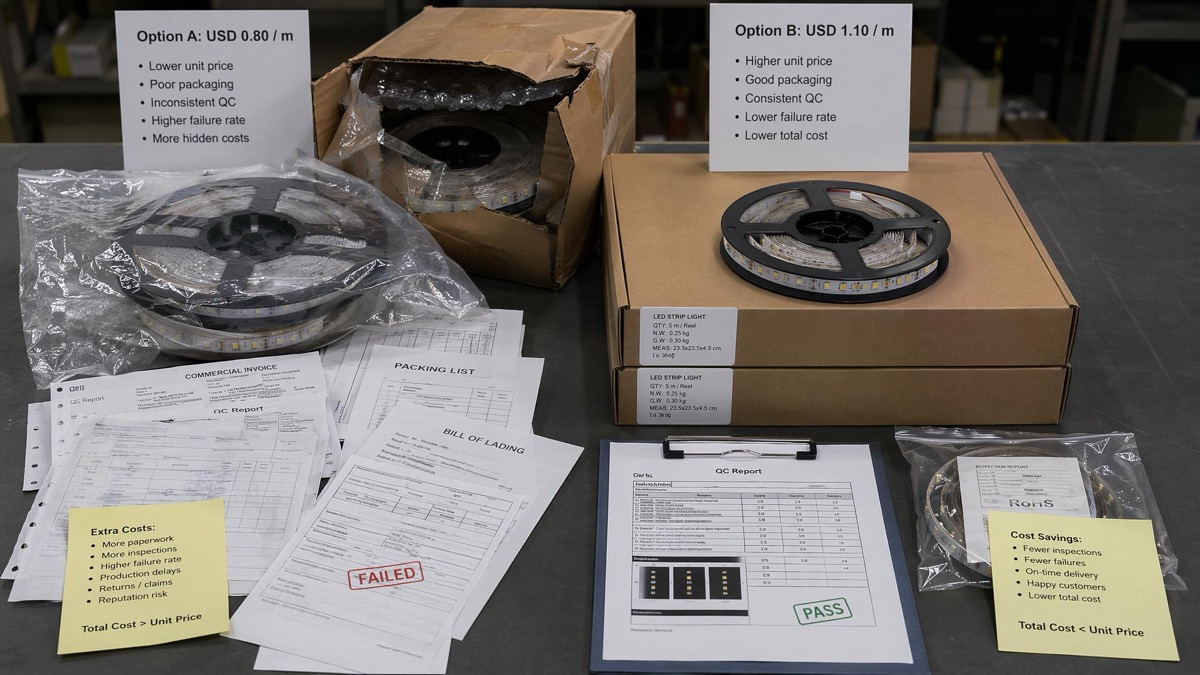
Consider a simplified example for 10,000 meters.
Factory A quotes USD 0.80 per meter. Factory B quotes USD 1.10 per meter. At invoice level, Factory A looks USD 3,000 cheaper.
Now add the real sourcing factors.
- Factory A uses bulkier packaging, so freight and destination handling add USD 0.09 per meter versus USD 0.06 for Factory B.
- Factory A’s documentation is incomplete, so compliance review and corrective testing add USD 0.05 per meter amortized across the order. Factory B adds only USD 0.01.
- Factory A requires heavier incoming inspection and sorting, adding USD 0.03 per meter. Factory B adds USD 0.01.
- Factory A has a 5 percent rework or claim-adjusted loss on the first order. Factory B has 1 percent.
- Factory A requires larger safety stock because lead time reliability is weak, increasing warehousing and capital cost by another USD 0.04 per meter equivalent. Factory B adds USD 0.02.
Once you convert those differences into usable-meter cost, the numbers change quickly. Factory A may land near or above USD 1.05 before adjusting for fallout. After a 5 percent usable-loss adjustment, the effective cost per sellable meter rises further. Factory B, despite the higher invoice price, may end up safer and cheaper on a total-cost basis.
The exact figures will vary, but the logic is consistent: the lower quote only wins if the surrounding cost structure is also controlled.
A practical landed-cost framework buyers can use
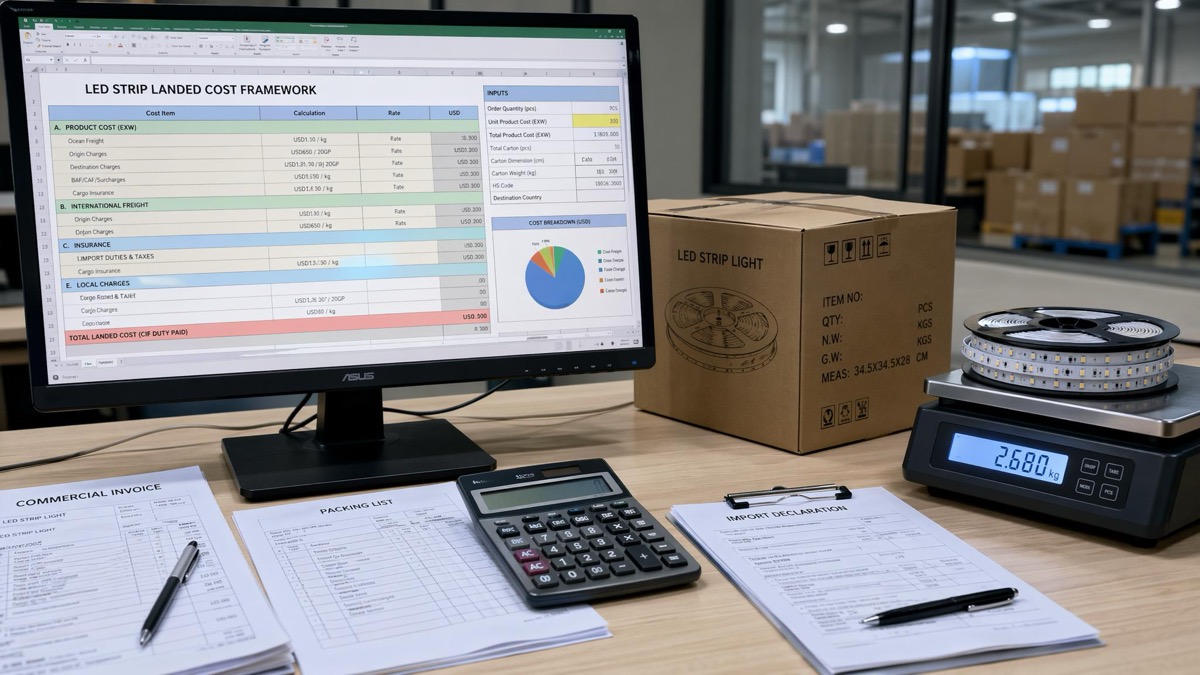
You do not need a complicated ERP model to make better sourcing decisions. A basic landed-cost worksheet is enough if it includes the right buckets.
Step 1: Start with total purchase cost
- Product cost
- Tooling or packaging setup charges if applicable
- Bank charges and transfer fees
Step 2: Add inbound logistics cost
- Ocean or air freight
- Port and terminal charges
- Brokerage and customs processing
- Inland trucking to warehouse
Step 3: Add border and compliance cost
- Import duty based on correct HS code
- VAT, GST, or equivalent tax treatment where relevant
- Compliance testing, report review, and certification updates
Step 4: Add receiving and quality cost
- Incoming inspection labor and equipment
- Sampling destruction where relevant
- Sorting, relabeling, or quarantine handling
- Expected first-order rejection or rework cost
Step 5: Add capital and inventory cost
- Deposit financing cost
- Inventory carrying cost during production and transit
- Warehouse storage and buffer stock cost
Step 6: Divide by usable meters, not ordered meters
This last step is critical. If 10,000 meters are ordered but only 9,600 meters are effectively usable without claim cost, your real cost per usable meter is total cost divided by 9,600, not 10,000.
That one adjustment often changes the supplier ranking.
Questions buyers should ask before comparing suppliers

- What packaging density and carton dimensions will this order use?
- Which HS code will the goods be declared under, and has my broker confirmed it?
- Are the compliance documents current, product-specific, and valid for my exact configuration?
- What level of incoming inspection should I expect for this supplier?
- What first-order fallout rate should I budget realistically?
- How stable is the supplier’s lead time, and how much safety stock will that force me to hold?
If a supplier is only competitive when every hidden-cost assumption is optimistic, the quote is not truly competitive.
What experienced buyers focus on instead of lowest price
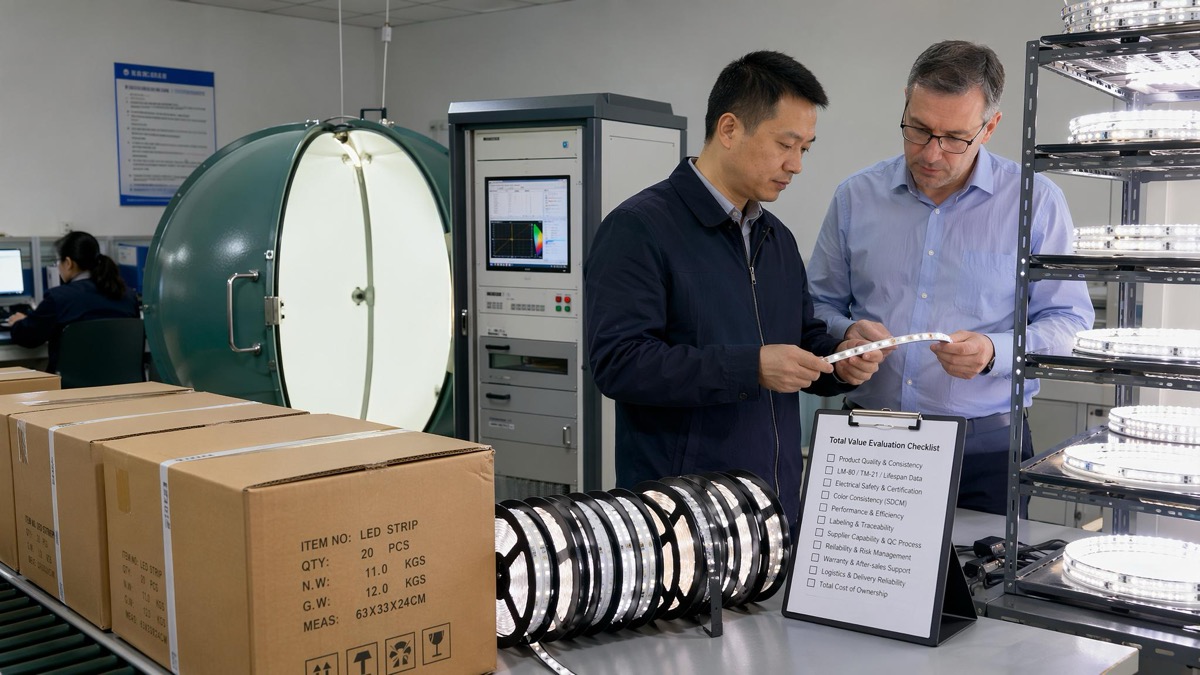
Experienced importers usually care about cost variance as much as cost level. A supplier that is predictably slightly higher on invoice price can be more valuable than a supplier that is unpredictably cheaper. Predictability reduces buffer stock, internal firefighting, and claim exposure.
In LED strip importing, stable specifications, current documentation, reliable packing, and low fallout are often worth more than a few cents per meter on the quote sheet.
FAQ
Is it really worth building a full landed-cost model for every supplier comparison?
Not necessarily every time, but you need one solid baseline model for each major SKU category. Once built, it takes minutes to update with new quotes. Without it, you are comparing invoice prices that exclude 20 to 40 percent of your actual cost, which makes supplier selection unreliable.
How do I estimate first-order fallout rate before I have experience with a supplier?
Ask for the factory’s internal rejection rate and first-order rework rate, then apply a skepticism buffer. If a factory cannot give you a number, budget 3 to 5 percent and adjust after the first order. Better-controlled factories can often show you inspection records from other customers.
Should payment terms affect which supplier I choose?
Yes. Payment terms affect your financing cost, your inventory exposure, and your cash cycle. A supplier offering 60-day payment terms on a product priced slightly higher may still cost less than a 30-percent-deposit supplier quoted lower. Model the capital cost explicitly.
The cheapest quote is not the cheapest source until the full cost is counted
The correct comparison is not USD 0.80 per meter versus USD 1.10 per meter. The correct comparison is total landed cost per usable meter after freight, duty, compliance, inspection, fallout, financing, and inventory carrying are included.
Build a simple cost model, confirm the assumptions with your broker and quality team, and compare suppliers on the full number. That is how you avoid buying a cheap strip that becomes expensive after it reaches your warehouse.
Recommended Products
Request a Project or Trade Quote
Sourcing for an installation project, resale or OEM production? Share your requirements below. You can discuss project samples before committing to a bulk order.
Related Articles

LED Strip Lighting for Indoor Plant Walls: Accent Light or Grow Light?
Specify LED lighting for indoor plant walls without confusing visual brightness with plant needs. Review PPFD, DLI, controls, moisture, and…

LED Strip Lighting After a Power Outage: Designing a Reliable Restart
Plan LED strip power restoration beyond total watts. Review driver inrush, switching limits, restart scenes, and commissioning before project handover.

Why LED Strip Lights Buzz When Dimmed: A Guide for Quiet Spaces
Diagnose LED strip buzzing without guessing. Review drivers, PWM controls, mounting resonance, and low-level acoustic acceptance for quiet interiors.