
Private Label LED Strips: What You Can Actually Customize (And What’s Just Relabeling)
Private Label LED Strips: What You Can Actually Customize (And What’s Just Relabeling)
Many importers ask Chinese factories for private label LED strips because they want to build margin, control presentation, and reduce direct price comparison. That is a reasonable goal. The problem is that the phrase “private label” is used very loosely in the LED strip industry.
Some factories use it to mean genuine product customization. Others use it to mean the same stock strip in a different box. Buyers who do not separate those two meanings often believe they are building a branded product line when they are really just repackaging commodity inventory.
If you are buying 5,000 to 50,000 meters per order, the question is not whether customization exists. The question is which parts of the product can actually be engineered, which parts are only cosmetic, and which options require volume large enough to justify material changes.
Start with the basic distinction
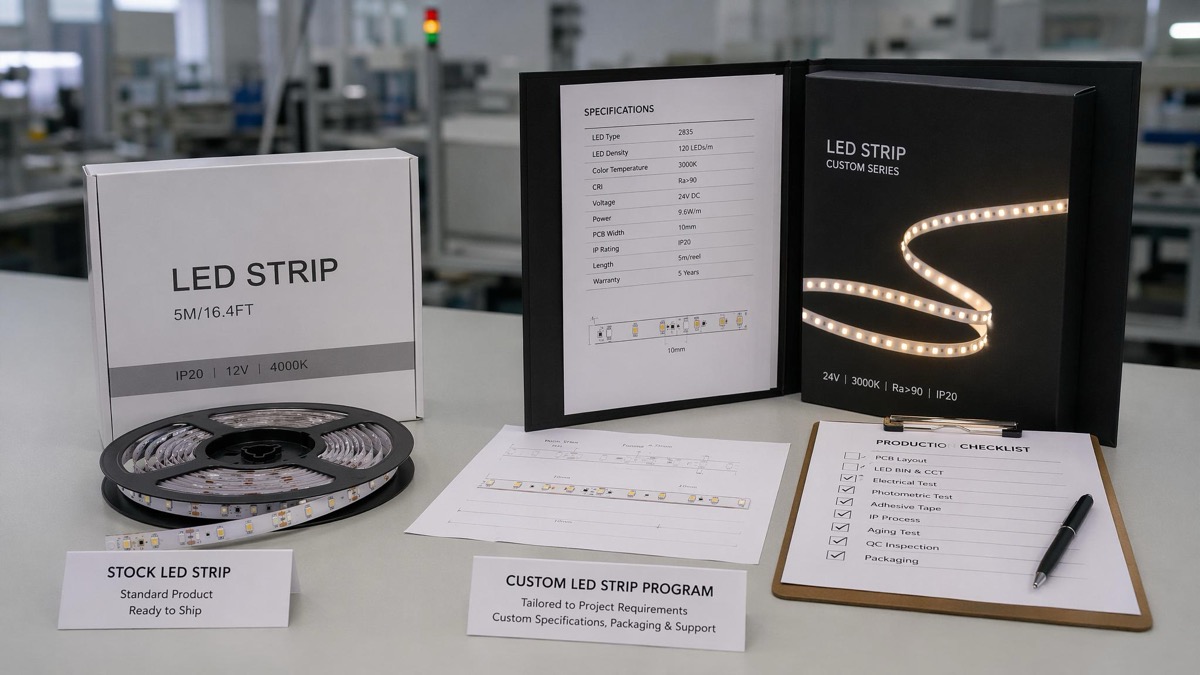
There are three levels of so-called private label in LED strip sourcing.
- Level one is repackaging stock product. The strip is standard. Only the label, carton, or paperwork changes.
- Level two is configured product. The strip is based on an existing platform but key commercial specifications are selected to fit your market.
- Level three is true custom product. Materials, structure, or component selection are changed specifically for your program.
Most factories can do level one. Many can do level two. Far fewer can do level three without larger MOQ, longer lead time, and engineering control.
What you can realistically customize on many LED strip programs
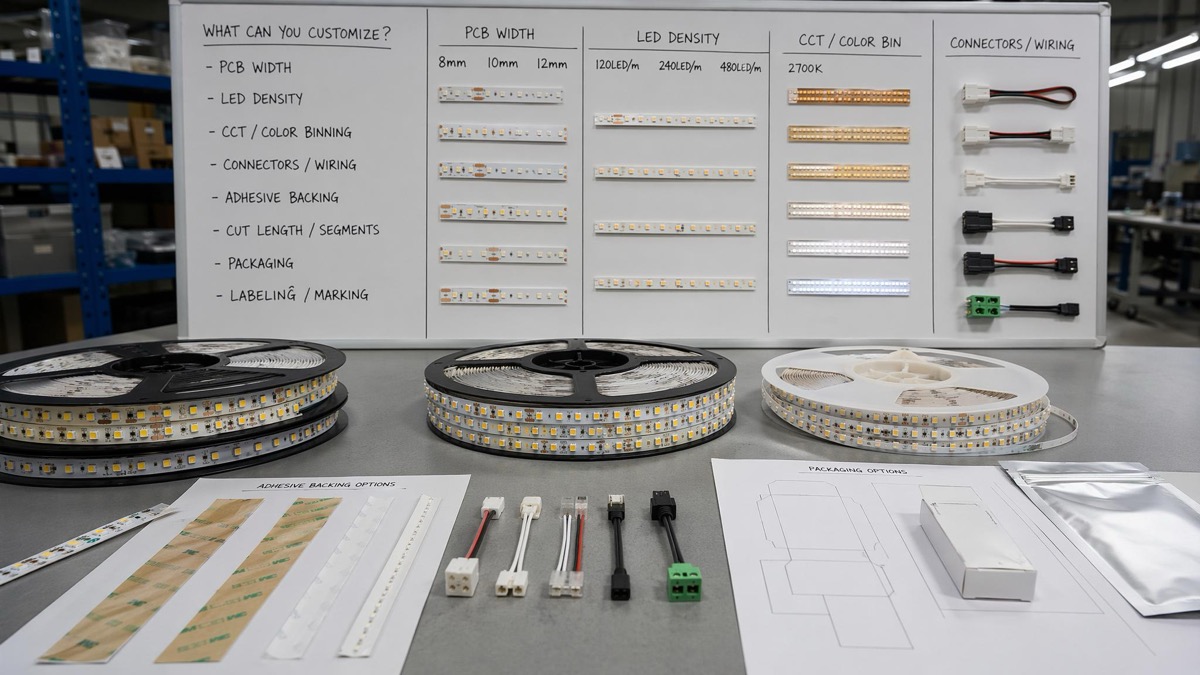
These are the specifications that serious factories can often adjust within an existing product family, especially when the order volume is commercial rather than small test quantity.
CCT
Color temperature is one of the most common meaningful customizations. Buyers can usually specify warm white, neutral white, cool white, or a more exact target range depending on the LED platform. This matters because CCT changes the commercial use case, not just the packaging.
However, buyers should remember that requesting a nominal CCT is not enough. The real question is what binning control the factory can hold around that target.
CRI
CRI is also a real customization, but it is not free. Moving from standard CRI to higher CRI often changes chip sourcing, efficacy, thermal behavior, and cost. If a factory offers high CRI at nearly no price difference and with no technical tradeoff, buyers should ask more questions.
LED density
LEDs per meter is a core product variable. Changing density affects uniformity, wattage, thermal load, and project suitability. A 60 LED per meter strip and a 120 LED per meter strip are not the same product with different labels. This is genuine specification control.
PCB width
PCB width can often be selected within a known format range, such as narrower or wider boards for channel compatibility, thermal considerations, or current handling. This is a real structural parameter because it affects installation compatibility and electrical behavior.
Voltage
Choosing 12V, 24V, or other commercial voltage options is also meaningful customization. It influences run length, voltage drop behavior, driver selection, and target market compatibility.
Wattage
Wattage can be adjusted through LED count, chip selection, and circuit design within certain product families. Again, this is functional customization, not branding decoration.
IP rating class
Changing from non-waterproof to IP65, IP67, or other protection levels is a real product difference because materials and construction change. Silicone coating, sleeve design, or extrusion method all affect both performance and cost.
Custom reel length
Reel length is often more flexible than buyers expect. If your distribution channel prefers 3-meter, 10-meter, or project-specific reel lengths, many factories can support this with manageable adjustment. It is not the deepest engineering change, but it is still commercially relevant because it affects labor, waste, and customer presentation.
What is usually cosmetic customization
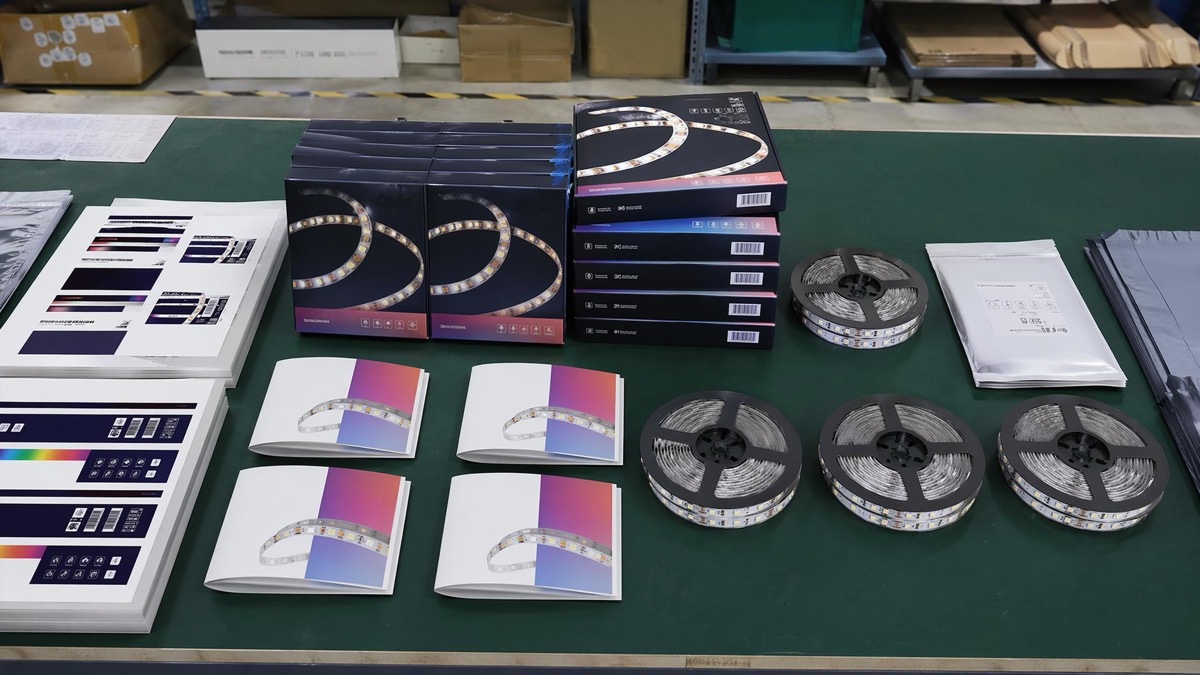
Cosmetic changes are not useless. They can help with brand presentation and sales-channel consistency. But buyers should not confuse them with true product differentiation.
Label on reel
Printing your brand, SKU, barcode, or compliance markings on the reel label is standard private label work. It can improve professionalism, but it does not change the strip itself.
Box packaging
Custom inner boxes, master cartons, inserts, and printed branding are also common. These matter for resale presentation and warehouse handling, but they are packaging work, not product development.
Brand name on spec sheet
Many factories will place your logo and item code on a data sheet. This may be useful for channel control, but by itself it is only documentation relabeling. It says nothing about whether the underlying strip is proprietary.
What usually requires higher MOQ and stronger engineering commitment
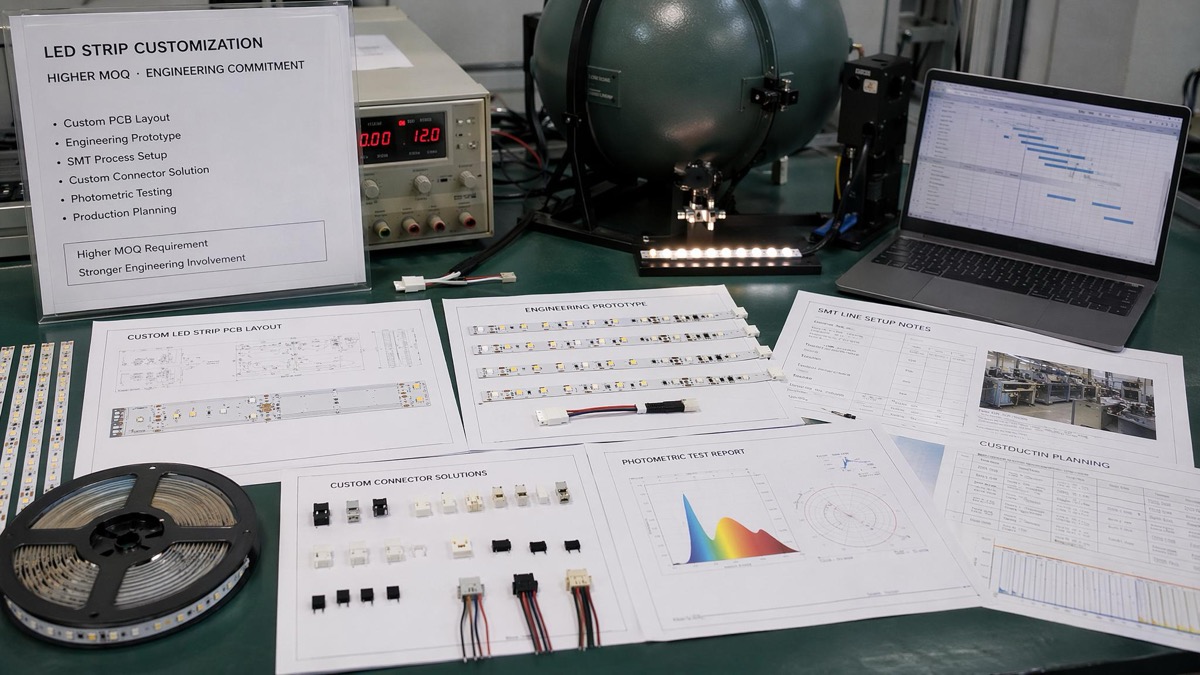
Some buyers ask for deep customization without realizing they are requesting a new product program. These requests are possible, but they generally require larger commitment.
Custom PCB color
Standard PCB colors are common because factories buy base materials at scale. A custom PCB color usually means a specific production setup, material planning, and minimum quantity high enough to justify it. Buyers should expect MOQ and sometimes longer lead time.
Custom LED chip specification
If you want a particular chip family, specific luminous behavior, or a non-standard supplier combination, that is not simple private labeling. It changes sourcing, binning control, and sometimes qualification testing. This usually needs higher MOQ and a more formal specification review.
Custom silicone extrusion profile
For waterproof or neon-style products, a custom extrusion profile can create meaningful differentiation. It can also create tooling cost, long lead time, and volume requirements. This is real customization, but it should be treated like an engineered product decision, not a packaging change.
What many factories call private label but is really just stock-product repackaging
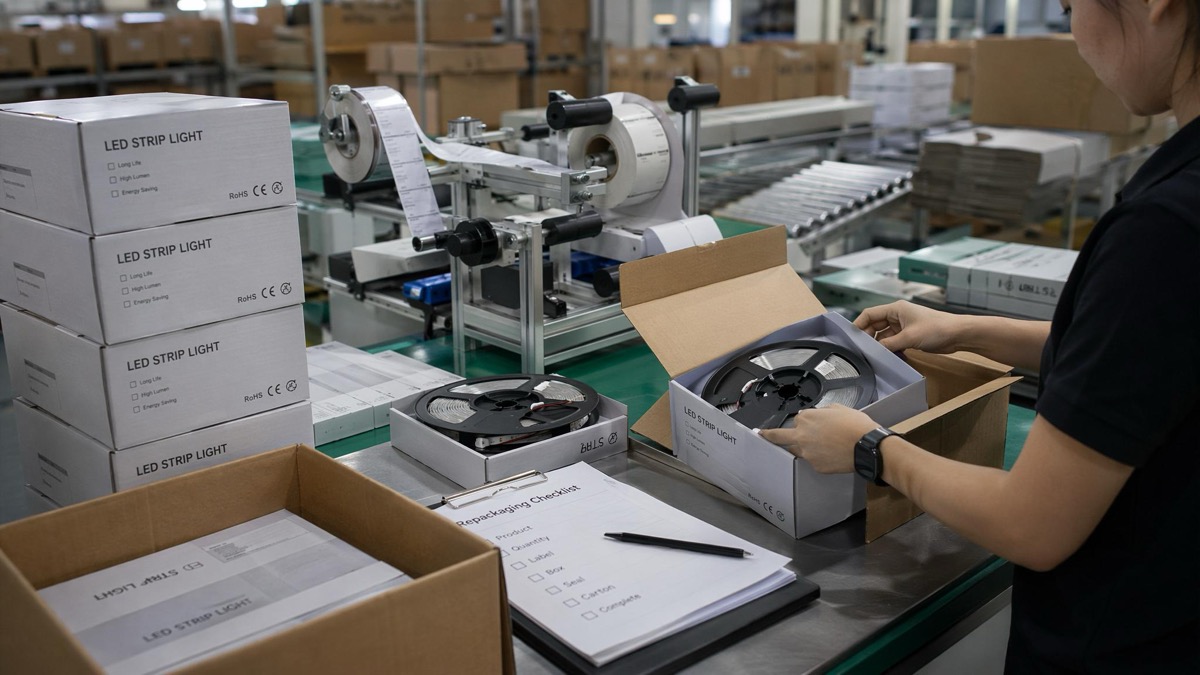
In many quotations, the factory will offer private label while the technical specification stays completely unchanged. The LED chip remains standard. The PCB remains standard. The reel length remains standard. The performance tolerance remains standard. The only changes are the sticker, the box, and the PDF.
There is nothing inherently wrong with that model. For some importers, it is enough. It can support a branded reseller strategy with low development risk.
The problem starts when buyers believe that this level of customization protects them from direct market comparison or ensures supplier exclusivity. It usually does not. Another buyer can often purchase the same strip and apply different packaging with minimal effort.
How to tell whether the customization is real
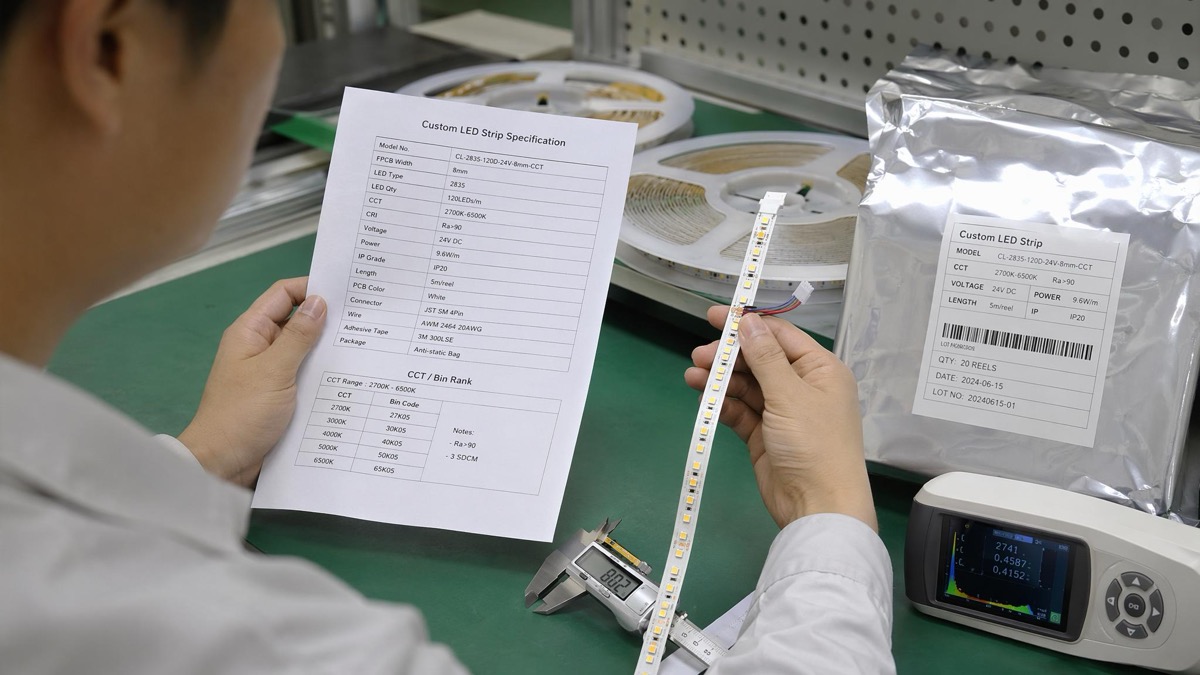
When speaking with a factory, ask specific questions instead of asking generally whether the product is private label.
- Which exact technical parameters can be changed without creating a new MOQ?
- Which changes affect the BOM?
- Which changes require a new PCB run, new tooling, or new material sourcing?
- Will the revised product have its own internal item code and production record?
- Can the factory provide a specification sheet that clearly shows what is unique to my version?
If the answer is mostly about logos and packaging, you are discussing relabeling, not real product customization.
How buyers should approach a private label discussion

The most productive approach is to define what commercial problem you are trying to solve.
If the goal is simply to sell under your own brand with limited upfront risk, cosmetic customization may be enough. In that case, focus on packaging accuracy, barcode control, and consistent labeling.
If the goal is to serve a specific market need or reduce direct SKU comparison, then you need functional customization. That means choosing the right CCT, CRI, density, voltage, wattage, IP rating, and reel format for your customer base, and documenting those specifications clearly.
If the goal is real product differentiation, be prepared for MOQ, tooling, and validation work. At that point, the conversation should shift from “Can you private label this?” to “Can you build and control this specification?”
Red flags during private label discussions
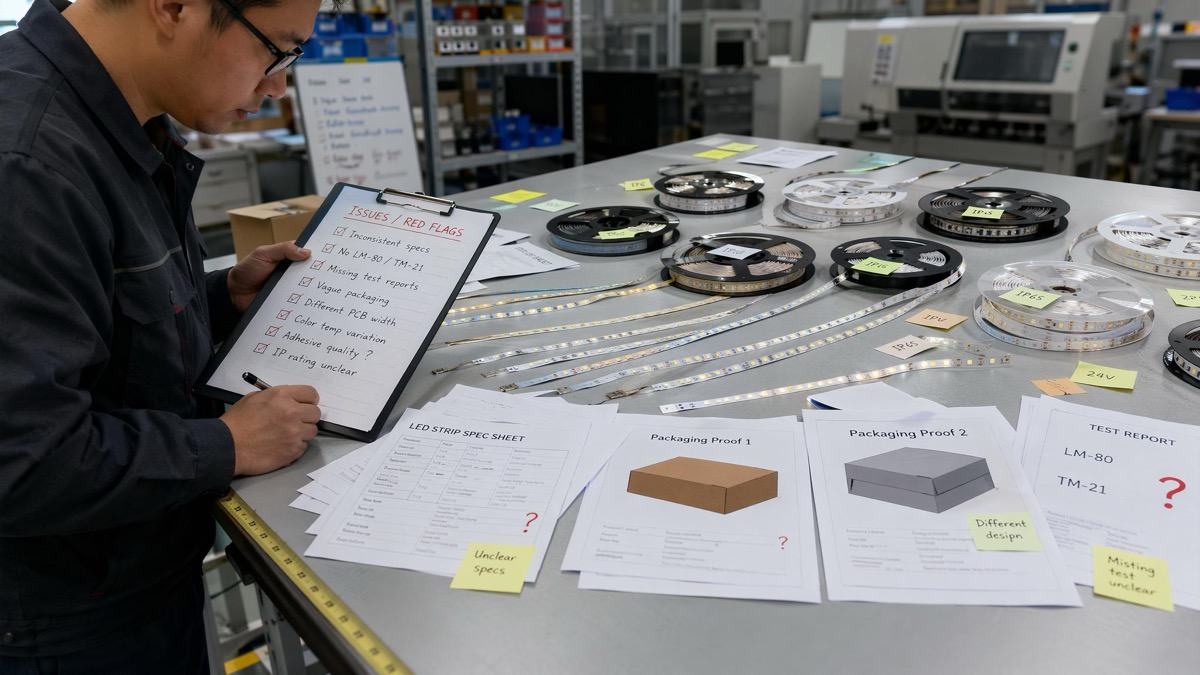
- The factory says everything is customizable but cannot explain MOQ impact.
- The quotation shows no change in BOM, lead time, or testing for supposedly major technical customization.
- The supplier avoids giving a revised specification sheet.
- The supplier uses the same internal SKU for your version and the standard stock version.
- The supplier talks only about artwork approval and never about performance control.
These signs usually mean you are buying a stock product with new labels.
FAQ
How do I know if a factory is offering real customization or just relabeling?
Ask whether your version will have its own internal item code and production record at the factory. Ask which BOM items change and what MOQ those changes require. If the answer stays focused on artwork and packaging with no BOM or specification discussion, you are looking at relabeling.
What MOQ is realistic for genuine technical customization?
It depends on what changes. CCT and CRI selection within an existing platform can often be done at 1,000 to 3,000 meters. Custom PCB color or layout changes typically require 5,000 meters or more. Custom chip specification or silicone profile work usually needs 10,000 meters and up, plus engineering time.
Can I protect my private label specification from being sold to other buyers?
You can include an exclusivity clause, but enforcing it is difficult without strong contracts and audit rights. More practical protection comes from meaningful technical differentiation rather than relying solely on agreements. If your product has distinctive specifications that took investment to develop, it is harder to commoditize.
Real private label starts with a different specification, not a different sticker
In LED strip sourcing, real customization usually includes technical variables such as CCT, CRI, LED density, PCB width, voltage, wattage, IP rating, and reel length. Cosmetic customization usually means labels, packaging, and branded documents. Deeper changes such as custom PCB color, custom chip specification, and custom silicone extrusion normally require higher MOQ and a more serious engineering process.
That distinction matters. If you understand it before negotiating with a factory, you can ask the right questions, budget realistically, and avoid mistaking repackaging for product development.
Recommended Products
Request a Project or Trade Quote
Sourcing for an installation project, resale or OEM production? Share your requirements below. You can discuss project samples before committing to a bulk order.
Related Articles

LED Strip Lighting in Historic Buildings: Design for Removal, Not Just Installation
Plan LED strip lighting in historic interiors around protected finishes, removable supports, cable routes, heat, and maintenance without avoidable damage.

LED Strip Lighting for Retail Fitting Rooms: Face, Fabric, and Mirror Glare
Specify fitting-room LED strip lighting for faces, fabrics, and mirrors. Compare color reports, test reflected glare, and approve a repeatable…

LED Strip Lighting for Indoor Plant Walls: Accent Light or Grow Light?
Specify LED lighting for indoor plant walls without confusing visual brightness with plant needs. Review PPFD, DLI, controls, moisture, and…