

How to Calculate Voltage Drop in LED Strip Lighting Runs
Voltage drop is one of the most common reasons LED strip light installations look uneven after completion. The LEDs at the far end of a run appear noticeably dimmer than those near the power supply. The product itself is not faulty. The circuit is working exactly as physics would predict. The problem is that voltage drop was not accounted for during the planning stage.
For contractors and specifiers working on commercial or large-scale residential projects, understanding how to calculate voltage drop before installation begins is not optional. It directly affects product selection, run length limits, power supply placement, and how the finished installation will look.
This article explains how voltage drop works in LED strip lighting, how to calculate it, and what decisions it should inform when you are planning a project.
Why Voltage Drop Happens in LED Strip Runs
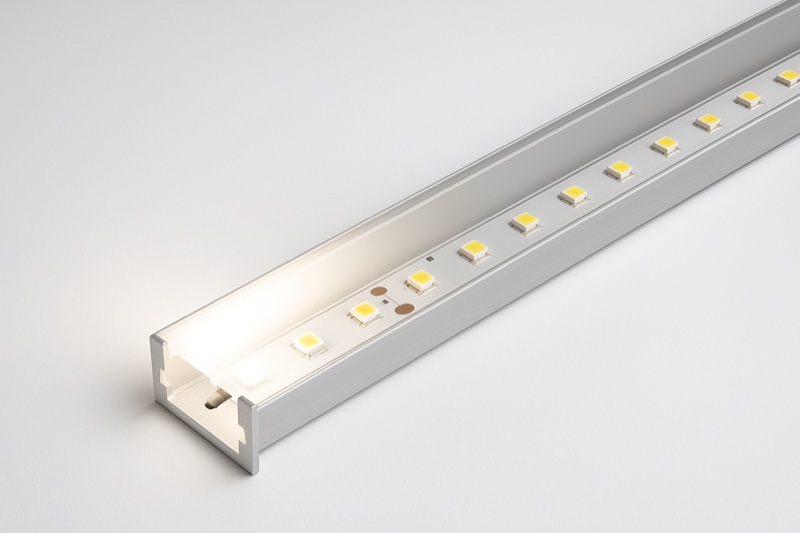
LED strip lights draw current continuously along the full length of the strip. As current travels through the copper conductors in the strip, resistance builds up over distance. This resistance causes the voltage to drop progressively from the feed point to the far end of the run.
The practical result is that LEDs at the start of a run receive the full supply voltage, while LEDs further along receive slightly less. Since LED brightness is directly tied to operating voltage, the further you go from the power supply, the dimmer the output becomes.
The severity of voltage drop depends on four factors:
- Strip wattage per metre — higher wattage means more current draw, which accelerates voltage drop
- Run length — longer runs accumulate more resistance
- Conductor width — the copper trace width in the strip determines its resistance per metre
- Supply voltage — lower voltage systems (12V) are more sensitive to voltage drop than higher voltage systems (24V or 48V)
A 5-metre run of a low-density 12V strip may show only marginal brightness variation. A 10-metre run of a high-density 24V strip fed from one end can show a visible brightness difference that most clients will notice.
The Voltage Drop Formula
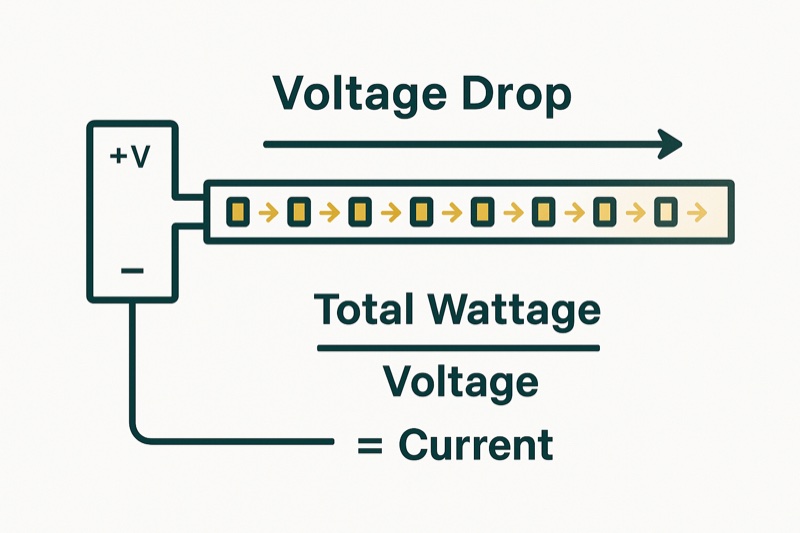
Voltage drop in an LED strip run can be calculated using a straightforward formula derived from Ohm’s Law:
Voltage Drop (V) = Current (A) × Resistance of the run (Ω)
To apply this, you need two values:
1. Current Draw of the Strip
Current = Total wattage of the run ÷ Supply voltage
For example:
- A 10-metre run of 14.4W/m strip on a 24V supply
- Total wattage = 10 × 14.4 = 144W
- Current = 144 ÷ 24 = 6A
2. Resistance of the Strip
Strip manufacturers provide a resistance value per metre in their datasheets, typically expressed in ohms per metre (Ω/m). If this is not available, it can be estimated based on the copper conductor width.
A typical 12mm-wide LED strip with standard copper weight has approximately 0.08–0.12Ω per metre depending on strip grade. Premium strips with heavier copper may be as low as 0.04Ω/m.
For a 10-metre run at 0.10Ω/m:
- Resistance = 10 × 0.10 = 1.0Ω
Putting It Together
Voltage Drop = 6A × 1.0Ω = 6V
On a 24V supply, a 6V drop means the far end of the run is operating at approximately 18V. That is a 25% voltage reduction, which will produce a clearly visible brightness difference.
Acceptable Voltage Drop Limits
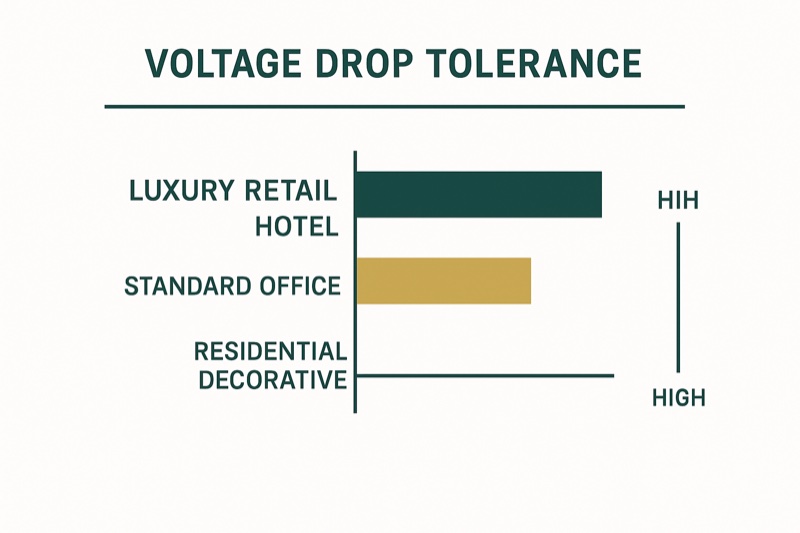
The maximum acceptable voltage drop depends on the application and how much brightness variation the finished installation can tolerate.
General guidelines used in practice:
| Application Type | Maximum Recommended Voltage Drop |
|---|---|
| High-end commercial, hospitality, retail | 3–5% of supply voltage |
| Standard commercial office, workspace | 5–8% |
| Residential indirect lighting | 8–10% |
| Decorative or accent applications | Up to 12% |
For a 24V system, 5% drop equals 1.2V. Staying within 1.2V drop across the full run is the correct target for premium applications.
Using the example above, a 6V drop on a 24V supply represents a 25% drop — far beyond what any commercial application would accept. That run either needs to be shortened, fed from both ends, or specified on a higher voltage system.
In practice, most installers working on commercial projects target a maximum drop of 0.5–1.0V for applications where even lighting is critical, such as museum display cases, retail shelf lighting, or linear cove lighting in hospitality spaces.
How Run Length Affects the Calculation
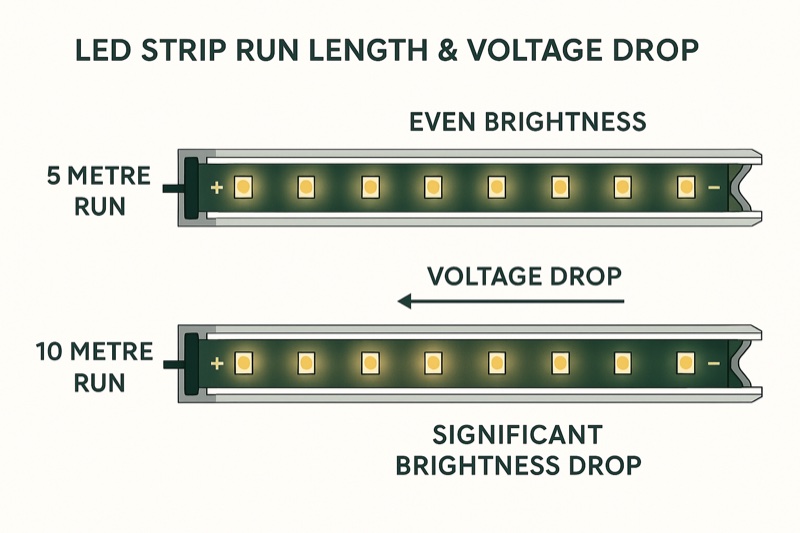
Run length is the variable that installers most often underestimate. A strip that performs well at 3 metres may show significant dimming at 8 metres without any change in specification.
Here is a simplified comparison to illustrate how run length interacts with strip wattage and supply voltage:
24V system, 0.10Ω/m strip resistance:
| Strip Density | Run Length | Current | Voltage Drop |
|---|---|---|---|
| 10W/m | 5m | 2.08A | 1.04V (4.3%) |
| 10W/m | 10m | 2.08A | 2.08V (8.7%) |
| 14.4W/m | 5m | 3.0A | 1.5V (6.25%) |
| 14.4W/m | 10m | 3.0A | 3.0V (12.5%) |
| 20W/m | 5m | 4.17A | 2.08V (8.7%) |
| 20W/m | 10m | 4.17A | 4.17V (17.4%) |
12V system, same strip resistance:
Voltage drop percentages double because the same current is now acting on a lower reference voltage. A 2V drop on a 12V supply is a 16.7% loss. On a 24V supply, the same 2V drop is only 8.3%.
This is why 24V and 48V systems are consistently recommended for commercial projects. They provide significantly more headroom against voltage drop for equivalent run lengths and power densities.
Three Practical Methods to Manage Voltage Drop
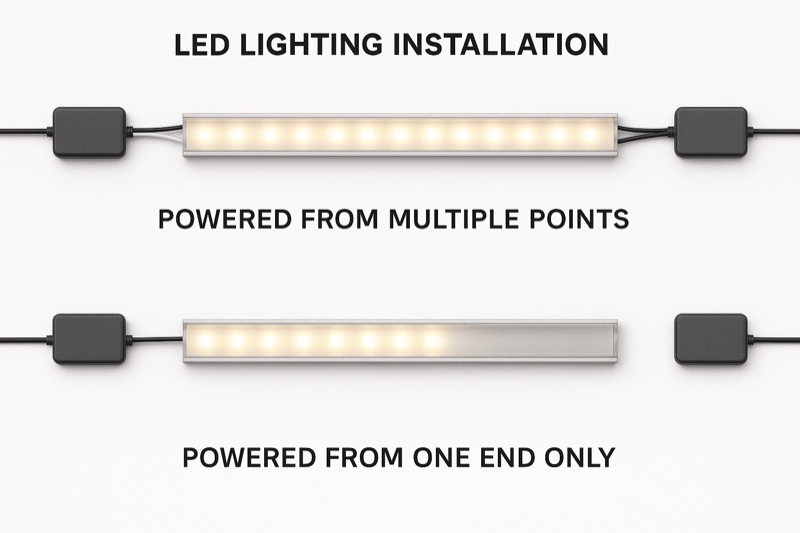
Once you have calculated the expected voltage drop for a planned run, you have several options if the drop exceeds acceptable limits.
Method 1: Shorten the Run
The simplest solution is to reduce individual run lengths. Instead of one 10-metre run fed from one end, use two 5-metre runs each fed from a central power supply or individual feeds.
This is often the cleanest solution architecturally, particularly for linear installations where supply points can be concealed within the profile or channel.
Method 2: Feed from Both Ends
Running power feed cables to both the start and end of a strip run effectively halves the electrical length of the run. Each end of the strip now draws current from a nearby feed point, reducing the maximum distance current has to travel.
This method works well in retrofit situations where the strip length cannot be changed but power access is available at both ends.
Method 3: Use Power Injection Points
For very long runs, intermediate power injection points can be added along the run. A feed is brought in at intervals — typically every 3–5 metres depending on strip specification — to maintain consistent voltage along the full length.
Power injection requires careful wiring to avoid creating ground loops or voltage conflicts, particularly on RGB or tunable white strips where multiple channels are involved.
12V vs 24V vs 48V: Voltage Drop Implications
Supply voltage is one of the most consequential specification decisions for managing voltage drop in LED strip projects.
12V systems are the most sensitive to voltage drop. Current draw per metre is higher for equivalent wattage, and the lower reference voltage means any drop represents a larger percentage loss. 12V strips are generally only suitable for short runs of 3–4 metres when voltage uniformity matters.
24V systems are the standard for most commercial projects. They offer double the headroom of 12V systems for equivalent run lengths. Most LED strip products in commercial grade are specified at 24V for this reason.
48V systems are increasingly used in high-specification commercial projects, particularly where long uninterrupted runs are needed without power injection. A 48V system can sustain runs of 15–20 metres with minimal visible voltage drop on strips of moderate density.
The tradeoff with higher voltage is that it introduces stricter safety classification requirements in many markets. 48V systems may need to meet different installation standards depending on the jurisdiction. For most commercial projects in the UK, US, and EU, 24V remains the practical default.
Voltage Drop and IP-Rated Strips
A detail that is easy to overlook is that IP-rated strips — particularly fully encapsulated IP67 and IP68 variants — typically have higher resistance per metre than open strips of equivalent specification. The encapsulation material adds thermal mass and the copper traces in weatherproof strips are sometimes thinner due to manufacturing constraints.
When calculating voltage drop for outdoor or wet-area installations using IP67/IP68 strip, use the manufacturer’s actual resistance value from the datasheet rather than estimates based on standard strip. In some cases, maximum run lengths for IP67 strips may be 20–30% shorter than for equivalent open strips.
FAQ
What is an acceptable voltage drop for a commercial LED strip project? For premium commercial applications including retail, hospitality, and high-end office environments, a maximum of 3–5% voltage drop is the typical target. For less critical commercial applications, up to 8% may be acceptable. Beyond 10%, brightness variation will be visible to most observers.
Does 24V LED strip always perform better than 12V for long runs? Yes. For equivalent wattage per metre and run length, 24V systems experience half the percentage voltage drop of 12V systems. For commercial projects involving run lengths over 4 metres, 24V is the practical minimum.
Can I use thicker wire to reduce voltage drop? Thicker power supply cables feeding the strip will reduce voltage drop in the wiring itself, but the limiting resistance is within the strip’s copper traces. Using heavier gauge feed cables helps, but shortening runs or adding injection points is more effective for reducing in-strip voltage drop.
How do I check if my strip has enough copper to minimise voltage drop? Request the strip’s datasheet and look for resistance per metre (Ω/m) or total resistance for a standard reel. Higher copper weight strips will show lower resistance values. Some manufacturers specify copper trace width and weight, which can be used to estimate resistance if direct values are not available.
Does dimming affect voltage drop calculations? Voltage drop calculations are based on full power draw. If the installation is typically operated at lower brightness levels, actual current draw will be lower and voltage drop proportionally reduced. However, always calculate for full load to ensure the installation works correctly at maximum output.
Conclusion
Voltage drop is a predictable, calculable problem. Projects that end up with uneven LED strip brightness almost always had a calculation step that was either skipped or based on assumptions rather than actual strip specifications.
The calculation is not complicated: current multiplied by resistance gives you the drop in volts, and comparing that against your supply voltage tells you whether it falls within an acceptable range. What matters is doing it before specifying run lengths, power supply placement, and injection points — not after the strips are installed.
For commercial projects where consistent visual output is part of the specification, voltage drop belongs in the same conversation as CRI, colour temperature, and IP rating. It is a basic parameter, and getting it wrong is entirely avoidable.
*Related: Why LED Strip Light Lumen Output Changes After Installation | How to Specify LED Strip Lighting for a Commercial Office Project*
References:
Interested in Our LED Solutions?
Get professional consultation and customized LED lighting solutions for your projects. Contact our expert team today.
Related Articles

What CRI Means for LED Strip Lights and Why It Matters in Commercial Projects
Learn what CRI means for LED strip lights and why it matters in commercial projects, including retail, hospitality, office, and…

Why LED Strip Light Lumen Output Changes After Installation
Learn why LED strip light lumen output changes after installation, including diffuser loss, profile setback, voltage drop, surface reflectance, and…

LED Strip Lighting for Staircases: What Installers Need to Know
Learn what installers should know about LED strip lighting for staircases, including mounting position, glare control, uniformity, driver planning, and…
