
CRI and LED Strip Lights: Why Color Rendering Index Matters for Professional Installations
The CRI Problem Most Lighting Specifications Miss
A CRI 90 specification appears frequently in lighting schedules for commercial, hospitality, and residential LED strip installations. It is presented as a quality benchmark—a clear line separating acceptable from premium. In many cases, it is. But CRI 90 Ra, the standard metric used in almost all product specifications, measures only eight colour samples, all of them pastel shades. It does not measure saturated red rendering. A strip can score CRI 90 Ra and have an R9 value below 10—and an R9 below 10 means skin tones look grey, fresh food looks unappetising, and red merchandise looks muted and brown.
This is not a theoretical concern. It is the reason that hospitality clients sometimes reject LED strip installations that passed the specification on paper: the space was compliant with the written spec but felt wrong to the people in it.
This article provides a complete, technically accurate treatment of CRI—what it measures, what it misses, how R9 fills the gap, how TM-30 goes further, and how to specify correctly for applications where colour quality actually matters.
What CRI Ra Actually Measures
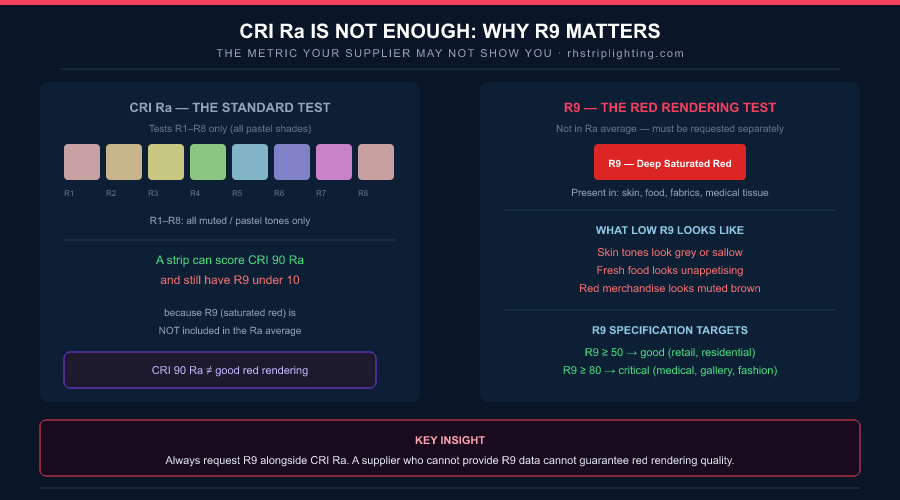
CRI (Color Rendering Index) Ra is an international standard metric defined by CIE Publication 13.3. It quantifies how accurately a light source renders the colours of objects compared to a reference illuminant—daylight or an ideal blackbody radiator at the same correlated colour temperature—by measuring eight standardised test colour samples (R1–R8).
The eight R1–R8 samples are all muted, pastel-range colours: desaturated red, yellow, green, blue-green, blue, blue-violet, violet, and a skin tone reference. Averaging the colour rendering accuracy across these eight samples produces the Ra value reported as CRI.1
A CRI Ra of 100 means perfect colour rendering accuracy relative to the reference illuminant. A CRI Ra of 80 means measurable colour distortion is present. The industry generally treats CRI 80 as the code-minimum threshold for occupied spaces and CRI 90 as the premium benchmark.
The R9 Gap: Why CRI Ra Is Not Enough
The IES and CIE extended the standard test colour samples beyond R8 to include R9 through R15, covering saturated colours: deep red (R9), yellow (R10), green (R11), blue (R12), leaf green (R13), skin tones at two additional reference points (R14, R15). Of these, R9—deep saturated red—is by far the most practically important.
Insight: The R9 blind spot in LED phosphor design. Many LED phosphor formulations are optimised for the R1–R8 sample set because that is what determines the commercially reported CRI Ra number. The deep red spectral component required for R9 accuracy requires either a different phosphor chemistry or the addition of a red-emitting semiconductor chip—both of which add cost and, in many formulations, reduce overall efficacy. The result is an industry pattern where products achieving CRI 90 Ra routinely have R9 values in the range of 5–30: technically compliant with common specifications, but objectively poor at rendering anything containing deep red spectral reflectance.2
The practical consequences of low R9 in occupied environments:
- Skin tones: Human skin has significant reflectance in the red and near-red spectrum. Under low-R9 lighting, skin of all ethnicities appears grey, pallid, or unnatural. This is the single most common occupant complaint in lighting installations with technically compliant CRI 90 specifications.
- Food: Fresh meat, tomatoes, berries, and other red foods lose their visual freshness cues under low-R9 lighting. In grocery, food service, and hospitality environments, this directly affects consumer perception and purchasing behaviour.
- Textile and retail merchandise: Red, burgundy, and warm-toned fabrics appear muted and shifted toward brown. Fashion retailers who have experienced this effect uniformly request high-R9 specification for their relighting projects.
- Medical and clinical environments: Tissue colour, wound assessment, and jaundice evaluation all depend on accurate red rendering. Clinical guidelines for healthcare lighting explicitly reference R9 performance.
For any of these applications, always specify R9 alongside CRI Ra. If a supplier cannot provide R9 data, they cannot guarantee red rendering quality.
TM-30-20: A More Complete Colour Quality Standard
The IES TM-30-20 standard was developed specifically to address the limitations of CRI Ra. It uses 99 test colour samples drawn systematically from across the full visible spectrum, providing a comprehensive coverage of colour rendering accuracy that is not biased toward pastels.
TM-30 reports two primary metrics:
- Rf (Fidelity Index): Analogous to CRI Ra—how accurately the full set of 99 colours is rendered compared to the reference. Scaled 0–100 like CRI.
- Rg (Gamut Index): A measure of whether colours appear more vivid (Rg > 100) or less vivid (Rg < 100) than under the reference illuminant. Scaled around 100, where 100 = perfect gamut fidelity.
Insight: The saturation paradox that CRI cannot detect. TM-30’s Rg metric reveals a failure mode that CRI Ra is blind to: colour oversaturation. Some LED phosphor formulations designed for high CRI Ra actually boost certain colour channels beyond the reference, producing Rg values above 110. The effect is that reds appear more vivid than they would under daylight—not less vivid. In museum and gallery applications, this is as problematic as undersaturation: it alters the artist’s intended colour relationships and distorts the viewer’s perception of the work. The IES TM-30-20 standard recommends Rg between 85 and 115 for general applications and between 95 and 105 for critical colour work. A strip with Rf 90 and Rg 105 is significantly more colour-accurate than one with Rf 92 and Rg 115—a distinction invisible to standard CRI Ra reporting.3
TM-30 reporting is increasingly specified in museum, gallery, medical, and high-end retail environments. When evaluating strips for these applications, request both Rf and Rg values in addition to CRI Ra and R9. An Rf ≥ 85 with Rg between 95–105 represents excellent colour quality for most critical applications.
CRI Tiers and How to Specify by Application
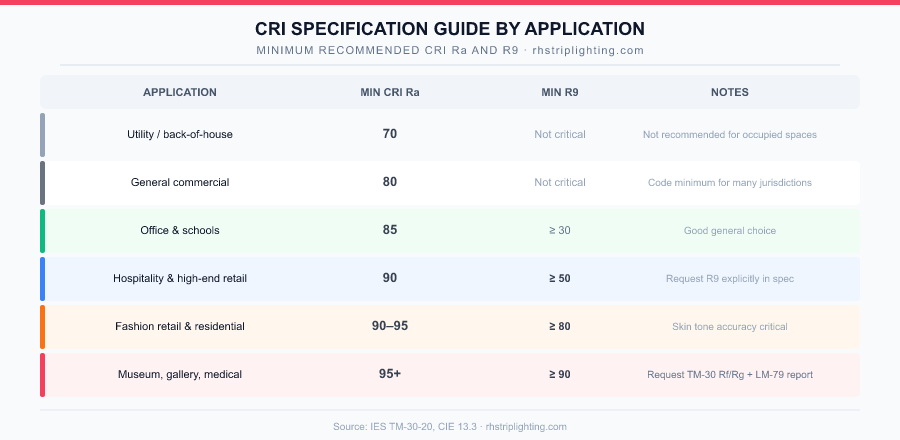
The table above provides a complete application-matched CRI specification reference. Several points deserve emphasis:
The Case Against Over-Specifying CRI
CRI 95 in a utility corridor wastes project budget without improving occupant experience. Higher CRI strips consume more electrical energy per lumen of output—the efficacy penalty for CRI 95 versus CRI 80 is typically 20–30% in equivalent products. Specifying the minimum CRI appropriate for each application type is an engineering discipline, not a quality shortcut.
The Case Against Under-Specifying CRI
The reverse error is more common and more consequential. Specifying CRI 80 in a restaurant, luxury residential space, or fashion retail environment produces objectively substandard light quality. The cost difference between CRI 80 and CRI 90 strip product is typically 10–20%—a small fraction of total project cost, but the quality difference is perceptible to every occupant every day for the life of the installation.
The R9 Addition Rule
As a practical rule: whenever you specify CRI 90 or above, also specify R9. The addition of a minimum R9 value to the specification costs nothing and prevents the specific failure mode of technically compliant but visually unsatisfactory installations. Minimum R9 targets by application tier:
- Office, retail (general): R9 ≥ 30
- Hospitality, premium retail: R9 ≥ 50
- Fashion retail, residential: R9 ≥ 80
- Medical, gallery, museum: R9 ≥ 90
The Efficacy Trade-Off: What You Give Up for Higher CRI
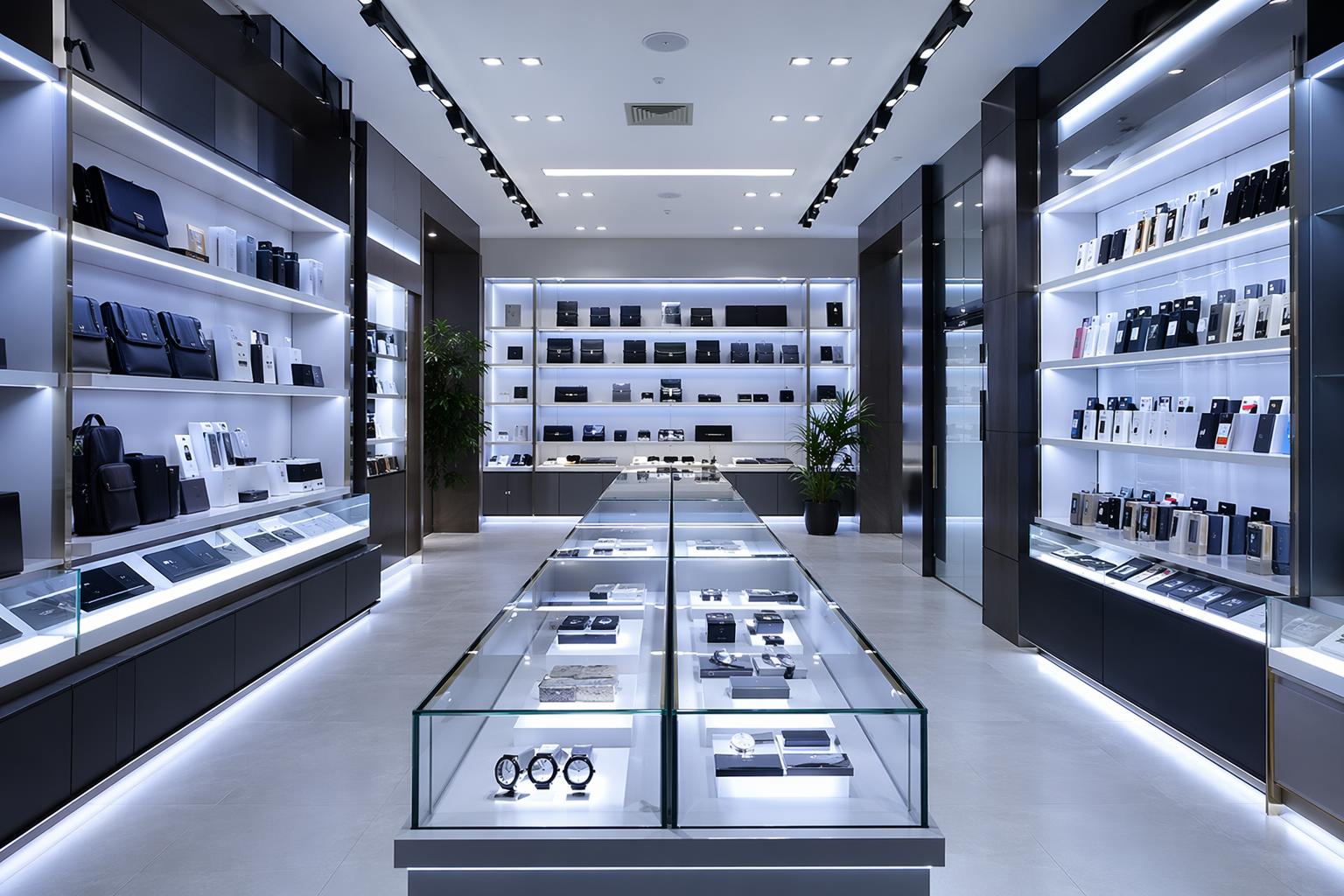
Higher CRI requires a phosphor formulation that fills in spectral gaps—particularly in the red range—that narrowband or lower-quality phosphors leave empty. This spectral infill adds optical path length and increases the probability of photon reabsorption before it exits the package, reducing efficacy.
| CRI Level | Typical Efficacy Range | Efficacy Penalty vs CRI 80 |
|---|---|---|
| CRI 70–79 | 160–200 lm/W | Baseline |
| CRI 80–84 | 140–180 lm/W | ~10% |
| CRI 85–89 | 130–165 lm/W | ~15% |
| CRI 90–94 | 110–150 lm/W | ~20% |
| CRI 95+ | 90–130 lm/W | ~25–30% |
This trade-off must be factored into photometric calculations. A specification that calls for CRI 95 but uses the same lm/W assumption as a CRI 80 product will under-deliver on illuminance levels. Obtain the specific lm/W for the actual product specified, not a generic category average.
Verifying CRI Claims: What to Ask For
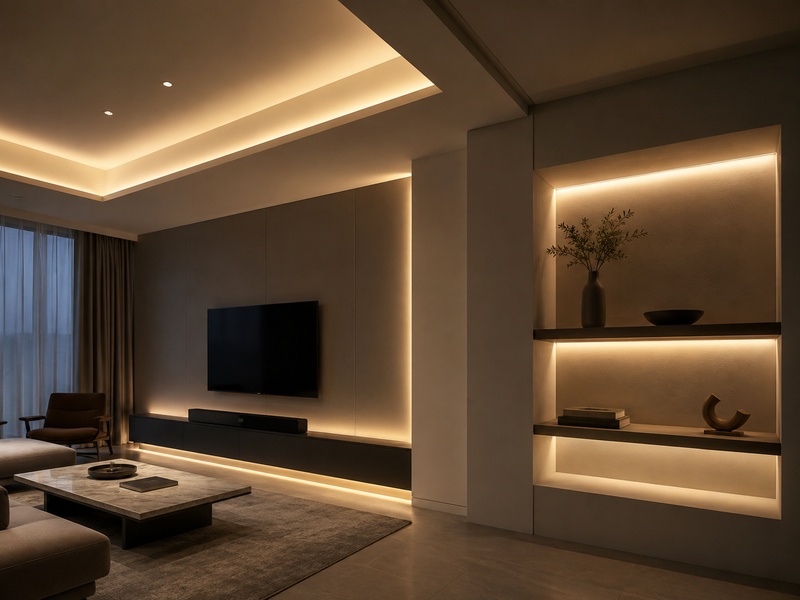
CRI can be self-certified by manufacturers without independent verification. In commodity LED strip markets, CRI ratings are sometimes materially overstated—not by a small rounding error, but by significant margins. For any specification above CRI 85, request:
- IES LM-79 test report from an accredited third-party laboratory. LM-79 is the accepted standard for measuring luminous flux, efficacy, and colour characteristics of LED products. Accredited laboratories include Intertek, UL, Eurofins, and SGS. In-house test reports, even from reputable manufacturers, are not acceptable substitutes for third-party LM-79 documentation in critical specifications.
- Spectral power distribution (SPD) data. The SPD curve plots energy output across the visible spectrum and immediately reveals the quality of the phosphor formulation. A high-quality CRI 90 strip shows a broad, well-distributed spectrum with no large gaps. A strip gaming CRI 90 Ra while sacrificing R9 will show a low red tail in the SPD.
- Physical samples with production batch numbers. Verify the sample against the specification before committing to a bulk order. CRI specifications are batch-specific, and production variability between batches is a documented issue in LED strip manufacturing.
The U.S. Department of Energy SSL program’s Lighting Facts database provides independently verified performance data for listed products—a useful verification resource for product categories where manufacturer claims require scrutiny.4
FAQ
Is CRI 90 always better than CRI 80 for retail?
Not necessarily—it depends on the retail category. Electronics and furniture showrooms can function well at CRI 85. Fashion, jewellery, cosmetics, and food retail genuinely benefit from CRI 90 with R9 ≥ 50. The question is not CRI per se but whether the specific spectral rendering of the product material is adequate for the visual merchandising task.
Can I specify CRI 95 and R9 ≥ 90 and expect any supplier to meet it?
Yes, but the product pool narrows significantly. CRI 95+ with R9 ≥ 90 requires premium phosphor formulations typically found only in specialist high-CRI product lines. Lead times may be longer and pricing will be higher. Request samples and LM-79 documentation before committing to a specification that constrains your sourcing options.
Does COB always have better CRI than SMD?
No. COB strips are more commonly specified at CRI 90+ as a baseline because the market for COB has historically been premium applications. But SMD strips are available at CRI 95+ as readily as COB strips, and the CRI of either technology is entirely a function of phosphor formulation, not package type.
What is R9 for addressable RGB strips?
RGB strips do not have a meaningful R9 specification in the conventional sense—R9 is a measure of rendered deep red, and RGB “white” by definition does not produce spectrally continuous light. R9 specifications apply only to phosphor-converted white light sources (single-colour, tunable white, RGBW in white mode).
Recommended Products
High-CRI LED Strip Products
| CRI Requirement | Recommended Product |
|---|---|
| CRI 85+, general commercial | Single Color SMD LED Strip (CRI 90 standard) |
| CRI 90+, R9 ≥ 50, hospitality | Single Color COB or SMD CRI 90+ spec |
| CRI 95+, R9 ≥ 80, critical applications | Single Color COB CRI 95+ (LM-79 on request) |
| CRI 90+ with tunable white | Tunable White SMD · Tunable White COB |
LM-79 test reports, SPD data, and R9 values are available on request for all high-CRI product lines. Contact our technical team before specifying for critical colour applications.
References
- CIE Publication 13.3, Method of Measuring and Specifying Colour Rendering Properties of Light Sources, Commission Internationale de l’Éclairage, 1995. ↩
- U.S. Department of Energy, Color Quality of LED Lamps, Solid-State Lighting Program; analysis of R9 performance in commercial LED products. ↩
- Illuminating Engineering Society, IES TM-30-20: IES Method for Evaluating Light Source Color Rendition, 2020; Rg gamut index methodology and recommended specification ranges. ↩
- U.S. Department of Energy, Lighting Facts Program, independently verified LED product performance database. ↩
Request a Project or Trade Quote
Sourcing for an installation project, resale or OEM production? Share your requirements below. You can discuss project samples before committing to a bulk order.
Related Articles

LED Strip Lighting in Historic Buildings: Design for Removal, Not Just Installation
Plan LED strip lighting in historic interiors around protected finishes, removable supports, cable routes, heat, and maintenance without avoidable damage.
LED Strip Lighting for Retail Fitting Rooms: Face, Fabric, and Mirror Glare
Specify fitting-room LED strip lighting for faces, fabrics, and mirrors. Compare color reports, test reflected glare, and approve a repeatable…

LED Strip Lighting for Indoor Plant Walls: Accent Light or Grow Light?
Specify LED lighting for indoor plant walls without confusing visual brightness with plant needs. Review PPFD, DLI, controls, moisture, and…