
LED Strip Lighting for Staircases: What Installers Need to Know
Staircase lighting is one of the easiest places for an LED strip project to look impressive at first glance and disappointing in real use.
From our perspective, that happens because too many staircase strip installations are still approached like decorative add-ons. The strip is treated as an architectural accent, but the installer is actually solving a mixed problem that includes safety, visual guidance, glare control, durability, driver planning, and finish quality at very close viewing distance.
That combination makes staircase lighting less forgiving than many wall-wash or cove-light applications. A strip that looks acceptable under a shelf or inside a ceiling recess may perform badly on a stair because people see it from above, below, and side-on, often from just a few feet away. They also rely on it to read tread depth, changes in level, and edge definition while moving.
So the right question is not simply how to put LED strip on a staircase. The better question is how to specify and install it so that the staircase looks clean, feels safe, and still performs reliably after regular daily use.
Staircase Strip Lighting Is a Safety-and-Detail Project, Not Just a Decorative One
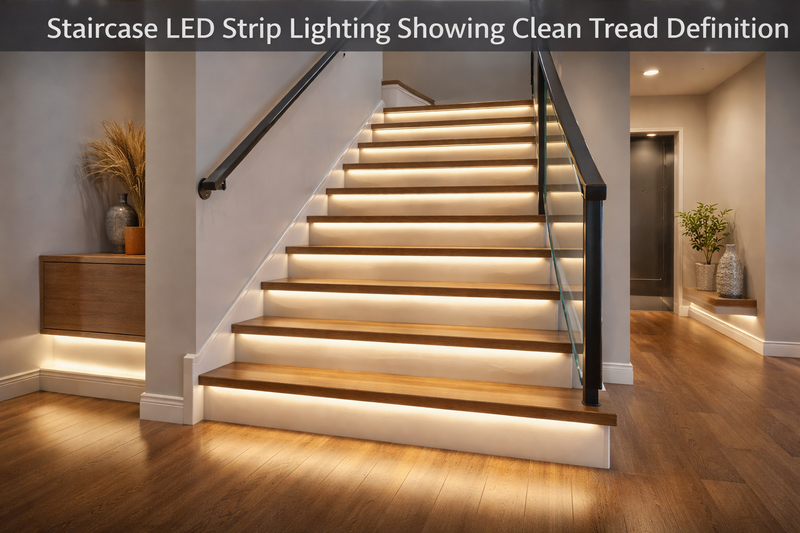
One of the biggest mistakes we see in staircase LED strip projects is that the installation is judged mainly by whether it looks dramatic in a photo. That is the wrong performance standard.
A staircase is not a shelf, not a wall niche, and not a media unit. People move through it dynamically, often carrying objects, turning corners, or stepping between lighting transitions. That means the strip has to do more than create a visual line. It needs to support orientation and comfort while still looking refined at close range.
From an installer’s point of view, staircase strip lighting needs to answer several practical questions at once:
- Can the user read the edge of each tread clearly?
- Does the strip create glare when viewed from below or from the landing?
- Will the strip still look continuous once mounted into the actual stair material?
- Is the channel protected enough from impact, cleaning, and foot traffic contamination?
- Can the power supply and cable routing be hidden without making future maintenance unreasonable?
When these questions are not handled early, the project usually ends up with one of two bad results. Either the staircase looks attractive but uncomfortable, or it feels bright enough for safety but visually crude and overexposed. In both cases, the installation has failed because staircase strip lighting has to satisfy both functions at the same time.
That is why we usually tell installers this: on a staircase, good-looking light is not enough. If the detail does not support movement, the design is incomplete.
The Mounting Position Changes Everything
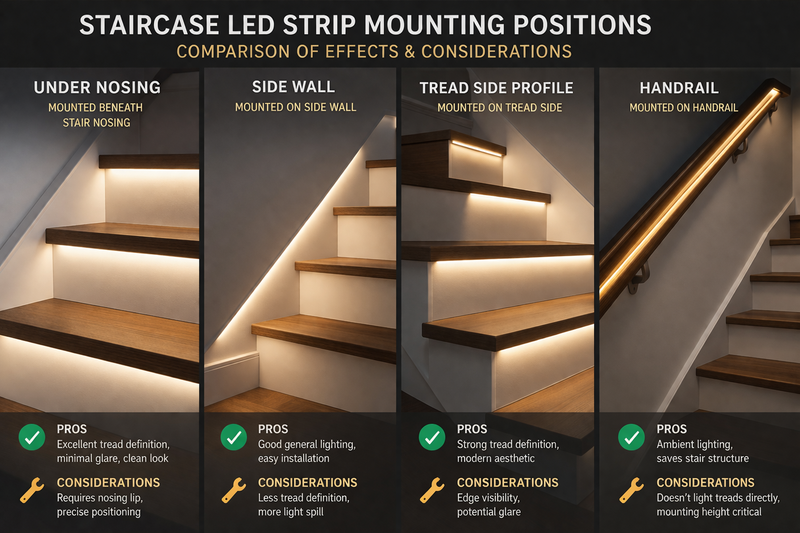
If there is one decision that changes the entire staircase result, it is mounting position.
We see many discussions around CCT, wattage, and profile type, but the mounting location usually has a bigger effect on the final experience than any one of those decisions in isolation. A strip mounted under the tread nosing behaves very differently from one mounted at side-wall skirting level. A handrail-integrated strip creates a different visual hierarchy from a recessed wall strip washing across the treads.
The most common staircase strip positions include:
| Mounting position | Typical effect | Main risk |
|---|---|---|
| Under tread nosing | Strong tread-edge definition, premium architectural look | Glare if exposed too directly |
| Side wall recessed low level | Good step visibility, cleaner sightline | Weak tread emphasis if too far from step edge |
| Tread side profile | Graphic linear effect, modern appearance | Visible source and inconsistent finish if detailing is weak |
| Handrail integrated | Soft wayfinding and side guidance | Insufficient tread definition if used alone |
| Stringer or underside wash | Architectural mood lighting | May look good but contribute little to actual step reading |
From our perspective, installers get into trouble when they choose the mounting position based mainly on where the cable route is easiest. That may save time during rough-in, but it often creates a staircase that is much harder to look at comfortably after handover. The easiest route is not always the right lighting position.
A strong staircase project usually chooses the mounting point by asking: where will the light do the best job of defining the stair without showing the source too aggressively? Once that answer is clear, the installation detail can be built around it.
Glare Is the Fastest Way to Ruin a Staircase Installation
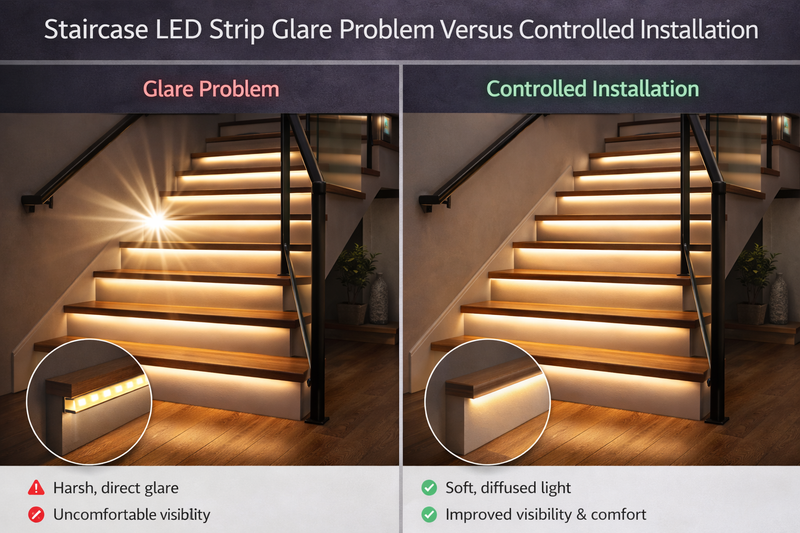
A staircase strip can be bright, elegant, expensive, and still fail because of glare.
This is one of the most common problems in stair projects, and it is also one of the most avoidable. Installers often focus on making the step visible, but in doing so they mount the strip in a position where the LED source can be seen directly from the approach angle, from below the stair, or from the landing. The result is a staircase that photographs well but feels uncomfortable in motion.
Direct glare is especially problematic on stairs because the eye is already adjusting to movement, changing elevation, and varying viewing angles. A visible source line at low level can become irritating very quickly, particularly in residential stairs, hotel corridors, apartment common areas, or premium retail settings where people expect the lighting to feel seamless.
There are several ways glare gets created:
- the strip is mounted with no diffuser or shielding
- the profile is too shallow for the viewing angle
- the source is too close to eye line at the approach direction
- the lumen output is too high for the scale of the stair
- the installer assumed brightness would solve visibility without checking comfort
From our side, staircase lighting should define the step, not fight the eye. If the user notices the LED chips before they notice the stair edge, the installation has already lost control of the visual hierarchy.
This is why diffuser quality, profile depth, and source setback matter so much on stairs. A slightly softer but cleaner line usually performs better than a more powerful strip that exposes the source and creates discomfort.
Uniformity and Cut-Point Planning Matter More Than People Expect
In staircase strip work, the visual tolerance is very unforgiving. People view the lighting from short distances, along long diagonal sightlines, and across repeating step geometry. That means inconsistency becomes visible immediately.
Two problems show up again and again in weak staircase installations:
- uneven brightness from step to step
- messy transitions at strip cut points, corners, or stair returns
Even when the electrical installation is technically acceptable, the project still looks unfinished if one step glows more brightly than the next, if a joint creates a visible dead gap, or if the profile alignment drifts as the staircase rises. This is where installers often discover too late that staircase strip projects are joinery-detail jobs as much as lighting jobs.
From our perspective, good staircase lighting depends heavily on consistency. The human eye reads repetition very quickly on a stair. When that repetition is broken, the viewer may not understand the technical cause, but they immediately register that the staircase feels cheaper, rougher, or less carefully built.
That is why installers should confirm all of the following before final fixing:
- actual run lengths for each stair segment
- cut points relative to profile terminations
- whether each step run needs equal visual output or equal electrical length
- corner treatment at landings or turns
- whether feed points create uneven brightness across longer stair runs
- how the strip output looks once installed behind the final diffuser, not just when powered loose on site
A staircase can have good materials, excellent craftsmanship, and still look wrong if the light line loses consistency. In many projects, visual continuity is what separates a premium installation from one that merely “has LED strips on it.”
Drivers, Voltage Drop, and Maintenance Planning Should Be Decided Before Finishes Close Up
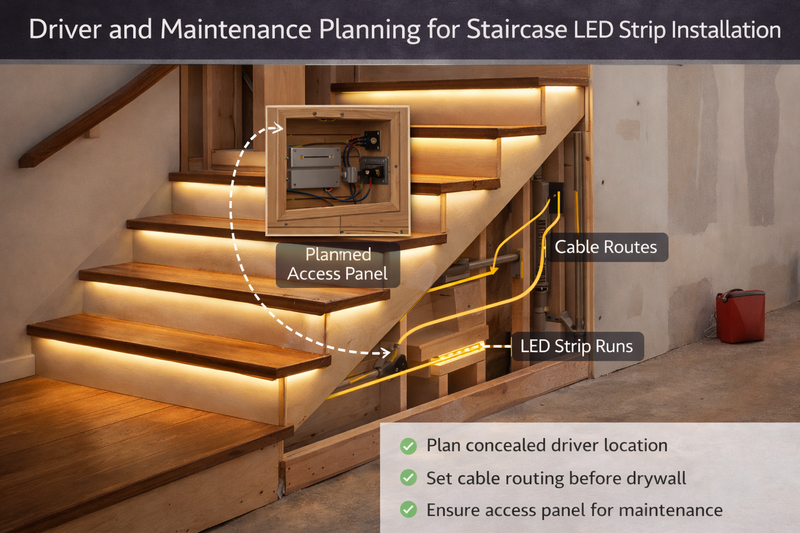
This is where many staircase strip projects become unnecessarily painful later.
Because the visible part of the installation is usually small and elegant, installers and site teams sometimes underestimate the support system behind it. But staircase LED strip reliability depends heavily on what happens behind the wall, under the tread, or inside the joinery before the visible profile is even fitted.
Key planning questions include:
- Where will the drivers sit?
- How accessible will they be after the staircase is finished?
- Are the run lengths suitable for the selected voltage and wattage?
- Will voltage drop become visible across a long stair run or multiple connected steps?
- How are cable transitions handled at turns, landings, or structural breaks?
- If one section fails later, can it be serviced without damaging expensive finished materials?
From our side, this is one of the clearest differences between a clean opening-day installation and a staircase that becomes a maintenance headache six months later. A project that hides every electrical component beautifully but makes it impossible to service is not really a premium installation. It is just postponing the pain.
We usually recommend that staircase strip projects treat access as part of the design brief. That does not mean exposing hardware. It means making intelligent decisions early enough that future replacement, driver servicing, or fault tracing does not require dismantling half the stair.
If the project team is still in specification mode, it also helps to think through the power and control side the same way we do in our article on how to choose the right dimming method for LED strip lights, because control compatibility problems are much more expensive once staircase finishes are already complete.
The Best Staircase Strip Installations Look Quiet, Not Overdesigned
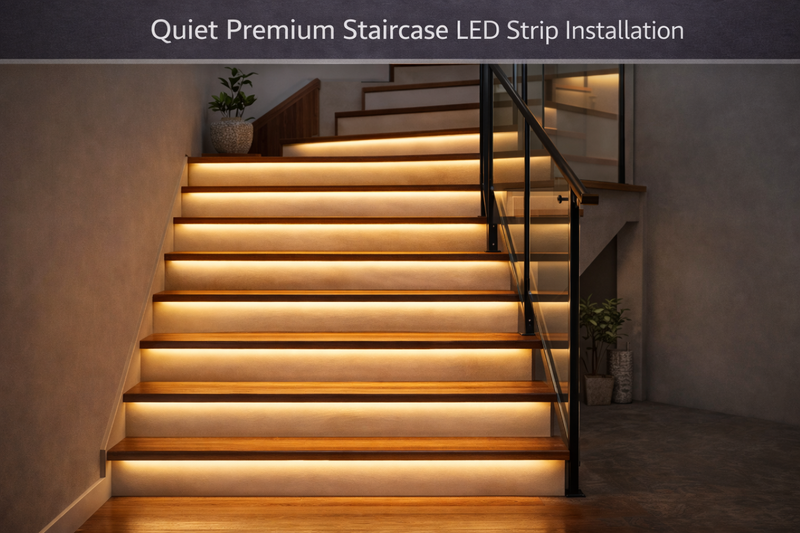
Image brief: Refined staircase lighting result with subtle, continuous LED strip integration that enhances the stair without overpowering the architecture.
A lot of staircase lighting goes wrong because too much effort is spent trying to make the lighting noticeable.
But the strongest staircase strip installations usually have the opposite quality. They look quiet. The stair feels more refined, easier to read, and more intentional, but the light does not scream for attention. It supports the architecture instead of competing with it.
From our perspective, that is an important mental shift for installers and specifiers. A staircase is one of the few places where LED strip can quickly cross the line from elegant to overdesigned. If the line is too bright, too exposed, too blue, too dotted, or too dramatic for the material palette, the whole stair can start to feel less premium instead of more.
That is especially true in projects where the staircase materials are already doing strong design work, such as:
- timber treads with concealed nosing details
- stone stairs with crisp geometric lines
- metal staircases with sharp architectural profiles
- boutique hospitality or luxury residential interiors
In those settings, the job of the strip is usually to support definition and atmosphere, not to become the main event. Installers who understand that tend to produce results that age better and receive fewer complaints after handover.
What Installers Should Confirm Before Ordering Staircase LED Strip
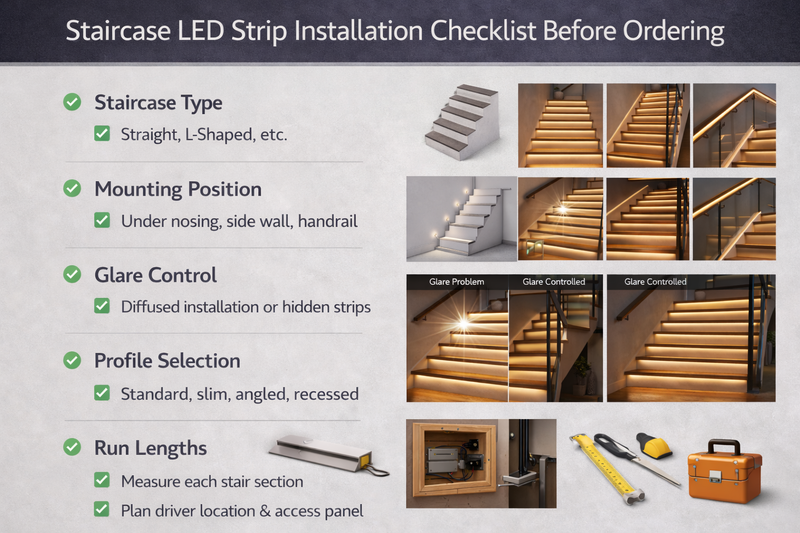
Before placing the order, we recommend checking these points clearly:
Staircase LED Strip Checklist
- staircase type and material palette are confirmed
- mounting position is selected based on visibility and glare, not only cable convenience
- profile and diffuser are matched to the viewing angle
- strip density and type are chosen for visual continuity
- actual run lengths and cut points are planned
- voltage drop has been checked for the real run layout
- driver location and future access are confirmed
- control or dimming requirements are confirmed if applicable
- mock-up or sample section has been reviewed from real approach angles
- the desired result is subtle and readable, not just bright
If these points are still unresolved before ordering, the staircase may still be buildable, but it is not yet well specified.
FAQ
Where is the best place to install LED strip on a staircase?
There is no single best location for every stair. Under-tread, side-wall recessed, tread-side profile, and handrail-integrated positions all work in different conditions. The right choice depends on glare risk, stair geometry, material finish, and the balance between visibility and aesthetics.
What colour temperature is best for staircase LED strip lighting?
For most residential, hospitality, and premium interior stairs, 2700K to 3000K is the strongest range because it feels warm and refined. In more commercial or functional settings, 3500K can also work. Very cool CCT values often make stairs feel harsher and less premium.
Do I need a diffuser for staircase LED strip?
In most cases, yes. Staircases are close-view applications, which means visible LED dots and direct source glare become obvious quickly. A proper diffuser usually improves both comfort and visual finish.
Why do staircase LED strips often look uneven after installation?
Common reasons include poor cut-point planning, inconsistent profile alignment, uneven feed distribution, visible voltage drop, and low-density strips used in close-view applications.
How do I make staircase LED strip easier to maintain later?
Plan driver access before finishes close up, keep service routes practical, and avoid installation details that require major dismantling to reach a failed component.
Final Thoughts
Staircase LED strip lighting is one of those installations that looks simple from a distance and turns highly technical once you start detailing it properly.
The best results come from treating it as a safety-and-detail project, not just a decorative one. Mounting position, glare control, continuity, power planning, and future maintenance all matter more than they do in many other strip-light applications.
From our perspective, the strongest staircase installations are not the brightest or most theatrical ones. They are the ones that feel calm, legible, and intentional every time someone uses the stair.
If you send us the staircase type, section details, mounting idea, and approximate run lengths, we can help you review which strip and profile approach makes the most sense before you place the order.
Footnotes
Recommended Products
Request a Project or Trade Quote
Sourcing for an installation project, resale or OEM production? Share your requirements below. You can discuss project samples before committing to a bulk order.
Related Articles

LED Strip Lighting for Indoor Plant Walls: Accent Light or Grow Light?
Specify LED lighting for indoor plant walls without confusing visual brightness with plant needs. Review PPFD, DLI, controls, moisture, and…

LED Strip Lighting After a Power Outage: Designing a Reliable Restart
Plan LED strip power restoration beyond total watts. Review driver inrush, switching limits, restart scenes, and commissioning before project handover.

Why LED Strip Lights Buzz When Dimmed: A Guide for Quiet Spaces
Diagnose LED strip buzzing without guessing. Review drivers, PWM controls, mounting resonance, and low-level acoustic acceptance for quiet interiors.