
How to Specify LED Strip Lighting for a Commercial Office Project
Most commercial office lighting specifications start from the wrong place. They begin with a fixture schedule or a product catalogue, before anyone has clearly defined what the lighting is supposed to do in each part of the space.
From our perspective, that is why so many office LED strip installations look acceptable in photos but feel flat in person. The product was chosen before the problem was defined.
Specifying LED strip lighting for a commercial office is not complicated, but it does require more rigour than most residential or hospitality applications. Office environments carry specific performance obligations: task illumination that meets occupational standards, visual comfort that reduces fatigue over a working day, and energy efficiency that satisfies building or certification requirements. A strip that misses any of these is not just aesthetically wrong. In some cases, it is a specification failure with measurable consequences for the people working under it.
The good news is that most of these failures are avoidable if the specification is built correctly from the start.
The Biggest Mistake in Office LED Strip Specifications Is Starting with the Product
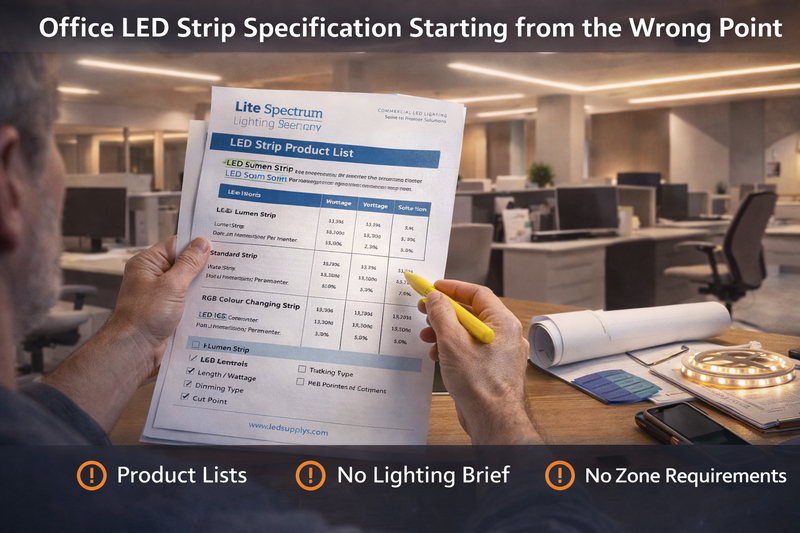
We see this pattern regularly. A contractor or fit-out team receives a brief that says something like "LED strip under all overhead shelving and in the ceiling coves." They select a product that looks appropriate, order it, and install it.
The result is usually functional but rarely optimal, because no one asked the harder questions first:
- What lux level is needed at the desk surface?
- What CCT suits the work being done in each zone?
- Does the strip need to support a building control or occupancy-sensing system?
- Is glare control required, and if so, how?
- What CRI level is appropriate for the tasks being performed?
- What dimming range is required, and must it be smooth at low levels?
When those questions are not answered before the product is chosen, the specification is built backwards. The team ends up defending a product choice rather than solving a lighting problem.
From our side, the better starting point is always a lighting brief, not a product list. The brief defines the performance requirements. The product comes after.
Understand the Zones Before Choosing Any Product
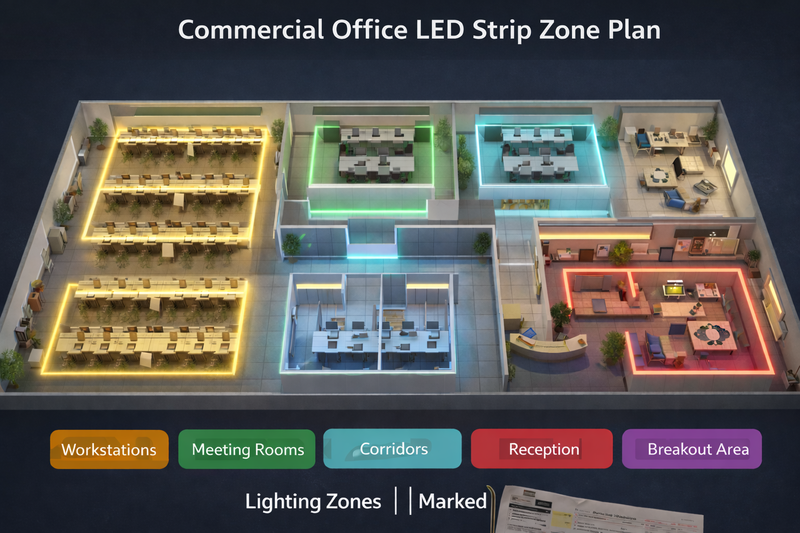
A commercial office is not one space. It is a collection of zones, each with different occupancy patterns, task requirements, and lighting goals.
Getting this wrong is expensive. Not because the strip itself costs much, but because fixing a poorly specified installation in a live office environment means disruption, downtime, and the kind of client relationship damage that follows a project team for a long time.
The zones that typically require individual attention in a commercial office LED strip project include:
| Zone | Key lighting requirement | Common mistake |
|---|---|---|
| Open plan workstations | Adequate task illumination, low glare | Over-bright ceiling ambient creating screen glare |
| Private offices | Controllable, adjustable | Single fixed output with no dimming |
| Meeting and conference rooms | Versatile, presentation-capable | Strip only, no task layer, poor lux at table |
| Reception and lobby | Brand impression, welcoming | Too cool a CCT, creating a clinical feel |
| Corridors and circulation | Orientation, safety, energy efficiency | Overpowered for the function |
| Breakout and café areas | Relaxed, lower intensity | Same spec as workstation area, feels wrong |
| Server rooms or specialist areas | Functional, maintenance-focused | Insufficient lux for service tasks |
We usually recommend completing a zone-by-zone matrix before any product is proposed. That matrix becomes the backbone of the specification and the reference point for any changes or value-engineering discussions later.
Lux Levels Matter, and Guessing Them Is a Professional Risk
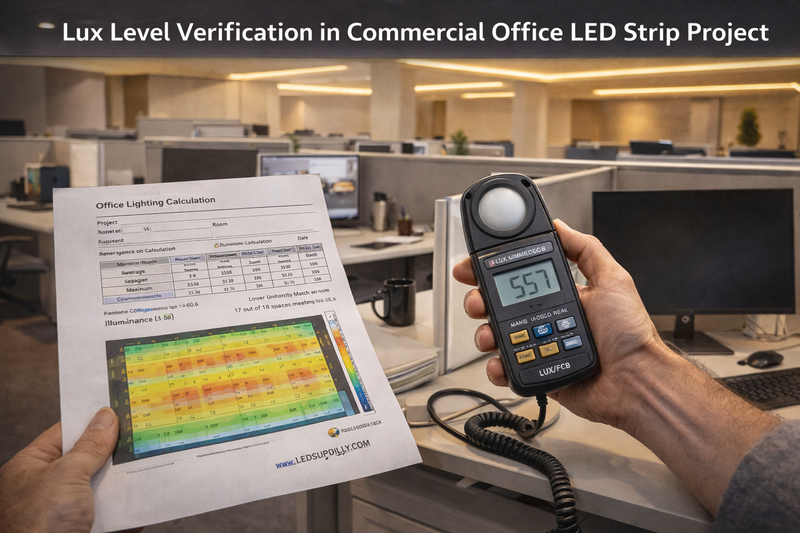
In a commercial office, lux levels are not a guideline. In many markets and under many building standards, they are a requirement.
Typical workstation areas in commercial offices are expected to achieve 300 to 500 lux at the desk surface, depending on the standard being applied and the nature of the work. Meeting rooms generally require similar levels. Corridors and circulation can be lower, typically 100 to 200 lux.
If LED strip is being used as the primary or supplementary light source, the specification must confirm that the strip, at the planned mounting height and spacing, will actually deliver the required illuminance level in use. That is not a visual judgement. It requires a lighting calculation.
From our side, this is where many office strip specifications fail quietly. The strip looks bright enough in a sample. It is installed. The office opens. The measured lux levels at the desk surface fall short because the calculation was never done.
We are not suggesting that every strip specification requires a full photometric design. But for any application where lux levels are a contractual or regulatory requirement, the strip output must be verified against the geometry of the installation before the product is committed.
Standards references that are commonly applied in commercial office lighting include guidance from the Illuminating Engineering Society and the CIBSE Lighting Guide, both of which provide recognised benchmarks for office illuminance requirements.
CCT for Offices Should Support Alertness Without Creating Harshness
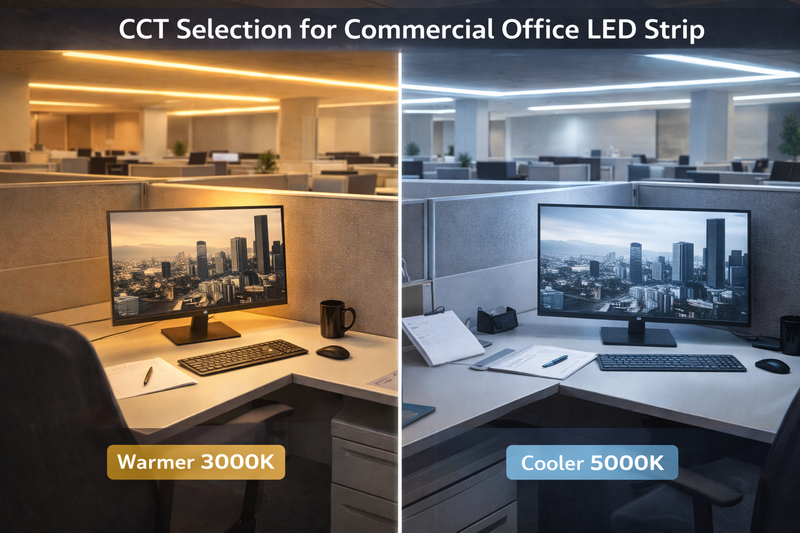
CCT in office environments is a balance between alertness and comfort.
The common error is specifying too cool a CCT across the entire office in the belief that higher colour temperature means better productivity. Research does not support that as a universal rule, and in practice, a 5000K to 6500K strip in an enclosed private office or meeting room often feels harsh and clinical after more than an hour of occupancy.
Our general guidance for commercial office CCT:
- Open plan workstations: 3500K to 4000K is usually the right range. It supports visual alertness without feeling cold or fatiguing over a full working day.
- Meeting and conference rooms: 3000K to 4000K, depending on whether the room is used primarily for focused work or for more relaxed discussion and presentation.
- Reception and lobby: 3000K to 3500K. A slightly warmer tone creates a more welcoming first impression without sacrificing clarity.
- Breakout and café areas: 2700K to 3000K. These zones benefit from a more relaxed tone that signals a change in pace from the workstation area.
- Corridors: 3500K to 4000K is functional and consistent with the broader office environment.
We also recommend thinking carefully before applying a single CCT across the entire office as a simplification measure. If a developer or fit-out contractor insists on a single product across all zones, 3500K is usually the most defensible compromise, but it is still a compromise.
CRI in Offices Is About More Than Aesthetics
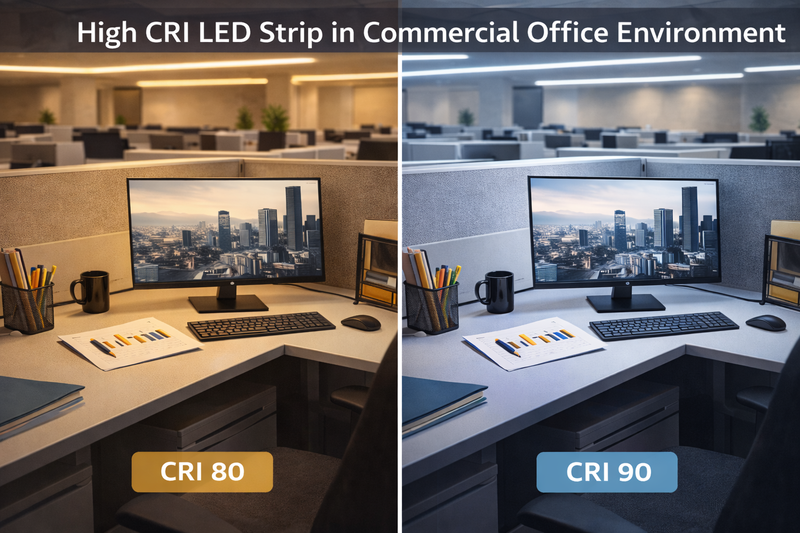
CRI matters in office environments for practical reasons that go beyond how the space looks.
Under low CRI lighting, occupants find it harder to distinguish document colours, screen content can be harder to evaluate against printed material, and after extended periods, many people report increased visual fatigue without being able to identify the cause.
CRI 80 is technically acceptable for many commercial environments, and many office strip specifications default to it for cost reasons. From our perspective, that is a reasonable choice only where budget constraints are significant and the lighting role is secondary.
For primary task lighting in a commercial office, we recommend CRI 90 or higher. The price difference is modest in the context of a full fit-out budget, and the benefit to the people working under it daily is measurable in terms of visual comfort and fatigue reduction.
For offices where colour accuracy matters professionally, such as design studios, media production, or printing environments, CRI 95 or higher should be considered mandatory.
Glare Control Is Not Optional in a Screen-Heavy Environment
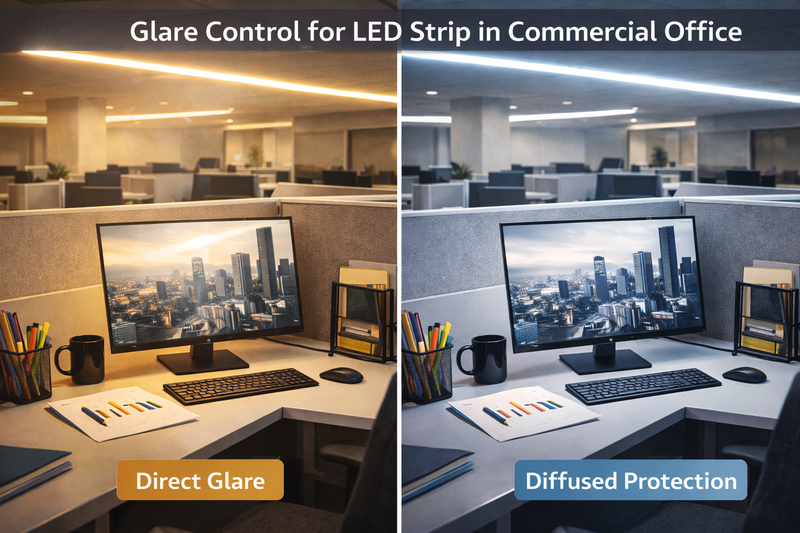
This is the specification point that most often gets underestimated in commercial office LED strip projects.
Glare from overhead LED strip can have two distinct negative effects in an office environment:
- Direct glare: The strip is bright enough and positioned such that occupants can see it directly, causing discomfort and distraction.
- Reflected glare: The strip is reflected in computer screens, making it harder to read the display without repositioning or squinting.
Both of these are avoidable if they are considered at the specification stage. They are much harder to fix after installation.
Glare control measures that should be considered during specification include:
- selecting strips with lower surface luminance or wider beam spread
- using diffuser profiles or channels that reduce the apparent brightness of the strip source
- positioning strips to avoid direct sightlines from primary seating positions
- considering indirect or semi-indirect installation configurations for overhead ambient applications
We usually recommend that any commercial office LED strip specification includes a glare assessment for primary workstation zones. This does not need to be a full photometric study, but the installer and specifier should be able to answer the question: will an occupant at the primary desk position be able to see this strip source directly?
If the answer is yes, the specification needs to address it.
Dimming and Control Integration Should Be Confirmed Before Product Selection
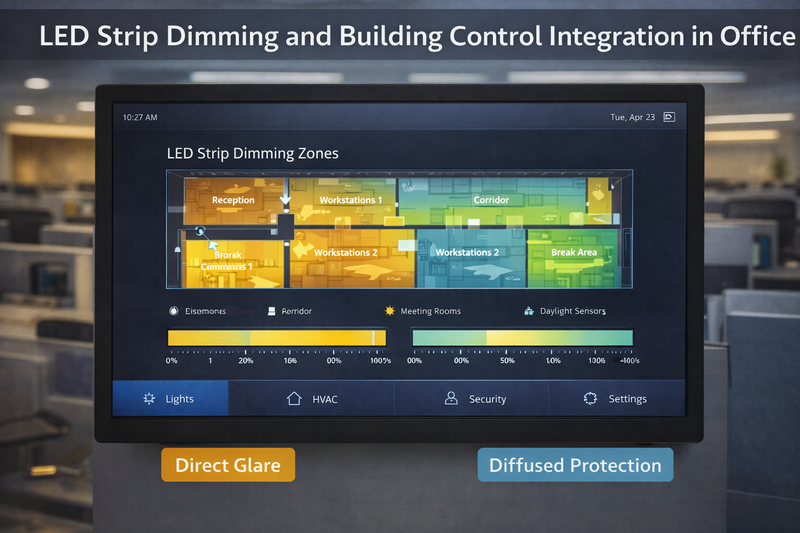
Commercial office LED strip specifications increasingly need to integrate with broader building management or lighting control systems. This requirement changes the product selection criteria significantly.
Before specifying the strip and driver, the project team should confirm:
- whether the office has or requires a building management system (BMS) integration
- what dimming protocol is being used: 0-10V, DALI, PWM, or proprietary
- whether occupancy sensors will be used to control strip zones
- whether daylight harvesting will modulate strip output in perimeter zones
- what the minimum and maximum dim level requirements are
- whether emergency lighting requirements affect any strip zones
Selecting a strip or driver that is incompatible with the control system is one of the most expensive mistakes in commercial office LED strip projects, because it is usually discovered only after installation. Replacing drivers or control gear in an occupied office is disruptive and disproportionately expensive relative to the original cost difference.
From our perspective, confirming the control system architecture is a non-negotiable step before finalising the strip and driver specification. This is also where a broader LED strip specification checklist can be useful for project teams working through a complex multi-zone commercial brief.
What Specifiers and Contractors Should Lock Down Before Ordering
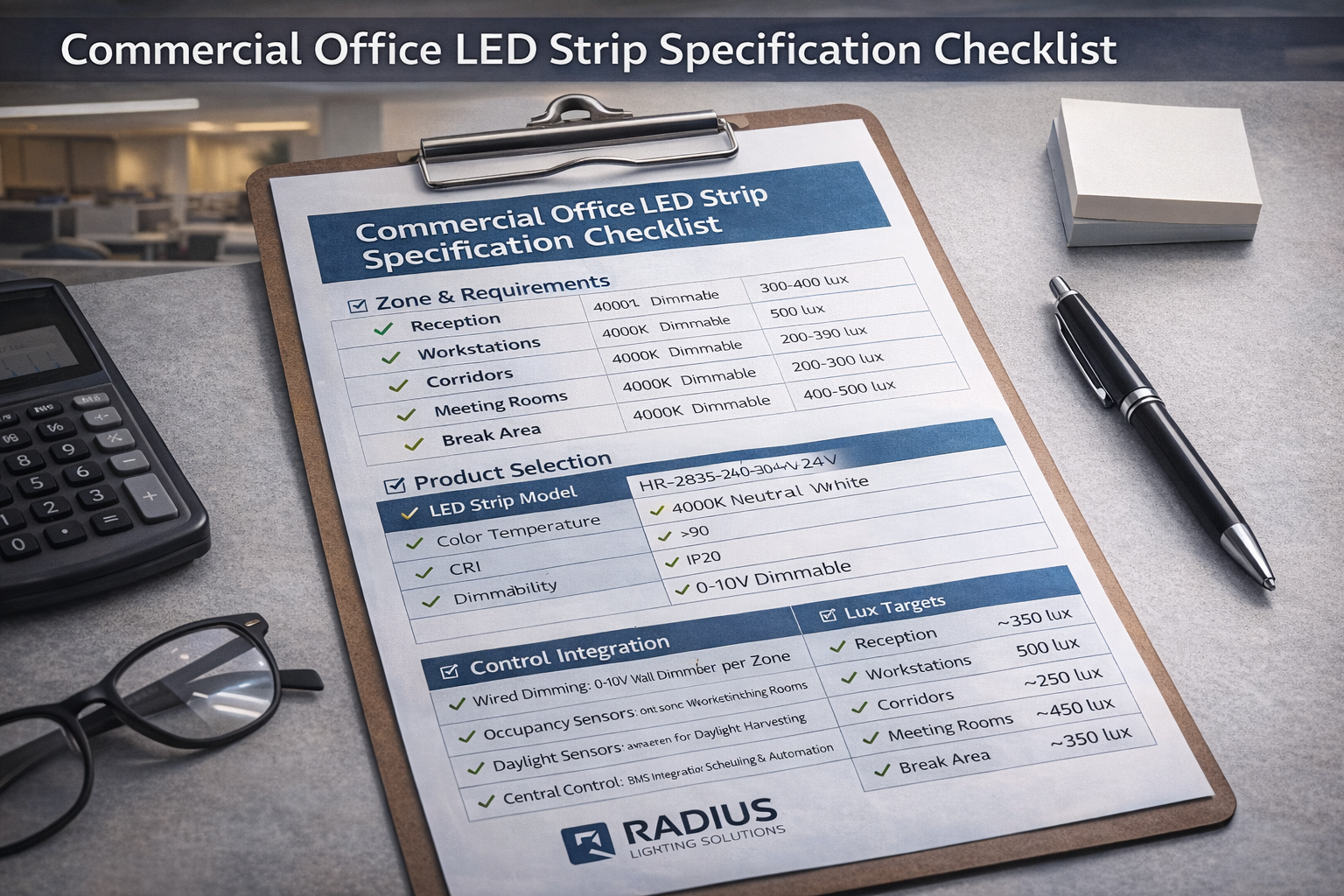
Before any product is ordered for a commercial office LED strip project, the specification should confirm:
Commercial Office LED Strip Specification Checklist
- zone map is complete with function and occupancy pattern for each area
- target lux levels are defined for task zones and verified by calculation
- CCT is specified per zone with rationale
- CRI requirement is confirmed (CRI 90 recommended for primary task areas)
- glare control measures are specified for workstation zones
- dimming range is confirmed and driver compatibility is verified
- control system protocol is confirmed (0-10V, DALI, PWM, or other)
- occupancy sensor and daylight harvesting integration is reviewed
- minimum dim level is tested and confirmed acceptable
- IP rating requirements are confirmed for any wet or exposed zones
- run length calculations are completed and maximum run limits are respected
- sample has been reviewed under real-world conditions before bulk ordering
If items on this list are still open when the order is placed, the project is carrying risk that should have been resolved at the desk, not on site.
FAQ
What lux level do I need for an office workstation?
Most commercial office standards require 300 to 500 lux at the desk surface for general office work. The applicable standard depends on the project location and building certification target. Always verify requirements against the relevant standard before finalising the specification.
Is CRI 80 acceptable for a commercial office?
Technically acceptable for secondary or ambient applications. For primary task lighting, CRI 90 or higher provides meaningfully better visual comfort and colour rendering. The cost difference at the product level is modest relative to the benefits for full-day occupants.
What CCT should I specify for open-plan workstations?
3500K to 4000K is usually the most appropriate range. It supports alertness and visual clarity without feeling cold or harsh over a full working day.
How do I avoid LED strip glare on computer screens?
Specify lower luminance strip products, use diffuser profiles, and assess the strip sightline from the primary seated position before finalising placement. Indirect or semi-indirect installation configurations eliminate direct glare at source.
What dimming protocol should I specify for a commercial office?
It depends on the building control system. DALI is widely used in commercial environments and offers precise individual zone control. 0-10V is simpler and more cost-effective for smaller projects. Confirm the protocol with the controls engineer or BMS provider before product selection.
Final Thoughts
Specifying LED strip lighting for a commercial office is not difficult, but it does require more front-end discipline than many projects allow for.
The most expensive office LED strip mistakes are not made on site. They are made at the specification stage, when someone skipped the lux calculation, ignored the glare question, or confirmed the product before verifying the control system protocol.
From our perspective, the best commercial office LED strip projects are the ones where the specification is thorough enough that by the time the product is ordered, there are no surprises left to find during installation. That level of rigour takes an extra few hours at the desk. It saves days on site and protects the professional relationship with the client.
If you are working on a commercial office LED strip specification and want to review the zone requirements, lux targets, CCT logic, or control integration before ordering, send us the project brief and we can help you check the key decision points before you commit.
Footnotes
Recommended Products
Request a Project or Trade Quote
Sourcing for an installation project, resale or OEM production? Share your requirements below. You can discuss project samples before committing to a bulk order.
Related Articles
LED Strip Lighting for Indoor Plant Walls: Accent Light or Grow Light?
Specify LED lighting for indoor plant walls without confusing visual brightness with plant needs. Review PPFD, DLI, controls, moisture, and…
LED Strip Lighting After a Power Outage: Designing a Reliable Restart
Plan LED strip power restoration beyond total watts. Review driver inrush, switching limits, restart scenes, and commissioning before project handover.

Why LED Strip Lights Buzz When Dimmed: A Guide for Quiet Spaces
Diagnose LED strip buzzing without guessing. Review drivers, PWM controls, mounting resonance, and low-level acoustic acceptance for quiet interiors.