
How to Plan LED Strip Lighting for a Hotel Room Renovation
Hotel room lighting is one of the most visible ways a renovation either succeeds or falls flat. Guests may not consciously describe the lighting, but they feel it immediately. A room with well-planned LED strip lighting feels warmer, more refined, and more deliberate. A room with poorly planned lighting feels cheap, even if everything else is expensive.
From our perspective, the problem in most hotel LED strip projects is not budget. It is planning. Most lighting mistakes in hotel renovations happen before a single fixture is ordered, because the specification phase is too short, too generic, or too focused on the wrong details. We see this pattern repeatedly: a hotel brand spends heavily on furniture, finishes, and fixtures, then uses a single generic LED strip specification across the whole room because it simplified the procurement. The result is a room that never quite feels right in any zone.
If you are planning LED strip lighting for a hotel room renovation, the right question is not simply which strip to buy. The better question is how the lighting should behave in each zone of the room, what experience it should create, and what technical conditions the strip needs to support that experience reliably over time.
That distinction matters because a strip that performs well in a warehouse demo can still disappoint in a hotel room if the colour quality, dimming behaviour, or installation method was not matched to the actual use case. And in hospitality, a lighting result that is almost right is still a problem because guests notice the gap even when they cannot name it.
Start by Mapping the Room into Lighting Zones, Not Just Locations
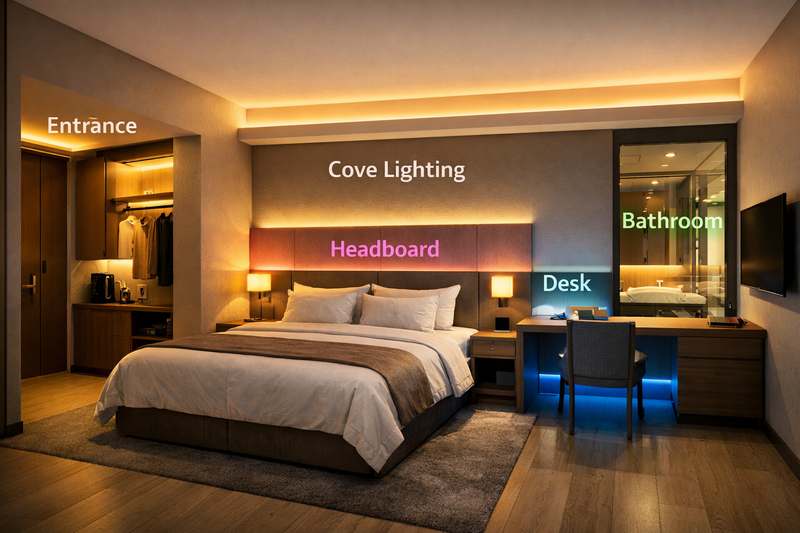
The most common mistake in hotel LED strip planning is treating the room as a single lighting problem. It is not. A hotel room contains several distinct lighting zones, each with different functional requirements, different ambience goals, and often different technical specifications.
Many hotel projects collapse all these zones into one product selection to simplify procurement. That decision always costs more in the final guest experience than it saves in the ordering process.
A structured zone map for a typical hotel room usually includes:
| Zone | Primary function | Lighting character needed |
|---|---|---|
| Cove / ceiling perimeter | Ambient fill, architectural feature | Soft, even, dimmable, no hotspots |
| Headboard / bedside | Reading, relaxation ambience | Warm, controllable, eye-level comfort |
| Desk / work area | Task lighting | Adequate brightness, neutral to cool CCT |
| Wardrobe / closet | Functional visibility | Even, triggered by door or motion |
| Bathroom mirror / vanity | Grooming task and hospitality feel | High CRI, minimal shadow, flattering tone |
| Entrance / corridor | Welcome impression, orientation | Warm, low-level, energy-efficient |
| Minibar / feature shelf | Product visibility, brand impression | Accent, colour rendering priority |
We recommend mapping these zones before any product discussion. Why? Because different zones often need different strips, different CCT values, different brightness levels, and sometimes different control systems.
If the specification collapses all zones into one product choice, the result is usually a compromise that satisfies nothing fully. The cove may be too cool, the bedside too bright, the bathroom too dim. Each zone is slightly wrong, and together they create a room that feels off without any single obvious reason.
CCT Selection Should Follow Guest Experience Logic, Not Personal Preference
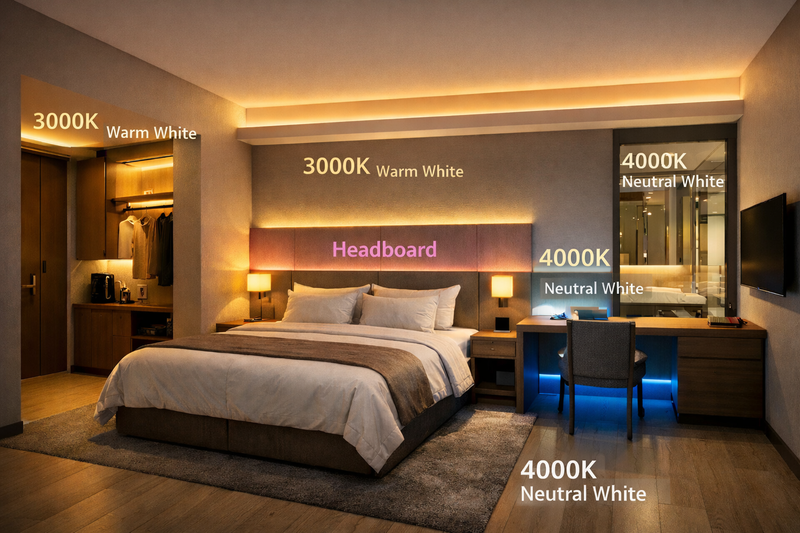
Colour temperature is one of the most impactful and most misunderstood decisions in hotel strip lighting.
The instinct many specifiers follow is "warm is better for hotels." That is partially true, but incomplete. The more expensive mistake is applying warm white everywhere because it sounds right, then delivering a work desk that feels too dim to use and a bathroom mirror that makes guests look jaundiced.
From our project experience, CCT selection should follow the guest behaviour in each zone:
- Cove and headboard areas: 2700K to 3000K. Warm tone supports relaxation and creates the premium feel most hotel brands want.
- Desk and work zone: 3500K to 4000K. Guests writing, reading, or working need adequate visual clarity. Too warm a tone makes this zone feel dim and reduces productivity.
- Bathroom and vanity: 3000K is usually the right balance. It provides enough clarity for grooming while still feeling warm enough to feel comfortable and flattering.
- Wardrobe interior: 3000K is usually sufficient. The goal is functional visibility, not ambience.
- Feature shelves or minibar accents: 2700K to 3000K, depending on the brand tone. Lower CCT values give a more premium retail feel.
We often see hotel specifications that apply a single CCT across the whole room to simplify procurement. That may be logistically convenient, but it creates lighting that never quite feels right in any zone. Procurement saves a few hours. The guest experience pays for it every night the room is occupied.
If you want to understand the broader principles behind commercial colour temperature selection, the Illuminating Engineering Society publishes guidance that remains a useful reference for specifiers working on hospitality projects.
CRI Is Not Optional in Hotel Rooms
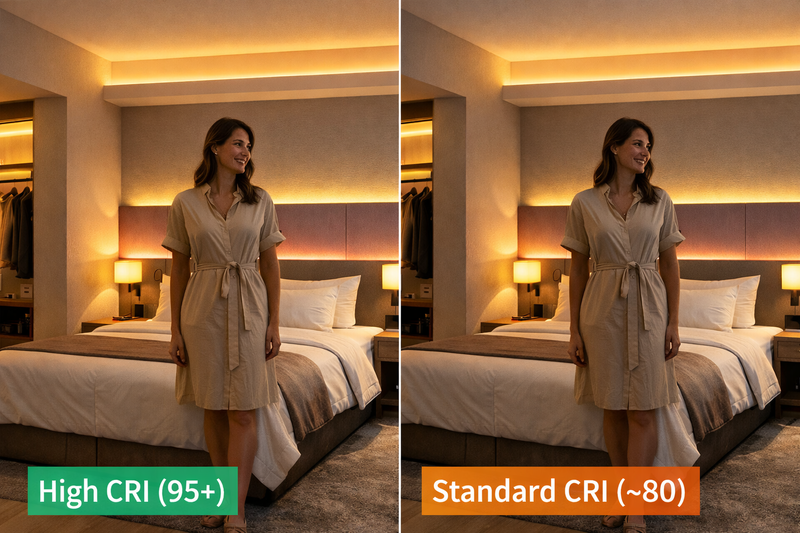
CRI is the specification item most commonly treated as optional in hotel LED strip projects. It rarely appears as a hard requirement in early briefs, which means suppliers default to the lowest grade that technically passes. In our view, that is a mistake that guests notice every time they look in the mirror or sit under the room lighting, even if they cannot name the cause.
CRI (Colour Rendering Index) measures how accurately a light source reveals the true colour of surfaces and materials. A strip with CRI 80 and a strip with CRI 90+ can have the same wattage, the same CCT, and the same brightness, but produce noticeably different results in a hotel room.
In hospitality environments, CRI affects:
- how bedding, soft furnishings, and wall finishes look
- how guests feel about their own appearance in the mirror
- how food and drinks look on the minibar or room service tray
- the overall perception of quality in the room
We usually recommend a minimum of CRI 90 for all visible hotel lighting applications. For vanity and mirror zones, CRI 95 or higher is worth specifying.
The cost difference between CRI 80 and CRI 90+ in LED strip is relatively small at the product level. The difference in guest perception is much larger. A CRI 80 strip makes skin tones look flat, fabrics look dull, and finishes look less refined. A CRI 90+ strip makes the same room look like it cost more to build.
For a more technical overview of colour rendering in lighting design, the U.S. Department of Energy publishes accessible references on LED performance metrics that are useful for specifiers who want to understand the underlying standards.
Dimming Behaviour Matters More in Hotels Than in Most Other Applications
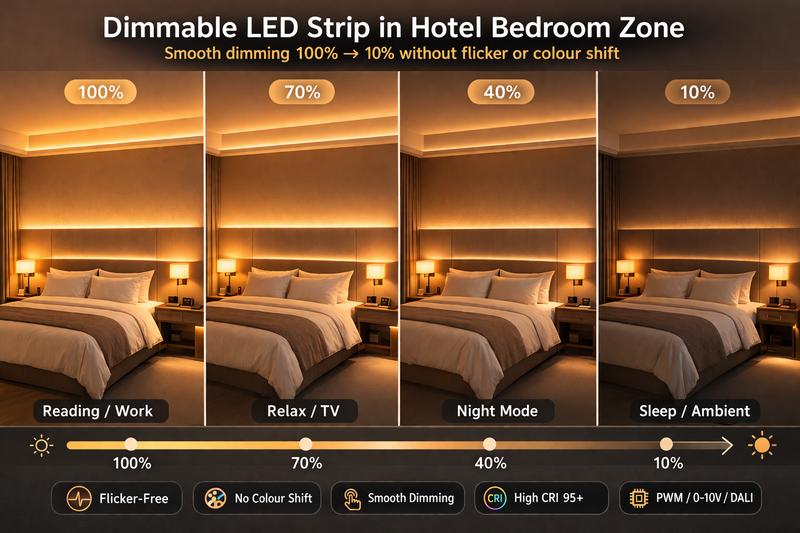
In most commercial applications, dimming is a convenience feature. In hotel rooms, it is a guest experience requirement. A guest who cannot dim the lights comfortably at bedtime will remember that frustration. A strip that flickers at low levels or shifts colour when dimmed makes an expensive renovation feel low-grade.
Guests expect to control the room lighting intuitively. That means they expect:
- smooth, flicker-free dimming with no visible stutter
- no colour shift as brightness drops
- consistent behaviour across zones
- compatibility with the room control system or bedside panel
Not all LED strips dim cleanly. Problems we frequently see in hotel projects include:
- visible flicker at low dim levels
- significant colour shift toward warmer or cooler tones when dimmed
- strips that do not dim below 20 to 30 percent without dropping out
- inconsistent behaviour when multiple strips share one dimmer
The way to avoid these problems is to specify and test dimming performance before finalising the product selection. This includes confirming compatibility between the strip, the driver, and the room control or dimming system being used.
We also recommend confirming the minimum dim level that still looks acceptable in each zone. For a cove or ambient strip, the guest may want to bring light down to a very low level for sleep. A strip that cannot hold a stable 5 to 10 percent level is not suitable for that zone.
Choosing the Right Strip Type for Each Zone
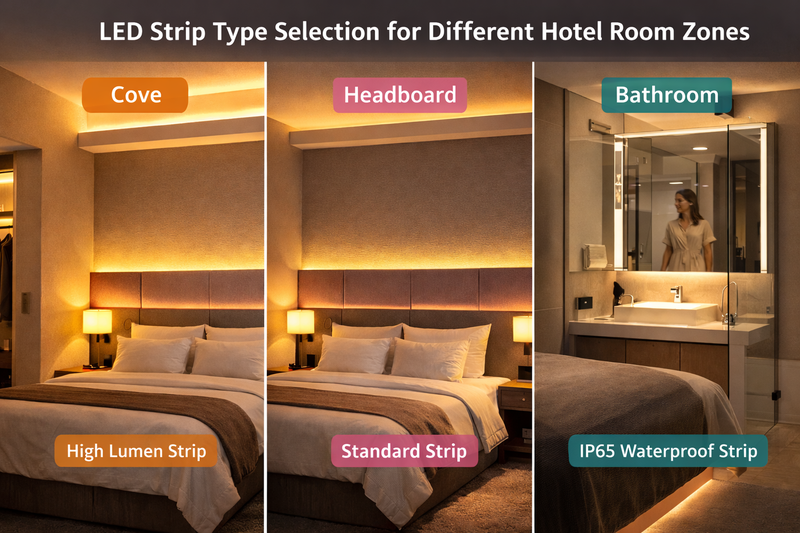
Not every hotel room zone needs the same LED strip type, and selecting the wrong type for a zone creates problems that cannot be fixed later without reinstallation.
Key decisions at the strip type level include:
COB vs SMD for visible applications
If the strip will be seen directly or partially visible in the installation, COB (chip-on-board) strips generally produce a cleaner, more continuous line of light with fewer visible dot patterns. For high-end hotel installations, this is often worth specifying for visible cove or bedhead applications.
For fully concealed or diffused applications, standard SMD strips may perform equally well and at lower cost.
Single density vs high density
Higher LED density reduces hotspot risk and produces a more even light output. For cove lighting where the ceiling above will catch the light, higher density is usually worth specifying. For interior closet or under-shelf applications, standard density is often sufficient.
IP rating
Bathroom zones require at least IP44. If the strip is close to a wet zone or shower enclosure, IP65 or higher is appropriate. Dry interior applications do not need a high IP rating, but using a lightly protected strip in dry zones does no harm.
Installation Quality Determines Whether the Specification Survives the Room
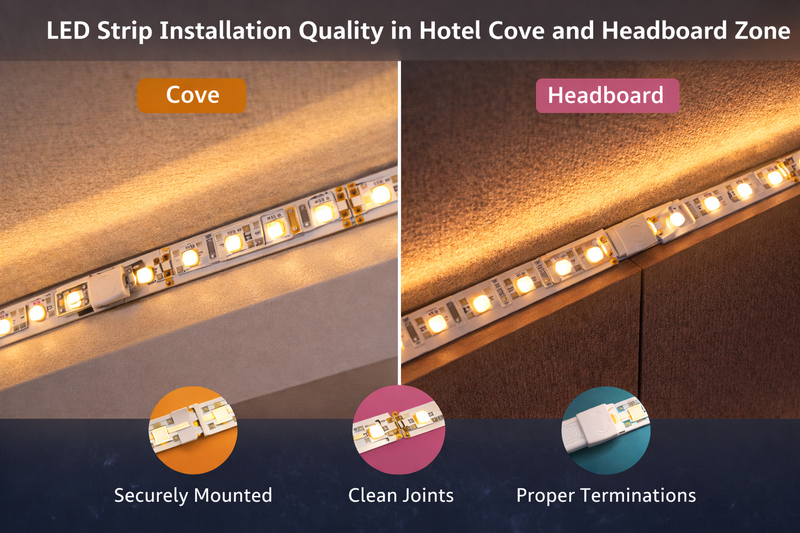
A well-specified LED strip can still deliver a poor result if the installation is not done properly.
In hotel room LED strip projects, the most common installation problems are:
- Uneven mounting: Strips that are not perfectly level inside a cove will create visible bright and dark bands on the ceiling.
- Poor joins and connections: Badly made connections between strip sections create visible dark spots, flicker, or drop-out failure over time.
- Incorrect channel selection: Using the wrong profile or diffuser changes the light output character significantly. A strip designed for a semi-direct cove effect needs a different profile than one intended for diffuse ambient fill.
- Insufficient driver capacity: Undersized drivers cause dimming problems, flickering, or premature failure.
- No room for thermal management: Strips mounted in enclosed cavities without adequate airflow run hotter, which reduces both light output and lifespan.
From our perspective, the installation detail is part of the specification. A project that is specified correctly but not installed correctly does not save the guest experience. We have seen strong specifications delivered poorly because the installation team was not briefed on the tolerances that matter in a hospitality context. The strip was right. The room was still wrong.
What Contractors Should Confirm Before Ordering for a Hotel Project
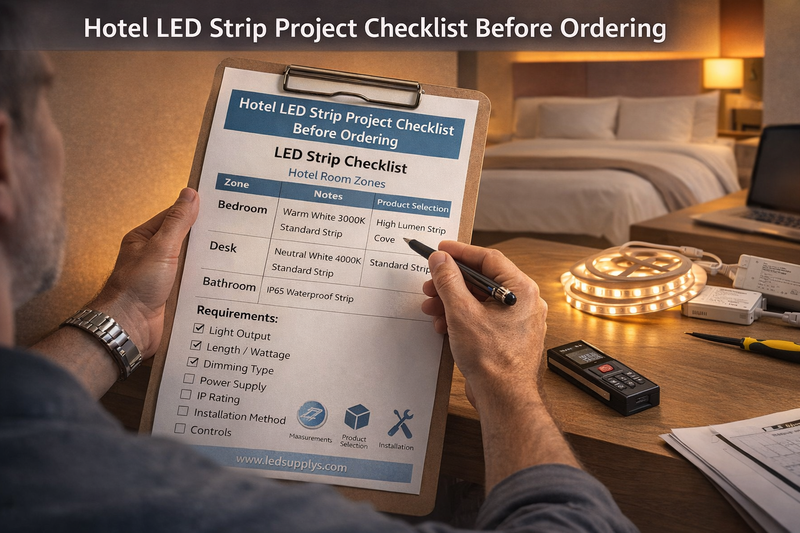
Before placing an order for a hotel LED strip project, contractors and specifiers should confirm:
Hotel Room LED Strip Pre-Order Checklist
- zone map is complete and agreed with client
- CCT is specified per zone, not as a single value for the whole room
- CRI requirement is confirmed (minimum CRI 90 for visible applications)
- dimming system is confirmed and driver compatibility is checked
- strip type is matched to visible vs concealed application in each zone
- IP rating requirements are confirmed for bathroom zones
- installation channel or profile is selected and available
- run lengths are calculated and maximum run limits are confirmed per driver
- sample or mock-up has been reviewed under room lighting conditions
- spare quantities are included in the order for future replacement matching
If this checklist is incomplete before ordering, the project usually discovers the missing detail during installation, when it is more expensive and disruptive to fix. In a hotel renovation with a fixed handover date, that kind of discovery becomes a much larger problem than the original specification gap.
FAQ
What CCT is best for a hotel room?
There is no single answer. Most hotel rooms benefit from 2700K to 3000K in bedroom and ambient zones, 3000K to 3500K in bathroom and desk zones. Using a single CCT across the whole room is a common compromise that usually produces a less convincing result in every zone.
Is CRI 80 good enough for hotel lighting?
In our view, CRI 80 is acceptable for concealed or secondary applications, but not for the main visible lighting in a hotel room. CRI 90 or higher is a better standard for hospitality environments where guest perception of quality matters.
Can the same LED strip be used throughout the room to simplify procurement?
It is possible, but not ideal. Using the same strip everywhere makes installation easier but usually means accepting compromises in multiple zones. A better approach is to standardise where possible but specify correctly for zones where performance matters most.
How do I avoid LED strip hotspots in hotel cove lighting?
Use higher density strips, select an appropriate diffuser profile, and ensure the strip is installed level and at the correct distance from the reflective surface. Testing with a physical mock-up before finalising the specification is strongly recommended.
Final Thoughts
Hotel room LED strip planning is not complicated, but it does require more attention to detail than most general commercial lighting projects.
The room contains multiple zones, each with distinct requirements for CCT, CRI, dimming behaviour, and installation method. A specification that treats the room as a single lighting problem usually creates a result that never fully satisfies the guest experience that hotel operators are trying to create.
From our perspective, most hotel LED strip projects that disappoint guests were not let down by the strip itself. They were let down by a specification that treated every zone the same and an installation that nobody checked against the spec. The uncomfortable truth is that the gap between a good hotel room and a mediocre one is often not the furniture or the finishes. It is the lighting, and inside the lighting, it is usually the details that nobody forced into the specification early enough.
If you are planning an LED strip specification for a hotel renovation project, send us the zone layout, room count, CCT preferences, and control system requirements, and we can help you review the specification before you finalise the order.
Footnotes
Recommended Products
Request a Project or Trade Quote
Sourcing for an installation project, resale or OEM production? Share your requirements below. You can discuss project samples before committing to a bulk order.
Related Articles

LED Strip Lighting for Indoor Plant Walls: Accent Light or Grow Light?
Specify LED lighting for indoor plant walls without confusing visual brightness with plant needs. Review PPFD, DLI, controls, moisture, and…

LED Strip Lighting After a Power Outage: Designing a Reliable Restart
Plan LED strip power restoration beyond total watts. Review driver inrush, switching limits, restart scenes, and commissioning before project handover.

Why LED Strip Lights Buzz When Dimmed: A Guide for Quiet Spaces
Diagnose LED strip buzzing without guessing. Review drivers, PWM controls, mounting resonance, and low-level acoustic acceptance for quiet interiors.