
COB vs SMD LED Strips: Which Technology Is Right for Your Project?
The Problem with Treating COB and SMD as Interchangeable
COB and SMD LED strips are frequently listed as alternative specifications in lighting schedules, with the implication that either technology will deliver equivalent results. They will not. The technologies differ not only in how they look but in how they perform photometrically, how they behave thermally, and critically, in what they can and cannot achieve in specific installation conditions. Specifying the wrong one results either in a visible quality problem that clients notice immediately, or in wasted project budget on capabilities the installation never needed.
This article provides a technically rigorous comparison of both technologies—covering construction, photometric behavior, efficacy trade-offs, color options, and thermal requirements—followed by a definitive guide to when each is the correct specification choice.
How SMD LED Strips Are Built
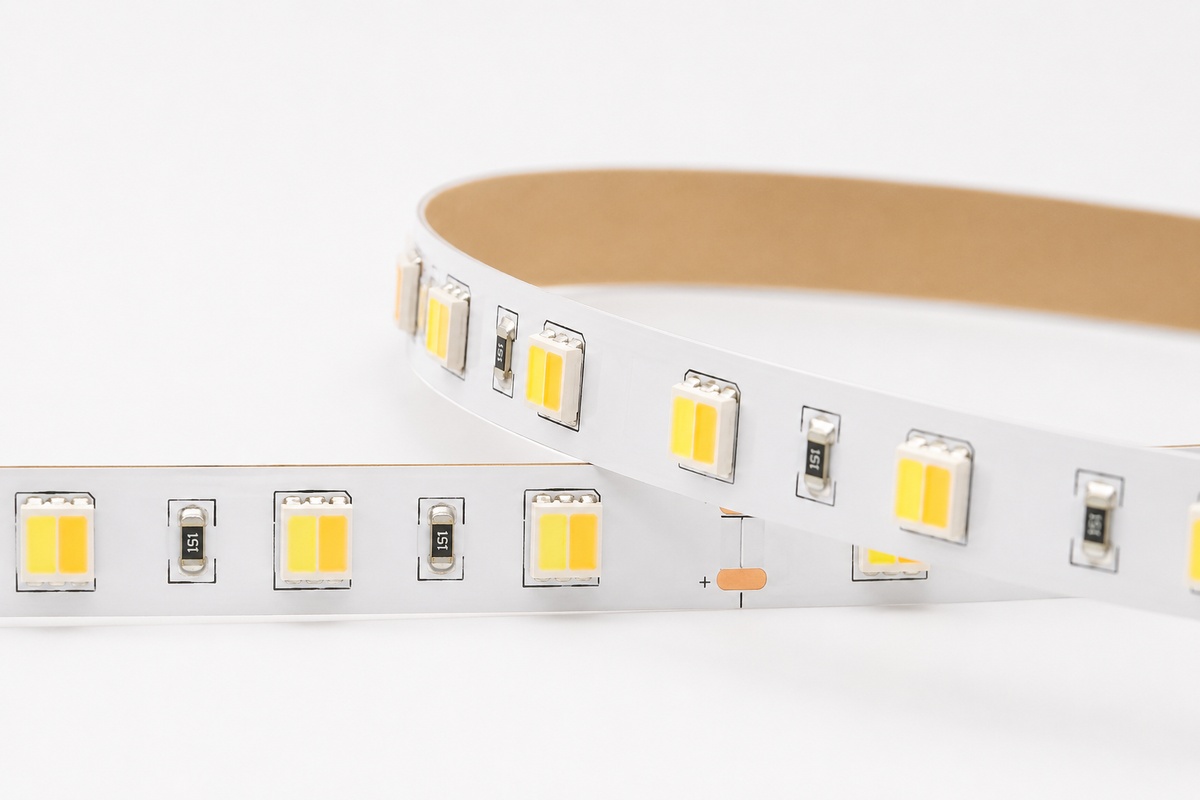
SMD (Surface-Mounted Device) strips mount discrete, pre-packaged LED components onto a flexible PCB at a defined linear pitch. Each component is a complete LED package: a semiconductor chip, a phosphor coating, a reflector, and a lens, all housed in a standardised package identified by its dimensions in tenths of millimetres. The most common packages for strip lighting are:
- 2835 (2.8 mm × 3.5 mm): The dominant package for high-efficacy single-color applications. Thin profile, very high lm/W, available in high-density configurations up to 240 LEDs/m.
- 5050 (5.0 mm × 5.0 mm): Larger package capable of housing three independent chips (used for RGB). Still widely used for color-changing applications but largely superseded by 2835 for single-color work.
- 3014 (3.0 mm × 1.4 mm): A compact high-density package used for very tight-pitch applications where profile width is constrained.
Because each LED is a distinct point source with its own lens, SMD strips produce a characteristic dotted light pattern when viewed at close range. The visibility of this pattern depends on:
- LED pitch (LEDs per meter): higher density reduces the visible gap between sources
- Viewing angle: below approximately 45° from the strip surface, individual LEDs become visible regardless of density
- Diffuser: a properly matched linear diffuser in an aluminum profile can eliminate dot visibility entirely
The U.S. Department of Energy SSL program’s product testing has consistently shown that SMD strips in the 2835 format achieve the highest efficacy of any commercial LED strip format—typically 120–200 lm/W in single-color configurations.1
How COB LED Strips Are Built

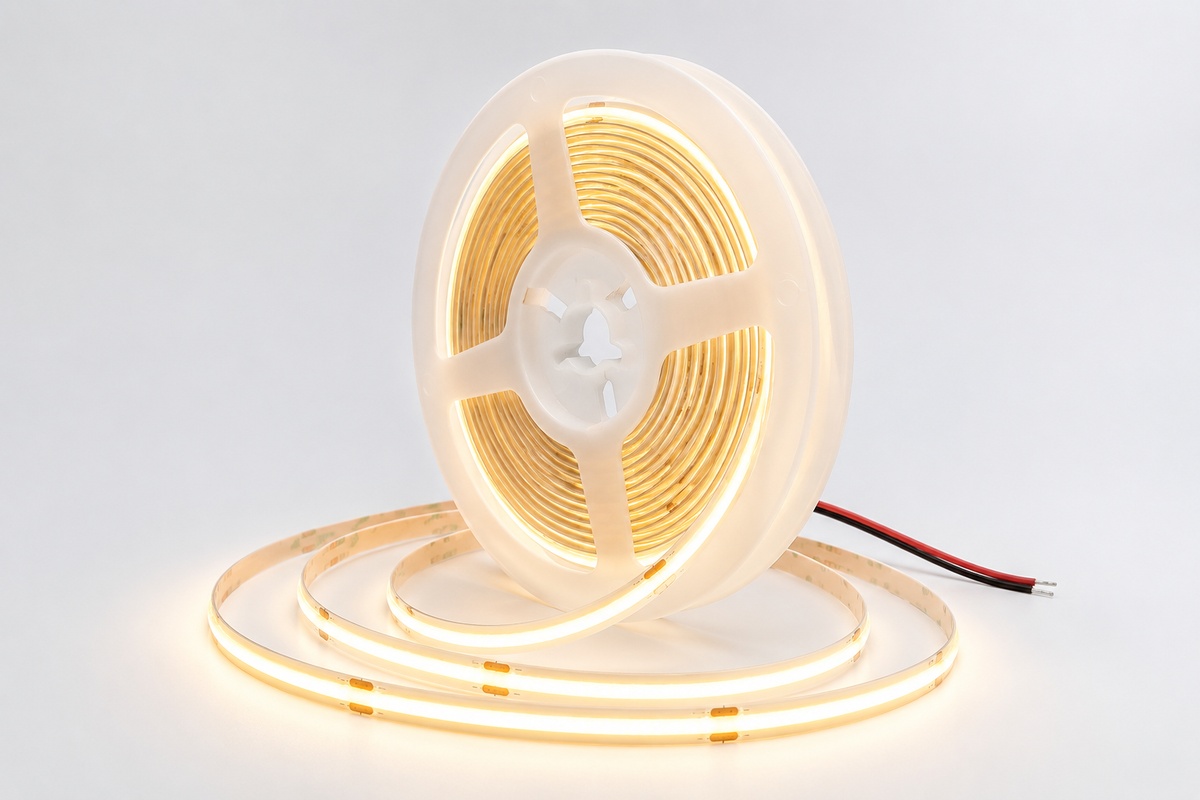
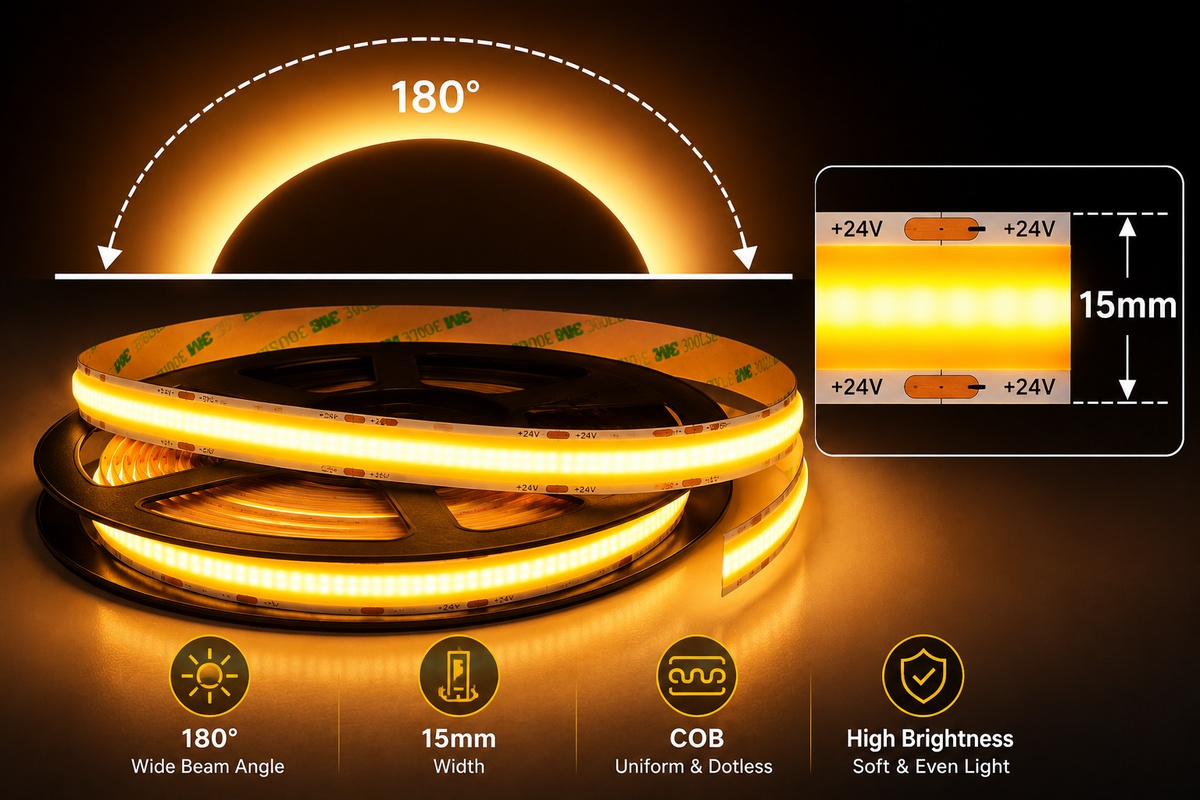
COB (Chip-on-Board) strips take a fundamentally different approach: bare semiconductor chips are placed directly onto the PCB surface without individual housings, then a single continuous phosphor coating is applied over the entire chip array. The phosphor layer converts the blue emission from the semiconductor chips into the target white or colored output, and because it covers the full PCB surface continuously, there are no visible gaps between emission points.
COB strips typically run 280–840 chips per meter—ten times the density achievable with standard SMD packages. At normal viewing distances, the strip appears as an unbroken line of uniform light, regardless of viewing angle. This is why COB strips are often described as producing a “filmstrip” quality of illumination.
Insight: The photometric consequence of COB uniformity. COB strips produce a fundamentally different illuminance distribution on adjacent surfaces compared to SMD. On a smooth white wall illuminated by a strip mounted 50 mm from the surface, an SMD strip at 60 LEDs/m creates a scalloped illuminance pattern with ±25% variation across a 500 mm span. An equivalent COB strip creates ±8% variation across the same span. On matte surfaces, this difference is not visible. On polished plaster, glass, or glossy materials, the scalloping from SMD strips at close range is visible to the naked eye—and is the most common complaint in high-end hospitality installations where the LED source is positioned close to a reflective surface without a diffuser.2
Head-to-Head Performance Comparison
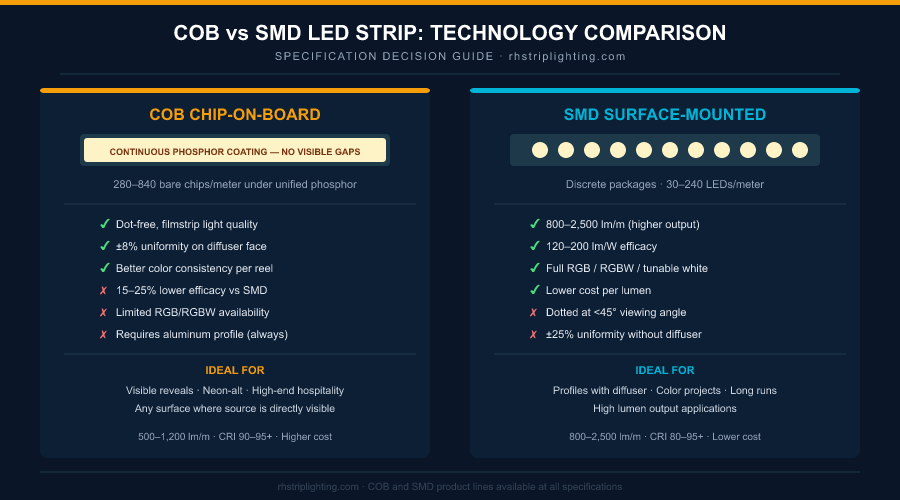
| Parameter | SMD 2835 (typical) | COB (typical) | Winner |
|---|---|---|---|
| Lumen output | 800–2,500 lm/m | 500–1,200 lm/m | SMD |
| Efficacy | 120–200 lm/W | 90–150 lm/W | SMD |
| Visual uniformity | ±25% without diffuser | ±8% without diffuser | COB |
| CRI availability | CRI 80 / 90 / 95+ | CRI 90 / 95+ (standard) | Tie |
| Color options | Single, RGB, RGBW, TW, addressable | Single, TW, multicolor | SMD |
| Within-reel color consistency | Varies by SDCM spec | Generally better | COB |
| Cut resolution | Every 33–50 mm | Every 25 mm (typical) | COB |
| Minimum bending radius | 5–8 cm | Similar | Tie |
| Cost per meter | Lower | 20–50% higher | SMD |
| Requires aluminum profile | Recommended | Required | SMD |
Insight: The efficacy gap explained. COB’s 15–25% efficacy deficit relative to SMD is real but is frequently misattributed. The semiconductor chips in COB and SMD formats often achieve similar internal quantum efficiency. The difference arises from two sources: (1) optical extraction loss—in COB, the continuous phosphor layer adds a light path through a thicker medium, increasing the probability of photon reabsorption; and (2) thermal management constraints—COB strips concentrate more heat in a smaller area, and without the individual thermal pads present in SMD packages, heat must conduct through the PCB substrate, reducing overall thermal efficiency. Both effects are manageable with proper aluminum profile thermal management, but the net result is that COB will consistently deliver fewer lumens per watt than the equivalent SMD product at the same wattage.3
Color Consistency: Where COB Has a Structural Advantage
For large uniform applications—wall-wash installations spanning multiple metres, long linear illuminated displays, or colour-consistent perimeter lighting in retail environments—within-reel and reel-to-reel color consistency is a procurement-critical specification. COB strips, by virtue of their shared phosphor layer applied in a single manufacturing step, generally exhibit superior within-reel uniformity. A single phosphor batch covers the full strip length, eliminating the chip-to-chip variation inherent in SMD assembly where each package may come from a slightly different bin.
For SMD strips in these applications, specifying tight SDCM (MacAdam ellipse) tolerance—3-step or better—and sourcing all material from a single production batch is the recommended mitigation. Our article on LED Binning and MacAdam Ellipses covers this specification in detail.
Thermal Management Requirements
The consequence of COB’s higher chip density per area is higher heat flux density. A COB strip running at 10 W/m concentrates that heat across a continuous chip array rather than distributing it across discrete packages separated by PCB material. The result is that COB strips are genuinely sensitive to thermal management in a way that SMD strips are not—a COB strip mounted directly to drywall or wood without an aluminum heatsink profile will operate above its thermal design point, reducing both efficacy and lifespan.
The IES TM-21 standard, which governs projection of long-term LED lumen maintenance, bases its calculations on junction temperature. For COB strips, the junction temperature is significantly more sensitive to heatsinking quality than for SMD strips.4 The practical rule is simple: COB always requires an aluminum extrusion profile with good thermal contact (thermal paste or tight mechanical fit). SMD will benefit from the same but is more forgiving in lower-wattage applications.
When to Specify Each Technology
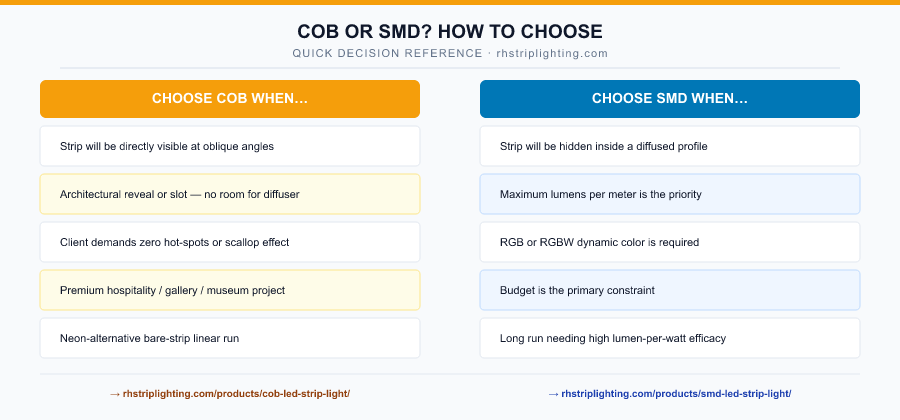
Specify COB When:
- The LED strip surface will be directly visible to occupants—in open channels, behind glass, in perforated panels, or in any configuration where the strip PCB is within the occupants’ field of view at oblique angles
- The installation uses architectural reveals, slots, or grooves where there is physically insufficient space for a diffuser profile
- The design requires a neon-alternative bare strip run where the luminous surface uniformity is the visual feature
- The project specification is for premium hospitality, high-end retail, museum, or gallery environments where light quality is non-negotiable and cost-per-lumen is secondary
- Wall-wash or grazing applications on polished or reflective surfaces where scalloping would be visible
- The client has reviewed both and specifically requires the filmstrip visual quality
Specify SMD When:
- The strip will be concealed inside an aluminum extrusion with a diffuser—the most common installation condition for commercial cove, cabinet, and retail lighting
- RGB or RGBW dynamic color capability is required (COB is not yet broadly available in RGB with equivalent performance)
- Addressable pixel control for animation effects or DMX chase sequences is specified
- Maximum lumens per metre is the primary photometric driver—a long run in a profile that needs to illuminate a large area
- The project budget cannot accommodate the COB cost premium without compromising other elements
- High-wattage applications where SMD’s higher efficacy meaningfully reduces energy consumption across a large installation
Colour Options: Where SMD Has the Advantage
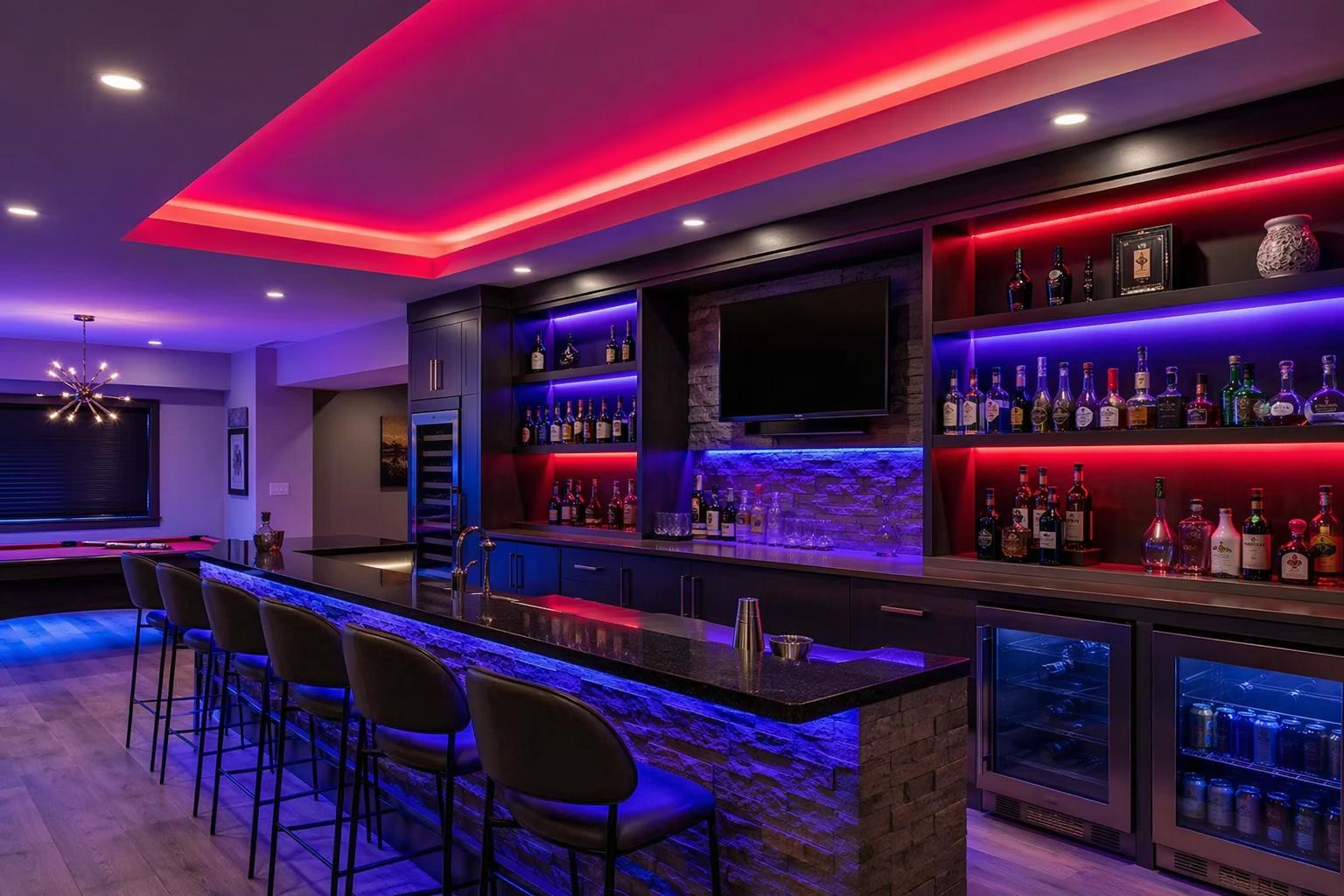
SMD’s broader colour option availability is not a marginal advantage—it is structurally significant. The full SMD colour range includes:
- Single color (warm, neutral, cool, and daylight CCTs)
- Tunable White (dual-chip 2-in-1 packages enabling CCT adjustment)
- RGB (3-channel colour mixing)
- RGBW (4-channel with dedicated white chip)
- RGBWW (4-channel with warm white chip)
- Addressable/pixel-controlled (individual LED or group control via SPI/DMX)
COB is available in single color, tunable white, and—through multicolor COB construction—RGBW-equivalent formats. However, full addressable pixel control in COB format remains a specialist product, and the RGB color gamut achievable with COB multicolor is generally narrower than with discrete SMD RGB packages. For any project where dynamic color, rich saturated hues, or per-pixel addressable effects are part of the design intent, SMD is the correct specification.
FAQ
Can I mix COB and SMD strips in the same installation?
Yes, provided they are in separate zones on separate circuits. Mixing technologies in the same visible run creates an obvious visual mismatch because COB and SMD produce different apparent source distributions even when color temperature and CRI are matched. In the same installation, they can coexist in different spaces or on different planes.
Is COB always better quality than SMD?
No. COB is better at uniformity; SMD is better at efficacy, color range, and cost-per-lumen. A CRI 95 SMD strip in a diffused profile will often produce higher quality light than an unspecified COB strip in an open channel. Quality is determined by specifications—CRI, SDCM, lm/W—not by technology designation.
Does COB require different controllers or drivers?
No. Single-color COB strips use the same constant-voltage drivers as SMD strips at the same voltage (12V or 24V). Tunable-white COB strips use the same 2-channel tunable white controllers. Only multicolor COB strips require specific multi-channel controllers matching their channel count.
Can COB strips be used without an aluminum profile?
Technically yes, but not recommended for any wattage above approximately 4 W/m. Above that wattage, junction temperature will exceed the design point on most non-conductive surfaces, reducing lumen output over time and shortening LED lifespan. For any commercial specification, assume aluminum profile is required.
Recommended Products
Our COB and SMD Product Lines
| Technology | Product | Key Spec |
|---|---|---|
| COB | Single Color COB | Dot-free, CRI 90–95+, 280–840 chips/m |
| COB | Tunable White COB | 2700K–6500K, dot-free CCT adjustment |
| COB | Multicolor COB | RGBW uniform output, premium quality |
| SMD | Single Color SMD | Up to 200 lm/W, 30–240 LEDs/m |
| SMD | RGB/RGBW SMD | Full color range, 3 or 4 channels |
| SMD | Addressable SMD | Per-pixel control, SPI protocol |
Request samples from both technology lines to compare visual quality in your target installation condition before committing to bulk order.
References
- U.S. Department of Energy, LED Lighting Basics, Office of Energy Efficiency & Renewable Energy, Solid-State Lighting Program. ↩
- IES RP-1-20, Recommended Practice for Office and Educational Lighting, uniformity ratio guidance. ↩
- Illuminating Engineering Society, IES LM-80-20: Measuring Luminous Flux and Color Maintenance of LED Packages, Arrays and Modules. ↩
- IES TM-21-19, Projecting Long-Term Lumen and Color Maintenance of LED Light Sources. ↩
Request a Project or Trade Quote
Sourcing for an installation project, resale or OEM production? Share your requirements below. You can discuss project samples before committing to a bulk order.
Related Articles

LED Strip Lighting for Indoor Plant Walls: Accent Light or Grow Light?
Specify LED lighting for indoor plant walls without confusing visual brightness with plant needs. Review PPFD, DLI, controls, moisture, and…

LED Strip Lighting After a Power Outage: Designing a Reliable Restart
Plan LED strip power restoration beyond total watts. Review driver inrush, switching limits, restart scenes, and commissioning before project handover.

Why LED Strip Lights Buzz When Dimmed: A Guide for Quiet Spaces
Diagnose LED strip buzzing without guessing. Review drivers, PWM controls, mounting resonance, and low-level acoustic acceptance for quiet interiors.