
How to Choose LED Strip Lights for Retail Shelf Displays
Retail shelf lighting looks simple until it starts hurting sales.
From our perspective, that is exactly why so many shelf-display LED strip projects underperform. The strip is usually treated as a finishing detail, something to be added after the shelving, product layout, and branding decisions are already fixed. But once the wrong strip goes into a retail shelf system, the products can look flat, patchy, overlit, or simply less premium than they should.
That matters because customers do not judge shelf lighting as a technical system. They judge it through product appearance. If the lighting makes packaging colours look dull, shadows hide the merchandise, or the shelf feels visually noisy instead of clean, the display is already working against the sale.
So the real question is not just which LED strip fits on the shelf. The better question is which strip helps the product look clearer, cleaner, and more valuable in the exact shelf condition where customers will see it.
The Biggest Shelf Lighting Mistake Is Choosing by Brightness Alone
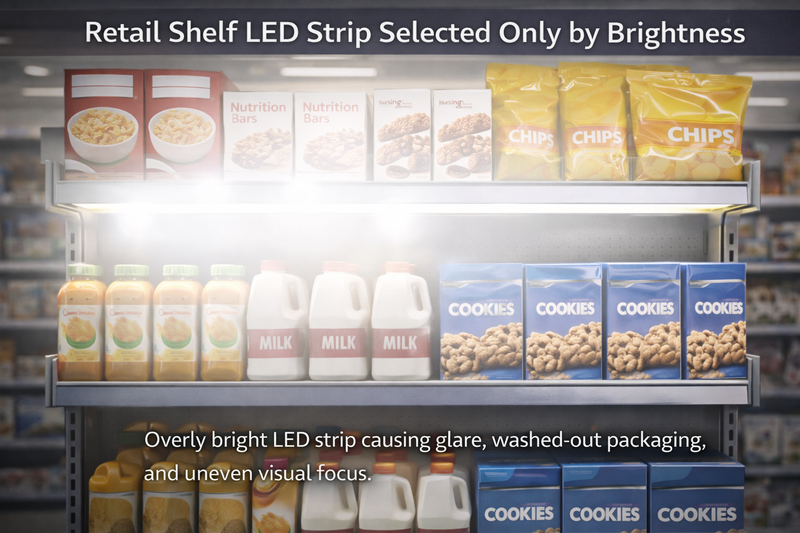
One of the most common mistakes in retail shelf lighting is choosing the strip by brightness alone.
We understand why that happens. Buyers look at a shelf and think, “This area needs to stand out, so I need a brighter strip.” But shelf displays do not fail because they are not bright enough in isolation. They fail because the brightness is wrong for the product, the shelf depth, the finish of the materials, or the viewing angle.
A strip that looks impressive in a product sample can become a problem in a real retail fixture when it:
- creates glare on glossy packaging
- overexposes white labels or reflective surfaces
- produces bright spots that distract from the merchandise
- makes the shelf edge brighter than the actual product
- creates visual fatigue when repeated across a long retail run
From our side, brightness is only one variable. In retail shelf displays, useful lighting is not the brightest lighting. It is the lighting that makes the merchandise easier to read, easier to compare, and more appealing to buy.
That is why we usually tell buyers this: if the customer notices the strip more than the product, the shelf lighting is already doing the wrong job.
Start with the Product Type, Not the Shelf Hardware
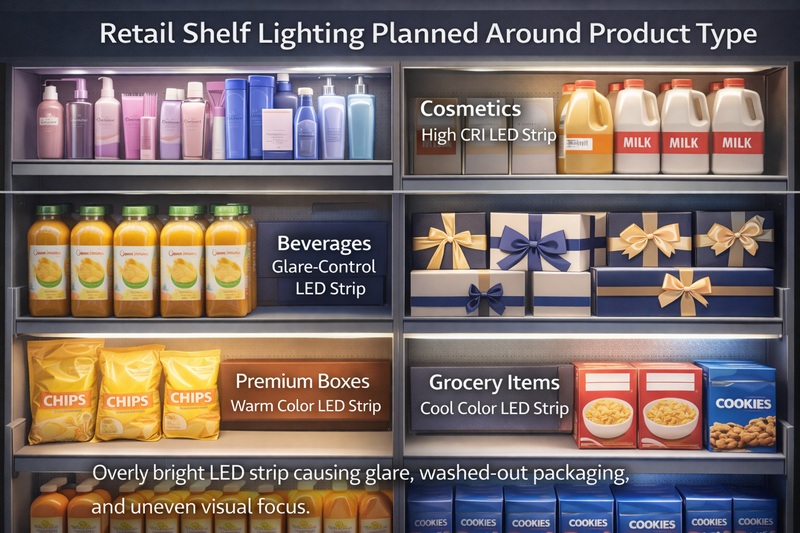
Many specifications for shelf lighting begin with the shelf profile or available mounting space. That is understandable, but it is not the strongest starting point.
The stronger starting point is the product itself.
Different retail categories behave very differently under LED strip lighting:
| Product type | Lighting priority | Common risk |
|---|---|---|
| Cosmetics / skincare | High CRI, flattering colour, soft highlight | Packaging glare, skin-tone distortion |
| Alcohol / premium beverages | Depth, glass clarity, label legibility | Reflection hotspots on bottles |
| Grocery / packaged food | Readability, freshness, consistency | Overly harsh light that cheapens packaging |
| Electronics accessories | Crisp visibility, clean white tone | Clinical feel, excessive contrast |
| Fashion accessories | Material texture, brand feel | Wrong CCT shifts perceived quality |
| Pharmacy / wellness | Clarity and trust | Too warm or too decorative for the category |
From our perspective, this is one of the biggest differences between a professional shelf-lighting decision and a generic one. The same shelf hardware can need very different strip specifications depending on what is being sold.
If buyers start with the aluminium profile and only later think about the merchandise, the project often ends up technically tidy but commercially weak.
CRI Has a Direct Effect on Whether Products Look Premium or Cheap
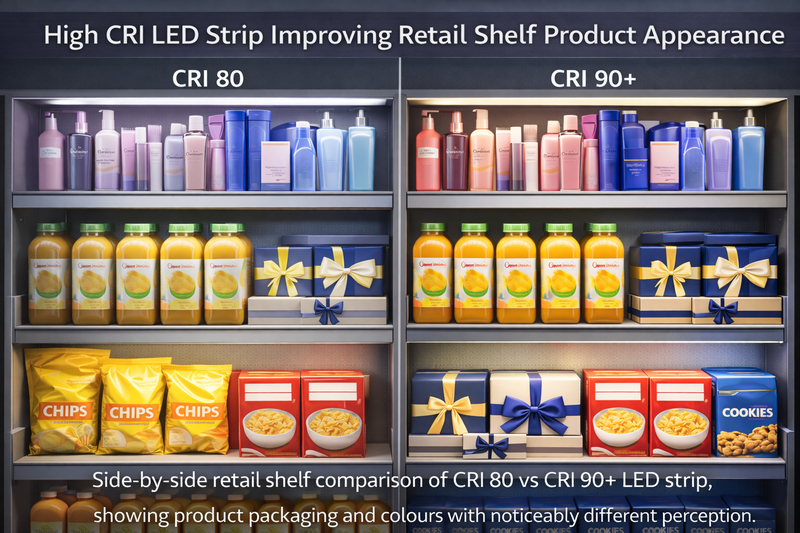
This is one of the most underestimated shelf-lighting decisions.
In retail displays, CRI is not just a technical specification. It is a sales-quality specification.
A low-CRI strip can make:
- packaging colours look flatter
- food look less fresh
- cosmetics look less attractive
- premium labels look cheaper
- materials such as leather, fabric, or matte paper lose depth
That matters because shelf displays often win or lose attention in the first second. If the light makes the product feel less rich, less clean, or less believable, the customer may never consciously think “the CRI is wrong,” but they still react to the result.
From our side, CRI 90 is the practical minimum for most serious retail shelf-display work. For cosmetics, premium liquor, jewellery-adjacent accessories, or colour-sensitive branded packaging, CRI 95 is worth considering.
The Lighting Research Center and IES both provide useful background on light quality and visual perception, but in practical shelf terms the rule is simple: if the merchandise depends on colour appeal, low CRI is a false economy.
CCT Should Match Brand Positioning, Not Just Personal Taste
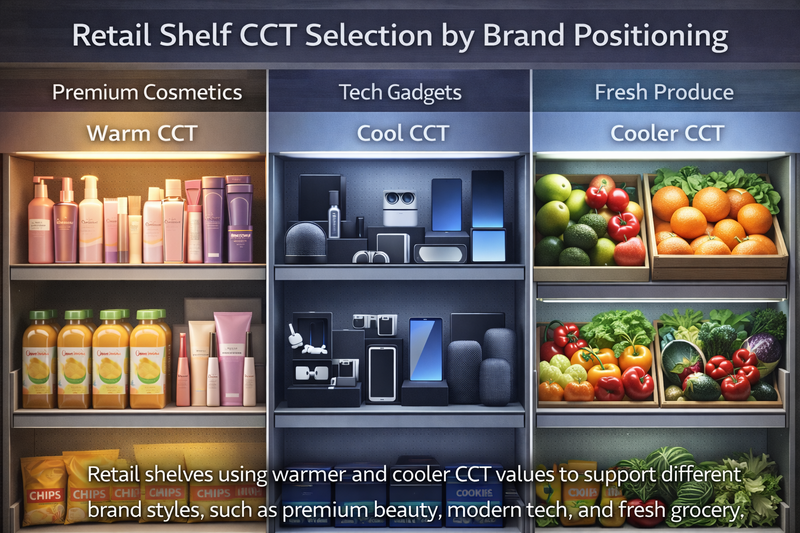
A lot of shelf-lighting choices are made on instinct: warm looks premium, cool looks clean. There is some truth in that, but retail shelf lighting needs a more disciplined approach.
From our experience, CCT should follow brand positioning and product category:
- 2700K to 3000K: best for premium, intimate, high-margin product displays such as cosmetics, gift items, wine, and boutique accessories. This range adds warmth and perceived value.
- 3500K to 4000K: strong for general retail, pharmacy, office-supply, and many packaged-product categories where clarity matters more than atmosphere alone.
- 5000K and above: rarely the best choice for shelf displays unless the concept specifically calls for a cool, clinical, high-contrast visual identity. In many retail settings, it makes shelves feel harsh and products feel less inviting.
The painful mistake here is choosing the CCT that looks “clean” in isolation, then discovering that the packaging or shelf finish looks colder, cheaper, or less branded than intended.
We often tell buyers that customers do not only see the product. They also absorb the emotional tone of the shelf. CCT is one of the fastest ways that tone gets set, correctly or incorrectly.
If you want a broader look at how colour temperature affects commercial lighting decisions, our article on how to choose the right LED strip color temperature for commercial spaces helps frame the choice in a more project-driven way.
Uniformity Usually Matters More Than Maximum Output
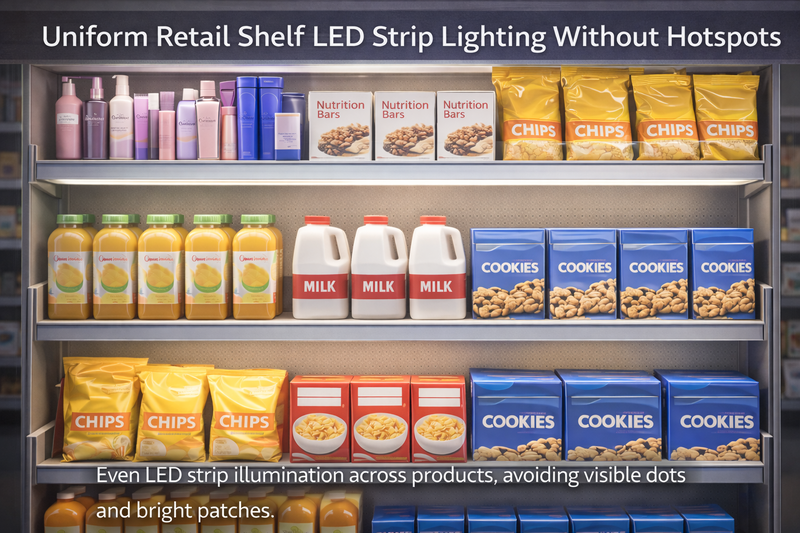
Retail shelves are one of the worst places to tolerate uneven light.
Hotspots, visible LED dots, or bright-dark transitions make shelves look improvised. That is especially damaging in:
- premium retail
- branded chain stores
- beauty or wellness shelves
- glass or reflective displays
- long continuous gondola runs
This is where buyers often make a specification mistake that looks cost-efficient on paper: they choose a lower-density strip because the lumen figure is acceptable. Then the installed result shows visible point sources or uneven product illumination.
From our perspective, a shelf display should usually prioritize uniformity before maximum output. In many cases, a slightly lower-output but more visually continuous strip creates a far stronger retail result than a brighter strip with visible dots.
For visible or semi-visible shelf applications, COB LED strip or higher-density SMD strip often makes more sense. That decision depends on diffuser quality, setback distance, and viewing angle, but the principle stays the same: the customer should notice the merchandise, not the LED pattern.
Glare and Reflection Are Where Many Shelf Displays Lose Their Impact
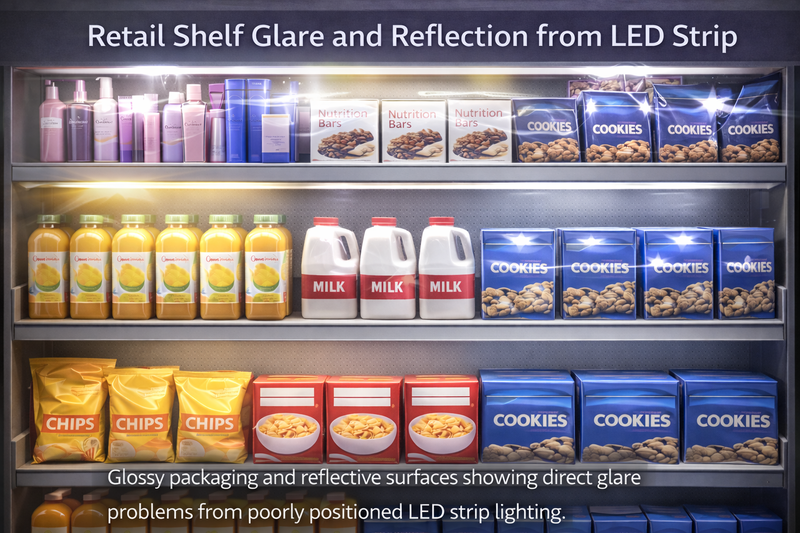
A retail shelf can be bright and still sell badly if the lighting creates too much glare.
We see this especially in:
- glossy cartons
- glass bottles
- plastic packaging
- acrylic shelf lips
- metal cosmetics components
- laminated price tags or brand cards
The problem is not just visual comfort. Glare changes what the customer can actually read. If reflections hide the label, distort the packaging colour, or force the eye away from the product, the strip is reducing shelf effectiveness.
This is why placement matters as much as product choice. Buyers should confirm:
- whether the strip sits at the front edge, back edge, or underside of the shelf
- the viewing angle from normal customer height
- whether the diffuser profile softens the direct source enough
- whether glossy surfaces create reflection hotspots in the real aisle conditions
From our side, shelf lighting should support the product face, not compete with it. A strip that photographs well in an empty mock-up can still fail once real packaging fills the shelf.
Shelf Depth and Mounting Position Change the Whole Result
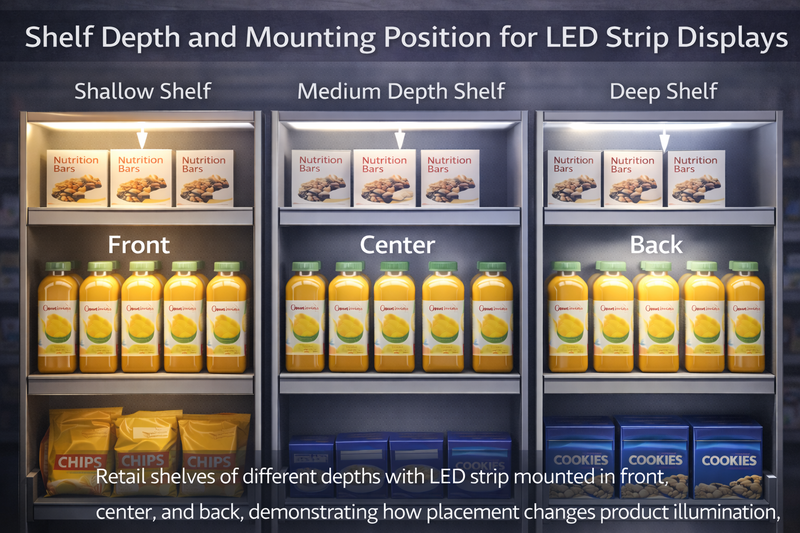
This is where many generic recommendations break down.
The right strip for a 250 mm shelf is not automatically the right strip for a 450 mm shelf. Shelf depth changes:
- how far the light has to travel
- where shadows form behind products
- whether front rows block rear rows
- how visible the strip source is to the shopper
- how much brightness is needed to maintain readability at the back of the shelf
Mounting position matters just as much. A front-mounted strip often improves label visibility but can create reflection on glossy packaging. A rear-mounted strip can create dramatic edge lighting but may reduce front-face readability. An underside centered strip may balance the shelf best, but only if the setback and beam spread are correct.
From our perspective, buyers get into trouble when they ask, “Which strip do you recommend for retail shelves?” without also defining shelf depth, product height, packaging finish, and mounting position.
That is why we prefer project information before product recommendation. A strip only becomes the right strip after the shelf geometry is understood.
Drivers, Controls, and Maintenance Access Should Be Considered Early
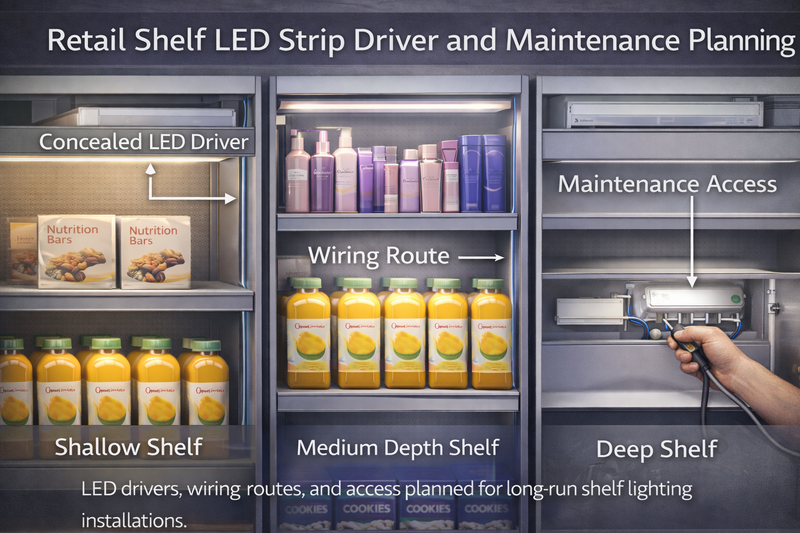
Retail projects often focus so much on the visible strip that they underestimate the support system behind it.
But real shelf-display performance also depends on:
- driver sizing
- voltage drop over longer runs
- dimming compatibility if required
- cable routing through modular shelving
- ease of replacing failed sections
- access to power supplies after fit-out completion
This is especially important in multi-bay retail systems, where one elegant shelf concept can become a maintenance headache if the driver locations were never planned properly.
We usually tell buyers that a retail shelf lighting system should not only look good on opening day. It should still be serviceable after merchandising changes, promotional resets, and normal wear over time.
That is why driver planning and maintenance access belong in the specification stage, not after the millwork is already closed.
What Buyers Should Confirm Before Ordering Retail Shelf LED Strip
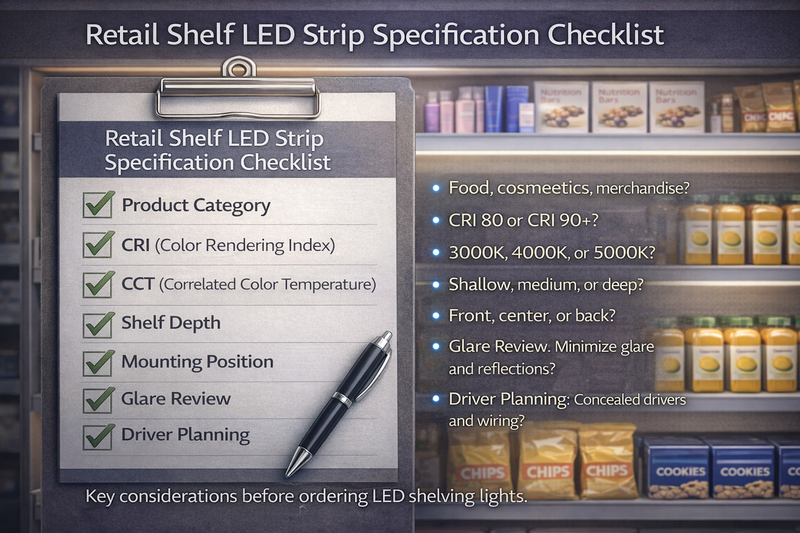
Before placing an order, we recommend confirming these points clearly:
Retail Shelf LED Strip Checklist
- product category and packaging finish are defined
- shelf depth and mounting position are confirmed
- CRI requirement is specified, usually CRI 90 or above
- CCT is matched to brand tone and product type
- uniformity requirement is reviewed, not just lumen output
- glare and reflection risks are checked with real product samples
- strip type is chosen based on visibility, density, and diffuser method
- driver sizing and run length are verified
- maintenance and replacement access are planned
- mock-up or sample shelf test is completed before bulk ordering
If these points are not resolved before ordering, the project often ends up adjusting the shelf to fit the strip instead of selecting the strip to fit the display.
FAQ
What LED strip is best for retail shelf displays?
There is no single best strip for every shelf. The right choice depends on the product category, shelf depth, packaging finish, required CRI, desired CCT, and how visible the strip source will be to the customer.
Is CRI really important for retail shelves?
Yes. In retail displays, CRI directly affects how premium, fresh, and accurate products look. Low CRI can make packaging and merchandise appear flatter and less attractive.
What CCT should I use for retail shelf lighting?
Warm white (2700K to 3000K) usually works best for premium and lifestyle products. Neutral white (3500K to 4000K) is stronger for many general retail categories where clarity matters. The right answer depends on brand positioning and product type.
How do I avoid LED hotspots on shelves?
Use a higher-density strip or COB strip, pair it with the right diffuser or profile, and confirm that the strip position and setback produce uniform light across the actual shelf depth.
Why does shelf lighting look good in samples but not in store?
Because store conditions add real packaging, real reflections, real shelf geometry, and real customer viewing angles. A test without those variables can hide problems that only appear after installation.
Final Thoughts
Retail shelf lighting is not a small detail. In many product categories, it is part of the selling environment itself.
The best shelf-display LED strip is not the brightest strip or the cheapest strip. It is the strip that matches the product category, supports the brand tone, delivers even light, and stays visually quiet while letting the merchandise do the work.
From our perspective, the strongest retail shelf projects are the ones where the product, the shelf geometry, and the lighting are specified together, not in separate conversations.
If you send us the shelf dimensions, product category, packaging finish, and mounting concept, we can help you review which LED strip specification makes the most sense before you place the order.
Footnotes
Recommended Products
Request a Project or Trade Quote
Sourcing for an installation project, resale or OEM production? Share your requirements below. You can discuss project samples before committing to a bulk order.
Related Articles
LED Strip Lighting for Indoor Plant Walls: Accent Light or Grow Light?
Specify LED lighting for indoor plant walls without confusing visual brightness with plant needs. Review PPFD, DLI, controls, moisture, and…

LED Strip Lighting After a Power Outage: Designing a Reliable Restart
Plan LED strip power restoration beyond total watts. Review driver inrush, switching limits, restart scenes, and commissioning before project handover.

Why LED Strip Lights Buzz When Dimmed: A Guide for Quiet Spaces
Diagnose LED strip buzzing without guessing. Review drivers, PWM controls, mounting resonance, and low-level acoustic acceptance for quiet interiors.