
How to Protect Reorder Consistency When Sourcing LED Strips from China
How to Protect Reorder Consistency When Sourcing LED Strips from China
The first order goes well. The strip color is right, the installation is clean, and your customer approves the product. Then, fourteen months later, you reorder the same SKU and the new batch looks different. The label may match, the wattage may be similar, and the supplier may insist it is the same item. But when the original and reorder are lit side by side, the difference is obvious.
This is a recurring problem in LED strip importing. Buyers often treat the first order as proof that future reorders are safe. In reality, reorder consistency must be designed into the sourcing process from the beginning. If it is not documented and controlled before the first PO, it becomes very difficult to enforce later.
For distributors, contractors, and project suppliers, reorder inconsistency is more than a technical nuisance. It can create unsellable mixed inventory, failed customer expectations, field complaints, and margin erosion. The right time to prevent it is before the initial order, not after the reorder dispute starts.
Why reorder mismatch happens so often
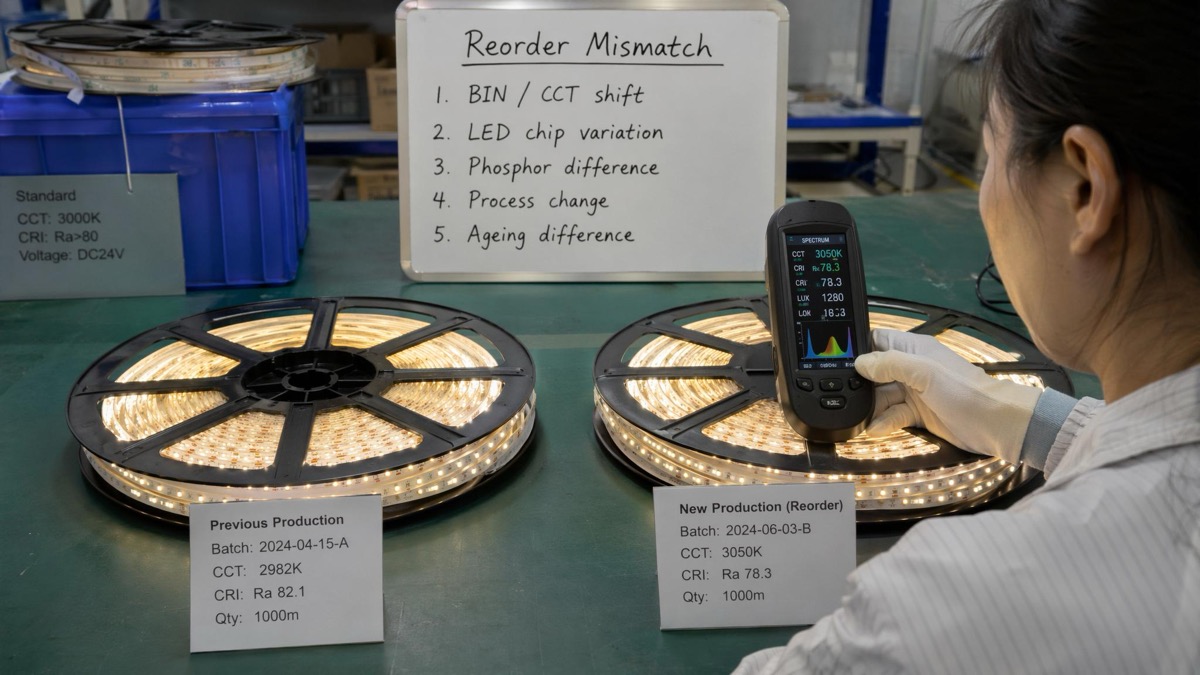
Factories do not always change a product intentionally. Often the mismatch is the cumulative result of small upstream changes that were never locked against the original reference.
LED chip generations change
Chip suppliers regularly update or replace product families. The nominal specification may look similar, but tint behavior, efficacy, and dimming characteristics may shift. If the factory substitutes the newer generation without controlled matching to the original lot, the reorder can drift visually.
Phosphor suppliers and coating behavior change
White LED appearance depends heavily on phosphor chemistry and process stability. Even within a similar CCT window, batch-to-batch behavior can move enough to create visible change. Over a long period, these small changes can accumulate.
PCB suppliers may change
Some factories assemble in-house but buy PCB from outside vendors. Others outsource more than buyers realize. If the PCB supplier changes, board thickness, copper quality, solder mask finish, and thermal behavior may shift. That can affect both consistency and perceived product quality, even if the strip is described with the same item code.
Binning tolerance may shift without notice
The factory’s accepted color range can widen over time, especially if cost pressure increases or the original components become harder to source. What was once a tightly controlled order may later be treated as a standard commercial tolerance product. Without a written matching standard, the buyer has little basis to object.
What buyers should do before the first order
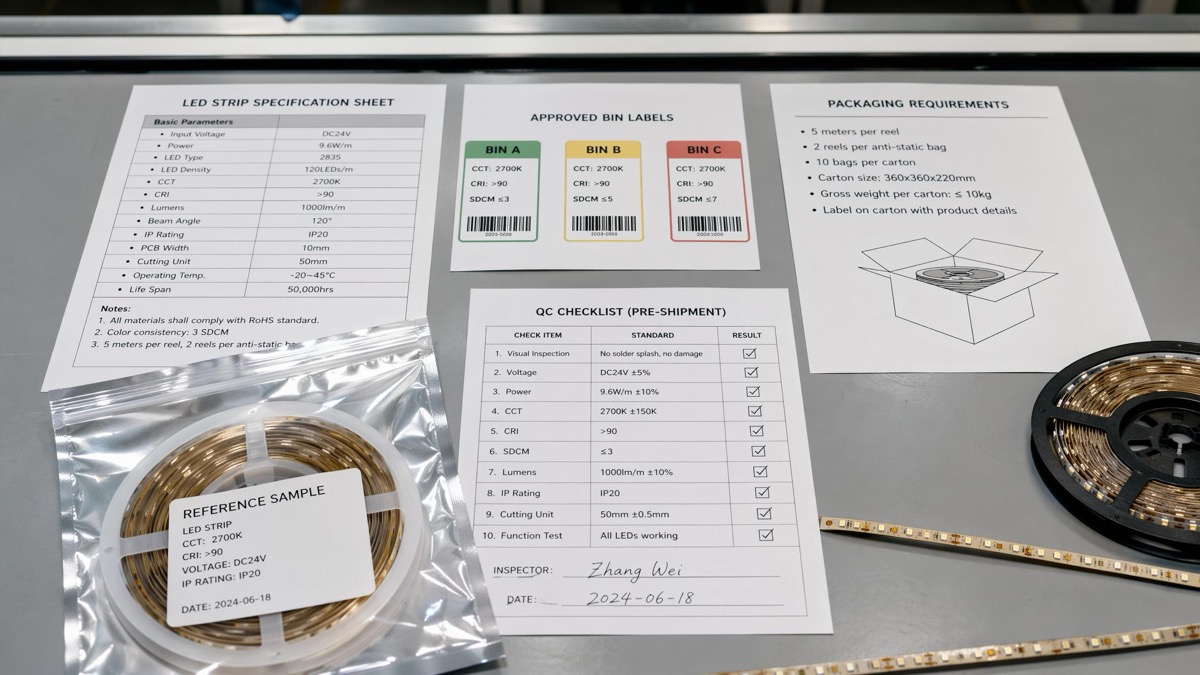
The strongest reorder protection is created at the start of the relationship. Buyers who wait until the second order to discuss matching standards usually discover that nothing useful was documented.
Record the exact chip bin code and production lot in writing
When approving the first order, ask the factory to record the actual chip supplier, chip model, bin code, and production lot used for the approved version. This should not remain inside the factory only. It should be part of your approved product record.
That does not guarantee the same materials will exist forever, but it creates a technical reference. If the factory later proposes a substitution, you can compare against something concrete instead of arguing from memory.
Require the factory to retain a reference sample for 24 months
The factory should keep a sealed reference sample from the approved production batch for at least 24 months. The buyer should do the same. This is simple and effective. If a reorder dispute arises, both parties can compare against the same historical reference instead of relying on photos or recollection.
Without retained reference samples, the discussion quickly becomes subjective.
Specify a reorder matching requirement
The purchase agreement or supply specification should state that future reorders must match the original approved product within a defined tolerance. For many commercial white-strip applications, MacAdam step 3 is a practical benchmark for reorder matching.
The exact requirement may vary by application, but the important point is to define it before the first shipment. Otherwise the supplier can argue that a broader internal tolerance is acceptable.
Include a reorder clause with right-to-reject
A reorder-matching clause is only useful if the buyer has a contractual remedy. The agreement should state that if the reorder falls outside the agreed match tolerance relative to the original approved reference, the buyer has the right to reject the shipment or require corrective action.
Without this, the factory may acknowledge the difference while still refusing commercial responsibility.
What buyers should do at reorder stage
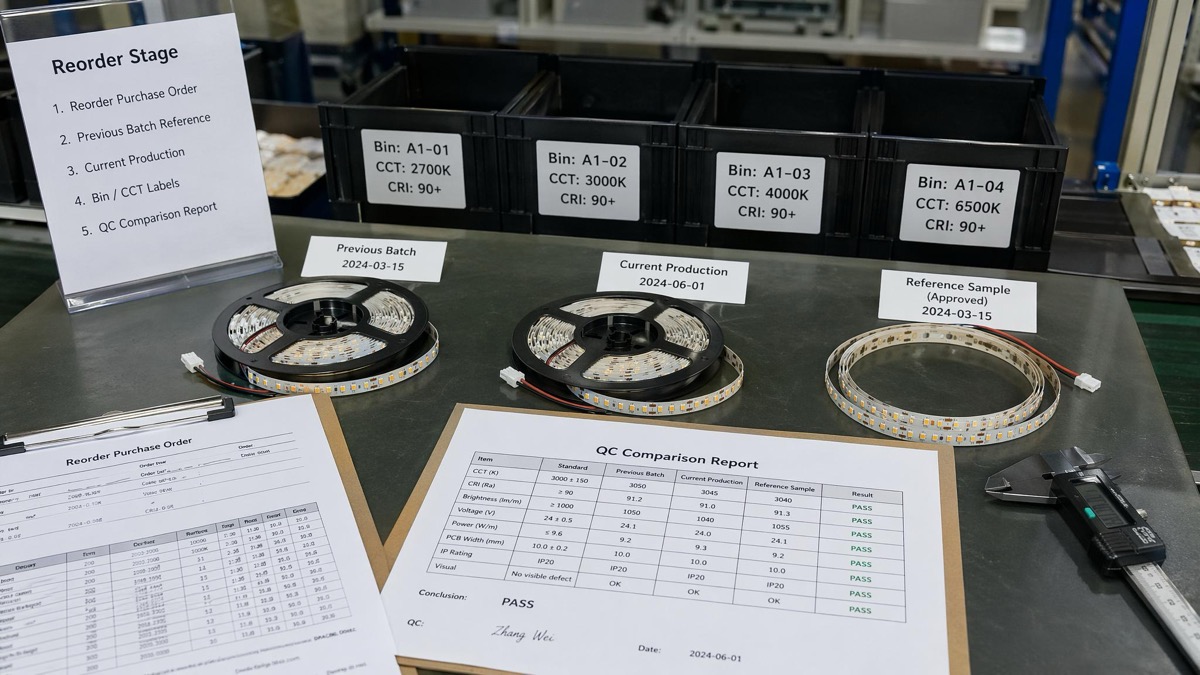
Even if the first order was controlled well, buyers should not release a reorder blindly, especially after a long gap.
Always request a pre-production sample
Before the bulk reorder is produced, ask for a pre-production sample made from the materials planned for that reorder. This is the fastest way to detect drift before full manufacturing starts.
If the factory resists because the SKU is “already approved,” that is exactly why the request matters. Reorders fail because assumptions replace verification.
Compare side by side under the same light conditions
Do not judge the reorder sample in isolation. Compare it directly against your retained original sample under the same environment, same power conditions, and same viewing angle. Ambient light can hide or exaggerate differences, so the comparison method should be controlled and repeatable.
What matters is whether the two samples match closely enough for your real market, not whether the new sample looks acceptable by itself.
Test at multiple dimming levels
Many buyers compare only at full output. That is a mistake. Differences in chip behavior and phosphor response can become more visible at lower dimming levels. Test at 100 percent, then at reduced output levels relevant to the end use.
If the strip will be used with dimmable drivers, this step is important. A reorder that seems acceptable at full brightness may behave differently in actual installation.
How factories should document reorder control
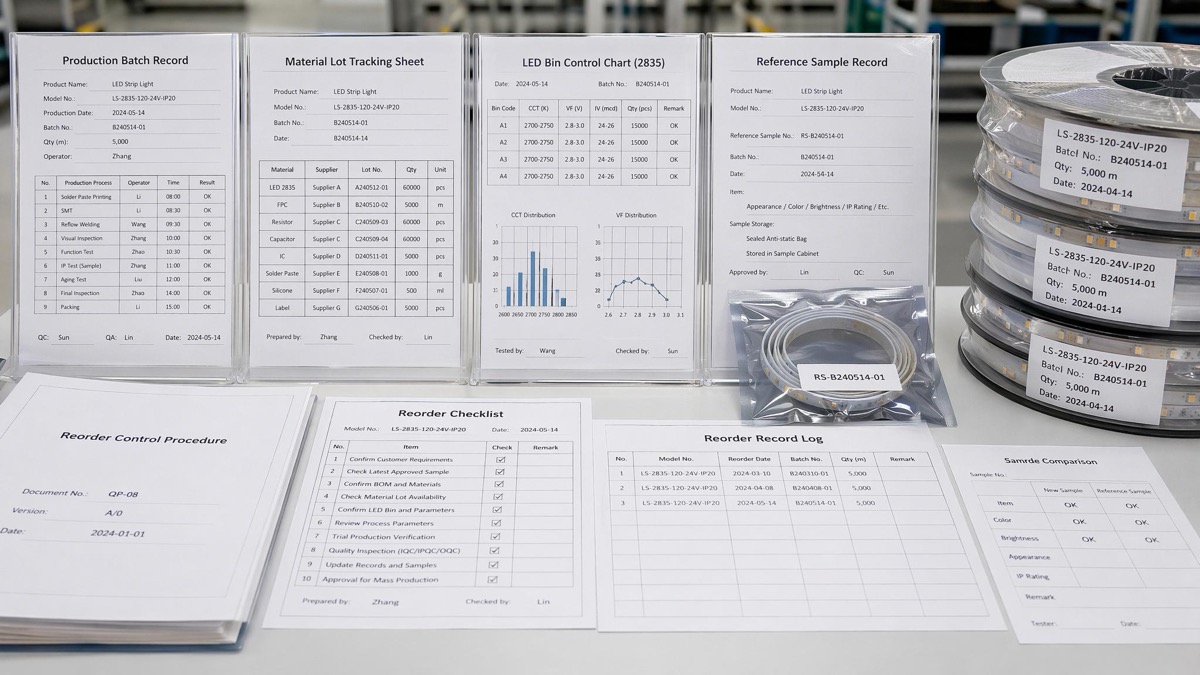
When dealing with a capable manufacturer, buyers should expect more than verbal assurance. Useful reorder control normally includes:
- Original approved sample record
- Component traceability, including chip supplier and bin data
- Retained reference sample storage
- Written substitution approval process
- Batch test records for each reorder lot
If the factory cannot show a structured method for preserving product identity across time, then reorder consistency is mostly depending on luck.
Common buyer mistakes on reorders
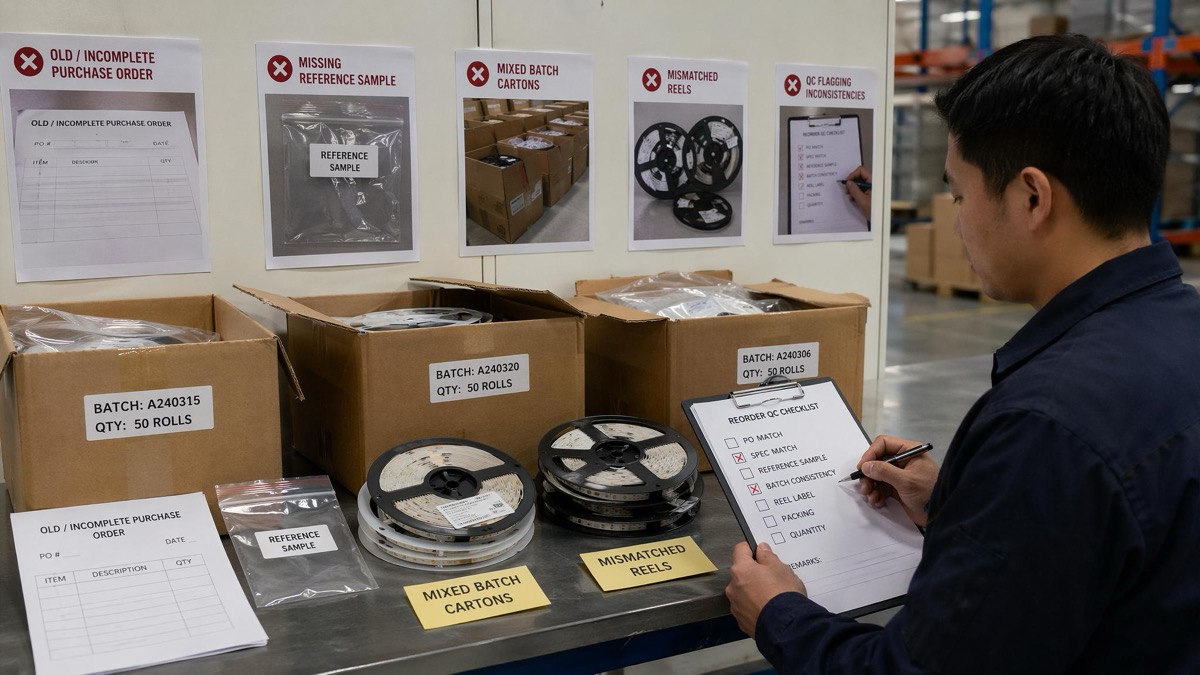
Using the same SKU name as the only reference
Internal item names are often too broad. A SKU description like “24V 4000K 10W strip” is not enough to preserve visual consistency over time. Many technically different products can fit that label.
Assuming old approval still controls new materials
Approval from a prior year does not automatically bind current material choices unless the contract says so. Buyers often assume that “same product” means “same components.” Factories may interpret it as “same commercial category.”
Skipping pre-production confirmation to save time
When the customer is waiting, buyers sometimes release the reorder immediately. That saves a few days and can create months of claims. Reorder sampling is usually cheaper than field correction.
Questions buyers should ask before approving a reorder

- Are you using the same chip supplier and chip family as the original approved lot?
- What is the current bin code for this reorder?
- Has any PCB, resistor, adhesive, or encapsulation material changed?
- Can you send a pre-production sample from the actual planned materials?
- Can you confirm the reorder will match the retained reference sample within the agreed tolerance?
These questions are not excessive. They are basic control for any buyer who depends on repeatability.
How to think about reorder risk commercially

Reorder risk increases with time gap, supply-chain volatility, and product sensitivity. If the original order was placed more than a year ago, the probability of upstream change is higher. If the product is sold into applications where adjacent installations must match, the cost of mismatch is also higher.
That means the most disciplined buyers apply stricter reorder control precisely when the supplier claims everything is routine.
FAQ
How long should I keep a reference sample from the original order?
At minimum 24 months. If your product cycle is longer or the application involves staged installation, keep samples for the full period you expect to reorder. Reference samples lose value the moment a dispute starts and you no longer have them.
What if the factory says the chip is discontinued and they need to substitute?
This happens. The question is not whether substitution is possible but whether the factory will qualify the new chip against the original before producing. Ask for a substitution sample matched to your retained reference under the same conditions you use for approval. If it matches within tolerance, accept. If not, negotiate or pause the order.
Is MacAdam step 3 always the right reorder matching standard?
For most commercial white-strip applications, step 3 is a practical and enforceable benchmark. Hospitality and high-end retail buyers often tighten this to step 2. Lower-sensitivity applications such as indirect cove lighting may tolerate step 4. The right standard depends on your application and on whether installations will be visually compared.
Reorder consistency is a contractual requirement, not a supplier favor
If you need LED strip reorders to match, start protecting that requirement before the first order. Record the chip bin code and production lot. Require the factory to hold a reference sample for 24 months. State that reorders must match within MacAdam step 3 of the original where the application requires it. Put a reorder-matching clause and right-to-reject into the contract.
Then, at reorder stage, ask for a pre-production sample, compare it side by side with the original under controlled conditions, and test at multiple dimming levels. Reorder consistency is not automatic. It is a process that has to be specified, checked, and enforced.
Recommended Products
Request a Project or Trade Quote
Sourcing for an installation project, resale or OEM production? Share your requirements below. You can discuss project samples before committing to a bulk order.
Related Articles

LED Strip Lighting in Historic Buildings: Design for Removal, Not Just Installation
Plan LED strip lighting in historic interiors around protected finishes, removable supports, cable routes, heat, and maintenance without avoidable damage.

LED Strip Lighting for Retail Fitting Rooms: Face, Fabric, and Mirror Glare
Specify fitting-room LED strip lighting for faces, fabrics, and mirrors. Compare color reports, test reflected glare, and approve a repeatable…

LED Strip Lighting for Indoor Plant Walls: Accent Light or Grow Light?
Specify LED lighting for indoor plant walls without confusing visual brightness with plant needs. Review PPFD, DLI, controls, moisture, and…