
Does Your Patio Lighting Attract Customers or Drive Them Away?
You invest heavily in outdoor furniture, landscaping, and menus, yet the patio feels cold and uninviting. Harsh, flickering, or poorly placed lighting kills the atmosphere and sends high-paying customers to your competitors.
For dining patios, avoid cool white light. Specify "Dim-to-Warm" (1800K-3000K) or "Tunable White" COB strips encased in IP67 Silicone. These technologies replicate the cozy glow of incandescent bulbs while providing the durability required for outdoor commercial use.
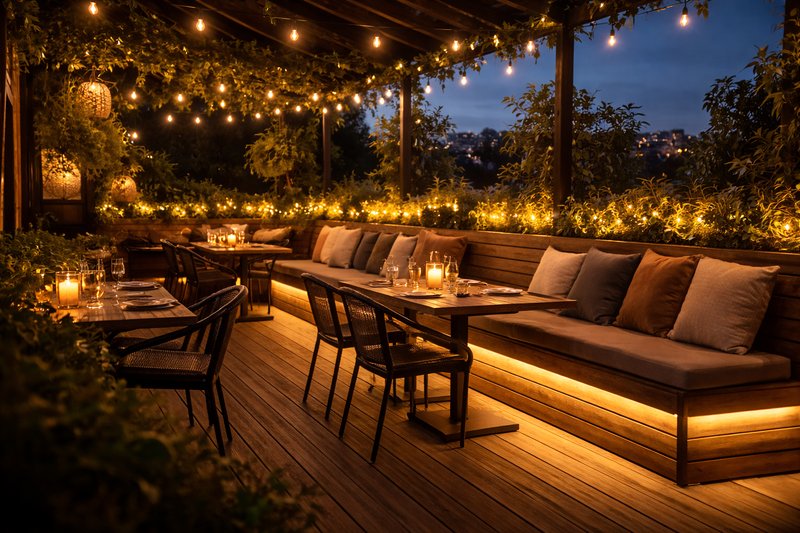
In my factory, we produce kilometers of "warm white" strips every month. But "warm" is subjective. If you get the color temperature wrong, your romantic bistro looks like a convenience store. Lighting is not just technical; it is psychological. It dictates how long people stay, how much food they order, and whether they come back. I want to share the specific technical choices that turn a patio into a revenue generator.
Why Is 3000K Too Bright for Dinner Service?
A bright patio is good for cleaning and setup, but it is terrible for intimacy. When the sun goes down, customers naturally crave a warmer, dimmer environment to relax.
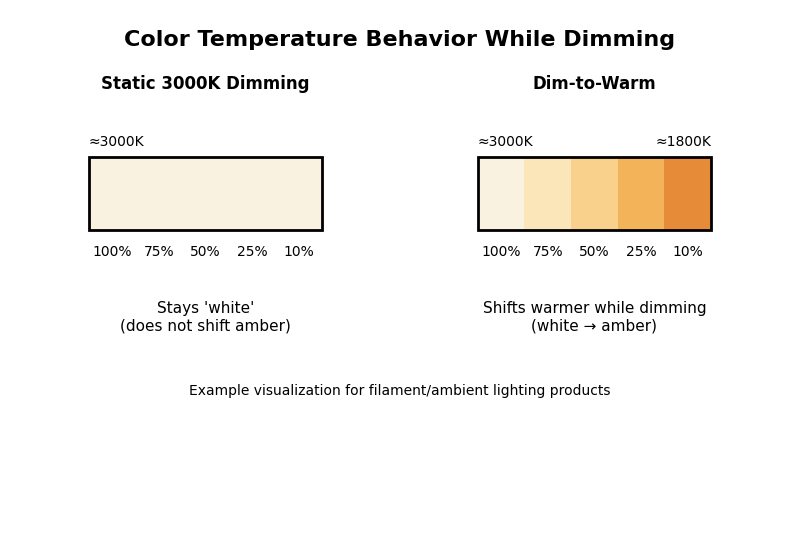
You must utilize "Dim-to-Warm" technology. As you dim these LED strips, the color temperature automatically shifts from a functional 3000K down to a candlelight-like 1800K. This mimics the natural sunset curve, triggering consumer relaxation.
The Science of Atmosphere
Most basic LED strips have a fixed color temperature. If you buy a standard 3000K (Warm White) strip and dim it, it simply becomes a greyish, dull version of 3000K. It does not get "warmer" or "cozier." It often feels ghostly.
Dim-to-Warm1 strips use a special chip architecture. As you reduce the current (dim the light), the circuit automatically mixes in more Red and Amber LEDs while reducing the White LEDs.
- 7:00 PM (Sunset): You run the lights at 100%. They are 3000K. The patio is bright enough for guests to read menus easily.
- 9:00 PM (Cocktail Hour): You dim the lights to 50%. The color shifts to 2400K. The mood becomes intimate.
- 11:00 PM (Late Night): You dim to 20%. The light is now a deep 1800K Amber. It feels like candlelight.
High CRI is Mandatory
When selecting these strips, you must check the CRI (Color Rendering Index)2. Food must look appetizing. A low CRI light makes steak look grey and salad look dull. You need a CRI of 90 or higher (CRI>90). This ensures the reds in the wine and the greens in the garnish look vibrant. As a buyer, you should demand the "Integrated Sphere Report" from your supplier to prove the CRI data.
| Time of Service | Recommended CCT | Light Intensity | Goal |
|---|---|---|---|
| Happy Hour | 3000K | 80-100% | Energy, Menu Reading |
| Dinner | 2400K | 50-60% | Comfort, Conversation |
| Late Night | 1800K – 2200K | 20-30% | Intimacy, Drinks |
How Do You Stop LED Dots from Blinding Guests?
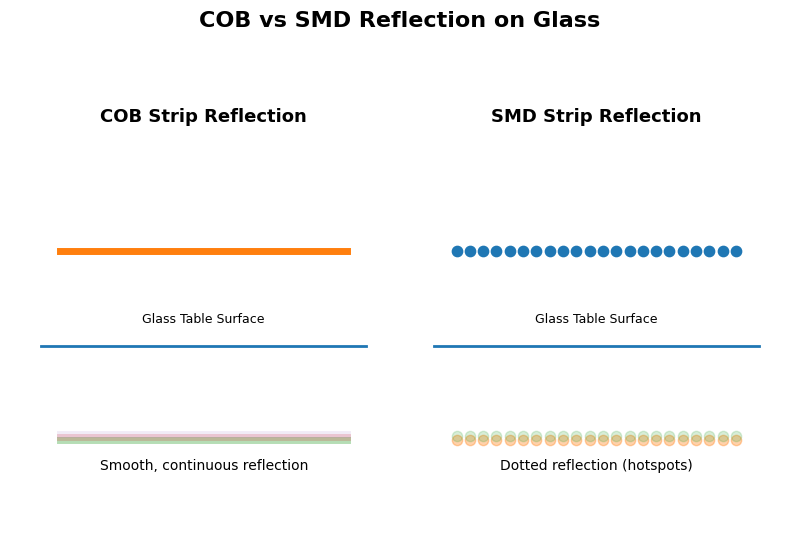
Seeing the actual LED chips (hotspots) is the hallmark of a cheap installation. It creates glare that hurts the eyes and reflects poorly on glass tables and wine glasses.
Switch to COB (Chip on Board) LED strips immediately. COB technology packs hundreds of chips closely together under a continuous phosphor layer, creating a seamless, dot-free line of light even without a diffuser cover.
The Problem with Reflections
In a restaurant, you have many shiny surfaces: polished wood tables, glass tops, silverware, and wine glasses. If you use standard "SMD" strips (the ones with visible black resistors and white square chips), every shiny surface will reflect a harsh row of dots. It looks like an airport runway, not a dining area.
To fix this with old technology, you had to use very deep aluminum channels with thick milky covers. This adds cost and bulk.
The COB Advantage
COB (Chip on Board)3 is a game-changer for hospitality. We mount the chips directly to the circuit board and cover the entire strip in a layer of yellow phosphor silicone.
- No Dots: Even at 100% brightness, it looks like a neon tube. It is one solid line of light.
- Wider Angle: Standard strips shoot light at 120 degrees. COB shoots light at 180 degrees. This provides a softer, more wrapped light distribution.
- Application: You can mount these under the lip of a bar counter or under bench seating. Even if a customer drops their napkin and looks under the seat, they wont be blinded by harsh points of light. It upgrades the perceived value of the establishment instantly.
| Feature | Standard SMD (5050/2835)4 | COB (Chip on Board) |
|---|---|---|
| Visual Appearance | Distinct "Dots" visible | Solid, continuous line |
| Glare | High (High intensity points) | Low (Diffused source) |
| Channel Depth Needed | Deep (to hide dots) | Shallow (can be flush) |
| Aesthetic Value | Low / Industrial | High / Luxury |
Can Your Lights Survive Pressure Washers and Spilled Drinks?
Restaurants are messy environments. Staff wash decks with heavy water pressure every night. Drinks get spilled. Alcohol and acidic aesthetic mixers are corrosive to standard electronics.
Specify IP67 Silicone extrusion with "Solid" square profiles. Silicone chemically resists the acidity of alcohol spills and UV rays, while the heavy-duty rating withstands daily cleaning rituals.

The "Friday Night Spill" Test
I tell my clients to imagine a glass of margarita spilling directly onto the lights installed under the bar rail.
- The Acid Test: A margarita contains lime juice (citric acid) and alcohol. If you use a cheap PU (Polyurethane) or Epoxy coated strip, the acid will etch the coating. Over time, the coating releases from the PCB.
- The Silicone Solution5: Silicone is chemically inert. It does not react to alcohol, accidental bleach splashes, or acidic food spills. You can wipe it clean, and it remains clear.
Understanding IP Ratings for Bars
You cannot use IP20 (bare strip) outdoors. But be careful with IP65.
- IP65 (Splash Proof): This is usually a thin layer of glue on top. It is fine for the ceiling of a covered patio.
- IP67 (Submersion)6: This involves a full silicone sleeve or solid injection. This is mandatory for low-level lighting (under benches, deck steps, toe-kicks). Why? Because when the staff washes the floor, water pools in these areas. Pressure washers drive water into tiny cracks.
- Connectors are the Weak Link: The strip might be waterproof, but the wire connection usually isn’t. You must demand "Injection Molded Connectors" from your factory. This means the plug and the wire are fused together by machine, not just soldered by hand and wrapped in tape.
| Location on Patio | Hazard | Recommended IP Rating |
|---|---|---|
| Pergola / Roof | Humidity, Occasional Mist | IP65 (Nano or Spray) |
| Under Bar Rail | Spilled Drinks, Hands | IP65 or IP67 Silicone |
| Under Bench / Floor | Standing Water, Hose Pressure | IP67 / IP68 Solid Silicone |
| Step Treads | Foot Traffic, Impact | Aluminum Channel + IP67 |
Conclusion
Lighting is the silent salesman. By upgrading to Dim-to-Warm COB technology, you give the owner control over the atmosphere. By using IP67 Silicone protection, you ensure that investment survives the harsh reality of restaurant operations. Creates a space where guests stay longer to order that extra bottle of wine.
Explore the advantages of Dim-to-Warm LED strips to enhance your lighting experience and create the perfect ambiance. ↩
Understanding CRI is crucial for selecting lights that make food look appealing and vibrant, enhancing your dining experience. ↩
Explore the advantages of COB lighting for restaurants, enhancing ambiance and reducing glare for a luxurious dining experience. ↩
Learn about the limitations of Standard SMD lighting and how it affects the visual appeal and comfort in dining environments. ↩
Explore how silicone’s chemical inertness makes it ideal for bar lighting, ensuring durability and easy maintenance. ↩
Learn about the importance of IP67 ratings for lighting in wet areas, ensuring safety and longevity in your installations. ↩
Recommended Products
Request a Project or Trade Quote
Sourcing for an installation project, resale or OEM production? Share your requirements below. You can discuss project samples before committing to a bulk order.
Related Articles
LED Strip Lighting After a Power Outage: Designing a Reliable Restart
Plan LED strip power restoration beyond total watts. Review driver inrush, switching limits, restart scenes, and commissioning before project handover.
Why LED Strip Lights Buzz When Dimmed: A Guide for Quiet Spaces
Diagnose LED strip buzzing without guessing. Review drivers, PWM controls, mounting resonance, and low-level acoustic acceptance for quiet interiors.
LED Strip Lighting for Modular Retail Shelves: Design for Reconfiguration
Specify modular shelf lighting beyond driver wattage. Check shared-feed current, connector durability, cable movement, controls, and approved configurations.