
How to Choose LED Strip Lights for Drawers and Pull-Out Cabinets
A well-lit drawer makes products and stored items easier to find while giving the furniture a more finished appearance. But the right LED strip is not simply the brightest one: it must fit the channel, cut to a workable length, and produce a clean light line at close viewing distances.
For cabinet manufacturers, retail fixture builders, and commercial fit-out teams, RH’s single-color COB and SMD ranges offer different starting points. Choose the light quality and physical fit first, then resolve how the assembly is powered as the drawer moves. A good sample should prove both the presentation and the installation.
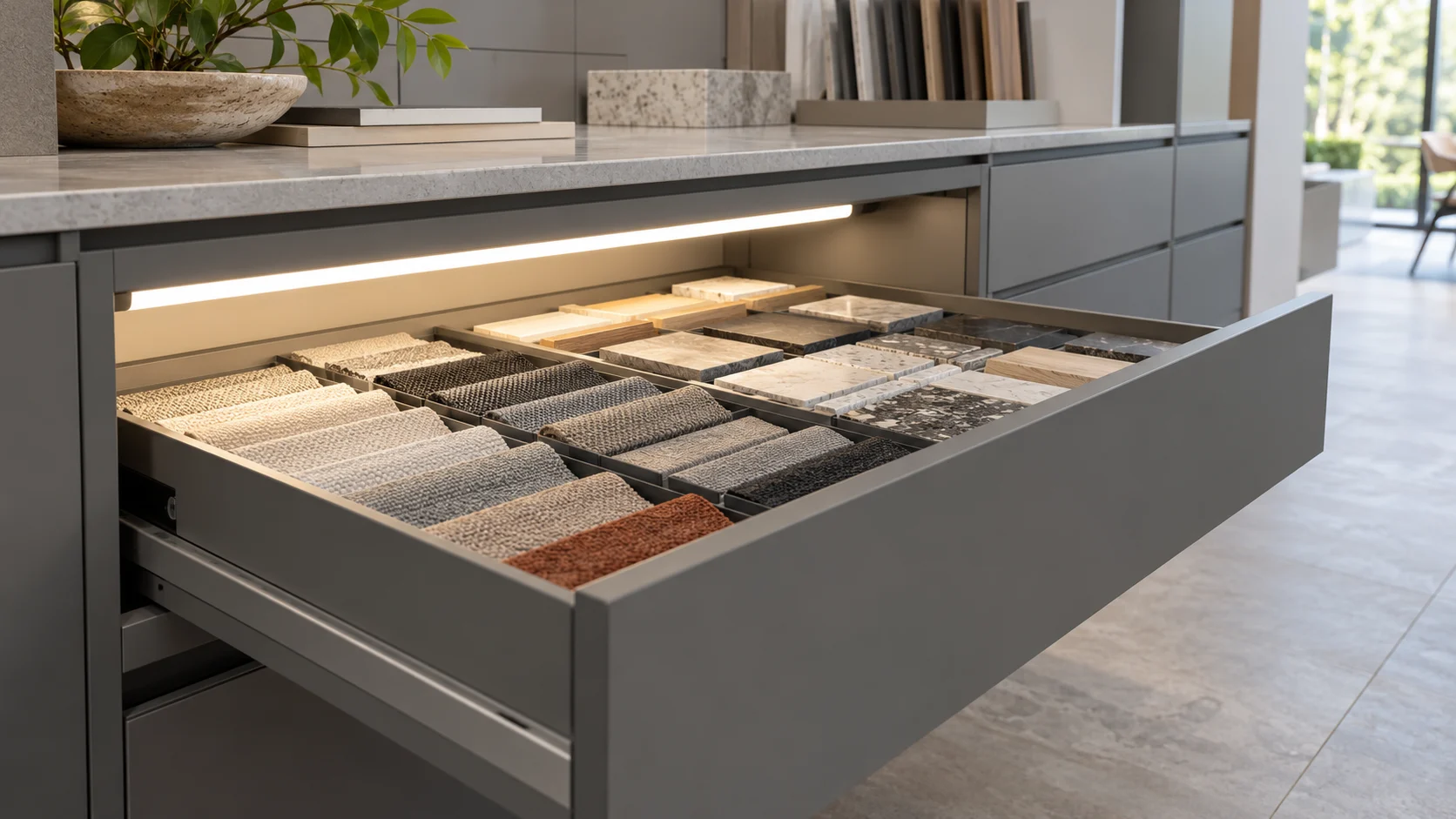
Which RH LED Strip Fits Your Drawer?
Use the furniture detail to shortlist products before comparing prices. For a shallow channel or a visible reflection, start with COB. For a well-concealed source with enough diffusion depth, compare SMD against the same finished-light requirement.
| Your project constraint | RH starting point | What to confirm in the sample |
|---|---|---|
| Narrow profile and a close-viewed light line | RH-COB-24V-4-WC: listed at 24V, 4mm PCB width, 5W/m, and 50mm cutting length. | Channel internal clearance, connector space, diffuser fit, and source visibility. |
| Drawer widths that do not match conventional cut steps | RH-COB-24V-5-WC-FC: listed at 24V, 5mm PCB width, 5W/m, and 4mm cutting length. | Permitted cut positions, termination allowance, and the final illuminated length. |
| Concealed lighting with room for a diffuser | RH single-color SMD range: compare a model matched to the required output, width, voltage, and budget. | Visible LED points at the actual profile depth, installed brightness, and total assembly cost. |
These COB values come from RH’s published model matrix; confirm the current model-specific drawing and quotation before ordering. The listed white models have CRI Ra >90 and selectable CCT options, not automatic color-temperature adjustment. Projects requiring adjustable white should instead review the tunable-white COB range with compatible controls.
Why cutting length can change the decision: suppose the available LED length is 584mm after reserving space for terminations and end components. A 50mm cut step permits 550mm, leaving 34mm unused; a 4mm step permits 584mm. This is a geometric comparison, not an installation guarantee. Check the exact cut and termination detail before treating a shorter cut interval as a production advantage.
For repeat furniture orders, price the accepted strip, profile, diffuser, leads, assembly work, and service access together. A cheaper roll is not a better purchase if it produces visible dots or requires reworking every drawer.
Have a drawer drawing ready? Send the usable light length, channel dimensions, preferred CCT, quantity, and whether the light stays fixed or moves. Ask RH for a suitable model shortlist and sample quotation.
Request a Drawer Lighting Sample QuoteChoose What Moves Before Choosing the Strip
There are three useful starting arrangements. None is universally best; the choice depends on what must remain illuminated, how far the drawer extends, and who maintains the furniture.
| Arrangement | What it avoids | What still needs proof |
|---|---|---|
| Fixed light on the cabinet carcass | No repeated flexing of the light’s supply lead, if all wiring stays stationary. | Contents remain visible at useful opening positions; the drawer front and stored objects do not block the beam. |
| Light fixed to the moving drawer | The source can remain close to the contents as the drawer extends. | A suitable moving harness, protected travel space, retained connections, and an agreed removal procedure. |
| Self-contained rechargeable drawer light | No permanent power cable crossing the moving interface. | Runtime in the actual operating pattern, charging access, battery care, and staff responsibility. |
Start the mockup with the fixed arrangement. It removes a moving electrical interface rather than trying to improve one. But do not accept it merely because the wiring is simpler. A deep pull-out tray may move beyond the useful beam, while tall stored items can shade the very labels a user needs to read.
If the source must move, keep the LED strip supported in an appropriate profile on the drawer. Put the repeated movement into a separately specified harness. Do not bridge the cabinet-to-drawer gap with ordinary LED tape unless its manufacturer explicitly rates that exact construction for the intended dynamic duty.
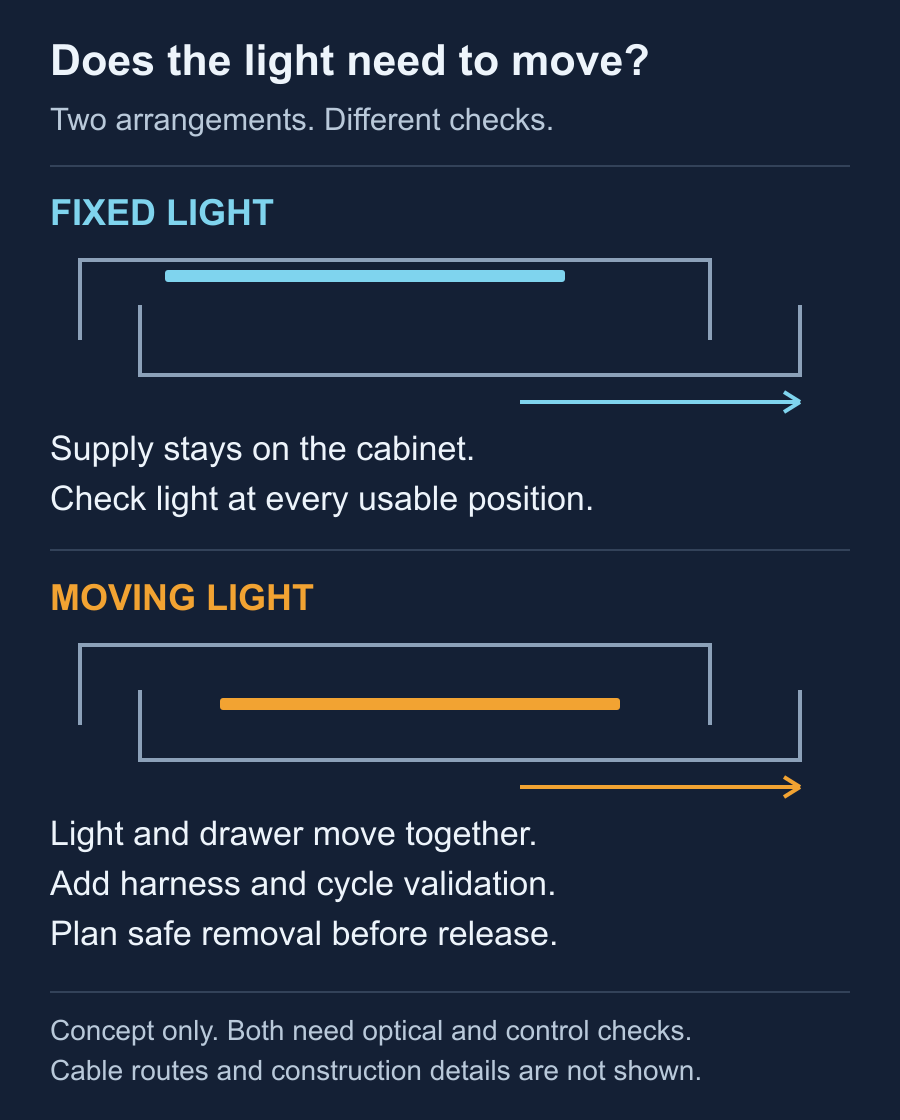
Our modular shelf-lighting guide covers reconfiguration and shared-feed limits. Here, the distinction is repeated motion during normal use, not occasional merchandising changes.
Specify Motion in Cycles and Travel, Not in the Word Flexible
A lead that bends easily in your hand may still be intended for fixed installation or occasional movement. LAPP distinguishes cables for occasional bending from constructions intended for repeated bending or torsion.[1] Specify the actual movement before accepting a cable description such as “soft,” “silicone,” or “high flexibility.”
Record the drawer stroke, cable bending plane, minimum available routing space, opening speed, expected daily use, and whether the drawer can be lifted or tilted during removal. A straight pull-out motion is not the same duty as a hinged door that twists the lead. A cable validated for one should not be assumed suitable for the other.
Illustrative duty calculation: define one cycle as one complete opening and closing. At 30 cycles per day, 365 operating days per year, and five years, the planned duty is 54,750 cycles. A frequently used commercial drawer at 200 cycles per day, 300 days per year, and five years reaches 300,000 cycles.
These are planning examples, not measured usage or RH life ratings. They explain why copying a domestic cabinet detail into a busy sample counter can be a poor decision. They are also not a finished test specification: the responsible designer must set qualification margins, sample quantities, loading, speed, temperature, and acceptance criteria.
Ask the harness supplier what evidence supports the proposed cable and terminations at your stroke, bend radius, and cycle count. A claim based on different test conditions is not enough.
Reserve the Cable’s Swept Space in the Furniture Drawing
Furniture drawings often show the cable only with the drawer open. The more revealing drawing shows closed, partly open, and fully extended positions, including the complete space occupied by the moving loop or carrier between those positions.
That space must stay clear of runners, soft-close mechanisms, screws, stored contents, and adjacent drawers. Adding extra cable is not a reliable cure for insufficient travel: excess length can migrate into a pinch point when the drawer closes.
Use the cable manufacturer’s limit for the actual movement. igus distinguishes fixed, flexible, and cable-carrier bend-radius conditions; the smallest number on a datasheet may not be the one that applies to repeated motion.[2]
A bend-radius value is not the size of the required service slot. A return loop needs its full curved envelope, cable or carrier thickness, and installation clearance. Reserve that space using the supplier’s dimensioned assembly drawing before releasing the cabinet design.
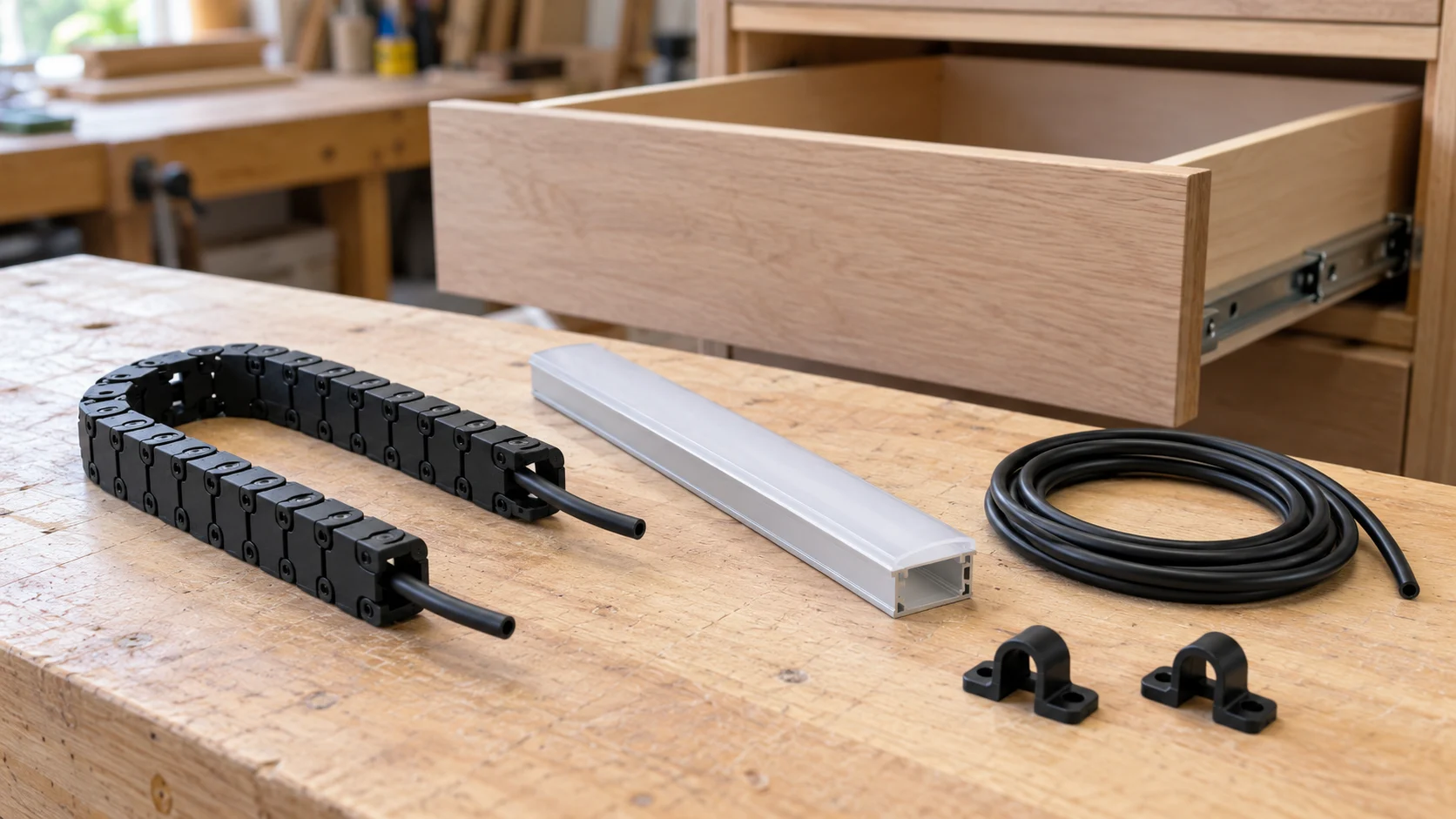
A cable carrier can control the route, but it cannot make an unsuitable cable suitable. igus installation guidance calls for appropriate cable freedom within the carrier, avoidance of twisting, and strain relief at the ends subject to the selected system’s instructions.[3] Retention should keep movement away from the connector and strip termination without crushing the cable or forcing the bend to start at the wrong point.
Keep the connector out of the active bending region where possible. Treat a service disconnect as a service disconnect, not as a joint that moves or separates every time the drawer opens. For termination selection, see the LED strip connection guide; the moving harness still needs its own validation.
Make the Sensor Detect the Drawer, Not the Contents
The mechanical and control drawings should agree on what “open” means. Identify the intended target surface or magnet, the mounting position, the permitted adjustment range, and the point at which the light should switch on and off. A sensor looking into the storage area may react to a box or fabric sample rather than the drawer front.
For diffuse-reflective optical sensing, OMRON explains that surface color and smoothness can affect reflected signal, sensing distance, and stability.[4] That principle is relevant to testing, but an industrial sensor’s performance is not a rating for a different furniture switch. Use the selected device’s instructions and test the production finishes, not just a convenient white board.
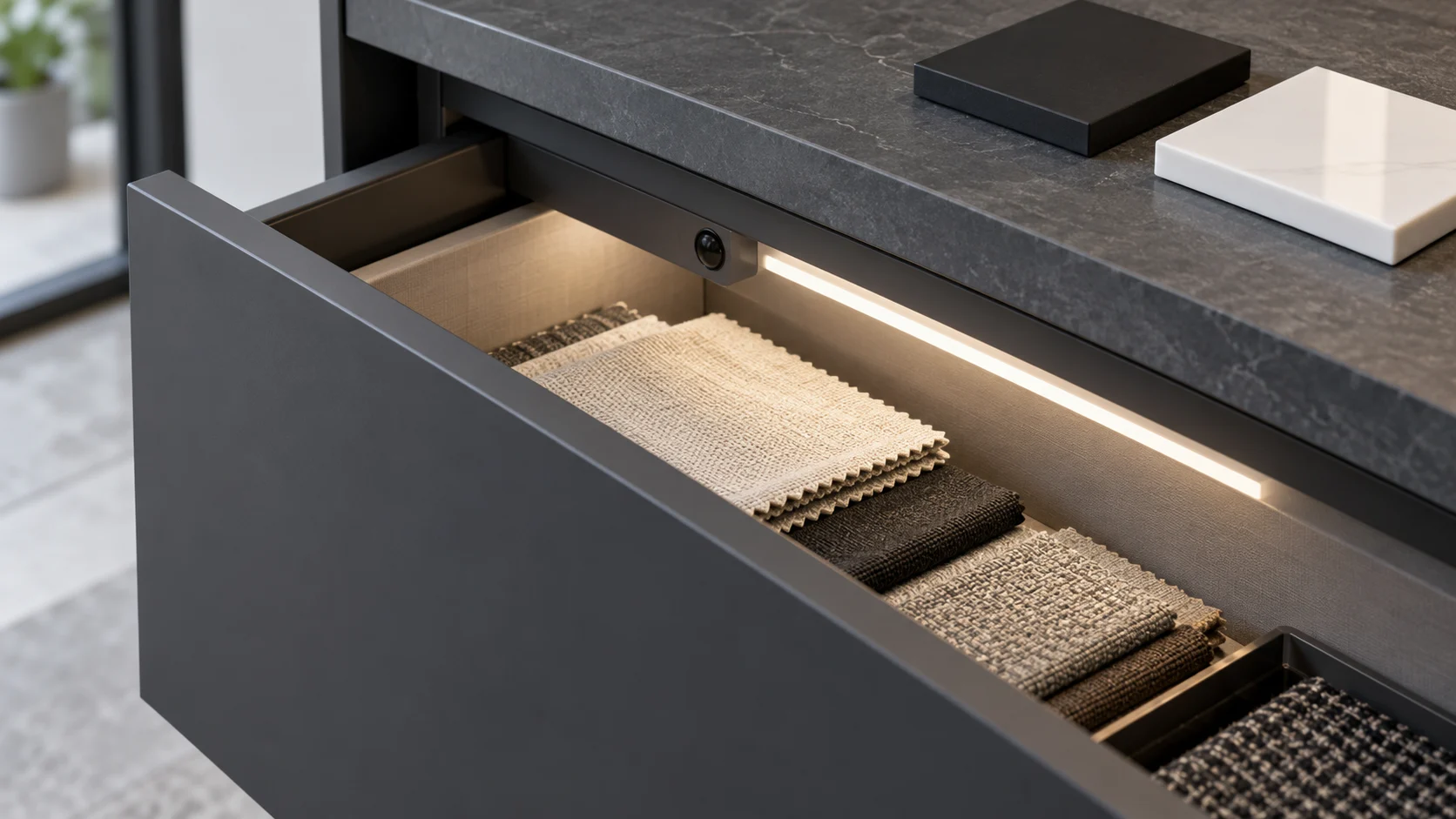
Test nearly closed, slowly opening, empty, and loaded drawers, including adjacent drawers moving and the brightest expected ambient conditions. Magnetic or mechanical switches need their own alignment or actuation checks.
Also distinguish a sensor that directly switches the LED load from one that signals a compatible controller. Its role changes what electrical ratings and interfaces must be checked. Do not infer allowable load from the connector’s appearance. Confirm voltage, polarity, switching capacity or control compatibility, and behavior after a power interruption.
A closed drawer is not necessarily a powered-off circuit: the sensor or controller may remain energized. Provide an identified isolation method for maintenance. The power-restoration guide is useful when several drawer lights share a driver or control system.
Approve the Light at the Positions People Actually Use
Test the drawer at its first useful opening, normal working position, and full extension with representative contents. Look from standing and seated positions where relevant. Check label visibility, shadows from dividers, glare from the exposed diffuser, and reflections in polished products.
A fixed strip can illuminate the rear well while leaving the front dark. A moving strip can keep the contents lit yet become an uncomfortable bright line as the user leans over the tray. Repositioning or shielding the profile may solve either problem more effectively than increasing watts per metre.
Use this mockup to settle the COB-versus-SMD decision. If a proposed SMD assembly still shows distracting points or reflections, compare a single-color COB sample in the same channel. If both deliver the accepted effect, compare the complete quoted assembly rather than paying for a feature the finished drawer does not need.
For material libraries, make clear whether the drawer supports finding samples or making critical color judgments. Attractive display lighting alone is not evidence that a color-assessment viewing condition has been met. The installed-output guide explains why catalogue lumens cannot establish the result on the drawer contents.
Test the Complete Drawer, Not Just Its Runners
Furniture-hardware durability is useful evidence, but its scope matters. For example, Blum states that its MOVENTO and TANDEM runner systems are designed for at least 100,000 opening-and-closing operations.[5] That does not qualify an added cable, sensor, connector, or LED assembly, nor establish a universal requirement for this project.
Use a loaded furniture mockup with the production routing and finishes. Agree the test plan with the furniture, lighting, and electrical suppliers before the order is released. An initial movement check finds obvious clashes; a durability program addresses a different question.
| Review | Evidence to retain | Reason to stop approval |
|---|---|---|
| Full-travel clearance | Routing at closed, intermediate, and fully open positions, with expected loading and adjustment tolerances. | Snagging, pinching, abrasion, tension at a termination, or intrusion into storage space. |
| Repeated motion | Agreed cycle definition, sample quantity, duty, inspection intervals, and results for the complete harness. | Intermittent light, damaged insulation, loosened retention, or unexplained changes in operation. |
| Detection and restart | Tests with production finishes, contents, opening positions, ambient light, and restored power. | False switching, chattering, or a closed drawer remaining lit unintentionally. |
| Electrical and thermal operation | Actual load and enclosure conditions, component limits, protection review, and relevant fault behavior. | Approval relies only on nominal driver watts or assumes the sensor always turns the light off. |
| Removal and replacement | Demonstrated isolation, disconnect access, drawer release, replacement, and reassembly. | The drawer can be pulled off its runners before the technician can safely release the harness. |
Make electrical testing and fault checks the work of qualified personnel using a suitable test procedure. Low operating voltage does not remove the need to assess short circuits, heating, conductor protection, or the complete furniture assembly’s applicable requirements.
Write a Service Procedure Before Approving Production
Drawer removal is a separate motion state. A harness that survives normal opening can still be torn away when someone releases the runners and lifts the drawer. Show where the supply is isolated, where the connector is reached, and how the harness is released before the drawer leaves the cabinet.
Specify the replaceable part as an identified assembly where practical: lead length, cable type, connector, retention parts, and routing instructions. A similar-looking spare may have the wrong dynamic construction. Retain photographs of the approved route and record substitutions before they enter production.
For a rechargeable option, the equivalent service question is operational: who checks charge, how is the unit removed, and can charging happen without disrupting the working counter? Eliminating a cable does not eliminate maintenance; it changes the maintenance task.
Turn the Approved Sample Into a Repeatable Order
Give RH the accepted model, CCT, strip length per drawer, drawer quantity, profile constraints, and control arrangement. Separate the sample requirement from the expected production quantity so the quotation reflects the intended rollout. Ask the quotation to identify the supplied items, any required customization, sample charges, minimum order quantities, and lead time.
Keep the approved sample and its component record for repeat orders. Confirm the moving harness and sensor integration with the responsible suppliers; do not assume that purchasing LED tape includes a qualified moving-cable assembly. This keeps the product order clear and the furniture builder’s integration responsibilities visible.
Get an RH LED Strip Recommendation for Your Drawer Project
Share your drawing or channel dimensions, usable light length, fixed or moving mounting position, CCT, voltage, and estimated order quantity. Request an RH model recommendation and quotation for sampling or production, with the required profile and accessory scope clearly identified.
Request a Project or Bulk QuoteChoose the strip for the finish your customer will see, then validate the details they should never have to think about. That is how an attractive drawer-lighting sample becomes a product you can specify again.
References
- LAPP: Flexible Cables for Fixed and Moving Applications. Distinguishes occasional bending, repeated bending, and torsional applications.
- igus: What Is a Cable Bend Radius and Why Is It Important?. Explains bend-radius conditions for different installation and movement duties.
- igus: Cable and Hose Packages in Energy Chains. Cable freedom, routing, and strain-relief guidance for the manufacturer’s carrier systems.
- OMRON: Overview of Photoelectric Sensors. Explains sensing methods and the effect of target surface conditions on diffuse-reflective sensing.
- Blum: Runner Systems. Manufacturer-specific runner durability information; not evidence for an added lighting harness.
Request a Project or Trade Quote
Sourcing for an installation project, resale or OEM production? Share your requirements below. You can discuss project samples before committing to a bulk order.
Related Articles

LED Strip Lighting in Historic Buildings: Design for Removal, Not Just Installation
Plan LED strip lighting in historic interiors around protected finishes, removable supports, cable routes, heat, and maintenance without avoidable damage.
LED Strip Lighting for Retail Fitting Rooms: Face, Fabric, and Mirror Glare
Specify fitting-room LED strip lighting for faces, fabrics, and mirrors. Compare color reports, test reflected glare, and approve a repeatable…

LED Strip Lighting for Indoor Plant Walls: Accent Light or Grow Light?
Specify LED lighting for indoor plant walls without confusing visual brightness with plant needs. Review PPFD, DLI, controls, moisture, and…