
LED Strip Lighting for Indoor Plant Walls: Accent Light or Grow Light?
A living wall looks rich and green on opening day. A concealed strip outlines the frame, the leaves catch a warm highlight, and the client approves the photograph. Months later, the lower planting pockets look sparse while the lighting still appears to work perfectly.
The missing question may not have been which LED strip looks best. It may have been which system is responsible for delivering the light the plants need, at their actual positions, throughout the operating week.
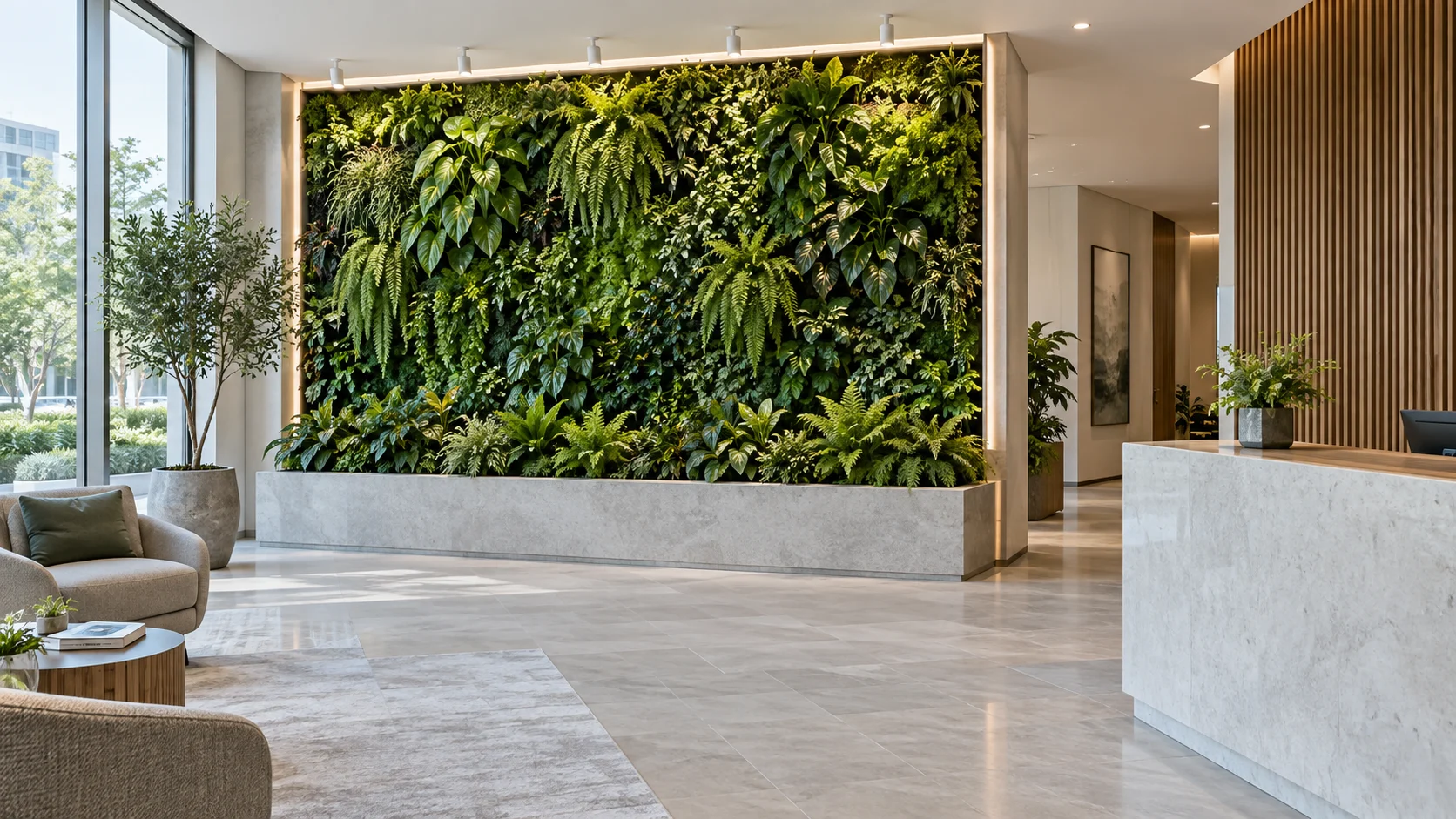
This guide is for commercial interiors, including hotel lobbies, office plant walls, restaurant planters, and retail greenery. It is not a crop-production recipe. Plant selection and light targets should be agreed with the landscape or horticultural specialist, while electrical installation remains the responsibility of qualified personnel.
1. Assign the Job Before Choosing the Strip
Start by naming the purpose of every light in the detail. A strip beneath a planter lip may illuminate the floor or the container rather than the leaves. A line around a green wall may reveal its outline without reaching the deeper foliage. Those can be successful architectural details without being meaningful plant-lighting solutions.
There are three useful scopes for a purchase order:
- Accent only: the strip presents the planting or its surrounding joinery. Plant-support lighting is provided and verified separately.
- Supplemental plant light: the proposed system contributes a measured amount of light in addition to daylight and other fixtures.
- Primary plant light: the planting depends substantially on the installed lighting. Require a horticultural lighting design and evidence for the actual assembly.
Do not let “suitable for a green wall” blur those scopes. University of Maryland Extension identifies intensity, duration, and light quality as distinct factors and recommends matching plant selection to the available light.[1] For a commercial specification, that means the planting schedule should be part of the lighting brief, not an attachment added after fixtures have been ordered.
Write down the intended appearance as well: maintaining a finished foliage display is not the same assignment as rapidly producing young plants or encouraging flowering. A target borrowed from a greenhouse production chart is not automatically the right target for an interior living wall.
2. Keep Human-Lighting Metrics Separate From Plant Metrics
Lumens, lux, CCT, and CRI remain useful for the human experience. They help describe perceived brightness, white-light appearance, and color rendering. None of them alone establishes that a particular planting receives enough photosynthetic light.
| Metric | What it describes | What still needs checking |
|---|---|---|
| Lumens / lux | Light output / illumination weighted for human vision. | Plant-relevant photon delivery at the foliage. |
| CCT / CRI | White-light appearance / color rendering for people. | The spectrum, intensity, and schedule needed by the planting. |
| PPF, in µmol/s | Photon output from a source within the specified waveband. | How much reaches the planted area. |
| PPFD, in µmol/m²/s | Photon flux density arriving at the measurement plane. | Spatial coverage and how that level changes over time. |
| DLI, in mol/m²/day | Accumulated daily photon delivery per unit area. | Species suitability, spectrum, photoperiod, and plant condition. |
Purdue Extension explains why a single photometric reading cannot describe a plant’s daily light supply and why conversions depend on the source.[2] Do not convert every lux reading to PPFD with one universal factor. Nor should a phone photograph or a phone lux app be treated as acceptance evidence for plant lighting.
In this article, PPFD and DLI calculations use the conventional 400-700 nm PAR waveband. Keep the measurement band consistent across targets, sensors, and reports; a reading over a wider band should not be silently compared with a narrower-band target.
A high-CRI white strip can improve how leaves and surrounding materials look. That is a valid reason to consider it, but not evidence of adequate plant support. Use the CRI guide for visual specification and request separate plant-lighting evidence when that function is part of the order.
3. Calculate the Contribution, Not a Promise of Growth
For a constant PPFD during a known operating period, the daily contribution is:
PPFD is in µmol/m²/s; the result is mol/m²/day.
Apogee’s measurement guidance distinguishes this constant-output calculation from changing daylight, which requires measurements accumulated over time.[3]
Hypothetical example, not an RH product specification: suppose a fixture delivers a steady 60 µmol/m²/s at a particular foliage position. Ten hours contributes 2.16 mol/m²/day. Fourteen hours contributes 3.024 mol/m²/day, approximately 3.02. These figures describe delivered light only; they do not establish whether either schedule suits the plant.
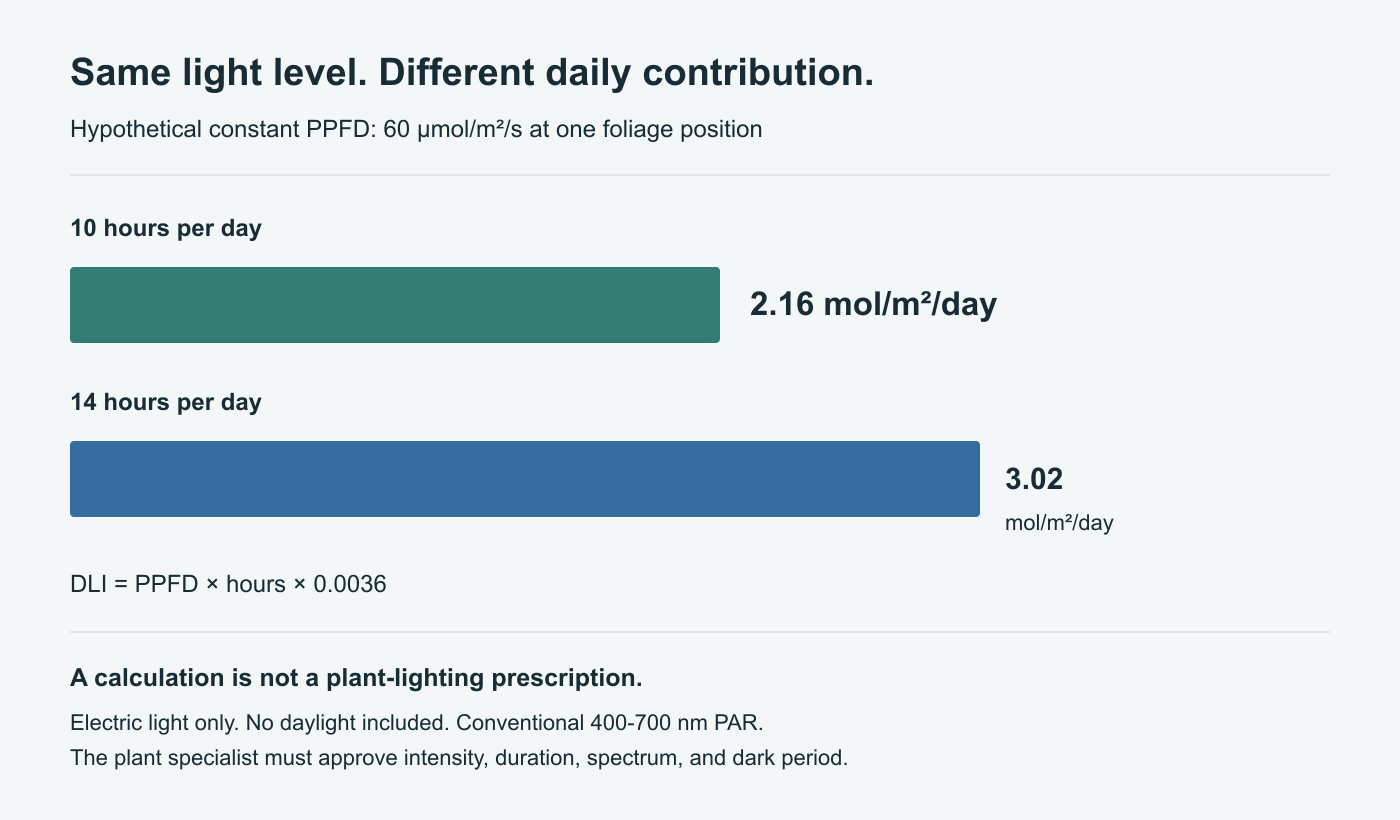
The operating schedule is therefore part of the specification. A display that is illuminated only during a six-hour evening service receives a different daily contribution from one running through the working day, even if both look identical when photographed at dinner time.
Do not simply extend the lighting period until the arithmetic reaches a desired total. The plant specialist must also approve the light/dark schedule and intensity. Equal daily totals are not proof that every combination of intensity and duration produces the same biological result.
For a daylit wall, assess electric and daylight contributions at the same positions and over comparable periods. If the logger already measured both together, do not add daylight again. A bright noon reading cannot stand in for a winter day’s accumulated light.
4. Measure the Foliage, Not the Empty Wall
A vertical planting is not a flat test board. Leaves project outward, pots and shelves cast shadows, and upper plants can shade lower ones. The most attractive viewpoint for a photograph may hide the least illuminated planting pockets.
Lighting-planning guidance published by Michigan State University emphasizes intensity and uniformity at the crop, followed by verification with a quantum sensor.[4] Applied to an interior display, the practical lesson is to agree the measurement locations before the team starts collecting favorable readings.
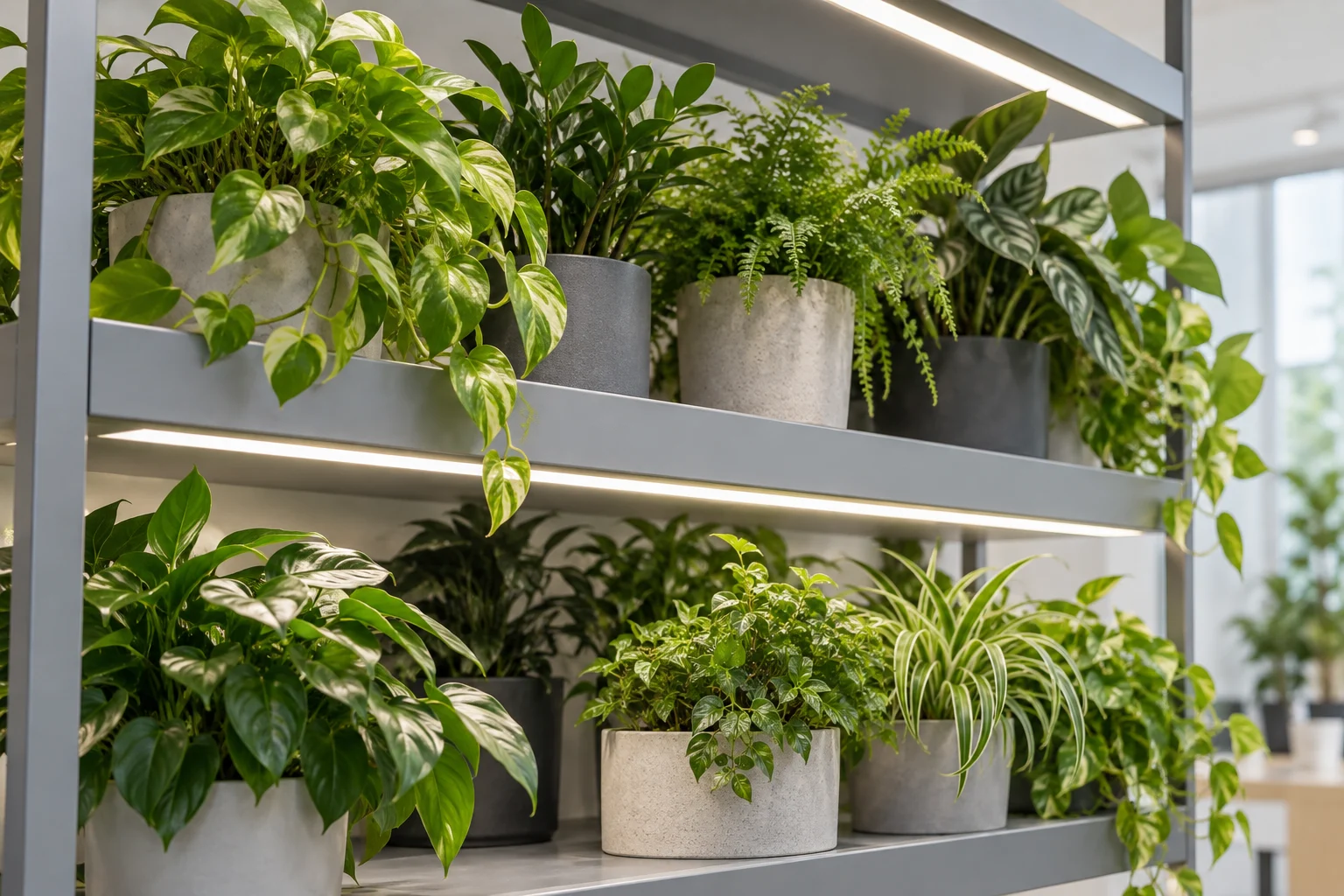
Use a marked grid covering representative upper, middle, lower, edge, and recessed positions. For a vertical wall, record sensor orientation and measurement plane with the horticultural designer; a horizontal reading and a wall-facing reading are not interchangeable. Keep the chosen method consistent when repeating the survey.
Record individual readings rather than only a wall-wide average. A high average can conceal a dark pocket or a hotspot. Ask for agreed minimum, maximum, and distribution criteria appropriate to the planting instead of inventing one universal uniformity ratio.
Test the installed profile, diffuser, and setback. Open-air strip data cannot account for those optical changes. The installed-output guide explains that broader issue; for plant lighting, the final check must use the appropriate photon metric.
Finally, include a mature-canopy review. A successful opening-day measurement with small plants is not a permanent guarantee after growth changes the shading. The maintenance plan should identify when trimming, rearrangement, or remeasurement is needed.
5. Give Plant Lighting Its Own Control Requirements
A restaurant’s evening dimming scene is designed around diners. An office occupancy sensor is designed around people. Neither automatically protects the intended plant-lighting schedule. A wall can lose much of its planned daily light because a room was empty, a manager selected a low scene, or a weekend timer was never configured.
Where the same luminaires serve both purposes, document how conflicting requests are resolved. Where possible, separate decorative accents from the verified plant-lighting function so that changing the atmosphere does not silently change the horticultural brief.
University of Minnesota Extension describes species-dependent responses to light duration and recommends timer-based supplemental lighting.[5] Its household guidance is not a ready-made commercial control schedule. Have the responsible specialist set the hours, dark period, and permitted overrides for the chosen planting.
- Record weekday, weekend, holiday, and closed-building behavior.
- Define which staff may override the schedule and when automatic operation resumes.
- Verify the relevant dimmed states; a controller percentage is not a measured PPFD value.
- Check clock retention and restoration behavior after loss of power.
The dimming-method guide and power-restoration checklist help with these system questions. Neither protocol compatibility nor a working app proves that the daily schedule is being delivered.
6. Design Around Water and Routine Maintenance
A dry-looking interior is not necessarily a dry lighting location. Planters are watered, foliage may be cleaned, irrigation can leak, and maintenance staff need access. Review the expected exposure of the complete assembly, including strip, end seals, connectors, cable entries, driver, and mounting detail.
Do not assume that a rating printed on one strip protects every connection in the installation. Ask the electrical designer and suppliers to approve the actual location and complete configuration. Keep equipment out of irrigation and drainage paths where practicable, and make isolation and service access part of the design. This article is not a wiring or wet-location installation procedure.
There is also a serviceability tradeoff. A deeply concealed line may be visually discreet but costly to reach once a mature wall fills the space. Before approving the detail, ask whether a failed section can be removed without dismantling planting pockets or damaging the waterproofing behind them.
Use the connection-reliability guide as a planning reference, then confirm model-specific installation instructions. A generic coating choice or connector photograph is not approval for the assembled application.
7. Commission Two Outcomes and Keep the Records
The following is a proposed project checklist, not a test standard. Agree the targets and responsibilities before ordering so that an attractive mockup does not become the only acceptance criterion.
| Approval item | Evidence to retain | Who should review it |
|---|---|---|
| Planting brief | Species, intended condition, locations, light targets, and approved daily schedule. | Landscape or horticultural specialist. |
| Visual appearance | Actual materials, viewing positions, glare review, color, and agreed scenes. | Interior designer and client. |
| Delivered electric light | PPFD grid, sensor details, orientation, fixture positions, and tested control state. | Lighting team with the plant specialist. |
| Daily light contribution | Logged conditions or a justified constant-output calculation; daylight counted once. | Plant specialist and controls integrator. |
| Operating schedule | Weekend, override, clock, and power-restoration checks. | Controls integrator and facilities team. |
| Exposure and maintenance | Approved assembly, irrigation clearances, access, cleaning, and replacement plan. | Electrical and landscape maintenance teams. |
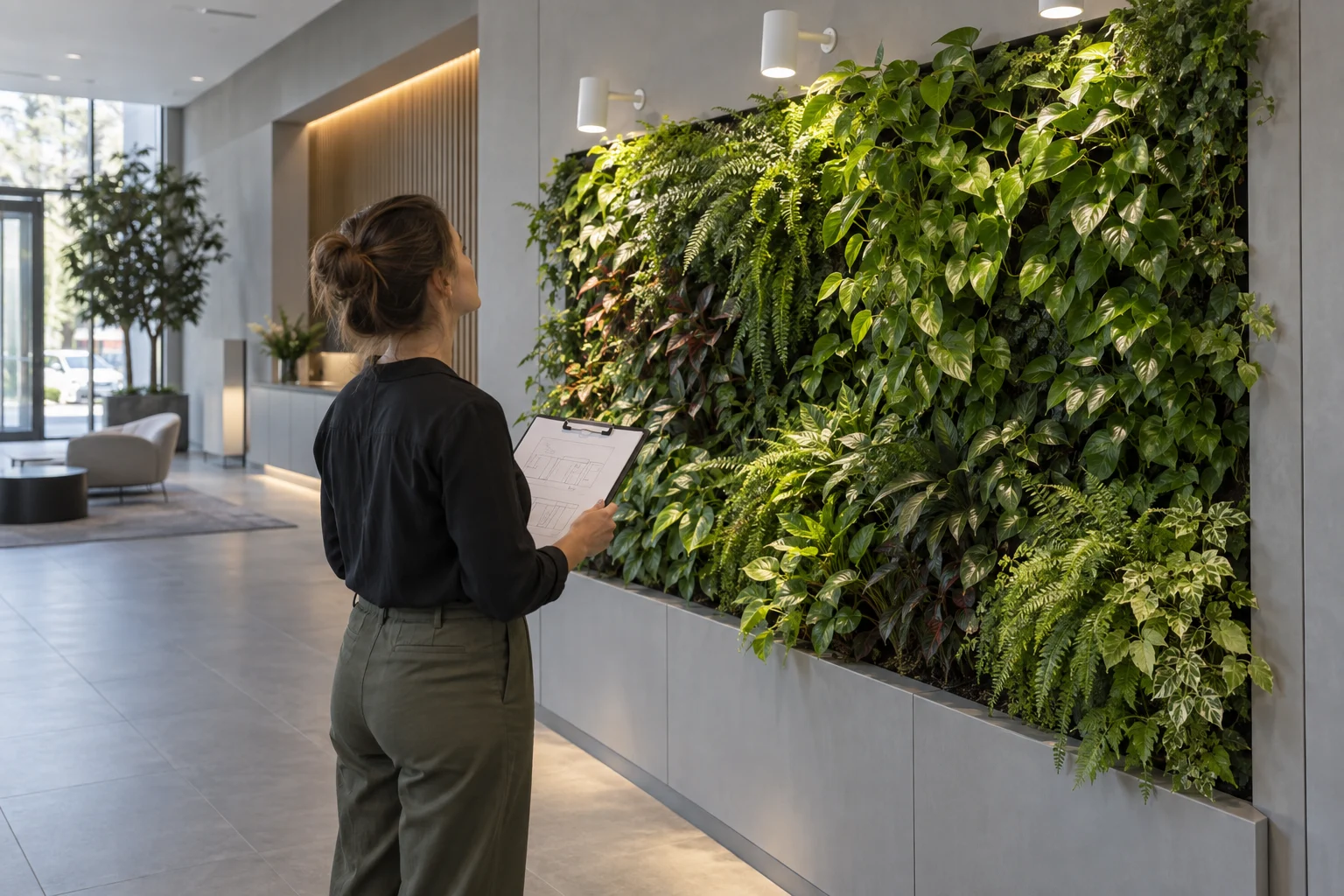
Keep the approved product configuration with the results. Replacing a strip with the same nominal wattage or CCT does not prove that the previous light distribution and photon delivery remain valid. Changes to the diffuser, mounting position, plant depth, or dimming schedule can also trigger a review.
Plan a follow-up inspection with the landscape contractor after an agreed establishment period and at relevant seasonal changes. Poor plant condition is not automatically a lighting defect: irrigation, nutrition, temperature, pests, and plant selection also need assessment. Retained light measurements make that discussion more useful than arguing from photographs.
Buyer Questions
Can an ordinary white LED strip support plants?
It can contribute photosynthetic light, but adequacy depends on the specific source, installation, plant, and schedule. Without suitable data and verification at the foliage, specify it as an accent rather than promise a plant-growth function.
Does a high CRI or “full spectrum” label prove suitability?
No. A label is not a delivered-light measurement. Ask for the relevant spectrum and photon data, the layout, and the intended operating conditions. Attractive leaf color to the observer is a separate acceptance result.
Should every living wall use one PPFD or DLI target?
No. Targets must follow the planting and the intended outcome. Mixed plants, different exposure zones, and seasonal daylight can require separate decisions. This guide intentionally does not prescribe a universal level.
Can the same strip provide both accent and plant light?
Possibly, if both requirements are demonstrated in the final assembly. If glare, concealment, or guest scenes conflict with the plant requirement, separate lighting systems may make approval and operation easier.
Specify the Architectural Lighting Honestly
For the decorative part of the project, compare COB LED strip options for close-view continuous lines and SMD LED strip options for the required output and layout. Neither product category alone establishes horticultural performance.
Planning lighting around an indoor plant display?
Send RH Strip Lighting the planting layout, profile detail, moisture exposure, visual requirements, and the horticultural specialist’s brief. State clearly whether the requested strip is accent-only or must contribute verified plant light. Request model-specific evidence before accepting the second scope.
Discuss the Lighting ScopeA well-specified plant wall does not ask one attractive product photograph to answer every question. It connects the appearance people approve with the light the plants receive and the operating plan the building will actually follow.
References
- University of Maryland Extension: Lighting for Indoor Plants. Plant selection and the distinct roles of light intensity, duration, and quality.
- Purdue Extension: Measuring Daily Light Integral in a Greenhouse. Foundational measurement concepts. Its greenhouse crop targets and historical equipment economics are not adopted as interior-project specifications.
- Apogee Instruments: Daily Light Integral Measurement. Constant-output calculation, changing-light measurement, and waveband distinctions.
- Michigan State University: Lighting Plans, Their Generation and Importance. Planning and verifying photon delivery and distribution at the plants.
- University of Minnesota Extension: Lighting for Indoor Plants and Starting Seeds. Indoor plant-lighting context and species-dependent light-duration considerations.
Request a Project or Trade Quote
Sourcing for an installation project, resale or OEM production? Share your requirements below. You can discuss project samples before committing to a bulk order.
Related Articles
LED Strip Lighting After a Power Outage: Designing a Reliable Restart
Plan LED strip power restoration beyond total watts. Review driver inrush, switching limits, restart scenes, and commissioning before project handover.
Why LED Strip Lights Buzz When Dimmed: A Guide for Quiet Spaces
Diagnose LED strip buzzing without guessing. Review drivers, PWM controls, mounting resonance, and low-level acoustic acceptance for quiet interiors.
LED Strip Lighting for Modular Retail Shelves: Design for Reconfiguration
Specify modular shelf lighting beyond driver wattage. Check shared-feed current, connector durability, cable movement, controls, and approved configurations.